

An earlier version of the core quantitative analysis underlying this Policy Note was presented by the authors to the Paris Europlace Securitisation Experts Group and co-published by Paris Europlace with IACPM in the short note “Which level of risk-weight floor to unlock SRT securitisation of residential mortgages?” in April 2026. This Policy Note expands that analysis from 10 banks to 40 banks and incorporates subsequent Trilogue text comparisons prepared in July 2026. It should be read alongside the companion SUERF Policy Note 418, “Capital cliffs in EU securitisation rules: Designing prudential safeguards without procyclical tripwires”, which addresses the broader anti-cliff framework, origination-date certainty and legal-coherence issues concerning insurer-provided protection. The views expressed are those of the authors and should not be attributed to their respective institutions.
Abstract
EU bank-centred mortgages remain largely absent from significant risk transfer (SRT). This Note argues that the proposed Resilient label for simple, transparent and standardised (STS) securitisation can unlock mortgage SRT only if two conditions are met: a senior risk-weight floor low enough to make capital relief usable, and EU (re)insurers providing unfunded credit protection eligible for STS Resilient treatment. Using Pillar 3 disclosures from 40 EU-regulated banks with €4.5trn of mortgage exposures, we estimate that the current 10% STS RW floor leaves 6% in the viable perimeter; a 5% floor raises this to 18%; and a 2% floor to 50%. But a lower floor without insurer access would create a market-access trap: banks would issue long-term mortgage SRT securitisations in STS Resilient format, while insurer-supported transactions may sit outside this segment. To succeed, reform must combine a usable floor with coherent insurer access.
EU banks are the main providers of credit to the EU housing market and hold the overwhelming majority of residential mortgages on their balance sheets. Covered bonds provide an efficient funding channel for these assets, but leave the underlying credit risk and associated regulatory capital requirement with the originating bank.1 This creates a structural gap: efficient mortgage funding, but only limited mortgage credit risk transfer. Significant risk transfer (SRT) securitisation can fill this gap by enabling banks to transfer part of a portfolio’s credit risk to investors or protection providers and, where supervisors recognise the transfer as significant, obtain regulatory capital relief. In a synthetic transaction, this risk is transferred without selling the underlying assets. Synthetic SRT transactions are already well established in Europe for loans to small and medium-sized enterprises and corporates, but remain marginal for residential mortgages. This leaves Europe’s largest bank balance-sheet asset class without a scalable risk-transfer market.
This matters because residential mortgages, despite their relatively low average risk-weight (RW) density, generate substantial risk-weighted assets (RWA) given their scale.2 Their low margins make the cost of retained capital particularly material for bank profitability and competitiveness. A scalable mortgage SRT market would allow banks to transfer targeted credit risk while preserving covered bond funding and optimising risk transfer for the parts of mortgage portfolios where capital relief is most valuable. The policy question is whether mortgage SRT can deliver enough capital relief to justify protection, structuring and supervisory execution costs.
The EU already provides favourable capital treatment for securitisations meeting the “simple, transparent and standardised” (STS) criteria, which are intended to make their structures and risks easier to assess. The June 2025 EU Securitisation Package proposes an additional “Resilient” category for senior securitisation positions meeting further structural safeguards, including requirements relating to portfolio granularity, amortisation and the senior tranche attachment point. Positions meeting both sets of criteria would qualify for the most favourable capital treatment as “STS Resilient”. For residential mortgages, however, this treatment will matter only if it improves transaction economics in practice. Achieving this requires both a senior risk-weight floor (RWF) low enough to permit proportionate capital relief and access to a broad, reliable base of long-term protection providers, including regulated (re)insurers3 providing unfunded credit protection (UFCP).
There is a specific policy trap to avoid. Several Resilient safeguards are already embedded in STS transactions, notably granularity and amortisation criteria. The main practical distinction between STS Resilient and STS Non-Resilient is therefore likely to be the senior attachment-point condition. Because that attachment point is largely within structuring discretion, mortgage SRT transactions are likely to be structured as Resilient whenever possible to maximise recognised capital relief.4 A lower STS Resilient RWF without (re)insurer access would make the economically relevant STS segment available primarily through eligible funded protection providers,5 while leaving insurer-supported STS transactions outside the economically usable STS segment. In practice, the reform could shift activity away from regulated insurance capacity precisely where long-term risk-bearing capacity is most needed.
The proposed Securitisation Package would make the senior RWF more risk-sensitive to the RW of the securitised pool, but still subject to a minimum floor. For low-RW assets such as residential mortgages, that floor can bind, leaving the retained senior tranche with a disproportionate capital charge relative to the residual risk retained and undermining transaction economics.
A simple capital-relief RW threshold identifies the pool-average RW at which SRT becomes economically attractive. After the introduction of the synthetic STS framework, IACPM survey evidence for 2022-2024 places the lower tail of synthetic SRT pool RWs close to 40%, against an average of around 60%.6 With euro-area banks’ average RW density estimated at 33%,7 this 40% benchmark helps explain why large parts of bank balance sheets, including residential mortgages, sit outside the viable SRT perimeter. Under the current 10% STS senior RWF, it implies a practical 4.0x relationship between the floor and the pool-level RW threshold.
Applied as a transparent rule of thumb, not a transaction model, this gives pool RW thresholds of 20% for a 5% floor and 8% for a 2% floor. The point is to show how floors affect the mortgage exposures capable of supporting economically viable capital-relief securitisation, and to give policymakers a practical measure of the impact of their calibration decision.
The calibration of the minimum senior RWF therefore determines whether STS Resilient can create an effective and scalable EU mortgage SRT market, freeing up capacity for new lending, or only a formal legal possibility with limited benefit for the EU economy.
To assess the effect of alternative RWF calibrations, we use Pillar 3 CR6 disclosures from 40 EU-regulated IRB banks selected for mortgage-market relevance, data availability and plausible SRT participation. The sample covers major and medium-sized mortgage lenders headquartered in 13 European jurisdictions. It represents €4.47 trillion of residential mortgage exposure at default (EAD), €626 billion of residential mortgage RWA and an average RW of 14.0%, compared with an estimated EU average residential mortgage RW of around 17%.8
The aggregate RW distribution is wide, as shown in Table 1. Exposures with PDs of 2.5% or above, including defaulted exposures, account for 6.3% of aggregated EAD and have an average RW of 72.6%. By contrast, the STS-relevant mortgage perimeter used in the analysis is the non-defaulted and non-distressed segment with PDs below 2.5%, representing 93.7% of aggregated EAD and an average RW of 10.1%. This is where STS Resilient calibration matters most: these assets form the core candidate perimeter for mortgage SRT securitisations seeking STS treatment, but their low average RW makes capital relief highly sensitive to the retained senior floor.
Table 1. Characteristics of the aggregated residential mortgage non-SME portfolios of the 40 EU-regulated IRB banks
(by PD range, in € millions)
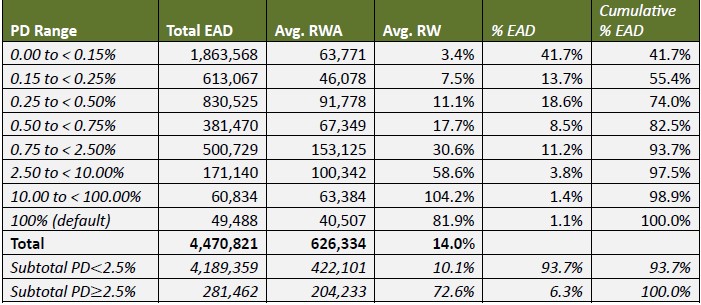
Because RWs vary both within and across PD buckets, Table 1 alone cannot determine the economically viable SRT perimeter. We therefore aggregate each bank’s cumulative RW distribution in Figure 1 to estimate viable mortgage EAD under alternative senior RWFs.
The orange series in Figure 1 plots the cumulative distribution of residential mortgage EAD by RW across the €4.47 trillion sample, using the left-hand axis. The dashed vertical black line separates the STS-relevant mortgage perimeter, namely the 93.7% of aggregated EAD with PDs below 2.5%, from the 6.3% high-PD and defaulted tail excluded from this analysis. The solid vertical threshold lines show the individual-exposure RW boundaries used to estimate the viable EAD perimeter under each senior RWF calibration.9 This is the share of EAD between each threshold line and the STS perimeter cut-off, reported in Table 2 as “% of Aggregated EAD”. The yellow curve shows the corresponding share of STS-relevant mortgage RWA (calculated as the area below the orange series) on the right-hand axis.
The effect is material. The estimated viable SRT perimeter is 6.5% of aggregated EAD at the current 10% STS floor, 17.9% at a 5% floor and 49.6% at a 2% floor, corresponding respectively to 25.5%, 52.3% and 84.2% of STS-relevant mortgage RWA. In amount terms, this is about €290 billion, €800 billion and €2.2 trillion. These figures are potential supply estimates, not issuance forecasts. Table 2 reports the full calibration ladder.
The evidence points to a clear calibration trade-off:
Figure 1. Distribution of aggregated residential mortgage EAD by RW and implied viable SRT perimeter under alternative senior RWF calibrations
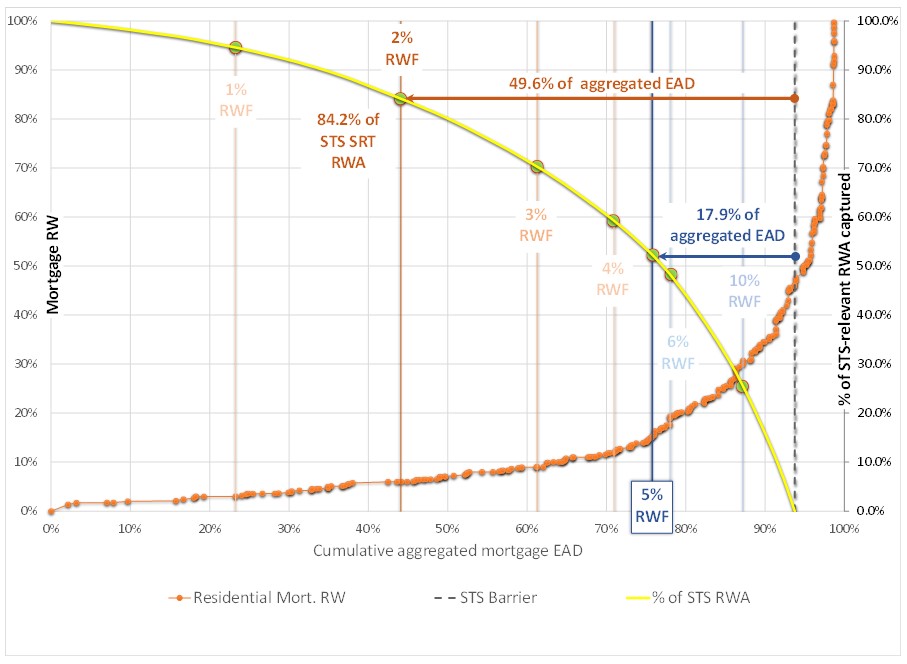
Table 2. Potential SRT perimeter under alternative senior RWF calibrations
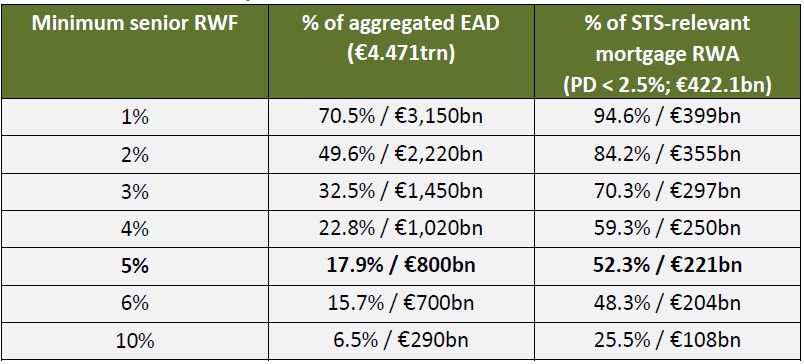
This also addresses the concern that a lower RWF could displace covered bonds. Even at a 2% floor, roughly half of aggregated mortgage EAD would remain outside the estimated SRT perimeter. A lower floor would therefore support complementarity, not substitution: higher-RW segments could support SRT, while lower-RW assets would remain natural collateral for covered bonds and other funding instruments. Nor would a lower floor remove prudential safeguards: STS Resilient treatment would remain limited to senior positions meeting structural resilience criteria, while tranche attachment, retained senior exposure and the securitisation formula would continue to constrain recognised capital relief.
Several limitations remain. The sample is limited to IRB banks with granular Pillar 3 disclosures. Pillar 3 data do not always separate EU from non-EU mortgage exposures, and reporting practices differ. The estimates also rely on portfolio-construction assumptions and exclude issuer-specific constraints such as leverage ratio, operational readiness and supervisory execution. A group-level cross-check against residential-mortgage covered-bond issuers indicates that most sample banks belong to groups with established mortgage covered-bond activity, reinforcing the complementarity point.
Appropriate RWF calibration is necessary, but not sufficient. Mortgage SRT is long-dated and requires resilient long-term protection capacity. Funded investors are important, but most, except pension funds, are better suited to shorter-duration assets matching closed-end fund horizons. Residential mortgage portfolios can have maturities of 15 to 25 years, making them a natural asset class for (re)insurers with long-term risk-bearing capacity.10
This underwriting capacity is already relevant: by end-2024, (re)insurers provided UFCP on about 30% of the EU Non-STS market,11 with appropriate SRT recognition by supervisors.12 They do so through regulated claims-paying balance sheets, subject to Solvency II supervision, capital requirements and governance standards. In a banking-regulation context, the term “unfunded” refers to protection provided by regulated underwriting capital and diversified insurer balance sheets, rather than by posted cash collateral.
The companion SUERF Policy Note on capital cliffs explains why safeguards for insurer-provided protection should be robust at origination, rather than ongoing binary tripwires that create procyclical cliff effects. The narrower issue here is legal and economic coherence between SECR and CRR.
If STS Resilient mortgage transactions benefit from a lower senior RWF, but (re)insurer guarantees are excluded from STS Resilient treatment, banks will have a strong incentive to structure around eligible funded protection providers. This is not only because STS Non-Resilient treatment would deliver weaker capital relief. For synthetic SRT, STS criteria already overlap substantially with the proposed Resilient criteria, leaving the senior attachment-point test as the main practical differentiator. STS Non-Resilient may therefore be a residual and largely uneconomic category for mortgage SRT. A reform intended to broaden the European risk-bearing base could instead reduce the role of regulated insurance capacity in the economically usable STS market.
If SECR Article 26e(8)(aa) creates a safeguarded route for EU-authorised (re)insurers to provide UFCP in STS synthetic securitisations, CRR Article 243 should not neutralise that route by excluding those guarantees from Resilient treatment.
Three fixes are therefore essential:
This is not a request to weaken prudential safeguards, but to make them robust entry conditions rather than market-closing tripwires. A lower RWF would make STS Resilient economically attractive for mortgage SRT; insurer access would provide the long-term protection capacity needed to scale.15
The EU Securitisation Package can create a genuine European mortgage SRT market only if STS Resilient is both economically usable and open to the protection capacity needed to support it. The 40-bank evidence shows that a 5% floor would broaden the current perimeter but still leave most mortgage EAD outside the viable perimeter, while a 2% floor would materially improve usability and preserve complementarity with covered bonds. A lower floor would not remove prudential safeguards: STS Resilient treatment would remain limited to senior positions meeting structural resilience criteria, while tranche attachment, retained senior exposure and the securitisation formula would continue to constrain recognised capital relief.
Calibration alone is not enough. If (re)insurers can access STS but not STS Resilient treatment, insurer-supported STS transactions could be left outside the economically usable mortgage SRT segment, even while SECR formally opens an STS route for them. The issue is therefore not only the floor level, but whether the capital framework allows the long-term protection capacity needed for mortgage SRT to participate in the viable segment.
A coherent reform should combine a usable 2% floor, clear (re)insurer access to STS Resilient treatment, continued UFCP access to Non-STS Resilient treatment, origination-date certainty and a sufficiently broad eligible provider base. In short, the Resilient label will only unlock SRT for mortgages, one of the largest and safest asset classes of EU banks, if calibration, legal coherence and access move together.
Bell, I., M. Bennett, G. Duponcheele, T. Joulia-Paris and V. Ormezzano (2025), “Insurance-based Credit Risk Transfer: a resilient risk-bearing capacity untapped in the EU,” SUERF Policy Note No. 375, September.
Bennett, M., G. Duponcheele, T. Joulia-Paris, V. Ormezzano and W. Perraudin (2026), “Capital Cliffs in EU Securitisation Rules: Designing Prudential Safeguards Without Procyclical Tripwires”, SUERF Policy Note 418, September.
Duponcheele, G., M. Fayémi, F. González Miranda, W. Perraudin and A. Tappi (2024), “Securitisation Reform to Boost European Competitiveness,” SUERF Policy Brief No. 976, September.
Paris Europlace / IACPM (2026), “Which level of Risk Weight Floor to unlock SRT securitisation of residential mortgages?”, Note, April.
European Commission (2025), Commission proposes measures to revive the EU securitisation framework, 17 June.
European Commission (2025), Proposal amending Regulation (EU) No 575/2013 as regards requirements for securitisation exposures, 17 June.
European Commission (2025), Proposal amending Regulation (EU) 2017/2402 as regards the securitisation framework, 17 June.
European Systemic Risk Board (2025), Unveiling the impact of STS on-balance-sheet securitisation on EU financial stability, Report, May.
The senior tranches of traditional non-SRT residential mortgage securitisations are generally not competitive with covered bonds as funding instruments and are therefore often retained for central bank monetary operations purposes. For mortgage securitisation to add prudential value, effective credit risk transfer must therefore be achieved, whether through traditional or synthetic structures. In synthetic SRT, the referenced mortgage assets remain on the originating bank’s balance sheet rather than being sold. Subject to applicable covered bond, programme and supervisory constraints, this means that mortgage exposures may continue to support funding while also being referenced for credit-risk transfer, allowing funding and capital relief to be optimised as complementary balance-sheet tools.
EBA data from the Risk Dashboard, Risk Assessment Report and Capital & RW statistics, covering more than 80% of EU banking assets, show that residential mortgage RWA is nearly the same as the RWA of EU loans to SMEs, underlining the capital materiality of the asset class.
The term “(re)insurers” is a standard term meaning “insurers and / or reinsurers”.
The same applies to Non-STS transactions: banks aiming at the maximum amount of capital release will structure Non-STS transactions as Resilient by adjusting the attachment point.
According to ESRB (2025), more than 75% of funded STS on-balance-sheet securitisation involves non-EU sources of protection. If EU (re)insurers were excluded from STS Resilient treatment, the economically usable STS segment could become more dependent on funded non-EU capital, rather than drawing on regulated European long-term risk-bearing capacity. Notably, much of the funded market, with the exception of pension funds, has investment horizons of 3–5 years, making it less suitable for mortgage SRT.
IACPM Bank SRT Survey 2016-2025. See the 5th percentile of synthetic SRT pool RWs for 2022-2024 in IACPM, Global SRT Market Overview 2025: Bigger, Broader, More Diverse, p. 4, available at: https://iacpm.org/global-srt-market-overview-2025-bigger-broader-more-diverse/.
ECB Occasional Paper Series, Understanding the banking sector capital framework in the European Union, No 387.
EBA data from the Risk Dashboard, Risk Assessment Report and Capital & RW statistics, covering more than 80% of EU banking assets, indicate that residential mortgages account for about €5.9 trillion of EAD and €1.0 trillion of RWA, equivalent to an average RW density of around 17%. The 40-bank sample is therefore large and broadly comparable, while remaining somewhat lower-risk than the wider EBA aggregate. The €4.47 trillion sample EAD should not, however, be expressed as a direct share of the €5.9 trillion EBA figure, because individual-bank CR6 templates may combine EU and non-EU exposures.
The analysis uses a simple rule of thumb to translate each minimum senior RWF into a pool-average RW threshold, and then into an individual-exposure RW boundary for estimating the viable perimeter. For example, a 5% senior RWF implies a 20% pool-average RW threshold, using the 4.0x relationship derived from the 40% benchmark discussed above under the current 10% STS floor. Since actual pools can combine exposures with RWs above and below that average, Figure 1 uses a lower 15% boundary, based on a 3.0x portfolio-construction assumption. The same method is applied to the other calibrations.
In Fannie Mae’s CIRT 2024-L1 transaction, 24 insurers and reinsurers provided actual-loss mortgage credit protection. Rob Schaefer, Fannie Mae Vice President, Capital Markets, noted that the participants “supported the extension of the CIRT maturity term on this deal to 18 years”, from the 12.5-year term used for most CIRT transactions since 2019. Source: Fannie Mae, 1 March 2024.
Since the implementation of the synthetic STS framework in 2021, unfunded credit protection provided by (re)insurers has not been eligible for synthetic STS treatment, an unintended consequence that the current reform aims to address. If (re)insurers account for around 15% of the EU synthetic SRT market overall, split broadly equally between STS and Non-STS transactions, their share of the Non-STS segment can therefore be estimated at around 30%.
See SUERF Policy Brief No. 976, section “Securitisation as a tool for capital velocity”.
CQS 2 means Credit Quality Step 2, corresponding in the CRR to a long-term of single-A rating.
This requires the cross-reference to include SECR Article 26e(8)(aa)(ii), on Solvency II supervision and rating, and Article 26e(8)(aa)(iii), on diversification. The Commission proposal allowed STS-eligible (re)insurers to provide UFCP in the Non-STS Resilient segment through a cross-reference to SECR Article 26e(8), (9) and (10). The text under discussion by the co-legislators excludes the new point (aa), which would block insurer access to Non-STS Resilient treatment, whether or not the provider is STS-eligible.
The US GSE mortgage Credit Risk Transfer (CRT) market provides a useful comparator: insurers are reported to account for more than 30% of CRT risk-transfer capacity, with more than seventy global and local insurers having participated since the first CRT transaction in 2013 (Source: Aon).