

This policy brief is based on Camous and Garcia Soto (2026), “Austria One Century Apart: Persistent Effects of Hyperinflation on Inflation Expectations”, Economics Letters, Vol. 267, July 2026, 113094, also available as Banque de France Working Paper No. 1050. The views expressed are those of the authors and do not necessarily reflect those of the Banque de France, the Eurosystem, the OECD, or its member states.
Abstract
Can the memory of past inflation shape how people form expectations about prices today? We link city-level price data from Austria’s post-WWI hyperinflation to quarterly consumer surveys run between May 2020 and October 2024. Individuals living in cities more exposed to the historical episode report higher inflation expectations a century later: a 1% higher local inflation rate in the early 1920s is associated with about 0.37% higher expected inflation today, once common national conditions and individual characteristics are accounted for. Moving from the least to the most exposed city implies a gap in expected inflation of roughly 10%. Regional newspapers in historically high-inflation areas also devote more attention to inflation, pointing to the local media environment as one channel through which inflation attitudes travel across generations. A common inflation shock can therefore meet materially different expectation levels within a single country, with implications for policy transmission and for the targeting of central bank communication.
Austria’s hyperinflation of the early 1920s followed the First World War and the collapse of the Austro-Hungarian Empire. Reduced to a fraction of its former territory and population, the young republic financed its budget deficits by printing money, and the price level rose by several orders of magnitude. Between July 1914 and December 1922, the average price of flour rose from 0.48 crowns to 7,456, bread from 0.39 to 5,270, butter from 2.95 to 53,900. The spiral ended in 1922, when a League of Nations plan combined an international loan, strict fiscal reform, and a new central bank barred from monetizing government deficits (Sargent, 1982).
A century later, Austria, like most of the world, lived through another inflation shock. Pandemic supply disruptions, pent-up demand as economies reopened, and the energy price surge that followed Russia’s invasion of Ukraine pushed inflation to 11.6% in January 2023, a level not seen in decades.
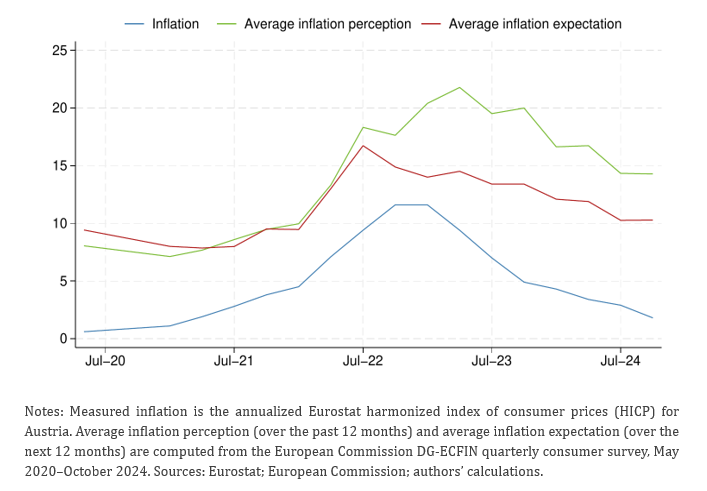
Figure 1 shows how Austrian households lived through this second episode. Perceptions and expectations moved in tandem with measured inflation, rising through 2021-22 and receding thereafter, but stood consistently above it throughout: expectations averaged close to 10% in 2020, when measured inflation was still near zero, and peaked at 16.7% in July 2022.
Figure 1. Austrian perceptions and expectations moved with measured inflation — and stayed well above it
Two large nominal shocks, separated by a hundred years, offer an appropriate setting to ask a basic question: does the memory of a major inflation event leave a durable imprint on how households form beliefs about prices? A growing literature finds that lived inflation experience shapes beliefs long afterwards (Malmendier and Nagel, 2016; Ehrmann and Tzamourani, 2012). Our exercise follows Braggion et al. (2024), who develop the conceptual design on highly granular German data; we test whether the pattern travels to a different institutional and data environment.
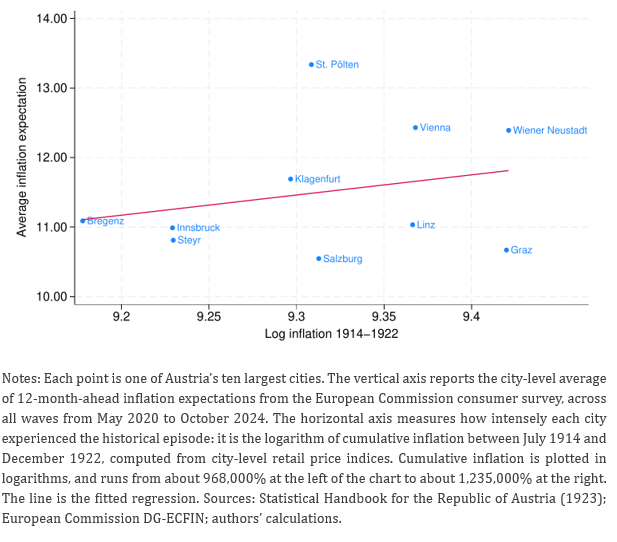
We bring two empirical sources together. The first is the Statistical Handbook for the Republic of Austria (1923), which reports prices for a broad range of consumption goods in the country’s ten largest cities over 1914–1922. From these we build a city-level retail price index, and hence a measure of how intensely each city experienced the episode. The analysis reveals genuine variation across cities: cumulative inflation between July 1914 and December 1922 ranges from about 968,000% in Bregenz to about 1,235,000% in Wiener Neustadt. The most exposed city saw prices rise roughly 28% more than the least exposed one.
The second source is the European Commission’s quarterly consumer survey (DG-ECFIN), which asks households how they expect consumer prices to develop over the coming twelve months, alongside socio-economic characteristics. We use the 21 Austrian survey waves conducted between May 2020 and October 2024 (14,723 responses) and match each respondent to a city through their postal code.
The aggregate picture in Figure 1 conceals considerable variation across cities. Average expected inflation over the period runs from 10.6% in Salzburg to 13.3% in Sankt Pölten. Figure 2 sets that variation against historical exposure, and the raw correlation is positive: cities where prices rose most in the early 1920s are, on average, the cities where households expect the most inflation today.
Figure 2. Cities hit harder by the 1920s hyperinflation report higher inflation expectations a century later
The pattern holds once socio-economic characteristics are accounted for. Comparing individuals who face the same national inflation in the same month, and holding constant gender, age, household size, income, education and employment status, a 1% higher local inflation rate in the early 1920s is associated with a 0.37% higher expected inflation today. Since every Austrian faces the same national inflation rate in a given month, the estimate comes entirely from differences across cities. The association is positive both before the surge (May 2020-April 2021) and during the high-inflation period (May 2021-August 2024), and somewhat larger in the second, though the small number of pre-surge survey waves precludes firm statistical confirmation. In practical terms, moving from the least to the most historically exposed city implies inflation expectations higher by about 9.5% over the full sample, and about 11.7% using the high-inflation-period estimate.
Two caveats matter. The variation comes from only ten cities, so these estimates should be read as correlations, not causal effects: historical inflation may stand in for persistent local characteristics (economic structure, financial development, political traditions), that shape expectations for other reasons. And while the analysis controls for common national shocks, it does not account for city-specific developments in local prices or labor markets.
None of the households surveyed in the 2020s experienced the hyperinflation themselves, so any persistence has to be carried by something other than personal memory. Austrian newspaper markets are strongly regional, the Salzburger Nachrichten is read in Salzburg, the Vorarlberger Tageszeitung around Bregenz, which means that even a national topic like inflation is filtered through regionally distinct coverage. And consumers’ inflation expectations are documented to respond to how much the press writes about inflation (Lamla and Lein, 2014).
Combining regional readership statistics with counts of inflation-related articles in eleven newspapers over 2020-2024, we build two measures of local exposure: the volume of inflation coverage reaching the average resident, and the share of all coverage devoted to inflation. Both vary sharply across regions. In volume, residents of Lower Austria, where Sankt Pölten and Wiener Neustadt are located, encountered roughly seven times more inflation-related articles than residents of Vorarlberg.
Both measures are positively correlated with historical inflation: regions that experienced more inflation a century ago read more about inflation today, whether counted in articles or in editorial attention. The evidence is descriptive, but it points to a concrete channel, the local information environment, through which beliefs shaped by an episode almost no one alive witnessed could be sustained and passed on.
While monetary policy and inflation communication are conducted at the national and supranational level, our results suggest that a common inflation shock can encounter materially different expectation levels within a single country, along lines partly drawn by history. Where expectations feed into wage- and price-setting, or into consumption and saving decisions, that heterogeneity matters for the transmission of monetary policy.
The local media correlation adds some concrete implications. The regions where past inflation makes price increases most salient are also the regions where inflation news is most present. Clarifying communication may therefore be most valuable precisely where, and when, expectations are most exposed: periods of elevated inflation are when targeted communication would do most to limit overreaction and support broad anchoring. More broadly, the results suggest that salience and memory should be taken into account when studying expectation formation, especially during large inflation shocks, when anchoring is most vulnerable.
Braggion, F., F. von Meyerinck, N. Schaub and M. Weber (2024). The Long-term Effects of Inflation on Inflation Expectations. NBER Working Paper No. 32160.
Camous, A. and N. Garcia Soto (2026). Austria One Century Apart: Persistent Effects of Hyperinflation on Inflation Expectations. Economics Letters 267, 113094. Also Banque de France Working Paper No. 1050, July 2026.
Ehrmann, M. and P. Tzamourani (2012). Memories of High Inflation. European Journal of Political Economy 28(2), 174–191.
Lamla, M. and S. Lein (2014). The Role of Media for Consumers’ Inflation Expectation Formation. Journal of Economic Behavior & Organization 106, 62–77.
Malmendier, U. and S. Nagel (2016). Learning from Inflation Experiences. Quarterly Journal of Economics 131(1), 53–88.
Sargent, T. J. (1982). The Ends of Four Big Inflations. University of Chicago Press.