

This policy brief is based on European Economy Discussion Paper 251, Demographic change and business dynamics in the EU. The views expressed in this document are solely those of the author(s) and do not necessarily represent the official views of the European Commission.
Abstract
Populations across the European Union are ageing. Concerns have been raised that ageing may reduce business dynamism, and, consequently, economic growth. We examine the relationship between demographic structure and firm entry rates in the European Union. The results suggest that the relative size of the 30-44 age group, which has been declining over time, has the strongest positive effect on firm entry. This finding is in line with the notion that age has a hump-shaped effect on the propensity to engage in entrepreneurship. In addition, younger age cohorts are found to exert a more negative impact on firm entry than older age cohorts. Rising educational attainment may partially offset the adverse effects of demographic ageing on business dynamism in the years ahead.
Business dynamism, the constant churn of firms starting up, growing, shrinking, and shutting down, is a useful gauge of an economy’s health. It captures how easily resources move from less productive activities to more productive ones, and how well “creative destruction” is working. This is the process by which weaker firms fail and free up capital, workers, and market share for newer, more innovative ones (Schumpeter, 1942).
Young firms tend to be more dynamic and more likely to grow quickly, and they contribute disproportionately to job creation — even though they’re also more likely to fail. More broadly, research shows that the age and turnover of firms in an economy shape employment, the pace of innovation and technology adoption and productivity, and overall economic growth (Geroski, 1995).
Business dynamism has recently regained research interest as some have pointed to the long-term decline of firm entry and the share of young firms in economic activity in some advanced countries, with potentially important implications for productivity growth (Akcigit and Ates, 2023; Decker et al., 2016). Still, there remains substantial unclarity regarding what is driving cross-country differences in firm entry and dynamics across time. The literature has identified several factors that are likely to play a role, such as economic growth, factors influencing the costs of entry and the expected returns, the quality of institutions, and access to human capital.
Recent policy discussions have drawn attention to the possible role of ageing, a development that is already affecting most advanced economies, with important socio-economic and macro-economic implications (see e.g. André et al., 2024; Bundesbank, 2024). Even if policy options to address ageing in the short run are limited, a better understanding of how ageing impacts our economies and societies can help anticipate possible challenges ahead and reflect on how to best address them.
Following work by Engbom (2019) and Kopecky (2019) on the US and by Liang et al. (2018) on a broader set of OECD countries, we examined the macro-level link between demographic structure and firm entry, a standard measure of business dynamism through a longitudinal analysis covering 28 countries in Europe over the period 2008-2020.
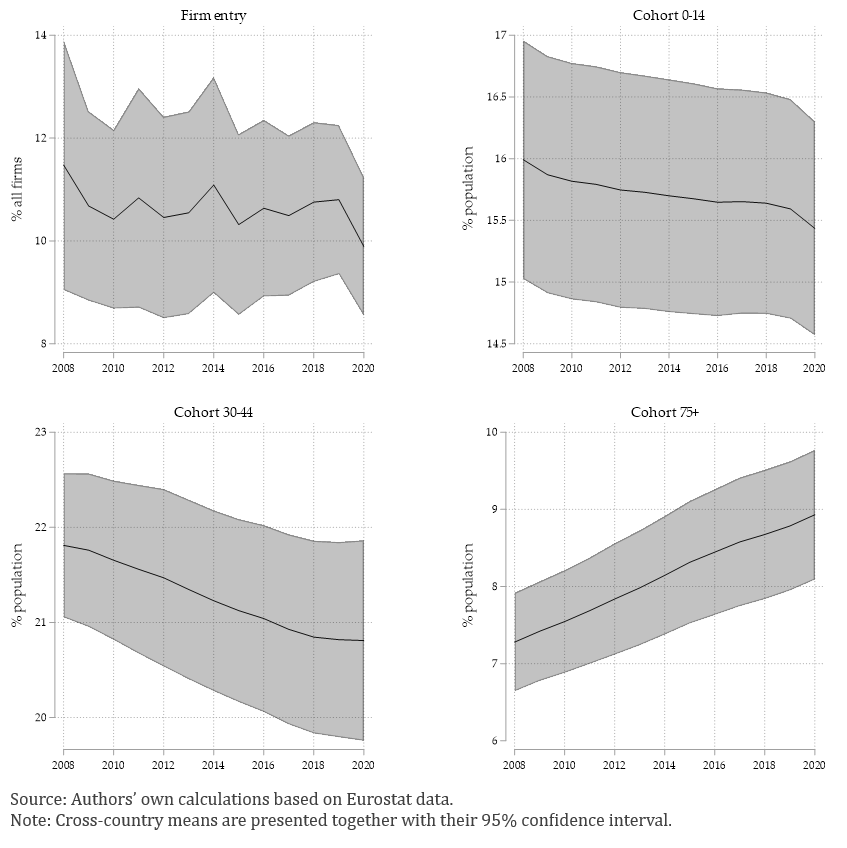
The firm entry rate is defined as the number of enterprise births divided by the number of active enterprises. Data are obtained from Eurostat’s business demography statistics. On average, firm entry rates have dropped or remained stable in the EU over the considered period (see Figure 1).
To keep the number of parameters in the regression analysis tractable, our estimations are performed using 15-year age cohorts (0-14, 15-29, 30-44, 45-59, 60-74, 75+: six cohorts in total). Relative cohort sizes are calculated as the share of a particular age group out of the total population, using Eurostat’s POPSTAT statistics. Similar methodologies are used, for example, by Lindh and Malmberg (1998) and Feyrer (2007, 2008). The youngest age cohort (0-14) is excluded from the regression in order to avoid perfect collinearity. As shown in Figure 1, on average, younger (such as the cohort of children below the age of 15) and core age cohorts (such as the 30-44 age group) have been declining over the considered time period, while older age cohorts (such as the 75+ age group) have been strongly expanding.
Figure 1. Firm entry and demographic structure over 2008-20
To address possible concerns that our results are driven by general population growth or by migration, we examine the robustness of our results to the inclusion of controls for population growth and migration (people born outside of the reporting country as a % of the population). These variables are available from the same source (Eurostat) as the data on age cohort sizes.
Firm birth rates may be impacted by cyclical developments (see further) and by development or convergence processes which at the same time influence demographic structure. Therefore, we include as controls GDP per capita, based on purchasing power parity (PPP), in constant international dollars,1 and real GDP growth from the World Bank Development Indicator Database. We also include a set of control variables that reflect the quality of institutions, as this may impact firm entry. In particular, we use data on the quality of rule of law from the World Bank’s Worldwide Governance indicators and the Index of Economic Freedom, published by the Heritage Foundation. We also use the proportion of the population with at least a secondary school qualification (from the EU-Labour Force Survey) as a proxy variable for human capital.
We start with a parsimonious model where firm entry rates are regressed only on the sizes of cohorts, with country and time fixed effects (Model 1). In Model 2, we control for population growth and the proportion of migrants. In Model 3, we control for GDP per capita PPP in constant prices and real GDP growth. In Models 4-6, we leave in GDP growth to account for cyclical effects and include various other control variables reflecting the quality of institutions and human capital. In particular, in Model 4, we control for the index of economic freedom. In Models 5 and 6, we control for the rule of law index and for the population share with at least a secondary school degree respectively.
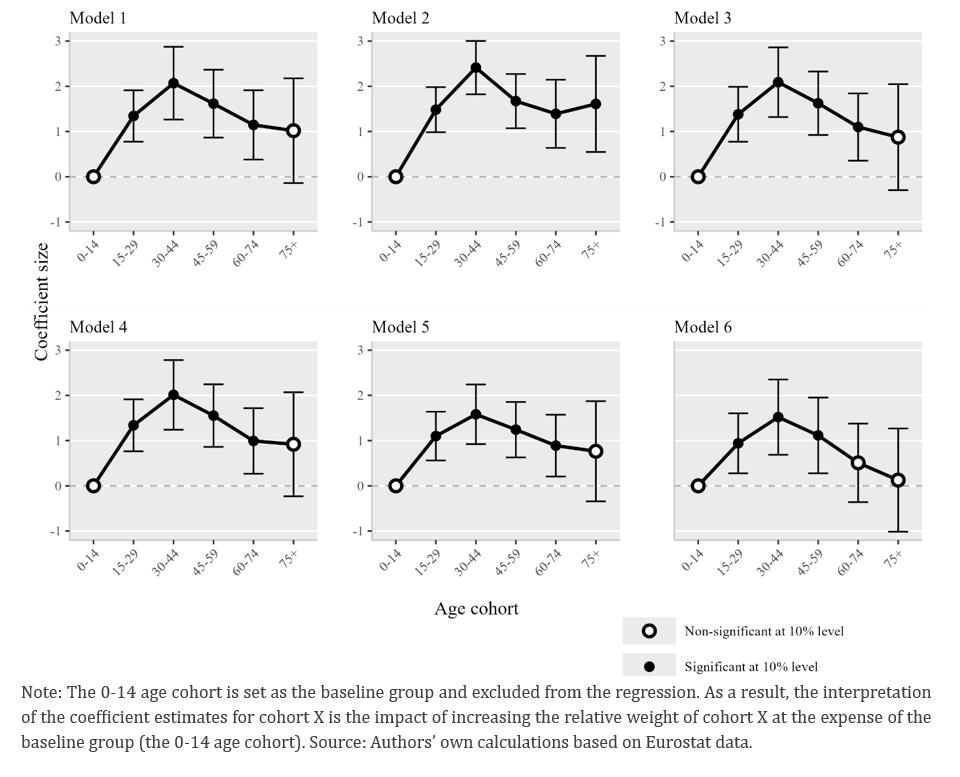
The implied impacts of cohort sizes are visualised in Figure 2. Generations 0-14 are used as a baseline group. This means that all estimated cohort-specific coefficients should be interpreted as the impact of increasing the relative weight of the cohort at the expense of the baseline group (the 0-14 age cohort). The effect of the size of cohort 15-29 is positive and statistically significant at the 5% significance level in all model specifications. This is the age where young people tend to enter the labour market. The effects of subsequent cohorts follow a hump-shaped profile, reaching a maximum at 30-44 years. According to the estimates of Models 1-6, a 1 percentage point shift from the 0-14 age group to the 30-44 age group results in a 1.4-2.5 percentage points increase in firm birth, depending on the model specification. Possible contributing factors are the high labour market participation rate of this age cohort, increasing the availability of labour, and accumulated human capital through work experience, which also eases access to financial capital and thus to enterpreneurship.
For older cohorts, the estimated coefficients decline, despite people of higher age groups having accumulated more human capital and financial assets. This is consistent with Engbom (2019)’s hypothesis that older employees may be less likely to attempt entrepreneurship and switch employers because they often have better jobs and less to gain from starting a new professional adventure.
This hump-shaped profile is the central finding of our paper, and consistent with earlier studies examining the relationship between demographic change and firm entry/entrepreneurship at an aggregate level based on US (Engbom, 2019; Kopecky, 2019) or OECD data (Liang et al., 2018). It is also consistent with studies at the micro-level showing that entrepreneurship entry rates peak in early midlife (see e.g. Lévesque et al., 2026).
The estimates corresponding to the relative size of the 60-74 cohort and of the 75+ cohort are positive (though for the latter mostly non-significant) implying a less adverse impact of these age cohorts in comparison to the 0-14 age cohort. In other words, young-age inactive individuals seem to have a stronger negative impact on firm birth than old-age inactive individuals.2 An explanation that is intuitively appealing would be that young children compete more for time and energy of their parents than retired individuals. Recent studies have indeed shed light on the negative impact of childbirth on entrepreneurial activity, particularly for mothers (see e.g. Ferrando et al. 2025).
Beyond that, however, there are a few reasons why older dependent age groups are likely to put less pressure on entrepreneurship and firm entry. A first reason relates to market demand. Older inactive individuals still tend to have higher incomes and expenditures than young inactive individuals. A second reason could relate to the supply side and work through the channel of easing access to capital. Although the literature is not fully conclusive on this3, several studies have suggested a positive link between longer life expectancy and larger aggregate savings stocks, capital deepening and lower real interest rates. Moreover, as elderly people tend to take out fewer loans, an ageing population could reduce the demand for loans, intensify bank competition for borrowers, and ease access to finance4. Third, in some countries or institutional settings, older (or higher earning) workers may have an incentive to set up a business (or become self-employed) in order to supplement their retirement income, to benefit from favourable tax treatment, or because of challenges to find a new job after dismissal in case of age discrimination.
Real GDP growth and education consistently show up with positive and statistically significant coefficients, and their inclusion does not affect the robustness of our main findings, which are robust to a broad set of alternative regression model specifications.
Figure 2. Cohort effects on firms’ entry rate (estimated coefficients)
We believe, based on the existing literature, and as explained above, that major channels through which the hump-shaped relationship arises are the availability of labour and access to entrepreneurship (e.g. through accumulated human capital and access to finance). Therefore, policy measures that boost labour market participation at all ages, strengthen human capital, and improve access to finance and enterpreneurship more widely are likely to have a positive effect on firm entry. In the same vein, the fact that the relative size of young age cohorts has a negative impact on firm entry may suggest that some enterpreneurs (like workers) are ‘constrained’ by parenting responsibilities – and hence that measures easing that constraint could have a positive impact on firm entry. Our results also suggest that the higher degree of educational attainment of younger generations is likely to mitigate the impact of ageing somewhat going forward. Further research in this field could separate the different mechanisms through which population ageing impacts firm entry and estimate their relative importance. The analysis of the nexus of demographic structure, firm entry rates and labour market institutions presents a promising avenue for future research as well.
Akcigit, U., Ates. S.T. (2023) What Happened to US Business Dynamism? Journal of Political Economy 131(8): 2059-2124.
André, C., Gal, P., Schief, M. (2024) Enhancing productivity and growth in an ageing society: key mechanisms and policy options. OECD Economics Department Working Papers No. 1807. https://dx.doi.org/10.1787/605b0787-en
Bloom, D. E., Canning, D., Mansfield, R. K., Moore, M. (2007). Demographic change, social security systems, and savings. Journal of Monetary Economics, 54(1), 92-114.
Bundesbank (2024) Developments in euro area business dynamism. Monthly Report – March 2024. https://publikationen.bundesbank.de/publikationen-en/reports-studies/monthly-reports/monthly-report-march-2024-926792?article=developments-in-euro-area-business-dynamism-928128.
Carvalho, C., Ferrero, A., Nechio, F. (2016) Demographics and real interest rates: inspecting the mechanism. European Economic Review, 88: 208-226.
Decker, R.A., Haltiwanger, J.C., Jarmin, R.S., Miranda, J. (2016) Declining business dynamism: what we know and the way forward. American Economic Review, 106: 203-207.
Engbom, N. (2019) Firm and Worker Dynamics in an Aging Labor Market. Working Paper 756, Federal Reserve Bank of Minneapolis.
Ferrando, M., Truffa, F., Tsankova, T. and Wong, A. (2025). Motherhood and the Gender Gap in Self-Employment. Mimeo.
Feyrer, J. (2007). Demographics and productivity. The Review of Economics and Statistics, 89(1), 100-109.
Feyrer, J. (2008) Aggregate evidence on the link between age structure and productivity. Population and Development Review, 34, 78-99.
Geroski, P.A. (1995) What do we know about entry? International Journal of Industrial Organization, 13: 421-440.
Hernández de Cos, P. (2020) Challenges of population ageing from a central bank perspective: Public Lecture at the International Centre for Monetary and Banking Studies (ICMB), Geneva. Banco de España, online available at: https://www.bis.org/review/r200304b.pdf
Kopecky, J. (2019) An aging dynamo: demographic change and the decline of entrepreneurial activity in the United States. Working paper.
Lévesque, M., Stephan, U., Kautonen, T., & Bakker, R. (2026). Entrepreneurship, age, and the lifespan: Taking stock and avenues for future research. Journal of Business Venturing, 41(1), 106548.
Liang, J., Wang, H., & Lazear, E. P. (2018). Demographics and entrepreneurship. Journal of Political Economy, 126(S1), S140-S196.
Lindh, T., Malmberg, B. (1998) Age structure and inflation – a Wicksellian interpretation of the OECD data. Journal of Economic Behavior & Organization, 36: 19-37.
Modigliani, F., Brumberg, R.E. (1954) Utility Analysis and the Consumption Function: An Interpretation of Cross-Section Data. In: Kurihara, K. (ed.) Post-Keynesian Economics, pp. 388–436. New Brunswick: Rutgers University Press
Schumpeter, J. (1942) Capitalism, socialism, and democracy. New York: Harper & Bros.
This is real GDP per capita, at chained purchasing power parities (PPP), as implied by the use of “constant” international dollars. The data have been adjusted for differences in price levels between countries and for inflation to allow for accurate comparisons of economic output over time.
This is also confirmed by a regression of firm entry on the young and the old age dependency ratio respectively with country and time fixed effects: the young age dependency ratio has a negative significant sign, the old age dependency ratio a non-significant impact (not shown).
The life-cycle hypothesis developed by Modigliani and Brumberg (1954) predicts that saving follows an inverted U-shaped pattern over an individual’s lifetime, with people running down their savings in retirement, potentially leading to a scarcity of investment capital in an ageing society. However, at the same time, rising longevity has been found to increase savings rates in anticipation of a longer retirement period (see e.g. Carvalho et al., 2016; Bloom et al., 2007).
See e.g. Hernández de Cos (2020)