

This policy brief is based on SSRN paper “Tokenizing Central Bank Money on Public Blockchains”.
Abstract
Issuing central bank money on public blockchains is likely to cost less to build and operate than a proprietary system because it can reuse open infrastructure and an established technology ecosystem. It can support provider substitutability and reduce vendor lock-in, although issuer-specific control costs remain. Reuse is particularly relevant where payment-infrastructure budgets are limited and where foreign-currency stablecoins are accelerating dollarization: domestic public money could use the wallets, rails and merchant integration built for those stablecoins. Central banks would retain control over issuance and redemption. Explicit network criteria and issuer safeguards can mitigate operational, financial-stability and illicit-use risks, but cannot remove external governance dependencies or cure an unstable currency. Public-chain issuance would complement banknotes and conventional CBDC.
More than a decade of work on central bank digital currencies (CBDCs) has largely converged on centrally managed ledgers for retail payments. Those designs reflect concerns about privacy, financial stability, resilience and private payment providers. Issuing central bank money directly on public blockchains has received much less attention.
Stablecoins have developed rapidly on these networks. They offer round-the-clock global availability and can combine payments with other tokenized assets through smart contracts. Wallets, custody services and merchant integrations already exist or are developing. Central bank money could use this infrastructure too, alongside banknotes and conventional CBDC.
The economic case rests on sharing infrastructure. A proprietary system requires technology developed and maintained for its issuer. Public networks already finance their settlement infrastructure. An issuer can draw on standardized protocols, open-source components and competing providers, making them easier to replace and reducing vendor lock-in. Reusable wallets and software-based merchant acceptance could also lower system-wide costs.
Two groups have a particularly strong reason to investigate reuse: central banks with limited payment-infrastructure budgets, and jurisdictions where dollarization through foreign-currency stablecoins is gathering pace. We expect materially lower issuer and system costs, subject to design requirements and network conditions. Control, resilience, offline functionality and user support may have to be recreated.
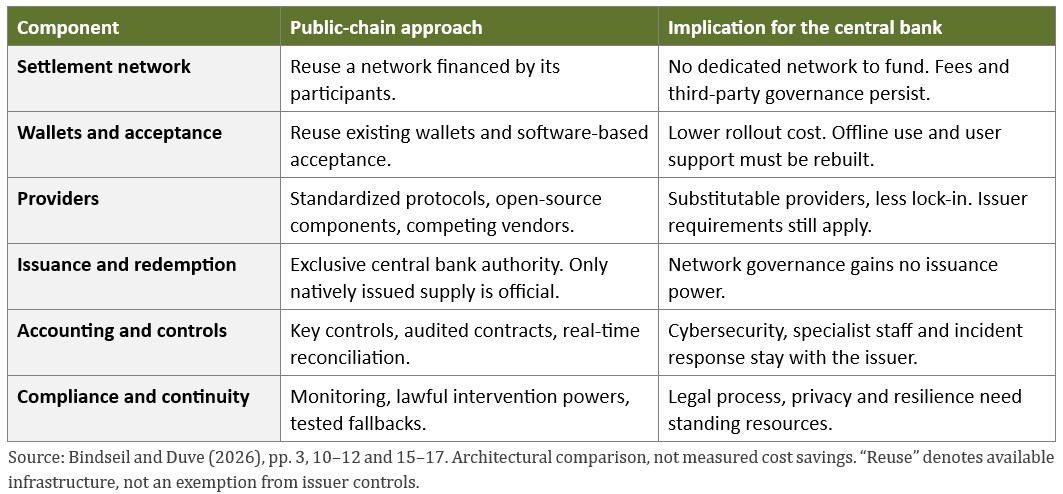
Public access does not imply permissionless creation of central bank money. The central bank would retain exclusive issuance and redemption authority, define official supply and set conditions for compliance interventions. Table 1 separates reusable infrastructure from issuer responsibilities.
Table 1. Components of a central bank currency issued on public blockchains
Seigniorage, the income from issuing money, should cover setup and annual fixed operating costs. The variable cost per payment falls on users, and it must stay small enough to be practically negligible for them and for merchants. These costs should be not more than in the order of magnitude of a cent. Such costs would be below those of traditional private electronic payment solutions.
No public blockchain maximizes decentralization, security and scalability at once. Central banks would need admission criteria covering finality, governance, resilience, costs, privacy and compliance. Finality needs a legal definition: technical assurance that a transaction will stand does not settle the legal question. Privacy belongs in the initial assessment because data can be visible to validators, analytics firms and others. We have begun a first look at the different routes available, while a more comprehensive review is clearly warranted (Table 2).
Table 2. Public blockchain options for central bank money: illustrative, mid-2026
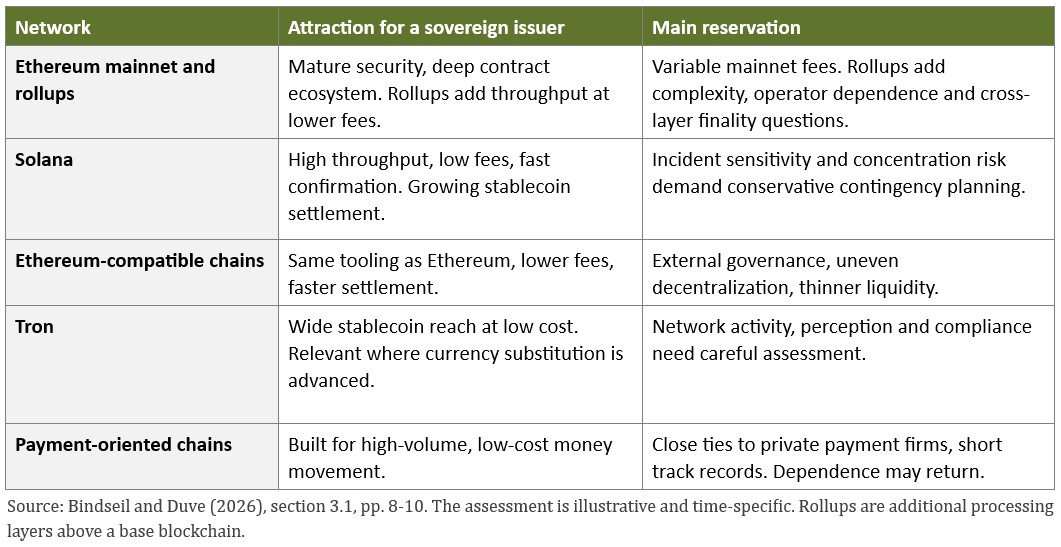
For many central banks, we see an Ethereum-anchored approach as a pragmatic current fit, with mainnet providing settlement assurance and major rollups offering efficiency. Additional issuance on a performance- or stablecoin-oriented chain could serve particular needs. A small, vetted set may reduce dependency and fragmentation while increasing monitoring and cyber exposure.
Transfers between networks require the same discipline as issuance. The central bank should recognize only natively issued tokens and control the process that destroys tokens on one network and issues them on another. Unapproved third-party bridges or wrapped versions should not constitute redeemable central bank claims. Contingency arrangements would allow issuance to be paused on a network whose security or governance deteriorates.
Token control must be credible in operation. Issuance, redemption and freezing keys require separated responsibilities, multi-party approval and tested recovery. Token contracts need independent audits because a defect could affect the monetary claim itself. Changes should be narrowly governed, with delayed non-emergency upgrades and separate emergency authority.
On-chain supply must be reconciled in real time with central bank accounts. A phased rollout and tested fallbacks would support operational readiness.
Token control and network control differ. A central bank can embed freezing powers in its contract, but does not thereby control transaction ordering or protocol governance. Admission criteria and contingencies reduce this exposure. Some rules may remain difficult to enforce on external infrastructure.
Compliance would combine supervised issuance and redemption with monitoring and contract restrictions. Freezing powers need a statutory basis, time limits and judicial review. Self-hosted-wallet transfers are not intermediated, so there is no customer due diligence on every transfer. Cross-border circulation can expose the issuer to conflicting laws.
Monitoring can weaken privacy and the cash-like qualities of public money. Legislators would need to clarify how good-faith acquisition applies where tokens are linked to earlier unlawful transactions, since permanent taint could impair acceptance. Promises of control may heighten reputational exposure. Central banks should explain controls and limits, not claim certainty.
Demand for tokenized central bank money could reduce bank deposits and change banks’ funding conditions. We favour preparedness over restrictive design choices introduced before they are needed. When market rates are sufficiently positive, paying no interest on the token limits its attraction as a store of value. At very low or negative rates, negative remuneration could become an exceptional safeguard under predefined conditions.
If demand exceeds expectations, central bank asset purchases could mitigate the resulting pressure on bank funding and avoid greater structural reliance on central bank credit. Whether and to what extent a central bank uses such balance-sheet offsets is ultimately a matter of its own operating framework and institutional preferences. Views on the appropriate scale and composition of central bank asset holdings differ across jurisdictions and traditions. In some settings, for instance in monetary unions or in economies with deep sovereign-bond markets, these questions are the subject of ongoing debate. We do not prejudge those choices, which remain for each central bank to make within its own mandate. We note only that the balance-sheet tools are available. Even where aggregate funding effects are offset, the composition of deposits can change: granular household balances may give way to less stable or more expensive funding. Funding composition therefore still matters.
Central banks have expressed concern that stablecoins could encourage dollarization and weaken monetary sovereignty. Foreign-currency stablecoins may appeal both as exposure to another currency and as convenient payment instruments. A domestic central bank token could use the same wallets and merchant infrastructure, giving users another payment and settlement option. It cannot remove demand for foreign currency caused by domestic monetary instability.
Preserving domestic public money could also preserve seigniorage as banknote use declines. The magnitudes depend on assumptions about adoption and interest rates rather than on forecasts. For smaller and emerging-market economies, a broad proprietary CBDC may be costly relative to its benefits, and reuse may be more proportionate.
Adoption would still require investment because payment networks favour incumbents. We discuss convenient, inexpensive use and public-sector disbursements where appropriate, while retaining alternatives. The same infrastructure could support tokenized markets and payments initiated by AI agents. These uses strengthen the case for assessing public-chain issuance alongside existing central bank money, including its control costs.
Bindseil, U. and B. Duve (2026), “Tokenizing central bank money on public blockchains”, 23 August, SSRN. https://papers.ssrn.com/sol3/papers.cfm?abstract_id=7348382