This Policy Brief is based on “The Contrasting Digital Transformation Of The U.S. And European Economies”. The views expressed are those of the authors and not necessarily those of the institutions the authors are affiliated with.
Abstract
Europe is reshaping its role within the AI boom, transitioning from a perceived outsider to a specialized provider of intermediate goods. Contrary to the common perspective that Europe is a bystander in the AI revolution, our analysis reveals a sizable, €572 billion trade footprint that tells a far more complex story.
AI is transforming the global economy, amid a widely accepted narrative in which the U.S. drives investment in AI infrastructure, Asia supplies AI-enabling goods, and Europe watches from the sidelines. Indeed, in a July 2026 interview on the AI boom, economist and Nobel laureate Philippe Aghion commented, “Europe needs to wake up.”
In this report, S&P Global Ratings examines the reality of Europe’s position in the global trade in AI-enabling goods. We test whether the prevailing narrative holds true, or if there are grounds to reconsider Europe’s role in the AI revolution.
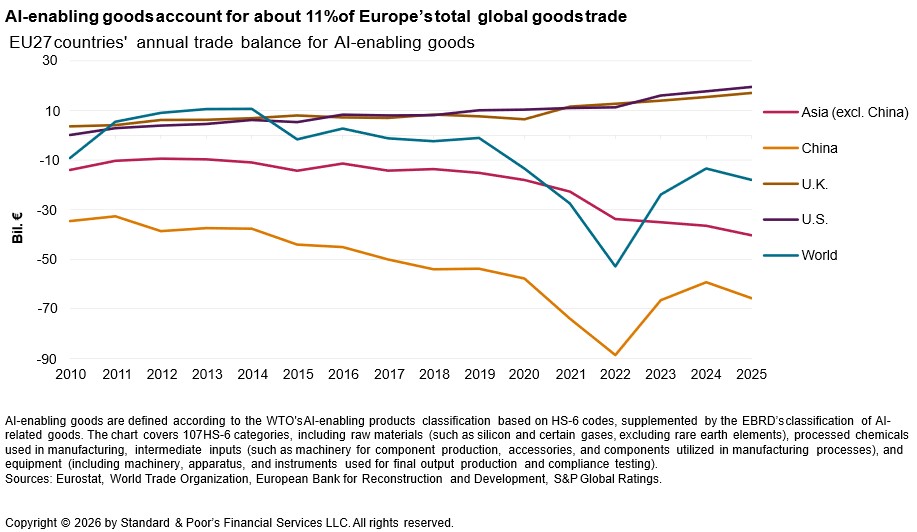
To define the perimeter of trade in AI-enabling goods, we use a WTO classification supplemented by European Bank for Reconstruction and Development (EBRD) mapping (see box below for details). On this basis, we estimate Europe’s annual trade in AI-enabling goods with the rest of the world at €572 billion (exports plus imports) and identify an €18 billion trade deficit in 2025 (see chart 1). This accounts for about 11% of Europe’s total global goods trade.
This perimeter is not without caveats: some categories, such as laptops or equipment enabling high-speed data interchange, have broad end-consumer applications and are not exclusively AI-enabling. Including them may therefore overstate the AI-specific component of trade; conversely, excluding them could understate the infrastructure and equipment that effectively supports AI adoption.
Such classification choices also have material implications for the bilateral picture: removing these categories would substantially reduce Europe’s measured trade deficit with Asian economies.
Chart 1.
The WTO classification offers a comprehensive definition of AI‑enabling goods. It covers 104 Harmonized System six-digit (HS‑6) product categories linked to the development and production of AI technologies, from raw materials to specialized machinery. This classification is not exhaustive; it excludes some HS‑6 categories that may include supply‑chain inputs but are primarily used for non‑AI purposes.
In addition, we used the EBRD classification of AI‑related goods to complement the WTO list. This classification adds three HS‑6 categories relevant for AI deployment, notably optical devices enabling computer vision and control instruments that provide inputs to AI‑automated systems.
The resulting basket covers 107 HS-6 categories, spanning raw materials (such as silicon and selected industrial gases, excluding rare earths according to the WTO methodology); processed chemicals central to the manufacturing of semiconductors; intermediate inputs (accessories, parts, and machinery used in semiconductors’ production); and final equipment (specialized machinery and tools used to develop, deploy, and test AI).
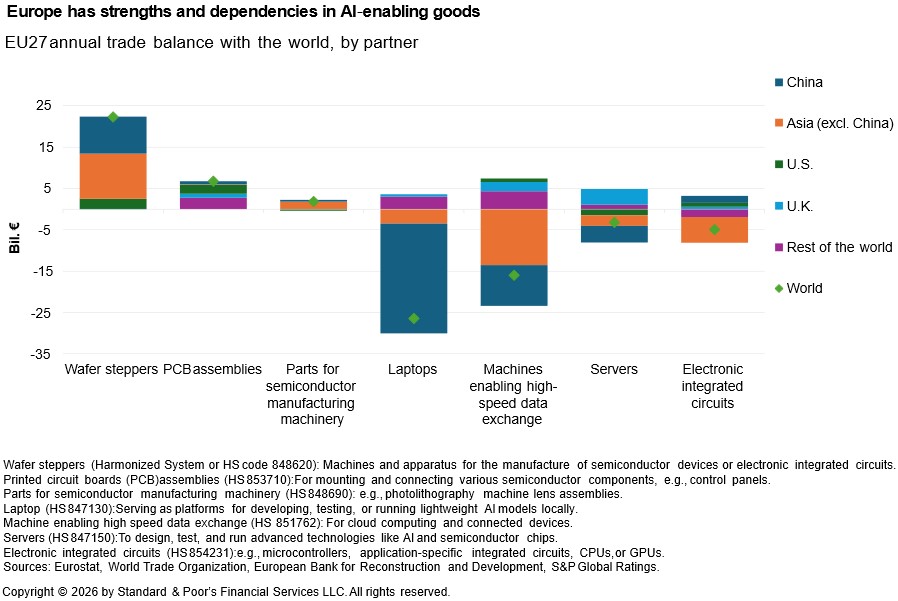
In 2025, European trade in this scope is concentrated. About one-third of exports come from just five HS-6 categories, led by wafer steppers (HS 848620) at €24 billion (8.6%), followed by electronic integrated circuits (HS 854231) at €17.3 billion (6.2%) and servers (HS 847150) at €17 billion (6.2%). On the import side, concentration is even higher: about two-fifths of imports are captured by five HS-6 categories, dominated by machines enabling high speed data exchange (HS 851762) at €33 billion (11.2%) and laptops (HS 847130) at €30.6 billion (10.4%).
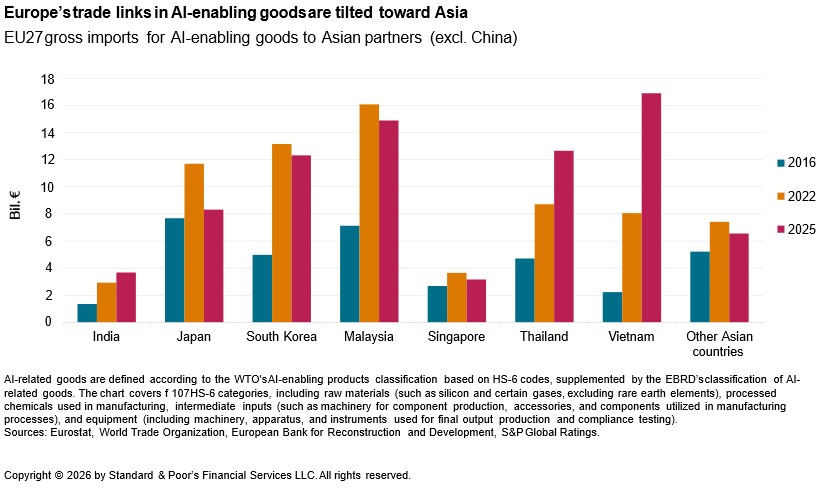
Europe’s trade links in AI-enabling goods are clearly tilted toward Asia, especially on the import side. Since 2016–often seen as the point when AI “came of age”, thanks to the diffusion of voice assistants, the Go breakthrough by Google’s DeepMind AI technology, and the creation of OpenAI–European imports from Asia excluding China have risen markedly (note that our Asia aggregate covers 31 countries and excludes China, which we present separately).
This pattern reflects a supply chain centered on memory production in South Korea, AI accelerators from Taiwan, and additional assembly capacity in economies such as Malaysia (see chart 3). While European imports from China have declined since 2022, this does not signal de-risking: the fall reflects lower Chinese export prices rather than a decisive shift away from China-based suppliers. In fact, imports from China have increased by 14% in terms of quantity since 2022. Because Europe’s trade deficit with Asia continues to widen, the evidence for a strong de-risking trend away from Chinese suppliers remains weak.
Chart 2.
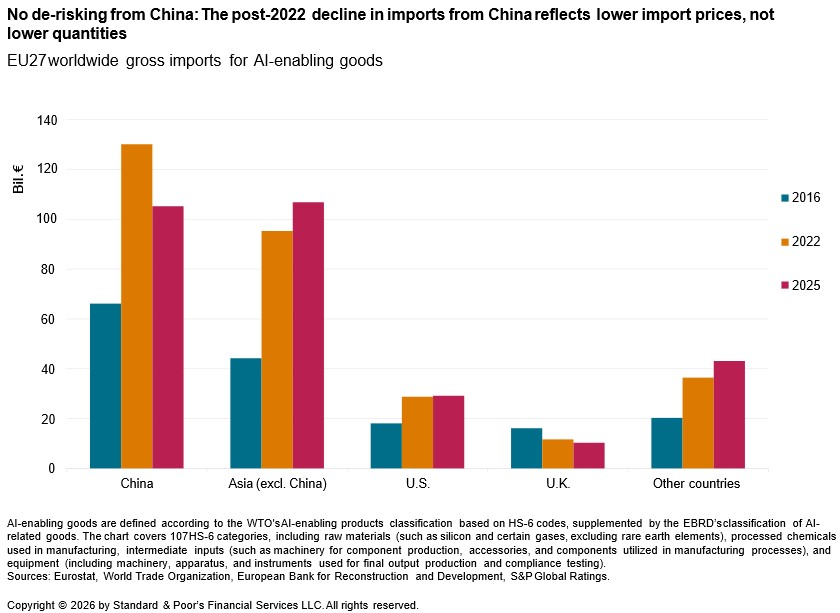
Chart 3.
Most of Europe’s dependencies on China and other Asian countries are in the field of AI-enabling equipment, such as laptops, machines enabling high-speed data exchange, servers, and integrated electronic circuits. But Europe’s dependencies on the global AI supply chain are not the full story, since it also has some comparative advantages.
Europe’s largest strengths lie in the net trade of wafer steppers (photolithography) and the assembly of printed circuit boards (PCB) and parts for semiconductor manufacturing machines. Wafer steppers are precision tools that pattern silicon wafers during chipmaking, enabling the production of integrated circuits such as CPUs and GPUs. Meanwhile, PCB assemblies provide the platform that mounts and links components, distributing power and data within devices (for example, between the CPU, GPU, and memory). Parts for semiconductor-manufacturing machines cover key components for lithography, wafer fabrication, and etching equipment, supporting both the build and reliable operation of these tools.
The three HS-6 categories for optical devices enabling computer vision that we add to our scope beyond the WTO classification, following the EBRD classification – deliver a trade surplus for Europe, although this is marginal compared with the rest.
Chart 4.
This comparative advantage is highly concentrated geographically. Just seven EU countries account for about 80% of total EU trade in AI related goods, and two of them – the Netherlands and Germany – make up the bulk of that concentration (53%). The Netherlands’ role largely reflects ASML Holding N.V.’s dominant position in photolithography. Meanwhile Germany’s strengths are concentrated in PCB assembly, supported by a broader regional ecosystem. The regional ecosystem is not restricted to the German industrial giants; many midsize companies, the “Mittelstand”, are also involved, and it extends into other European countries, which is usual in the European supply chain.
Chart 5.
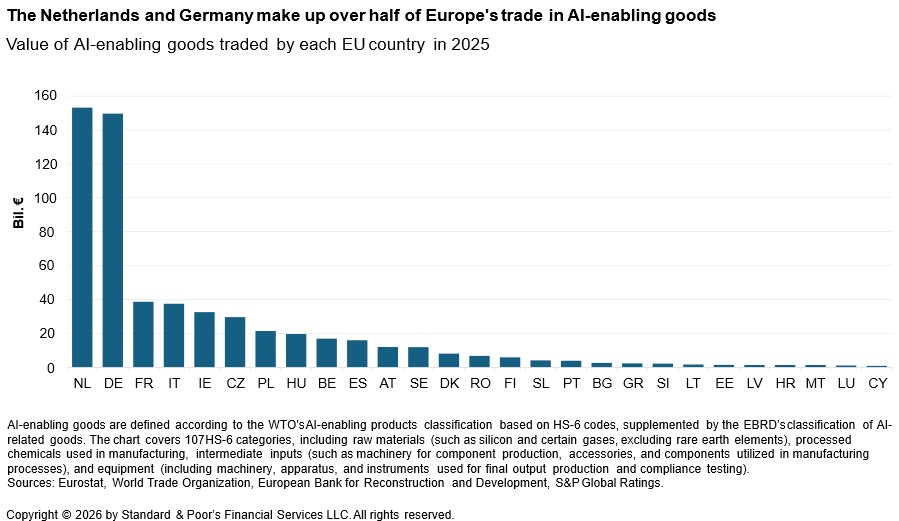
Concentration risk is visible on both the production and destination sides. In terms of production, a small number of firms and ecosystems generate Europe’s trade surplus in intermediate AI-enabling goods. Meanwhile, Europe’s trade in this segment is strongly tilted toward Asia, with China absorbing about 40% of Europe’s wafer-stepper trade surplus. As a result, Europe’s exposure to China in AI-related goods is both upstream (imports of AI-enabling equipment) and downstream (exports of critical photolithography equipment). This two-sided dependence leaves parts of Europe’s tech sector vulnerable to further trade escalation or tightening restrictions involving China, while the specialization in a narrow set of AI-enabling intermediates leaves it vulnerable to potential shifts in the technological frontier.
Trade in AI-enabling goods captures only one dimension of Europe’s digital economy. The broader transformation hinges on technology services and, more generally, the development of the ICT sector as a whole, spanning both manufacturing and a wide range of digital services. We will assess the development of the European ICT sector in an upcoming article.
“Europe’s established tech firms emerge as unexpected AI winners,” published by Reuters on Aug. 5, 2026 (https://www.reuters.com/business/media-telecom/europes-established-tech-firms-emerge-unexpected-ai-winners-2026-08-05/)
“Behind the AI boom: Electronics supply chain outlook,” published by S&P Global Market Intelligence, July 28, 2026 (https://www.spglobal.com/market-intelligence/en/news-insights/research/2026/07/behind-ai-boom-electronics-supply-side-constraints)
“Resilient growth amid continued trade tensions,” published by the European Bank for Reconstruction and Development on February 2026 (https://www.ebrd.com/home/news-and-events/publications/economics/rep/resilient-growth-amid-continued-trade-tensions.html)
“AI: Why Europe is falling behind, and how it can catch up,” published by DW.com, July 16, 2026 (https://www.dw.com/en/ai-why-europe-is-falling-behind-and-how-it-can-catch-up/a-77853943)
“World Trade Report 2025: How trade and AI can contribute to inclusive growth,” published by the World Trade Organization on September 2025 (https://doi.org/10.30875/9789287074560)