

This policy brief is based on Ambrocio, Fungáčová, Heikkinen, Kerola, Korhonen and Norring (2026), “Northern InSights: Geopolitical Risk from Finnish News Media”. The views expressed are those of the authors and do not necessarily reflect the views of the Bank of Finland, the Eurosystem, or the IMF.
Abstract
We construct a geopolitical risk index for Finland (FinnGPR) drawing from domestic Finnish-language news using a conventional dictionary approach and a novel fine-tuned language model. The language model matches human classification of news articles substantially better than the dictionary approach. Our index, capturing local perceptions of geopolitical risk, differs sharply from indices built from English-language international media, which likely reflect global attention directed at Finland. Increases in perceived geopolitical risk leave the Finnish real economy largely unscathed while raising financial market stress and dampening consumer confidence. Our findings suggest that, especially for small open economies, local-language news measures contain information that conventional global indices miss and that geopolitical risk may transmit largely through financial channels, with direct relevance for financial stability.
Geopolitical risk has moved to the center of the policy debate. A growing body of evidence shows that wars, terrorism and interstate tensions depress output, investment, sentiment and asset prices around the world (Caldara and Iacoviello, 2022; Bondarenko et al., 2024; Alonso-Alvarez et al., 2025; Gorodnichenko et al., 2025). The first step in studying these effects is measurement, and the workhorse approach counts articles mentioning geopolitical tensions in major English-language media from the United States, the United Kingdom and Canada.
These indices are invaluable gauges of global geopolitical risk. But for a small open economy, they can be misleading. Country-specific variants, which flag geopolitical articles that also mention the country in question, inherit the perspective of the international media that produce them. Small countries rarely feature in global news, and when they do, it is typically because something has caught the attention of the international readership, not necessarily because risk facing the country has risen.
The case of Finland illustrates this point. The country-specific index for Finland from Caldara and Iacoviello (2022), built from English-language media, peaks in July 2018, the month of the Trump–Putin summit in Helsinki, and reacts more strongly to Finland’s NATO accession than to Russia’s full-scale invasion of Ukraine. Neither event plausibly marked the high point of geopolitical risk faced by Finland. What the index captures is better described as global geopolitical attention directed toward Finland. Our index built from domestic Finnish-language news shows no spike in July 2018 and instead peaks at the onset of the invasion of Ukraine in early 2022.
We construct a Finnish geopolitical risk index, FinnGPR, from the full archive of online news published by the Finnish public broadcaster Yle between 2011 and 2024, roughly one million articles (Ambrocio et al., 2026). Finland is a particularly suitable setting for this exercise: Finnish is spoken almost exclusively within the country, the media landscape is concentrated, and trust in news media is among the highest in the world, with Yle reaching about 92% of Finns.
We build the index in two ways. The first follows the established dictionary approach, translating and adapting the keyword rules of Caldara and Iacoviello (2022) into Finnish, including additions reflecting the modern threat landscape such as airspace violations, hybrid influence and cyber-attacks. The second is methodologically novel: we fine-tune the Finnish BERT language model (Virtanen et al., 2019) on 700 human-classified articles so that it mimics a human reader’s judgment of whether an article signals geopolitical risk, and apply it to the full corpus.
The two versions of the index are highly correlated (about 0.8), but the language model matches human judgment considerably more closely. On held-out articles the model was never trained on, it agrees with the human evaluator about 98% of the time, against roughly 88% for the dictionary approach. The dictionary approach is also systematically conservative, missing many articles a human would flag, while the language model’s errors are small and symmetric. The model picks up contextual cues that rule-based searches cannot, such as narrative accounts of wars or attacks that avoid specific keywords. We therefore view the language-model index as our preferred measure of local risk perceptions, and we see fine-tuned local-language models as a promising, low-cost tool for other countries and institutions. The two approaches remain complementary, however: the dictionary method still underpins the topical decomposition of the index into sub-categories such as war threats and terrorist acts, for which labeled training samples are as yet too small to fine-tune the model.
Comparing FinnGPR with existing indices reveals a clear pattern. Our index correlates fairly strongly with the global geopolitical risk index of Caldara and Iacoviello (2022), at around 0.6 for the language-model version and 0.8 for the dictionary version, but barely at all with their country-specific index for Finland (correlation of about 0.1). In other words, how Finns perceive geopolitical risk closely tracks how the world perceives global geopolitical risk, yet has little to do with how often Finland appears in international geopolitical coverage. Figure 1 illustrates this: the attention-based index for Finland (GPRC-FIN) spikes at the July 2018 Helsinki summit, an event FinnGPR barely registers, while FinnGPR peaks at the onset of Russia’s invasion of Ukraine in early 2022.
Figure 1. Local perceptions versus global attention: FinnGPR and international geopolitical risk indices
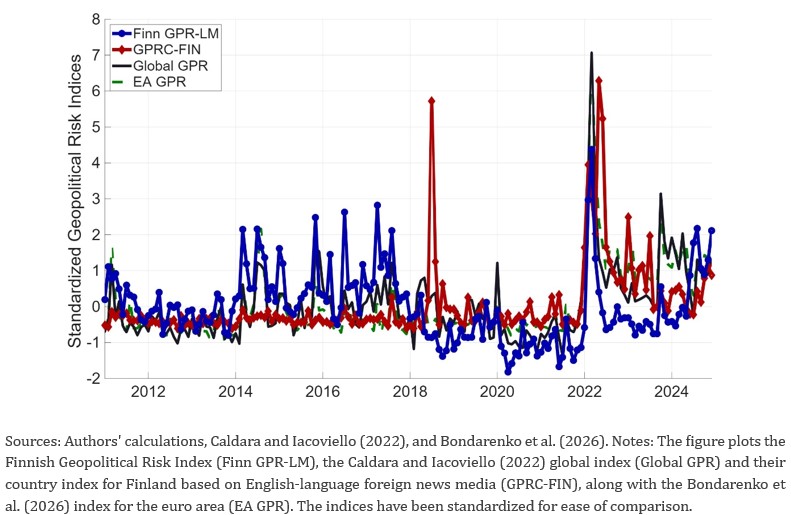
This distinction is relevant for the use of country-level geopolitical risk indices in research and surveillance. Indices for small countries constructed from international media are best interpreted as measures of geopolitical attention on the country, not of the geopolitical risk its residents, firms and markets actually perceive. The two concepts can diverge substantially, and, as we show next, they have different economic consequences.
Using local projections on monthly Finnish data from 2011 to 2024, we trace the effects of a one-standard-deviation shock to perceived geopolitical risk. Three findings stand out.
First, the real economy appears resilient. Industrial production and unemployment show no significant response, and inflation rises only mildly. Plausible explanations for such mild effects may be that most geopolitical conflicts are geographically distant, Finland’s culture of preparedness with 97% of Finns report trusting the armed forces, far above the EU average, and also that the willingness to defend the country is exceptionally high.
Second, our results indicate that the effects of geopolitical risks are concentrated in financial markets. Systemic stress in Finnish financial markets rises significantly after a geopolitical risk shock, with peak effects slightly above one standard deviation, and consumer confidence weakens. Finland’s internationally integrated financial markets transmit global geopolitical developments even when the domestic real economy does not.
Finally, the choice of geopolitical risk measure matters when evaluating economic consequences. Shocks to perception-based indices from various perspectives (our FinnGPR, the global index, and the euro area index of Bondarenko et al., 2026) move Finnish financial and sentiment variables, with somewhat stronger effects for the local perceptions measure. In contrast, shocks to the attention-based country index for Finland produce smaller and generally insignificant effects. This echoes evidence documented for Russia and the euro area that locally sourced geopolitical risk shocks have significant economic effects (Bondarenko et al., 2024 & 2026).
Three lessons emerge for policymakers and analysts. First, for small open economies, geopolitical risk should be measured where it is perceived: in local media, and in the local language. Country indices built from international media may capture attention rather than risk and may not reflect the episodes that matter most locally. Second, modern language models make this feasible at modest cost. A model fine-tuned on a few hundred human-labeled articles can classify millions of articles with accuracy close to that of a human evaluator and matches human classification more closely than keyword dictionaries. Central banks and supervisors can realistically build and maintain such indicators in-house. Third, the transmission of geopolitical risks for a prepared, stable small open economy may run primarily through financial markets and sentiment. This suggests that geopolitical risk belongs on the agenda of financial stability surveillance even in economies whose real activity appears resilient to it.
Alonso-Alvarez, I., Diakonova, M., and Perez, J. J. (2025). Rethinking GPR: The sources of geopolitical risk. Banco de España Working Papers, No. 2522.
Ambrocio, G., Fungáčová, Z., Heikkinen, J., Kerola, E., Korhonen, I., and Norring, A. (2026). Northern InSights: Geopolitical risk from Finnish news media. Available at SSRN: https://ssrn.com/abstract=5970674 (revised version of Bank of Finland Research Discussion Paper 13/2025).
Bondarenko, Y., Lewis, V., Rottner, M., and Schueler, Y. (2024). Geopolitical risk perceptions. Journal of International Economics, 152.
Bondarenko, Y., Kang, N., Lewis, V., Rottner, M., and Schueler, Y. (2026). Geopolitical risk in the euro area: Measurement and transmission. Bundesbank Discussion Paper, 14/2026.
Caldara, D. and Iacoviello, M. (2022). Measuring geopolitical risk. American Economic Review, 112(4), 1194–1225.
Gorodnichenko, Y., Georgarakos, D., Kenny, G., and Coibion, O. (2025). The impact of geopolitical risk on consumer expectations and spending. NBER Working Paper, No. 34195.
Virtanen, A., Kanerva, J., Ilo, R., Luoma, J., Luotolahti, J., Salakoski, T., Ginter, F., and Pyysalo, S. (2019). Multilingual is not enough: BERT for Finnish. CoRR, abs/1912.07076.