

This Policy Brief is based on Spiteri, S., Lebouteiller, L., Vorderobermeier, N., Delgado-Téllez, M., & Ceglar, A. (2026): “Beat the heat, the role of heat waves and droughts in regional EU economies”, European Central Bank Working Paper Series No 3248. The views expressed are those of the authors and do not necessarily reflect those of their respective institutions, the European Central Bank or the Eurosystem.
Abstract
Extreme climate events such as heat waves and droughts are becoming more frequent and severe in Europe, posing significant risks to regional economies. This study uses a set of machine learning models to predict the short-term economic impacts of these events on agriculture, industry, and manufacturing across 1,117 EU regions. The findings reveal that, while agriculture is the most severely affected sector, industry and manufacturing are not immune, highlighting the need for targeted adaptation policies to mitigate the economic consequences of climate extremes.
Europe entered August 2026 under intensifying and increasingly interconnected climate pressures. Persistent rainfall deficits, depleted soil moisture and a prolonged sequence of record-breaking heat have combined to worsen drought conditions across large parts of the continent. Extremely low river flows (Figure 1) are affecting water availability, inland navigation, energy production, and ecosystems. Heat and water stress are damaging crops and vegetation. At the same time, exceptionally dry and hot conditions have created an environment conducive to extraordinary wildfires. These are not isolated hazards: heat accelerates water loss from soils and vegetation, intensifies drought and fire danger, and increases pressure on already constrained water resources (JRC, 2026).
Figure 1. River flow anomalies across Europe in mid-August 2026
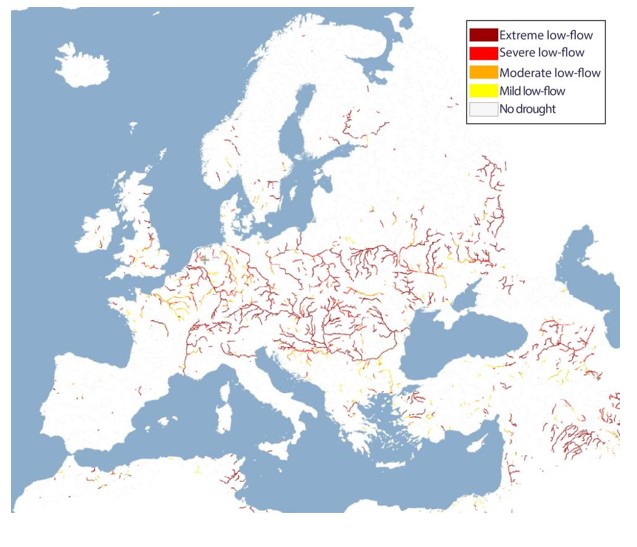
Note: The map shows the Low-Flow Index across Europe in mid-August 2026. The Low-Flow Index is based on 6-hour river discharge simulations from the JRC’s LISFLOOD hydrological model, capturing periods of unusually low streamflow and comparing them against historical conditions from 1995–2024 to determine severity. Source: European Drought Observatory, https://edo.jrc.ec.europa.eu/.
The ongoing situation illustrates why the economic consequences of climate extremes cannot be understood by examining individual hazards in isolation. Concurrent heat and drought can reduce agricultural productivity, constrain industrial and energy production, disrupt river transport and supply chains, and place additional pressure on ecosystems, workers and public services. These effects may propagate across sectors and regions well beyond the locations initially affected. Against this background, this policy brief presents new evidence on how compound heat and drought stress affects regional economic activity in Europe that conventional single-hazard assessments may overlook.
A growing literature has started to quantify the economic consequences of such climate extremes. Concerning Europe, Usman et al. (2025) show that severe droughts can generate persistent regional output losses, while related studies document the role of droughts and harvest failures in driving food prices, inflation dynamics and broader macroeconomic volatility (Peersman, 2022; Parker, 2016; Beirne et al., 2021; Kotz et al., 2025; Wegner et al., 2025). However, much of this evidence relies on aggregate, linear or semi-structural approaches, which may be less suited to capturing nonlinearities, compounding hazards, spatial spillovers, and sector-specific vulnerabilities at a granular regional level.
We examine how information on heat waves and droughts can improve assessments of short-term regional economic developments across the EU by developing climate-augmented machine learning models. We analyse how droughts and heat waves individually, or in combination, contribute to economic outcomes across regions. The findings provide new evidence on the value of integrating climate information into forward-looking economic and risk assessments, helping policymakers identify regional vulnerabilities and potential economic hotspots at an earlier stage.
Our analysis combines annual regional economic data with high-frequency climate indicators, from Eurostat and the Copernicus European Drought Observatory, respectively. The indicators capture heat wave intensity and different dimensions of drought stress, including meteorological, hydrological and agricultural conditions.
The intensity and the duration of the climate extremes as well as their interactions are captured by the implemented models. The feature design allows for the individual identification of the weights applied when heat waves and droughts coincide, when climate events last longer, or when climate conditions worsen in neighbouring regions. This provides a richer representation of climate stress and allows the models to capture spatial spillovers and nonlinear effects of compound events.
We assess whether this information improves short-term predictions of regional GVA per capita growth in agriculture, industry and manufacturing across EU NUTS-3 regions. Random Forest and XGBoost models are compared with a conventional linear benchmark, using specifications with economic variables only and specifications augmented with climate information. High-frequency climate data are incorporated through annual aggregation, principal components and mixed-frequency approaches, with predictive performance evaluated out of sample over 2018–2022.
Heat wave indicators rank among the most important predictors of agricultural growth, while drought and compound-event indicators also contribute significantly. This is consistent with agriculture’s direct dependence on temperature, water availability, soil moisture and vegetation conditions. In industry and manufacturing, climate variables play a smaller role relative to past economic performance and regional characteristics. The results therefore suggest that climate-augmented machine learning tools are particularly useful for sectors that are directly exposed to weather and water stress.
To illustrate the potential economic consequences of compound climate stress, we simulate an extreme heat wave and drought event comparable to the conditions experienced in 2022. Regional economic growth under this scenario is compared with a benchmark without unusual climate conditions, while other factors are kept unchanged. The results identify agriculture as the most exposed sector (Figure 2): average agricultural GVA per capita growth is 4.5 percentage points lower under the extreme-event scenario. The largest reductions are concentrated in parts of eastern Europe, where agricultural production is often more dependent on rainfall and may have less capacity (e.g. through irrigation) to buffer severe heat and water stress.
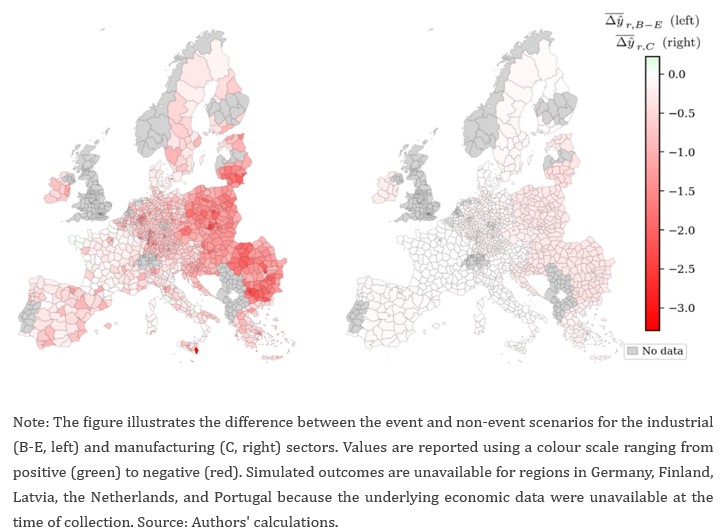
Industry appears less vulnerable to direct effects (Figure 3), but it is not unaffected. Under the same scenario, industrial GVA per capita growth is, on average, 0.75 percentage points lower, while manufacturing records a smaller average reduction of 0.11 percentage points. This contrast reflects agriculture’s immediate dependence on temperature, water availability, soil moisture and vegetation conditions. Industrial and manufacturing activities generally operate in more controlled environments and may therefore be better able to absorb direct climate pressures.
Nevertheless, the aggregate results conceal considerable regional differences. Parts of eastern Europe and the Baltic region also experience comparatively strong adverse effects on industrial activity. These may arise through several channels, including constraints on water and energy availability, heat-related reductions in labour productivity, transport disruption and pressures transmitted through supply chains.
Figure 2. Simulated impact of heat waves and droughts on agricultural GVA growth
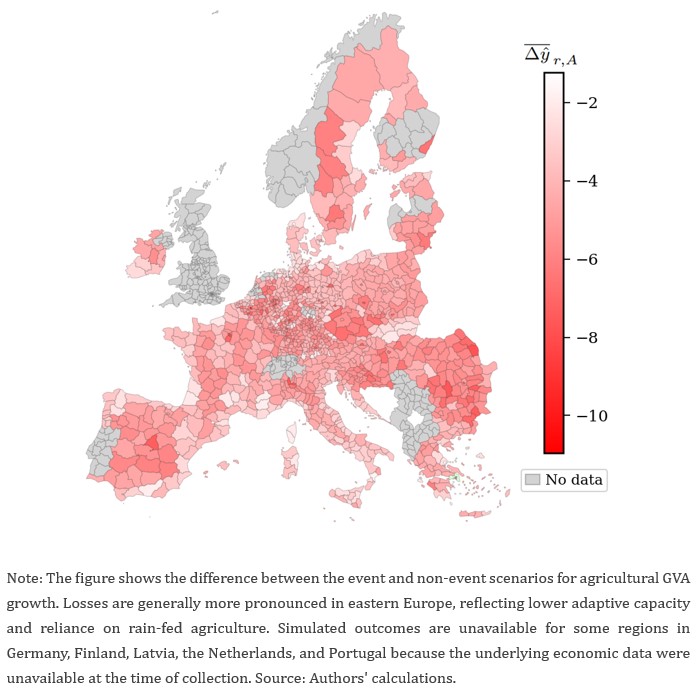
Figure 3. Simulated impact of heat waves and droughts on industrial
(Sectors B-E, left panel) and manufacturing (Sector C, right panel) GVA growth
These findings reveal marked differences in climate vulnerability across sectors and regions. Agriculture faces the strongest immediate effects, but smaller changes in industry and manufacturing should not be interpreted as economically insignificant. Given the much larger contribution of these sectors to regional and EU value added, even modest percentage point reductions can translate into substantial economic consequences. The results therefore support a differentiated approach to climate-risk assessment, one that accounts for sectoral exposure, regional vulnerabilities and the indirect transmission of climate shocks across the economy.
The findings underline the value of integrating climate information into short-term economic monitoring and risk assessment. Climate-informed analytical tools can help identify sectors and regions that may be particularly vulnerable to compound heat and drought stress, providing additional evidence for preparedness and adaptation decisions. The pronounced differences across sectors and regions also suggest that uniform measures are unlikely to address the full range of vulnerabilities effectively.
Adaptation efforts could therefore be tailored to regional and sectoral conditions. In agriculture, priorities may include more efficient water management, drought-resilient production systems and measures that strengthen soil and ecosystem resilience. For industry and manufacturing, attention should also be paid to indirect transmission channels, including water and energy constraints, heat-related productivity losses, transport disruption and supply-chain dependencies. Identifying potential hotspots can support the prioritisation of measures and resources before climate shocks translate into broader economic disruption.
Combining frequently updated climate indicators with economic information could also strengthen existing monitoring and early-warning frameworks. Such tools are not a substitute for established economic analysis or detailed sectoral assessments. Rather, they can complement them by detecting emerging vulnerabilities, compound pressures and regional spillovers that may otherwise remain difficult to identify. Their policy value lies in supporting earlier and more forward-looking assessments of where climate stress may create the greatest economic pressures.
Future research could extend the analysis to other hazards, including floods and wildfires, and investigate more closely the channels through which climate shocks affect regional economies. Linking climate and economic indicators with information on firms, supply chains and financial exposures could provide a basis for more comprehensive scenario analysis and system-wide stress testing. This would help connect climate monitoring with economic preparedness, adaptation planning and financial-risk assessment.
Beirne, J., Dafermos, Y., Kriwoluzky, A., Renzhi, N., Volz, U., and Wittich, J. (2021): “The Effects of Natural Disasters on Price Stability in the Euro Area”, Discussion papers no. 1981, DIW Berlin.
Kotz, M., Donat, M. G., Lancaster, T., Parker, M., Smith, P., Taylor, A., and Vetter, S. H. (2025): “Climate extremes, food price spikes, and their wider societal risks”, Environmental Research Letters, 20(8).
Joint Research Centre (JRC) (2026): “Worsening drought and record heat grip Europe, fuel-ling extraordinary wildfires and extremely low river flows”, European Commission, 12 August. Available at: https://joint-research-centre.ec.europa.eu/jrc-news-and-updates/worsening-drought-and-record-heat-grip-europe-fuelling-extraordinary-wildfires-and-extremely-low-2026-08-12_en (Accessed: 19 August 2026).
Parker, M. (2016): “Global inflation: the role of food, housing and energy prices”, Discussion paper no. 2016/05, Reserve Bank of New Zealand.
Peersman, G. (2022): “International Food Commodity Prices and Missing (Dis)Inflation in the Euro Area”, The Review of Economics and Statistics, 104(1), 85–100.
Usman, S., González-Torres Fernández, G., and Parker, M. (2025): “Going nuts: The region-al impact of extreme climate events over the medium term”, European Economic Review, 178:105081.
Wegner, O., Dees, S., Boullot, M., Lesterquy, P., Serfaty, C., Thubin, C., Ulgazi, Y., Boitout, A., and Gabet, M. (2025): “Seeds of Inflation: Macro Modelling of Nature-Related Risks through Agricultural Prices”, Working Paper Series 1006, Banque de France, Paris, France.