

This policy brief is based on Groiss and Sondermann (2026) “Monetary Policy and the Rigidity of Firm Employment Expectations” ECB Working Paper No. 3272. The views expressed in this policy brief are those of the authors and do not necessarily reflect those of the European Central Bank (ECB).
Abstract
Monetary policy affects the labour market and this can already be seen from changes in firms’ employment expectations. Using German ifo Business Survey data and high-frequency ECB monetary policy surprises, this policy brief shows that rate hikes lead firms to quickly adjust their employment plans, mainly by cancelling or postponing hiring plans. While production expectations react more sharply but only temporarily, employment expectations deteriorate and remain weak for more than a year. These expectations predict lower subsequent employment growth and mirror aggregate movements in vacancies, employment and unemployment. The response is stronger for financially constrained firms, but weaker where collective bargaining coverage is high. These findings emphasise that firm expectations help to preview monetary policy transmission and to gauge whether ‘this time is different’.
How quickly does monetary policy affect employment? The conventional answer is that employment follows output: higher interest rates reduce demand, firms produce less, and employment subsequently declines. While this chain of events is correct, it misses a crucial detail: employment adjusts slowly, and the process begins not with layoffs, but with expectations. Firms do not instantly fire workers when demand weakens. Hiring takes time since firms must find candidates, recruit, and train them. Dismissing employees is even harder, due to legal protections, notice periods, and the value of firm-specific skills. These frictions make employment more rigid than production. As a result, the labour market responds to monetary policy with a delay. But this reaction can be anticipated by changes in firms’ expectations about future hiring and layoffs. Changes in these plans may therefore provide information about the future labour market response well before official employment statistics become available. Groiss and Sondermann (2026) investigate this mechanism using German firm-level survey data. We ask three questions. Do firms change their employment expectations following an unexpected monetary policy shock? Do these changes subsequently translate into actual employment? And why do employment expectations behave differently from production expectations?
To uncover how firms react to monetary policy, we use data from the German ifo Business Survey, which captures monthly responses from around 9,000 firms across industry, construction, trade, and services – covering over two million firm-month observations from 2005 to 2024. Firms report whether they expect their number of employees over the following three months to increase, remain unchanged or decrease. The key empirical challenge is to distinguish the effect of monetary policy from everything else happening in the economy. We therefore focus on unexpected monetary policy surprises around ECB announcements (Altavilla et al., 2019). Moreover, we exploit the exact date on which firms complete the survey. ECB monetary policy announcements take place on specific dates, while firms complete their monthly survey at (quasi-random) different times during the month. We can therefore compare firms responding shortly before an announcement with otherwise similar firms responding shortly afterwards. Firms in the latter group have received the new monetary policy information; firms in the former group have not. This provides a particularly clean way of asking what happens to firms’ expectations immediately after a monetary policy surprise. Using a local projection framework, we then examine whether the initial adjustment persists and is associated with subsequent changes in employment by following firms over time.
The first result is striking: firms respond to monetary policy in their employment plans almost immediately. A contractionary monetary policy surprise equivalent to a 25-basis-point increase in the policy rate reduces the employment expectation balance by around 13 percentage points. In other words, the balance between firms planning to increase and firms planning to reduce their workforce over the next three months deteriorates substantially immediately after the announcement. But the composition of this adjustment is particularly informative. Around three quarters of the immediate deterioration comes from firms withdrawing plans to increase their workforce. Only about one quarter initially comes from firms planning more layoffs. In line with economic intuition, stopping a recruitment process or postponing a planned hiring is much easier than dismissing an existing employee. Employment protection, notice periods and the costs of losing workers all make reductions in the existing workforce more difficult. This distinction matters for the interpretation of labour market data. A weakening labour market does not necessarily begin with mass layoffs. It may start with something less visible: firms simply deciding not to hire.
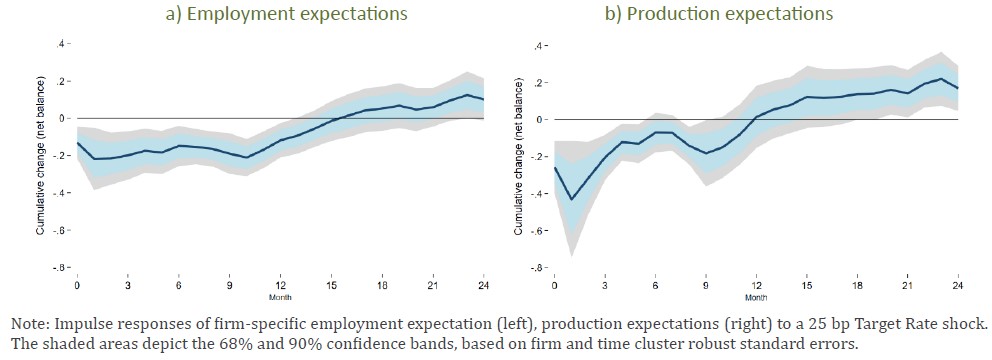
Another revealing finding emerges when employment expectations are compared with production expectations. Firms are almost twice as likely to adjust their production expectations immediately after a contractionary monetary policy surprise as their employment expectations. Production plans reach a stronger initial response, but the adjustment reverses relatively quickly. Within around six months, the production response is no longer statistically different from zero.
Employment expectations behave differently. Using a panel local projection framework, we estimate the dynamic responses of firm-level employment expectations to a monetary policy surprise. Consistent with the immediate effect, firms’ employment expectations deteriorate after a 25-basis-point Target Rate shock. Their negative response peaks around one month after the monetary policy shock and remains at a similar level for roughly twelve months before gradually fading as shown by Figure 1. This implies that firms can change production plans relatively quickly while continuing to hold on to workers. This is consistent with labour hoarding: firms may temporarily accept lower labour utilisation rather than incurring the costs of adjusting their workforce. The persistence of employment expectations reflects several forces. Employment protection and notice periods slow adjustment. Finding new workers can be difficult, particularly in sectors affected by persistent skill shortages. At the same time, firms may value retaining workers whose skills are costly to replace. The result is an important asymmetry: production can respond quickly to monetary policy, while employment can remain comparatively rigid.
Figure 1. Employment and production expectation responses to monetary tightening
The composition of adjustment in employment expectation is also informative in the dynamic setting. While reduction in hiring plans dominate the immediate effect, the picture changes over time. Layoff intentions become increasingly important and slightly dominate. Monetary tightening therefore affects both sides of the labour market flow: it reduces job creation and increases job destruction.
A natural question is whether these survey responses matter for actual employment. Following a contractionary monetary policy surprise, (realised) firm-level employment growth is significantly lower over the following year. Depending on the specification, the estimated decline in year-ahead firm-level employment growth ranges from around 0.6% to 1.4%. These estimates should be interpreted with some caution because employment in the underlying survey is only measured annually. Nevertheless, the direction of the effect is consistent with the response of employment expectations. The relationship between expectations and subsequent employment is also economically meaningful. Firms that expect their employment to decline are more likely to experience weak or negative employment growth subsequently, whereas firms with positive employment expectations tend to record stronger employment growth. The aggregate evidence from official statistics points in the same direction. Following a contractionary shock, vacancies decline and remain subdued for around a year. Employment also falls, while unemployment increases with a lag. Thus, the information contained in firms’ expectations appears before the corresponding movements in aggregate labour market indicators. This is perhaps the most important policy implication of the analysis: employment expectations are not merely a measure of sentiment. They contain information about future labour market outcomes.
Not all firms react in the same way. The response is substantially stronger among firms that report financial difficulties or restricted access to credit. Firms experiencing financial difficulties reduce their employment expectations by an additional amount that is roughly comparable to the baseline effect. Firms reporting restrictive credit conditions also respond particularly strongly. This finding adds an important dimension to the financial-accelerator mechanism. Previous evidence has shown that financially constrained firms reduce investment and employment more strongly after monetary tightening. Our results suggest that the mechanism begins even earlier: financially constrained firms anticipate the consequences of tighter financial conditions and adjust their hiring plans before employment itself changes. This has implications for how policymakers monitor monetary transmission. Aggregate credit and employment indicators may show the final stage of the process. Firm expectations can reveal the adjustment much earlier. The result also highlights why firm-level heterogeneity matters. The same monetary policy shock does not have the same implications for every firm. A firm with comfortable financing conditions may be able to postpone investment or absorb weaker demand. A financially constrained firm may have much less room to manoeuvre and may therefore respond by immediately scaling back its workforce plans.
The second source of heterogeneity comes from labour market institutions. Collective bargaining appears to dampen the response of employment expectations. Across sectors, firms operating where a larger share of employees is covered by collective bargaining agreements react less strongly to a contractionary monetary policy surprise. This suggests that collective bargaining may provide some protection against employment adjustment when economic conditions deteriorate. Its role is therefore not limited to determining wages; it may also influence how employment responds to macroeconomic shocks. The minimum wage provides a contrasting example. Firms affected by the statutory minimum wage reduce their employment expectations more strongly following a contractionary monetary policy shock. One interpretation is that when wages are less able to adjust downwards, firms rely more heavily on employment as an adjustment margin. Importantly, the paper does not find systematic differences in the employment expectation response by firm size. This is noteworthy because smaller firms are often assumed to be more sensitive to monetary policy because they depend more heavily on bank financing and are less regulated. The survey evidence suggests that the relevant distinction is less about size itself and more about the firm’s actual financial and labour market constraints when it comes to expectation formation.
This paper shows that monetary policy affects the labour market and that this can be previewed by looking at changes in firms’ employment expectations. German firms revise their employment plans almost immediately following unexpected monetary policy tightening. Yet employment expectations adjust much more slowly and persistently than production expectations. The results point to four practical lessons. First, monitor firms’ employment expectations to preview aggregate labour market data. Official employment, unemployment and vacancy statistics remain essential, but they are necessarily backward-looking relative to firms’ decisions. Survey information can provide an earlier indication of whether monetary policy is beginning to affect hiring. Second, distinguish the hiring and layoff margins. A deterioration in employment expectations initially reflects fewer planned hires rather than widespread layoffs. A central bank looking only at unemployment or realised employment may therefore miss the first stage of labour market adjustment. Third, pay attention to persistence. The employment response is slower and longer-lasting than the production response. A temporary decline in output expectations should therefore not automatically be interpreted as implying an equally temporary labour market effect. Fourth, monitor heterogeneity. Aggregate indicators can conceal important differences across firms. Financially constrained firms react more strongly, while collective bargaining appears to cushion employment expectations. Such heterogeneity matters for understanding how a common monetary policy shock translates into employment outcomes. Central bank announcements influence firms’ beliefs about future labour demand, and these beliefs are subsequently reflected in employment.
Altavilla, C., Brugnolini, L., Gürkaynak, R. S., Motto, R., & Ragusa, G. (2019). Measuring euro area monetary policy. Journal of Monetary Economics, 108, 162-179.
Groiss, M., & Sondermann, D. (2026). Monetary policy and the rigidity of firm employment expectations, ECB Working Paper, No. 3272.