

This policy brief is based on ECB Working Paper Series No 3092. The views expressed are those of the authors and not necessarily those of the institutions the authors are affiliated with.
Abstract
The March 2023 banking turmoil has revived the discussion about whether social media and the digitalisation of finance intensify deposit outflows. More convenient and faster access to digital banking services may make retail depositors quicker in reacting to news or events. As a consequence, deposits may become flightier during a stress episode. We shed light on whether access to digital banking has affected extreme deposit flows in Europe, using quantile regressions to disentangle tail effects from baseline trends in deposit flows. Our findings indicate that an increased use of online banking services leads to a moderate amplification of extreme deposit outflows. We do not find an additional effect of social media.
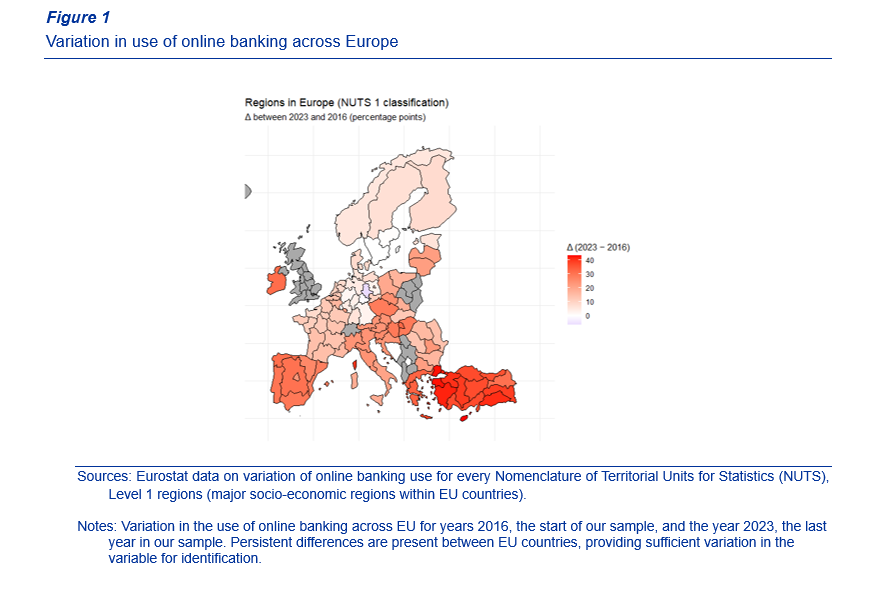
Since the March 2023 banking turmoil originated in the US, most research on how digitalisation affects deposit outflows is on the US banking system (e.g. Koont et al. 2024, Cipriani et al. 2024). However, also in Europe, access to online banking services and banking apps has increased (Figure 1). We use regulatory reporting data on deposits for a sample of large banks directly supervised by the European Central Bank (ECB). Since there have not been many bank runs in Europe since the Global Financial Crisis, we use a value-at-risk concept to develop an idea of ‘deposits-at-risk’ (DaR), i.e. extreme outflows at the lower tail of the distribution.
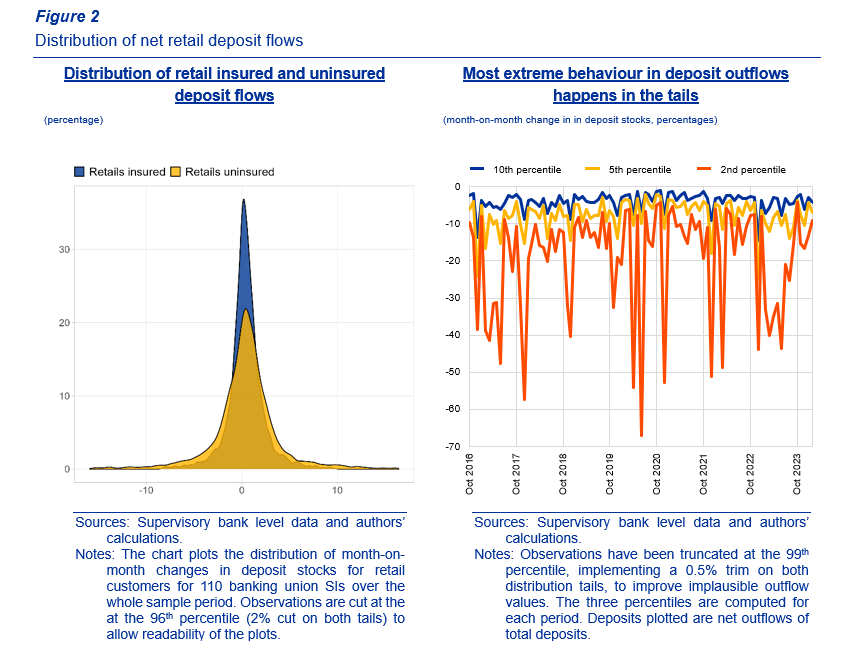
The distribution of net deposit flows is concentrated around 0, but with long tails. Figure 2, left panel shows this distribution for bank-level data of net retail insured (blue) and uninsured (yellow) deposits flows for the period for which supervisory data on deposits is available, i.e. October 2016-December 2024, for the banks directly supervised by the ECB.1 The long tails indicate that indeed extreme flows are rare events. The most severe net outflows can be identified in the 2nd percentile of the distribution, as shown in the orange line in Figure 2, right panel. Particularly during the pandemic (2020Q2), monthly net outflows amounted to up to 70% of deposits. Fascione et al. (2024) provides a detailed descriptive take on the data.
To develop a measure of mobile banking app use, we web-scrape data from Google Play Store (the app store used on Android hand-held devices) and come up with two measures of mobile app use. One continuous variable captures the cumulative app reviews on Google Play over time for the period 2016-2024 and one binary variable switching to 1 when a bank’s mobile app has its first review (approximating the launch time of a bank’s mobile app). In addition, Eurostat data on the use of online banking services is available only annually and at the country level, which is why we mainly use it to compare outflows for the same banking group if it operates in more than one country. Bank-level information on mobile app availability and Eurostat data on online banking use allow us to assess the impact of the availability of an app and the use of online banking on the size of deposit outflows.
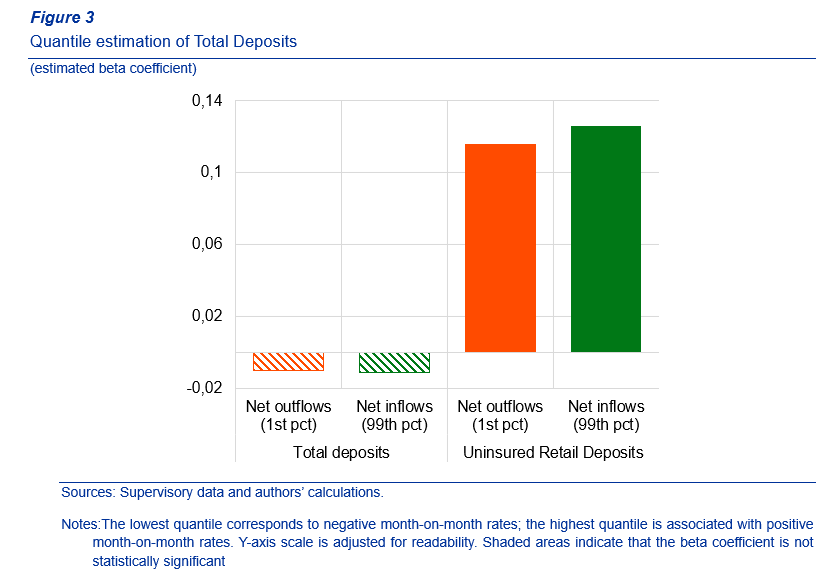
Does the availability of a mobile banking app make deposits more mobile? In a first stage regression we try to answer the question with monthly deposit flow data at the banking group level, which is regressed on typical bank level characteristics (total assets and change in return on assets), bank and time fixed effects, and the binary variable which indicates whether a bank offers a mobile banking app service. The bank fixed effects capture unobserved bank-specific characteristics. We repeat this exercise for different categories of deposits, namely total deposits, uninsured and insured retail deposits. We find an amplification effect of having a mobile banking app only for uninsured retail deposit flows, at both tails of the distribution (Figure 3). In addition, results confirm that larger banks face lower deposit flow volatility, i.e. lower outflows in bad times and lower inflows in good times. This size effect is consistent and significant across all types of deposits.
However, this simple type of regression analysis may only capture the digitalisation effect partially. Using just information on app availability, we cannot measure whether customers actually use the app. Another confounding factor may be a changing digital literacy in the customer base.
We thus use EU data on online banking use and deposit flow data at the bank-country breakdown to complement the analysis based on app use only. First, Eurostat collects annual data on the use of online banking. This data provides us with cross-country variation which we can use for identification. Crucially, second, we match the online banking use data with deposit flow data at the bank-country breakdown. Specifically, this allows us to compare deposit outflows for the same bank in different countries. In addition, the share of the population using online banking is a continuous measure such that we can identify a marginal effect. Importantly, we can control for any bank-specific characteristics including those which may vary over time, except for when they change between countries (including, for instance, the composition of the customer base).
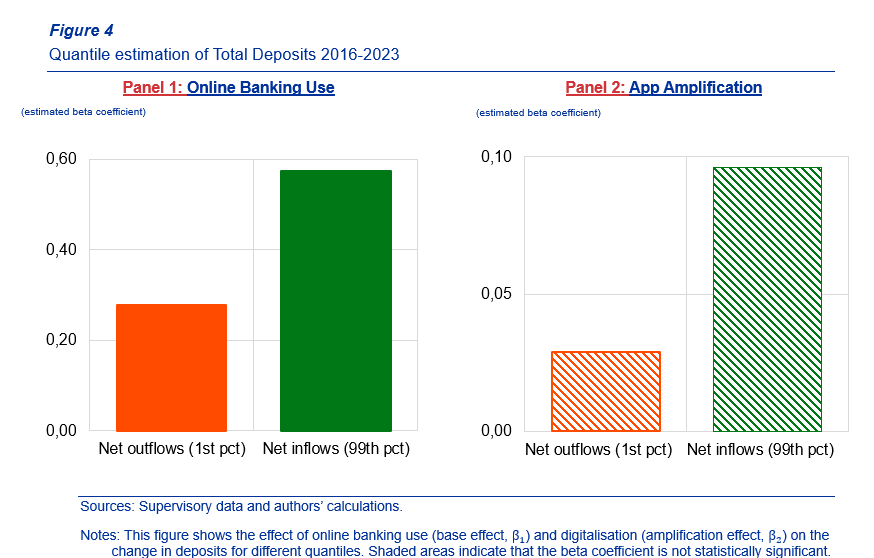
Our findings indicate that an increased use of online banking services amplifies severe deposit outflows, but this effect is not further exacerbated by the availability of a mobile banking app. Specifically, outflows increase by around 0.28 percentage points for a 1 percentage point increase in online banking use for the first percentile of the distribution (Figure 4, Panel 1). The effect approximately halves to 0.16 percentage points at the fifth quantile of the distribution. While having a mobile banking app could amplify the effect of online banking use, the coefficient is not statistically different from zero for any part of the distribution (Figure 4, Panel 2).
We conduct a case study for German savings banks, for which a regional breakdown of online banking use is available, for which the customer base is very homogeneous, and all of which use the same unique app. This case study can gauge the possible impact of online banking use excluding the potential bias from between-country customer base changes and/or from different app design. Importantly, results for the case study are very similar to the cross-country results, yielding similar and significant coefficients for the amplification effect of online banking use.
Following the March 2023 banking turmoil, information-sharing on both private chat groups and X (formerly Twitter) about Silicon Valley Bank has been identified as a key driver of precipitous deposit outflows which, ultimately, led to its failure. To investigate this channel, we draw from two different approaches to approximate social media coverage using Bloomberg data. First, we use the number of tweets which mention the name of a specific bank on X during a certain month. This indicator can be interpreted as a measure of how strongly news about a specific bank get amplified. Second, we use the average sentiment regarding a specific bank expressed on X tweets during a given month. This second measure can be interpreted as a reflection of a more sustained negative or positive sentiment about a bank, reflecting, for instance, the disclosure of financial statements.
While we do not find a causal effect of social media on deposit flows neither during normal times nor during stress episodes, the results have to be interpreted with a grain of salt since they are based on monthly data.
To make our results comparable with existing studies on the US banking system, we also estimate the interest rate sensitivity of deposits. US studies, among others Koont et al. (2024), find that interest rate sensitivity has increased with digitalisation. Specifically, Koont et al. (2024) find that deposit growth slows when interest rates rise, and that this effect is stronger for more digital banks. We use two approaches to gauge whether there are similar effects in the EU. Specifically, we classify banks as more or less digital based on (i) data on digital interactions for a small sample of banks, collected by the ECB and (ii) the dummy on app availability for the larger sample of banks. Our evidence indicates that also for EU banks, the sensitivity of changes in deposit flows to changes in long-term interest rates is higher for more digital banks, with coefficients similar to the findings in Koont et al. (2024).
Our study confirms that digitalised banking services moderately amplify severe deposit flows. Empirically, it appears that the customers’ use of online banking is a more relevant predictor than the mere availability of a mobile banking app, which is often used in existing studies. Importantly, this evidence is derived from data covering a period that has not seen severe deposit runs or full-scale banking crises. As such, the potential impact of social media and digitalisation may have not yet been fully tested in Europe. Finally, further research is needed to better measure the multifaceted aspects of digitalisation with comparable bank-level data to better understanding its effects. The International Banking Research Network (IBRN) has launched an international initiative to better understand the impact of digitalisation on banking.
While Figure 2 shows deposit flows derived from monthly supervisory data, we also draw on a different supervisory data template which collects information on deposits at quarterly frequency. The latter have somewhat wider and flatter tails, which is due to the fact that the monthly data is consolidated at the bank group level, while the quarterly data is consolidated at the bank and country level.