

This policy brief is based on the Deutsche Bundesbank Discussion Paper No 19/2026 “Long-term implications of a digital euro on liquidity and funding costs in the German banking system”. The views expressed in this policy brief are those of the authors and do not necessarily reflect those of the Deutsche Bundesbank.
Abstract
The digital euro (D€), envisaged as a retail central bank digital currency, would establish an efficient addition to the European payment landscape. It is designed to boost autonomy, resilience and inclusion of the European payment sector. This study assesses its long-term implications and alleviates concerns regarding potential negative effects on liquidity and funding costs in the German banking system. Using a theoretical model calibrated to German banks, we find that the impact of a D€ on funding costs and liquidity is contained, in particular with holding limits imposed as an important design feature. For a holding limit of €3,000 per person, the return on equity (ROE) for German banks decreases by between 0.03 percentage points (PP) in the favourable scenario and 0.2 percentage points in the most adverse scenario due to higher funding costs, while the aggregate Liquidity Coverage Ratio (LCR) declines by between 4 PP and 7 PP. The effects differ across banking groups. They are smallest for commercial banks, which rely less on retail deposits, whereas retail banks face stronger deposit outflows. These outflows can, however, be partly offset by adjusting liquidity buffers and, for institutions belonging to banking associations, by accessing wholesale funding through their central institutions.
The Eurosystem launched the D€-project, aimed at developing a retail central bank digital currency for the euro area, in October 2021 with a two-year investigation phase, which led to an initial design concept and informed the European Commission’s legislative proposal of June 2023. Following a preparation phase that began in November 2023 and focused on technical testing, the project entered a new phase in November 2025. This phase aims to prepare the Eurosystem for a possible issuance of a digital euro in 2029. However, a D€ could only be issued once the EU legislative process has been completed, currently expected by the end of 2026, and a corresponding legal framework is in place.
While the D€ could strengthen efficiency, autonomy and financial inclusion, it would also allow euro area residents to convert bank deposits into digital central bank money. Such deposit substitution could have implications for banks’ liquidity and funding costs. To address these concerns, the European Commission’s legislative proposal allows the ECB to impose holding limits on individual D€ balances as a store of value.
Our study contributes to this debate by analysing the long-term implications of a D€ for funding costs and liquidity in the German banking system. We examine how banks may respond to D€-induced deposit outflows by either drawing down their liquidity buffers or adjusting their mix of retail and wholesale funding. Using an optimisation approach, we simulate the effects on banks’ funding costs, profitability and liquidity under different market conditions, holding limits and interest rate environments.
Our analysis is deliberately partial in scope and does not account for certain potentially mitigating aspects. In particular, we abstract from positive effects on profitability, such as gains through new business opportunities associated with a D€, as discussed in Cipollone (2025). In fact, we assume banks’ lending remains constant and is separable from banks’ funding decisions as posited by Arping (2017). We do not explicitly model the role of the central bank, such as banks’ access to additional liquidity through central bank funding operations to compensate for liquidity outflows into a D€. Instead, our focus is on the structural adaptability and resilience of the banking system to the introduction of a D€ through adjustments in private funding. Accordingly, the estimated impact on profitability and liquidity should be interpreted as conservative.
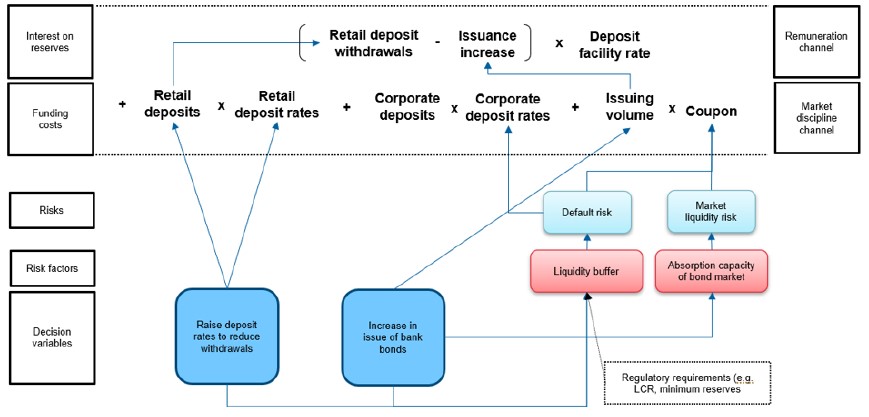
Banks therefore face a trade-off. Using existing liquidity buffers to service liquidity outflows into a D€ avoids the immediate need to raise more expensive funding and can therefore support profitability. However, drawing down liquidity buffers to low levels (yet still above the regulatory minimum requirements) increases the perceived risk of illiquidity and may be priced by creditors through higher funding costs. This market discipline channel is particularly relevant for holders of corporate deposits and investors in bank bonds. First, they must be compensated for credit risk, as these instruments are not subject to deposit protection in the same way as insured deposits. Second, bank bonds may be exposed to market liquidity risk.1 At the same time, the remuneration of central bank reserves affects banks’ incentives to preserve liquidity: the higher the return on liquidity holdings, the more costly it becomes for banks to draw down their buffers. Banks can mitigate deposit outflows by raising retail deposit rates or by issuing bonds to obtain longer-term funding, including from international capital markets. Available options are not mutually exclusive and determine how the initial outflow is split between a drawdown of liquidity buffers and adjustments in the funding mix. The optimal response depends on the relative costs of retaining deposits, accessing the bond funding market and reducing liquidity buffers. The following figure illustrates the decision-making processes of banks and the transmission channel at play.
Figure 1. Conceptual overview of banks’ decision-making
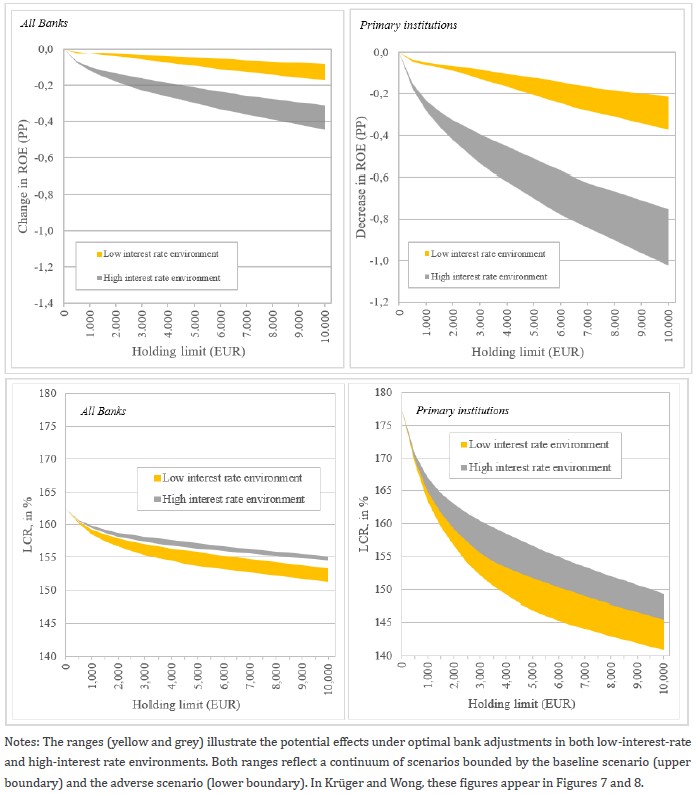
Our results suggest that the long-term impact of a D€ on the German banking system is contained, especially if holding limits are introduced. For a holding limit of €3,000 per person – a figure widely discussed among regulators – the return on equity (ROE) for German banks decreases by between 0.03 percentage points (PP) in the favourable scenario and 0.2 percentage points in the most adverse scenario, while the aggregate Liquidity Coverage Ratio (LCR) declines by between 4 PP and 7 PP; see below figures.
The effects are not uniform across banking groups. Commercial banks, which rely less on retail deposits, experience minimal impact. The potential outflows for retail banks, which depend heavily on retail deposits, are to a certain degree more pronounced. These banks, however, have greater flexibility to adapt than commercial banks by reducing their liquidity buffers, as their funding models rely less on wholesale funding and are therefore less exposed to market-discipline effects. Interestingly, the simulations show that smaller retail banks within banking associations (primary institutions) can leverage their central institutions to access wholesale funding. This allows them to mitigate adverse effects on profitability.
The simulated effects on ROE are somewhat more pronounced in a high-interest-rate environment than in a low-interest-rate environment. This is mainly driven by the limited variation in empirically observed retail deposit rates for primary institutions across interest rate environments, which is carried through to the model via the empirical inputs. As a result, the relative attractiveness of the D€ and thus the market discipline channel is of similar magnitude across environments, while the additional loss of reserve remuneration (remuneration channel) in a high-rate setting adds to the negative impact on ROE.
Across scenarios, banks limit D€-induced deposit outflows only to a limited extent by raising retail deposit rates. Given the large stock of retail deposits, even small permanent increases in deposit rates would materially raise funding costs. Moreover, depositors’ interest rate sensitivity is relatively low, implying that banks would need to offer substantially higher rates to retain a significant share of deposits. Consequently, issuing additional market funding appears to be the more relevant adjustment channel than broad-based increases in retail deposit rates.
Figure 2. Effects on profitability and LCR buffers under alternative holding limits
The study shows that the introduction of a D€ would require banks to adjust their liquidity buffers and funding structures, but its overall long-term impact on funding costs and liquidity appears limited, even under adverse assumptions, especially with holding limits imposed as an important design feature. A holding limit in the range of €3,000 appears to mitigate adverse effects while preserving the D€’s role as a payment instrument. However, effects differ across banking groups: retail banks are more exposed to deposit outflows but also have greater flexibility to adapt by reducing their liquidity buffers, while commercial banks are less affected due to lower reliance on retail deposits. Policymakers should maintain comprehensive oversight during and after the introduction of the D€ as the resilience of the banking system to liquidity shocks depends on the adequacy of existing liquidity buffers.
Arping, S. (2017), Deposit competition and loan markets, Journal of Banking and Finance, Volume 80, July 2017, Pages 108-118.
Bidder, R., Jackson, T. and Rottner, M. (2024), CBDC and banks: Disintermediating fast and slow, Deutsche Bundesbank Discussion Paper, No 15/2024.
BIS (2021), Central bank digital currencies: financial stability implications, Report No 4, September 2021.
Cipollone, P. (2025), The role of the digital euro in digital payments and finance, Contribution to Bancaria by Piero Cipollone, Member of the Executive Board of the ECB, based on remarks at the Crypto Asset Lab Conference on 17 January 2025, 28 February 2025, retrieved from https://www.ecb.europa.eu/press/inter/date/2025/html/ecb.in250228~7c25c90e4d.en.html.
Krüger, U., & Wong, L.-H. (2026). Digital Euro: Long-Term Implications for Liquidity and Funding Costs in the German Banking System. Deutsche Bundesbank Discussion Paper, 19/2026.
Meller, B., & Soons, O. (2023). Know your (holding) limits: CBDC, financial stability and central bank reliance. ECB Occasional Paper Series, No. 326.
Bond yields are modelled as increasing with banks’ aggregate issuance volume, reflecting the bond market’s limited absorption capacity. This introduces strategic interdependencies and turns each bank’s optimisation problem into a game-theoretic one.
Depositor preferences are derived from Deutsche Bundesbank’s Survey on Consumer Expectations of German households. For further details see Bidder, Jackson and Rottner (2024).