

This policy brief is based on OECD Economics Department Working Paper No. 1870. OECD Working Papers should not be reported as representing the official views of the OECD or of its member countries. The opinions expressed and arguments employed are those of the authors.
Abstract
Demographic headwinds are set to weaken economic growth in OECD countries over the coming decades. At the same time, artificial intelligence (AI) provides opportunities for productivity gains, potentially alleviating labour shortages and boosting economic growth. However, little is known about how ageing may affect AI deployment and its economic impact. Workers’ overall exposure to AI (automation and augmentation) exhibits an inverted U-shaped pattern across age groups, albeit less pronounced when controlling for education, occupation and country. Exposure to automation is higher in younger age groups and declines rapidly with age, as experience tends to complement AI. Nevertheless, as a general-purpose technology, AI is bound to be disruptive. Reaping its benefits will require labour market reallocation, reskilling and upskilling, and business dynamism and innovation, which may all be weaker in ageing societies.
Population ageing is set to weigh on economic growth in most OECD countries over the coming decades. The associated fall in the employment-to-population ratio between 2021 and 2050 could lower GDP per capita by up to 0.8 percentage points per year in some economies, unless it is compensated by higher employment rates or stronger productivity growth (André, Gal and Schief, 2024a). At the same time, AI broadens the range of cognitive tasks that can be performed by computers and brings prospects of further productivity gains by augmenting human capabilities. Although AI’s impact on productivity remains highly uncertain, recent estimates suggest that an AI adoption speed similar to that of previous ICT technologies, such as computers and the internet, could result in an increase in annual GDP per capita growth over the next decade by up to more than one percentage point in some countries (Filippucci et al., 2026). However, little is known about how the age structure of the population may affect AI’s diffusion and impact on the economy.
In André and Schief (2026), we provide early insights on the potential relationship between ageing and AI. First, building on earlier OECD work (André, Gal and Schief, 2024b; Filippucci et al., 2026), we show that OECD countries face diverse challenges and opportunities due to differences in demographic developments and AI potential. Second, we use data from the latest cycle of the OECD Survey of Adult Skills (Programme for the International Assessment of Adult Competencies, PIAAC) to build a measure of exposure to AI across age groups, distinguishing between exposure to automation and to augmentation. Third, we examine factors that could affect the ability of ageing societies to respond to potential AI-induced disruptions, including lower labour mobility, less reskilling and upskilling, and weaker business dynamism and innovation.
Figure 1 maps OECD countries according to the speed at which their population is ageing and their projected productivity gains through the adoption of AI over the next decade. Countries in the top-right quadrant, including the United States, Canada and the Nordic countries, enjoy relatively favourable working-age population growth and AI potential, which offers them the opportunity to use AI to enhance productivity in existing tasks and to develop new applications that generate labour demand in new tasks. Countries in the top-left quadrant, including Austria, Germany, Japan and Korea, face demographic headwinds but have high AI potential. Many of these countries have a high share of science, technology, engineering and math graduates, which should further help them speed up AI adoption. Nevertheless, they may still face skills shortages, hampering AI adoption, notably in SMEs. There is also a risk that lower business dynamism in ageing societies slows AI adoption. Countries in the bottom-right quadrant, mainly in Latin America, display relatively low AI potential, but working-age population growth should allow them to continue growing even without wide AI adoption. However, if AI spreads rapidly globally and brings significant productivity gains, low adoption may lead to a loss in competitiveness. Countries in the bottom-left quadrant, mainly in Central, Eastern and Southern Europe, face both demographic headwinds and low AI potential. However, as AI is in constant evolution, with huge uncertainties about the future capabilities of AI to perform increasingly complex cognitive tasks, as well as to transform the physical world through progress in robotics, the current assessment of AI potential is only tentative and countries currently lagging in AI adoption could catch up.
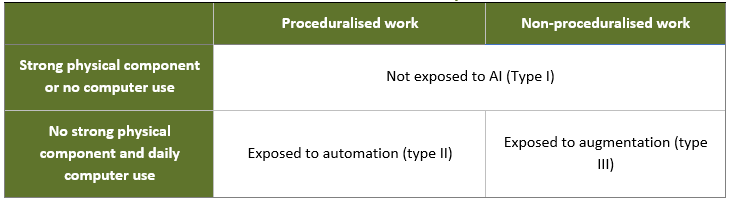
To assess the potential impact of AI on workers of different ages, we construct a new index of AI exposure at the individual level, using the latest vintage of PIAAC data. We distinguish between individuals that are exposed to AI (types II and III) and those that are not (type I) using information about two broad aspects of their job: the presence of a strong physical component and the daily use of computers or other electronic devices (Table 1). Responses indicating the degree to which work is proceduralised versus context dependent are used to differentiate between exposure to automation versus augmentation. Proceduralised work refers to activities whose essential functions can be codified into relatively stable and well-defined sequences of actions performed within a relatively rigid production process (for example, standard insurance claim processing or legal document drafting). By contrast, context dependent work is not fully specified ex ante, and the sequence of tasks must often be adapted in real time to changing circumstances, involving human judgement (for example, project management under changing constraints).
Figure 1. The impact of ageing and AI potential vary widely across countries
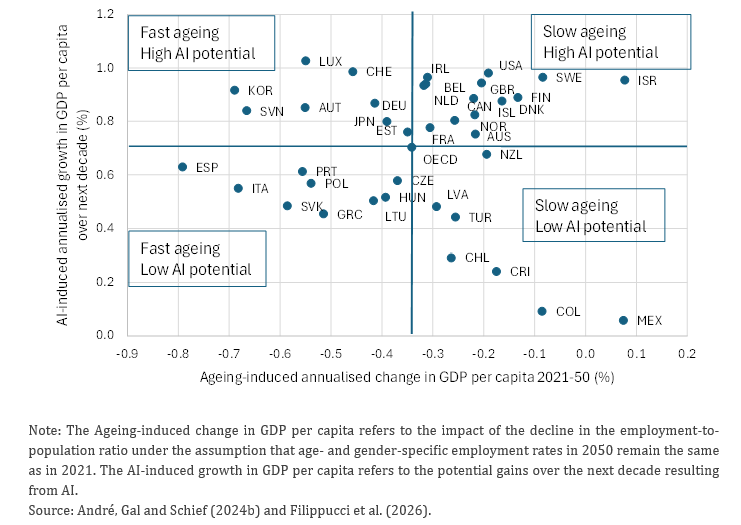
Table 1. A classification of AI exposure
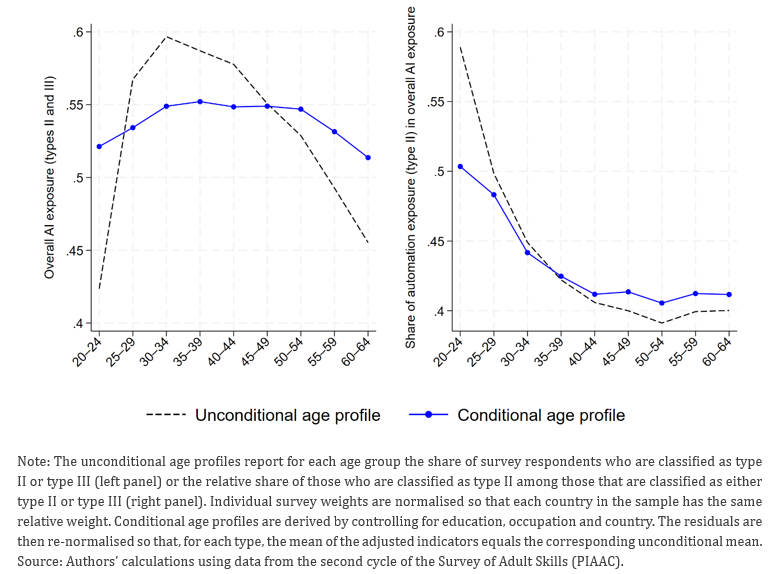
Our overall (automation and augmentation) exposure to AI indicator exhibits an inverted U-shaped pattern across age groups (Figure 2, left panel). However, this pattern is less pronounced when controlling for education, occupation and country, pointing to the role of differences across cohorts in education and occupational choices in explaining differences in AI exposure between age groups. Exposure to automation is highest in younger age groups and declines rapidly with age, with middle-aged and older workers less exposed to substitution as their experience tends to complement AI (Figure 2, right panel). Exposure to automation remains similar when controlling for education, occupation and country, suggesting only minor influence of cohort effects. The strong exposure of youth to automation is in line with the weak entry-job creation in AI-exposed sectors observed recently in the United States (Brynjolfsson, Chandar and Chen, 2026) and several other OECD countries (see references in André and Schief, 2026), even though factors other than AI also seem to be at play (Tucker, 2026).
Figure 2. AI exposure exhibits strong age profiles in the PIAAC data
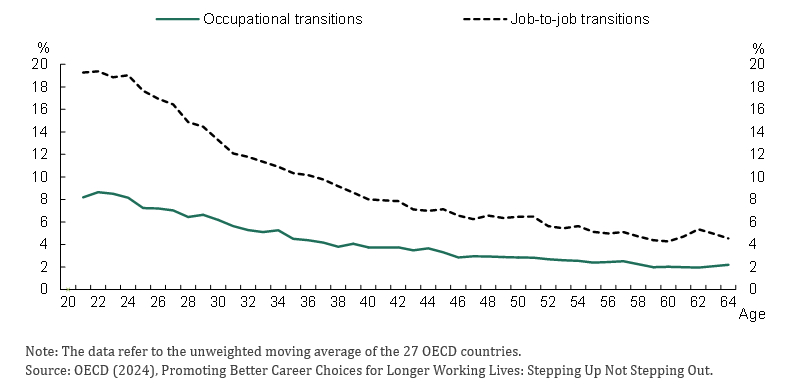
Our analysis suggests older workers are less vulnerable to AI-induced displacement than younger individuals. The technology could even help lengthen working lives if it improves job quality by reducing repetitive tasks and facilitating skills updating, which could alleviate labour shortages. Nevertheless, as a general-purpose technology bound to affect a wide range of economic activities, AI may require higher labour mobility than in the past, which may be challenging in ageing societies, as mobility tends to decline sharply with age (Figure 3). This increases the importance of policies that support individuals through work transitions, notably through reskilling and upskilling. Business dynamism and innovation will also determine the ability of economies to reap the potential benefits from AI but may be weaker in ageing countries. For example, slowing workforce growth has been linked to declining firm entry rates in the United States (Karahan et al., 2024). Altogether, AI may offer opportunities for ageing societies to at least partly offset the demographic drag on economic growth. However, this will require overcoming major challenges in lifelong learning, labour reallocation, and business dynamism and innovation.
Figure 3. Labour mobility falls steeply with age
Job-to-job and occupational transitions over the life cycle, average of selected OECD countries, 2017-2020
André, C., P. Gal and M. Schief (2024a), “Enhancing productivity and growth in an ageing society: Key mechanisms and policy options”, SUERF Policy Brief, No. 960, https://www.suerf.org/publications/suerf-policy-notes-and-briefs/enhancing-productivity-and-growth-in-an-ageing-society-key-mechanisms-and-policy-options/.
André, C., P. Gal and M. Schief (2024b), “Enhancing Productivity and Growth in an Ageing Society: Key Mechanisms and Policy Options”, OECD Economics Department Working Papers, No. 1807, OECD Publishing, Paris, https://doi.org/10.1787/605b0787-en.
André, C. and M. Schief (2026), “A potential boost from AI in ageing societies: Early insights”, OECD Economics Department Working Papers, No. 1870, OECD Publishing, Paris, https://doi.org/10.1787/be002e40-en.
Brynjolfsson, E., B. Chandar, and R. Chen (2025, revised 2026), “Canaries in the Coal Mine? Six Facts about the Recent Employment Effects of Artificial Intelligence”, Stanford Digital Economy Lab, https://digitaleconomy.stanford.edu/publications/canaries-in-the-coal-mine/.
Filippucci, F., P. Gal, K. Laengle, M. Schief and M.A. Yildirim (2026), “AI meets trade: Global linkages and the cross-country distribution of the gains from AI”, OECD Artificial Intelligence Papers, No. 57, OECD Publishing, Paris, https://doi.org/10.1787/13081644-en.
Karahan, F., B. Pugsley and A. Şahin (2024), “Demographic Origins of the start-up Deficit”, American Economic Review, 114(7), 1986-2023, https://doi.org/10.1257/aer.20210362.
OECD (2024), Promoting Better Career Choices for Longer Working Lives: Stepping Up Not Stepping Out, OECD Publishing, Paris, https://doi.org/10.1787/1ef9a0d0-en.
Tucker, L. C. (2026), “You’re (not) Hired: Artificial Intelligence and Early Career Hiring in the Quarterly Workforce Indicators”, Working Paper CES-26-27, US Census Bureau, Center for Economic Studies, https://www.census.gov/library/working-papers/2026/adrm/CES-WP-26-27.html.