

The views expressed are those of the author and do not necessarily reflect those of the institutions he is affiliated with. He is grateful for feedback on an earlier draft from Darrell Duffie, Larry Wall and Richard Senner and for comments and careful proofreading by David McNulty. He is responsible for all remaining errors and omissions.
Abstract
This note challenges the widespread perception that tokenization of financial assets on new programmable ledgers is necessary for improving the efficiency of global financial market operations. Benefits attributed to tokenization – the use of ‘programmability’ for faster settlement, automation, transparency and improved liquidity management – do not require assets to be moved onto new ledgers. They can be more practically achieved by the direct holding of money and securities on the existing authoritative central records of issue; combined with their direct control using cryptographic keys and wallet-based services for transfer initiation and automated exchange. Examining intraday liquidity, foreign exchange, overnight funding, repo and securities transactions, the paper argues that directly held and controlled assets offer the surer route to market modernization.
This note challenges the widespread perception that ‘tokenization’ of financial assets – the transfer of financial assets onto decentralized programmable (or distributed) ledgers – is necessary for efficiency-enhancing innovation in global financial market operations.
Claims for the benefits of tokenization are prominent in global regulatory policy discussion and supported by many leading industry figures. Tokenization projects have moved beyond proof of concept with major implementation initiatives now launched, most notably the DTCC US Treasury tokenization project and the ECB distributed ledger projects Pontes and Appia.1 The envisaged gains are substantial: faster and more reliable settlement, less time and resources devoted to manual trade reconciliation, greater transparency, more efficient use of collateral and cash, 24/7 liquidity management, and the automation and coordination of complex transactions. These are all desirable ends. These discussions have, however, paid little attention to some key questions. Does achieving these ends necessarily require tokenization? Are there perhaps other, better ways of achieving these ends?
It should also be recognised that the core operational problem in global financial markets is not that financial assets are insufficiently digital or are not programmable. Most money, and almost all securities, are already held digitally. Computers can be programmed to make automated transfers on existing ledgers. The problem is the fragmentation of ownership records, transaction systems and intermediary balance sheets – with multiple layers of ownership (“tiering”) and reliance on manual interventions to fulfill transfer requests.
Tokenization is one way of addressing this fragmentation, but it is not the only one. This note presents an alternative, Ultimate owners: (i) directly hold money and securities on the authoritative records that determine ownership – i.e. central bank accounts for money and accounts at central securities depositories (CSDs) for securities;2 and (ii) directly control transfers using private cryptographic keys, managed through wallet services.
Proponents of tokenization can, with justification, argue that this direct ownership and control is exactly what tokenization seeks to achieve. This though leaves open the question of whether this is better achieved by moving assets onto new decentralized programmable ledgers, i.e. tokenization; or while retaining assets on existing ledgers.
Direct ownership and control changes the responsibilities of banks, custodians, broker-dealers and other intermediaries. These institutions would continue to provide the same essential services as they do today: trade execution, credit provision, regulatory reporting and compliance, tax administration, corporate actions and advice. They would no longer provide inessential services, consequential on tiered ownership arrangements: maintaining records of legal ownership and authorization of transfers.
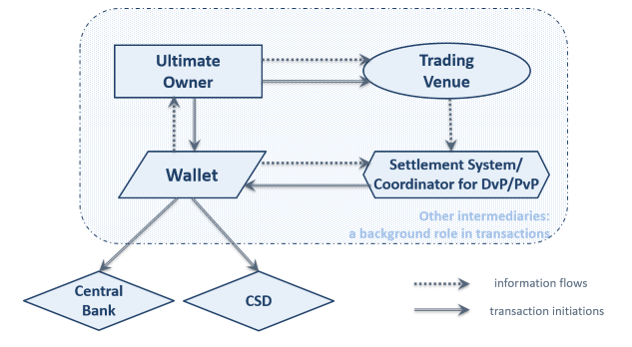
Figure 1 illustrates the resulting arrangement. The benefits attributed to tokenization do not require decentralization or moving assets onto new shared ledgers. They can be achieved with direct holding, cryptographic control and automated coordination on existing ledgers. Indeed, as discussed below, this route may be more achievable because it can build on existing infrastructures and be introduced in stages.
Figure 1. Direct Holding and Control
A final introductory remark. There are many capable professionals working on tokenization projects (including those of the DTCC and the ECB). They may well argue that, now we have started on the tokenization route to direct ownership and control, it will be best to stick to the plan. The issue addressed in this note is that there is no overall plan. To draw an analogy: it would be unwise, in a major building renovation, to first call in tradesmen to construct new rooms, passageways and facilities; and only later employ an architect to deliver the overall design. Current tokenization initiatives are uncoordinated and address only narrow niche use cases. This note presents an alternative and argues this will more effectively address the market-wide problems of tiering and fragmentation.
The remainder of this note is set out as follows. Section 2 discusses some conceptual and practical problems with tokenization. Section 3 sets out more fully the arrangements proposed in this note: direct holding and control of financial assets. Section 4 looks at some practical consequences in liquidity management and securities markets. Section 5 is a concluding summary.
A motivation for “tokenization” is the much greater operational efficiency, when compared to traditional established finance, observed in the newly emerged arrangements for transactions of crypto assets in decentralized finance. The interest is understandable. The potential cost savings and efficiency gains are large. There have been dozens of official and industry reports and a growing number of trials and live tokenization projects by major financial institutions.3 Central banks and other authorities are nevertheless devoting substantial resources to experimentation, including work on the settlement of transactions on distributed-ledger platforms against central bank money.4 Yet the scale is still very small relative to global markets. A recent industry review put cumulative tokenized fixed-income issuance over 2021-2025 at around $8 billion, against a global bond market measured in well over $100 trillion.5
Discussion of these new technologies is however clouded by terminological difficulties and conceptual confusions.6 Tokenization has a relatively clear meaning in decentralized finance: assets are represented as digital tokens on permissionless ledgers, and software operating on those ledgers can transfer them and enforce contractual rules. This is an essential part of decentralized finance because, by design, decentralized finance has no role at all for intermediaries and agreement on asset transfers is only possible through blockchain consensus protocols such as proof of work or proof of stake. Ethereum (which now uses proof of stake) provides the best-known example, with standard interfaces for token creation and transfer;7 and with applications able to combine trading, borrowing, collateral and liquidation in a single programmable environment.8
Problems arise when the term tokenization is extended from decentralized finance into regulated finance, where it is used in a much less precise way covering a wide variety of possibilities. The Bank for International Settlements has been especially influential in encouraging interest in tokenization, arguing that programmable ledgers can deliver the benefits of tokenization, combining central bank money, bank deposits and other assets on a common infrastructure.9 However, a later BIS/CPMI report acknowledges that tokenization has no generally accepted definition.10
More generally applying the language of decentralized finance to traditional financial assets leads to confusion. Reference is often made in discussion of tokenization initiatives to jargon carried over from decentralized finance, for example: atomic settlement; keeping assets ‘on chain’; consensus protocols; the use of atomic swaps to manage transactions involving more than one blockchain; without any explanation of what these terms mean – if they mean anything at all – in the very different context of holding traditional regulated financial assets. Different innovations are bundled together under the banner of ‘tokenization’ without careful examination of what elements actually deliver the anticipated benefits. As a result: there is misunderstanding of how tokenization delivers its proposed benefits; and possible alternatives are inadequately discussed.
Traditional finance is essentially different from decentralized finance. Financial assets must be linked to real-world identities to comply with legal, regulatory and financial-crime obligations. Intermediaries are needed to perform regulated functions and to aid market participants who do not want to do everything themselves. Authorities take responsibility for the integrity of the system.
The question is therefore not whether traditional finance should reproduce decentralized finance without intermediaries. The question is what features of modern data technology – including those applied in decentralized finance – can improve the efficiency of regulated finance with continued involvement of intermediaries.
A key point is the following. The operational benefits being sought do not depend on creating a new representation of the asset on a new ledger. Most financial assets are already digital. Existing databases can be programmed. Software can coordinate transactions across more than one infrastructure. What prevents full automation is principally that information and control are fragmented: the cash is in one place, the securities in another, while trade information can be in a third; as a result, several intermediaries have to exchange messages before assets can move.
Tokenization tries to solve this by bringing assets and transaction logic together on a single shared programmable platform. That can work technically. But it is only one way of reducing fragmentation. As the following section discusses, if the underlying asset is directly held on the authoritative record and the owner can directly authorize its movement, the problem of fragmentation is addressed without employing a new asset-holding technology.
There are also specific problems associated with decentralization. As often noted, it is challenging to handle the speed and volume of transactions in traditional finance, using the necessarily slow process of blockchain consensus required in permissionless distributed ledgers. More generally, decentralised ledgers are inherently less efficient than centralized ledgers, because of the need to co-ordinate change when the database is held in multiple places without a single ‘golden record’.
An alternative distributed ledger architecture, so called permissioned distributed ledgers, addresses further deficiencies that rule out the use of permissionless distributed ledgers in traditional finance. These ledgers use the same underlying software as permissionless ledgers (for example the Ethereum and in particular its ERC-721 non-fungible token standard that supports cryptographic control of asset transfers). They do not however require blockchain consensus mechanism, instead the ledger is controlled by one or more identified institutions, who also implement agreed rules governing who can participate and who can update data.
These permissioned distribute ledgers can range from genuinely distributed validation across several entities to arrangements that are decentralized in little more than name.11 Permissioned ledgers sit on a continuum ranging from what is hardly different from traditional centralized architectures at one end to collaborative structures with multiple participating intermediaries. Governance questions about who manages the ledger, who validates changes, who supplies software and who bears liability are central; but these are separate from the subject of this note, the opportunity for assets owners to directly hold and securely authorize and control transfers on the ledger. Having this software reside on the same platform as the data, as permissioned distributed ledger solutions require, could be an unnecessary centralization limiting participants choice of software solutions and thus creating barriers to innovation.
A further practical objection – a well-known issue in financial technologies that has been largely ignored in the enthusiasm for tokenization – is the risk of non-adoption. The point here is not that the technology cannot work. It is that a new financial infrastructure is only useful if enough of the market adopt it. There is a familiar network problem. An innovative platform may offer substantial benefits and still fail to reach viable scale because each participant has a reason to wait for others to join first. The economics of two-sided platforms and payment systems provides a large literature on precisely this ‘chicken and egg’ problem.12
The problem is acute in financial markets because adoption costs fall on individual institutions, while many of the benefits – e.g. greater liquidity – accrue to the market as a whole. A bank, broker-dealer or custodian must spend money changing internal systems, operational procedures, legal documentation and risk controls. It then obtains only part of the benefit from industry-wide adoption. There is consequently a strong incentive to wait, observe the experience of early movers, and invest only once the new arrangements have clearly succeeded.
These limited incentives for adoption explain why the history of financial infrastructures offers few examples of rapid voluntary migration onto radically new arrangements.13 Major changes have generally occurred because the existing system was demonstrably intolerable or because authorities imposed a common timetable. The transformation of US securities processing after the paperwork crisis of the late 1960s is one example; the recent mandatory move from T+2 to T+1 settlement is another. Mobile money in parts of Africa and Asia is a further example: rapid adoption occurred because the existing payment services left major needs unmet. Global wholesale markets today are not in that position. Existing arrangements in global financial markets are cumbersome and costly, but they work well enough to weaken the incentive for a migration.
This suggests that there are two possible outcomes from current programs of tokenization: neither particularly attractive. The first is limited adoption: tokenized assets remain a niche alongside conventional assets and have little effect on overall market efficiency. The second may be worse: partial adoption creates an additional layer of fragmentation, with some assets and transactions on new platforms and others continuing through the old custody, payment, clearing and settlement chains. The technology intended to reduce reconciliation, and complexity could then increase both.
Authorities could, of course, mandate a complete migration. But once compulsion is contemplated, the question changes. It is no longer whether private firms will choose tokenization because it is obviously superior. It is which industry-wide ledger infrastructure authorities should require market participants to use. Before imposing a wholesale change, alternative ways of addressing fragmentation must therefore be compared. Directly held and controlled assets are one such alternative.
The alternative presented in this note can be stated without the terminology of decentralized finance e.g. phrases such as ‘on-chain’ and ‘off-chain’. It has just two elements:14
Direct holding is not a novel proposal. It is already available for securities in some jurisdictions, in so called individually segregated accounts at central securities depositories. It has been explored, in various guises, in a number of initiatives that widen access to central bank money.15
This direct holding can be for retail clients, not just large investors, though that might not be introduced initially. It could initially apply to insurers, pension funds, investment funds, hedge funds, sovereign wealth funds and other professional investors. Intermediaries such as commercial banks, custodian banks and broker-dealers would relinquish their roles maintaining records of ownership and transaction execution; but would continue to provide other services, much as they do now.
Direct control can be implemented through wallet-based public-private key cryptography. A private key is a secure digital credential proving that a particular instruction has been authorized by the person or institution entitled to give it. A wallet is the software and service layer that manages those credentials and presents the information needed to use them. There is nothing intrinsically ‘crypto’ about applying this technology to conventional assets. Public-private key cryptography is a standard tool for secure communications and digital signatures.16
Figure 1, in the introduction, illustrates. Transfers require a combination of information flows and initiations. Initiation can be a push initiation by the asset holder, or it can a pull initiation by a settlement system or settlement co-ordinator (which can simultaneously pull both sides of a trade to ensure delivery against payment).17
This change offers direct practical benefits. Consider an asset manager buying a security for one of its funds. At present the asset manager executes the trade through a broker, but the cash and securities are typically held with a custodian. Settlement therefore depends on messages and reconciliations across several organizations. The broker may be legally responsible for settlement even though it does not control the client’s cash or securities. It must bridge any timing gap, adding to its own liquidity needs.
With directly held and controlled assets, the fund’s cash and securities are already held on the authoritative records. At trade execution, the fund can authorize the settlement system to reserve the necessary cash and, once the matching security is available, to transfer the cash only against delivery of the security. The same idea applies in reverse to the seller. The settlement system does not take an unrestricted power over the account; it receives a specific, cryptographically validated permission for a specified transaction. This is a form of pull initiation: the asset owner authorizes the settlement mechanism to initiate a transfer under defined conditions rather than sending a sequence of messages asking intermediaries to push assets onward.
This supports delivery-versus-payment (DvP) for securities and payment-versus-payment (PvP) for foreign exchange. It also supports netting. A central counterparty can still become buyer to every seller and seller to every buyer, and the resulting obligations can still be netted before final transfers occur. There is therefore no implication that every trade must settle gross and immediately. Programmability should not be confused with a requirement for instantaneous settlement.
Intermediaries remain central. A custodian could continue to provide the client interface, portfolio reporting, net-asset-value calculations, corporate-action processing, tax administration, compliance and key-management services. A broker-dealer would continue to find counterparties, make markets, supply credit and execute transactions. What changes is that the legal ownership of the asset and the authority to transfer it no longer have to be embedded in the intermediary’s balance sheet or internal custody ledger.
This separation could increase competition. If the asset is held on an authoritative record independently of the service provider, changing the institution that supplies reporting, key management or other wallet services becomes easier. The investor need not move the underlying asset from one custodian balance sheet to another simply to change service provider. Existing intermediaries may not welcome every implication of this shift, but it gives them a clear continuing role rather than assuming that a new common platform will somehow replace the existing division of responsibilities.
An advantage of direct holding and control, when compared to tokenization, is sequencing. The initial shift to direct holding need not alter the trading or settlement timetable at all. An investor could hold an asset directly while its existing custodian continues to manage the private keys and provide exactly the same user interface as before. Trades could continue to settle at T+1 or T+2. Broker-dealers could continue to provide settlement finance, and existing payment and securities systems could retain their current operating hours.
Subsequent changes can then be introduced separately. Clients could gain direct control of their keys. Operating hours for transfers of positive balances could be extended, without immediately extending central-bank credit around the clock. Regulated settlement systems could be permitted to use narrowly defined third-party initiation for DvP and PvP. Repo and foreign-exchange swaps could then be arranged with more immediate movement of cash and collateral. Only at a later stage, if desirable, would markets need to consider near-real-time settlement of trades. Existing systems already demonstrate that automation of collateral against settlement can be introduced without rebuilding the entire market architecture.18
This staged approach matters because the difficult questions are not primarily computer-science questions. They concern law, regulation, access, credit, liquidity, operational responsibility and cross-border recognition. Breaking the reform into steps makes it possible to examine each issue separately rather than embedding them all in a new platform design and hoping that widespread adoption will resolve the rest.
Intraday liquidity is the money that banks and other financial institutions can actually use during the business day to make payments as they fall due. It matters because the timing of incoming and outgoing payments is uncertain. A firm can control when it sends a payment, but not when money owed to it will arrive. Even a solvent institution can therefore face a serious problem if usable cash is not in the right account, currency and legal entity at the right time.
This is a long-established concern of bank regulation. The Basel Committee has explicit principles for intraday liquidity management and monitoring;19 while payment-system standards emphasize the possibility that one institution’s delay can transmit liquidity stress to others.20 Recent supervisory work also emphasizes that conventional end-of-day liquidity measures do not capture these intraday pressures well.21
These liquidity problems are a consequence of tiering and can be substantially addressed by a switch to direct holding. Each additional tier creates another balance sheet, another set of operating hours and another point at which an instruction may be delayed.
Consider an asset manager buying a security on behalf of a managed fund. If the fund holds the settlement cash directly, the asset manager can authorize that cash to be reserved at the time of trade and released only against delivery of the security. The broker no longer needs to supply temporary settlement liquidity merely because the client cash is sitting elsewhere in the custody chain. This does not entirely eliminate the liquidity role of broker-dealers. Dealers still finance their own inventories and market-making positions, and hedge funds and other clients still require prime-brokerage credit.
Liquidity challenges are most acute for global banking groups. A major broker-dealer operates through multiple legal entities, currencies and time zones. It is not enough for the group to have ample liquidity in aggregate; the cash must be in the right legal entity and currency when an obligation falls due. Reliance on correspondents and restricted payment-system hours requires holding multiple pools of liquidity in both cash and collateral. Wider direct access, combined with 24/7 or near-24/7 transfer of positive central-bank balances, could create what earlier work (on which the proposed direct holding and control of this note is based) describes as a single pool of liquidity in each currency, transferable within the group as required.22 Central-bank intraday credit need not itself be available around the clock; the important first step is the ability to move already funded balances.
Large-value payment systems supporting direct holding and transfer of central bank money face their own liquidity challenges.23 They employ queues, offsetting and liquidity-saving mechanisms to prevent gridlock.24 The key point here is that if asset rich, unleveraged and thus naturally liquid lower-tier institutions such as asset managers, pension funds and sovereign wealth funds are given direct access to central-bank money and large value payment systems, then they need rely less on correspondents and broker-dealers for liquidity and payment execution, reducing much of the pressure passed upwards to the large value payment system by direct participants.
Foreign exchange provides an especially clear illustration. PvP settlement eliminates the principal risk that one side of an FX trade pays away the currency it sold but fails to receive the currency it bought. CLS provides this protection for major currencies, but it does so through a specialized settlement arrangement and tightly scheduled payment processes. These constraints and consequent costs of market participants have meant that a large share of global FX settlement still occurs without PvP.25
If both counterparties directly hold the relevant central bank money and can authorize conditional transfer, PvP does not require either side to place funds on the balance sheet of a separate settlement institution. A regulated coordinating service can verify that both permissions are valid and trigger the two transfers simultaneously. This is operationally simpler and, with wider payment-system hours, need not be confined to a narrow settlement window. It does not eliminate foreign-exchange market risk or the funding required to hold currency positions but removes a layer of settlement risk and operational cost.
Overnight funding raises similar issues over a longer horizon. For long-only investors the problem is not leverage but location. A fund may be liquid in sterling or dollars but need euros, yen or another currency to settle a purchase the following day. Current arrangements use combinations of foreign-exchange transactions, foreign exchange swaps and temporary credit lines to bridge liquidity gaps. Some of this temporary financing exists only because the exchange and settlement processes are poorly co-ordinated.
Faster, more controllable transfers can reduce that need, but there is an important qualification. Operational changes help with transfer of liquidity but may not reduce aggregate liquidity pressures. Making repo and foreign exchange swaps near instantaneous would allow individual institutions to economise on liquid balances. However, when liquidity balances are lower than vulnerability to market wide liquidity shock is not reduced. The analogy is squeezing a balloon: removing one operational bulge does not make the underlying imbalance disappear.
Repo is economically simple: one party obtains cash against securities and agrees to reverse the transaction later. Operationally, however, a non-bank may hold the securities through a custodian, receive cash through a bank, trade through a dealer. Direct holding and control of securities and cash make the collateral immediately transferable. At the outset of the repo, cash and securities can move DvP. Permissions for the reverse transaction can be established at the same time, although the cash obtained from the initial repo must then be restored for return.
Similar problems arise for large market makers and broker-dealers that frequently need to finance positions overnight. Where they lack direct access to central bank money, the path from repo borrowing to usable settlement cash can run through a nostro account (for receipt of cash) and through a custodian bank (for providing collateral). Direct central-bank balances and directly controlled securities removes the chain of intermediaries and allows collateral to be mobilized for cash on a near immediate basis.
The benefits should not be exaggerated. Cryptographic control does not remove credit risk, market risk or rollover risk. It does not guarantee that a lender will renew funding tomorrow. Nor does it create a scarce security needed to cover a short position. Those are economic problems rather than record-keeping problems. Central counterparty clearing, capital, margin, securities lending and prudent liquidity management remain necessary. The argument is more limited: when good collateral and cash already exist, there is no need for operational fragmentation to make their exchange slow and uncertain.
As an example, consider the US Treasury market. Many banks and dealers already have direct access to Federal Reserve cash and Fedwire Securities, but most of the buy-side – asset managers, hedge funds, money-market funds and sovereign investors – rely on intermediaries for settlement. Thus, while these investors have direct access to trading venues, they rely on banks, custodians and dealers to settle their trades.
Allowing a wider range of regulated investors to hold Treasuries and settlement cash directly would align trading access more closely with settlement. The clearest impact would be in repo and collateral mobility. Treasury balances could be committed to financing transactions without first being moved through a custodian or dealer balance sheet. This could also make it operationally easier for market participants to trade with a wider range of counterparties when dealer balance-sheet capacity is strained. This is much the same functionality as being provided by the current DTCC US Treasury tokenization project.26 However, that project is not being developed as an overall redesign of the architecture of US financial markets, it is a more limited focus especially on inefficiencies in repo.
Direct holding reduces operational dependence on intermediaries, but it does not remove the dealer’s role in price discovery, market making, inventory and credit. Nor does direct settlement by itself protect a participant against the risk that a counterparty defaults before settlement. A CCP can address some of these replacement and settlement risks, but not every investor will become a clearing member.; it there does not change the market functions of dealers.
Potentially, removing operational depending on dealers for settlement could also facilitate greater competition and the possibility of “all against all” trading, thus supporting more reliable liquidity in the market for US Treasuries.27
Turning to direct holding and control in emerging and lower-income markets. Cross-border portfolio investment can involve a global custodian, a local sub-custodian, a CSD, a correspondent bank and several separate systems for tax and corporate actions. Establishing this chain creates fixed costs that are disproportionately burdensome for smaller markets. Direct beneficial ownership at the local CSD, combined with standardized wallet-based services, could lower some of these barriers and make portfolio administration less dependent on integrating several custody records.
But technology cannot repair weak institutions. Direct holding does not resolve poor corporate governance, uncertain property rights, capital controls or arbitrary government intervention. Nor does it remove the need for client onboarding, sanctions screening and tax compliance. Direct holding control isolates the operational problem – how ownership is recorded and transfer authority exercised – from other economic, legal and governance processes.
The most difficult policy question is access. Central banks and CSDs would have to maintain accounts for a wider range of regulated institutions, potentially including asset managers, securities firms, foreign banks and other non-banks. This does not imply that every account holder should obtain central-bank credit or membership of every payment system. Access to an authoritative balance and access to credit are separate policy decisions.
A financial institution admitted to direct holding in one country will not automatically satisfy the regulatory requirements of another. Wider access may therefore require mutual recognition: Country X accepting that an institution supervised in Country Y meets sufficiently robust standards for KYC, sanctions compliance, operational resilience and prudential oversight, with reciprocal arrangements in the other direction. Such recognition demands confidence between authorities and may take time.
The current enthusiasm for tokenization rests on a correct diagnosis and, arguably, an unnecessarily complicated prescription. Global financial markets are fragmented. Ownership is tiered, recorded through multiple layers of intermediaries. Cash and securities are often separated from the institutions that ultimately need to use them. Transfers depend on messages passing between systems with different rules and operating hours. This creates delay, reconciliation, liquidity costs and risk. Modern data technologies can substantially improve these arrangements.
Tokenization is one way of addressing these problems, but it is not the only way. They can also be achieved by keeping the authoritative records of ownership on conventional centralized ledgers and eliminating tiering by extending access. Direct cryptographic control can then remove unnecessary intermediary roles in transaction processing and support automated exchange, for example for DVP and PVP by settlement synchronisers (as illustrated in Figure 1).
In theory tokenization and direct holding and control are not so different. A sufficiently comprehensive tokenization – one where all financial assets are held in native form (i.e. ledger entries represent legal ownership) on a widely-accessible programmable distributed ledger – would actually be an implementation of direct holding and control. This is the vision of a ‘universal ledger’ espoused by the Bank of International Settlements.28
In practice there are material differences. Tokenization requires moving assets and transaction activities onto new platforms. This creates an adoption problem: incentives for changes in business practice to transaction operations are limited by network and co-ordination failures. There may be successful adoption in specific contexts: for example, US Treasury backed repo might substantially migrate onto the new DTCC Treasury tokenization platform. However, migrating all post-trade clearing and settlement transaction activity on tokenized platforms is a much bigger challenge about which market participants can be expected to be rather cautious. Direct holding and control offer a simpler path forward to the same ultimate destination, one more closely aligned with existing arrangements: the central bank or CSD maintains the definitive record; the owner controls the asset; intermediaries compete to provide execution, credit, reporting, compliance, key management and other services; and regulated settlement mechanisms coordinate conditional exchange. Financial authorities can address the adoption challenge by establishing, in consultation with market participants, a sequenced program of adoption of direct holding and control, mandating change where necessary.
A first stage might concentrate on domestic securities and central-bank money, with existing intermediaries continuing to manage client keys. Subsequent stages could expand direct client access and control as well as extension of operating hours. Regulated third-party initiation for DvP and PvP through the services of settlement system coordinators could also be a staged introduction, perhaps focusing first on OTC markets where DvP is not so fully enforced. Cross-border access and automated funding, for example to meet calls for variation margin, might then follow. Each step can be evaluated against its own prospective costs and benefits.
The fundamental challenges of addressing the fragmentation and inefficiency in global financial markets are not as many assume technological, but rather about business models, governance and institutional design. One example of what seems to be an unnecessary governance issue created by tokenization, Distributed ledgers transaction software resides on the ledger alongside the data. A permissioned distributed ledger therefore restricts software innovations to those approved by the controller of the ledger, a potential limit on competition that does not arise with direct holding and control.
There are many other difficult questions of governance, regulation, key-management and recovery, cybersecurity, operational resilience and cross-border recognition. Who should have direct access, on what legal basis, under whose supervision, with what safeguards for keys and operational failure, and with what arrangements for central-bank credit and cross-border recognition? Questions such as these are better addressed incrementally and through evolution rather than complete replacement of the current arrangements. This is a further reason to suggest that directly holding and control may be a better way forward than tokenization.
afme. (2026). DLT-Based Capital Market Report 2025 FY. https://www.afme.eu/publications/data-research/dlt-based-capital-market-report-2025-fy/
Alexandrova Kabadjova, B., Badev, A., Benchimol Bastos, S., Benos, E., Cepeda-López, F., Chapman, J. T. E., Diehl, M., Duca-Radu, I., Garratt, R., Heijmans, R., Kosse, A., Martin, A., Nellen, T., Nilsson, T., Paulick, J., Pustelnikov, A., Rivadeneyra, F., do Coutto Bastos, M. R., & Testi, S. (2023). Intraday Liquidity Around the World. In BIS Working Papers (1089; BIS Working Papers). Bank for International Settlements. https://www.bis.org/publ/work1089.pdf
Antonopoulos, A. M. (2023). Mastering Bitcoin: Programming the Open Blockchain (3rd ed.). O’Reilly Media. https://github.com/bitcoinbook/bitcoinbook
BCBS. (2008). Principles for Sound Liquidity Risk Management and Supervision. Bank for International Settlements. https://www.bis.org/publ/bcbs144.pdf
BCBS. (2013). Monitoring Tools for Intraday Liquidity Management. Bank for International Settlements. https://www.bis.org/publ/bcbs248.pdf
Bear, K., Hussain, H., Vertex, P., Coelho, H., & Zhang, B. (2024). Wholesale Central Bank Digital Currencies: Approaches, Implementation Strategies and Use Cases. Cambridge Centre for Alternative Finance, Cambridge Judge Business School, University of Cambridge. https://www.jbs.cam.ac.uk/wp-content/uploads/2024/12/2024-12-ccaf-wcbdcs-approaches-implementation-strategies-and-use-cases.pdf
Bech, M. L., Preisig, C., & Soramäki, K. (2008). Global Trends in Large-Value Payments. Federal Reserve Bank of New York Economic Policy Review, 14(2), 59–81. https://www.newyorkfed.org/medialibrary/media/research/epr/08v14n2/0809prei.pdf
Bindseil, U., Coste, C.-E., & Pantelopoulos, G. (2025). Digital money and finance: a critical review of terminology. In European Central Bank Working Paper Series (3022; ECB Working Paper, Number 3022). https://www.ecb.europa.eu/pub/pdf/scpwps/ecb.wp3022~67ea842a2a.en.pdf
BIS. (2023). Blueprint for the future monetary system: improving the old, enabling the new. In Annual Economic Report (pp. 85–118). Bank for International Settlements. https://www.bis.org/publ/arpdf/ar2023e.htm
BIS. (2026). BIS Innovation Hub projects. https://www.bis.org/about/bisih/projects.htm
BIS/CPMI. (2024). Tokenisation in the context of money and other assets: concepts and implications for central banks (Joint report to the G20). https://www.bis.org/cpmi/publ/d225.htm
Chaboud, A., Correia Golay, E., Cox, C., Fleming, M. J., Huh, Y., Keane, F. M., Lee, K., Schwarz, K., Vega, C., & Windover, C. (2024). All-to-All Trading in the U.S. Treasury Market (revised). In Federal Reserve Bank of New York Staff Reports (1036; Staff Reports, Number 1036). Federal Reserve Bank of New York. https://www.newyorkfed.org/research/staff_reports/sr1036.html
Chan, K. K., Milne, A., & Skeie, D. (2026). Payment Initiation and Transaction Costs.
Chan, T., von Peter, G., & Wooldridge, P. (2025). International finance through the lens of BIS statistics: bond markets, domestic and international 1. BIS Quarterly Review. https://www.bis.org/publ/qtrpdf/r_qt2509e.htm
Conway, M., Drehmann, M., Lovell, N., McGuire, P., & Shirakami, T. (2026). Uncovering FX settlement risk: new measures from the 2025 BIS Triennial Survey. BIS Quarterly Review. https://www.bis.org/publ/qtrpdf/r_qt2606c.htm
CPMI. (2017). Distributed ledger technology in payment, clearing and settlement: An analytical framework. Bank for International Settlements. https://www.bis.org/cpmi/publ/d157.pdf
CPSS. (2005). New Developments in Large-Value Payment Systems. Bank for International Settlements. https://www.bis.org/cpmi/publ/d67.pdf
CPSS, & IOSCO. (2012). Principles for Financial Market Infrastructures. In CPMI Papers. Bank for International Settlements and International Organization of Securities Commissions. https://www.bis.org/cpmi/publ/d101a.pdf
ECB. (2024). Sound Practices for Managing Intraday Liquidity Risk. European Central Bank. https://www.bankingsupervision.europa.eu/ecb/pub/pdf/ssm.Sound_practices_for_managing_intraday_liquidity_risk_202411~aec6d34ffa.en.pdf
ECB. (2025). T2S Auto-collateralisation Brochure. European Central Bank. https://www.ecb.europa.eu/paym/target/target-professional-use-documents-links/t2s/shared/pdf/2025-12_T2S_Auto-collateralisation_Brochure.ro.pdf
ECB. (2026). Tokenisation and DLT. https://www.ecb.europa.eu/paym/dlt/html/index.en.html
Ethereum. (2024). ERC-20 Token Standard | ethereum.org. https://ethereum.org/en/developers/docs/standards/tokens/erc-20/
FSB. (2019). Decentralised financial technologies: Report on financial stability, regulatory and governance implications. Financial Stability Board. https://www.fsb.org/uploads/P060619.pdf
FSB. (2024). The financial stability implications of tokenisation. Financial Stability Board. https://www.fsb.org/uploads/P221024-2.pdf
Group of Central Banks. (2025). Wholesale central bank money in the context of technological innovation. Bank for International Settlements. https://www.bis.org/publ/othp99.htm
IOSCO. (2025). Tokenization of Financial Assets The Board of the International Organization of Securities Commissions. https://www.iosco.org/news/pdf/IOSCONEWS778.pdf
Milne, A. (2016). Central Securities Depositories and Securities Clearing and Settlement. In M. Diehl, A. Alexandrova-Kabadjova, R. Huever, & S. Martínez-Jaramillo (Eds.), Analyzing the Economics of Financial Market Infrastructures (Number 17, pp. 334–358). IGI Global. https://doi.org/10.4018/978-1-4666-8745-5.ch017
Milne, A. (2023). Argument by False Analogy: The Mistaken Classification of Bitcoin as Token Money. Journal of Money, Credit and Banking, n/a(n/a). https://doi.org/https://doi.org/10.1111/jmcb.13061
Milne, A. (2026). Tokenized deposits: Old wine in new bottles? (415; SUERF Policy Note). https://www.suerf.org/publications/suerf-policy-notes-and-briefs/tokenized-deposits-old-wine-in-new-bottles/
Milne, A., & Ransome, O. (2024). Payment ‘tokens’: a route to optimizing liquidity management? (2024=001; Swift Institute Working Papers). https://papers.ssrn.com/sol3/papers.cfm?abstract_id=4823807
Natarajan, H., Krause, S., & Gradstein, H. (2017). Distributed Ledger Technology (DLT) and Blockchain Acknowledgments III (1; FinTech Notes). https://documents.worldbank.org/en/publication/documents-reports/documentdetail/134831513333483951
Norman, B. (2010). Liquidity Saving in Real-Time Gross Settlement Systems: An Overview. In Financial Stability Paper (Number 7). Bank of England. https://www.bankofengland.co.uk/-/media/boe/files/financial-stability-paper/2010/liquidity-saving-in-real-time-gross-settlement-systems-an-overview.pdf
Paar, C., & Pelzl, J. (2010). Understanding Cryptography: A Textbook for Students and Practitioners. Springer. https://doi.org/10.1007/978-3-642-04101-3
Pfister, C. (2024). Issuing a Wholesale Central Bank Digital Currency: Why and How. Intereconomics, 59(1), 35–40. https://doi.org/10.2478/ie-2024-0008
Rapp, H., & Parisi, C. (2016). From Paper-Based to Electronic Securities Post-Trading: Financial Automation and the Case of CREST (SWIFT Institute Working Paper No. 2015-004). The SWIFT Institute. https://www.swift.com/sites/default/files/files/swip_2015_004_crest_final.pdf
Rochet, J.-C., & Tirole, J. (2006). Two-Sided Markets: A Progress Report. The RAND Journal of Economics, 37(3), 645–667. https://doi.org/10.2307/25046265
Rochet, J.-C., & Wright, J. (2010). Credit card interchange fees. Journal of Banking & Finance, 34(8), 1788–1797.
Rysman, M. (2009). The Economics of Two-Sided Markets. The Journal of Economic Perspectives, 23(3), 125-143 CR-Copyright & #169; 2009 American Econom. https://doi.org/10.2307/27740544
Schär, F. (2021). Decentralized finance: On blockchain-and smart contract-based financial markets. FRB of St. Louis Review, 2021(Second Quarter), 153–174. https://research.stlouisfed.org/publications/review/2021/02/05/decentralized-finance-on-blockchain-and-smart-contract-based-financial-markets
The Clearing House. (2024, April 2). The CHIPS Liquidity Algorithm. https://www.theclearinghouse.org/payment-systems/Articles/2024/04/CHIPS_Liquidity_Algorithm_04-02-2024
Wells, W. (2000). Certificates and Computers: The Remaking of Wall Street, 1967 to 1971. Business History Review, 74(2), 193–235. https://doi.org/10.2307/3116692
Woolard, C. (2026). Wholesale Digital Markets Champion – first report. HM Treasury https://www.gov.uk/government/publications/wholesale-digital-markets-champion-first-report
(DTCC, 2025; ECB, 2026). See also Woolard (2026) for a review of other tokenization initiatives in UK wholesale markets.
Such broadening of access to central bank for settlement is sometimes referred to as ‘Wholesale CBDC’, but this largely a terminological choice; it could also be called enhancement of existing RTGS, with a range of choices about how this might be done, see (Bear et al., 2024; Group of Central Banks, 2025; Pfister, 2024)
For example, in the tokenization of bank deposits. See (Milne, 2026)
See (ECB, 2026) and (BIS, 2026).
For the issuance comparison, see (afme, 2026) and (T. Chan et al., 2025).
See (Bindseil et al., 2025; Milne, 2023).
See (Ethereum, 2024).
For a fuller discussion, see (Schär, 2021).
(BIS, 2023).
(BIS/CPMI, 2024 pgs. 6-7).
For reviews of permissioned ledger architectures, see (Natarajan et al., 2017) and (BIS/CPMI, 2024; CPMI, 2017; FSB, 2019, 2024; IOSCO, 2025).
See, inter alia, (Rochet & Tirole, 2006; Rochet & Wright, 2010; Rysman, 2009).
On past technology adoption in financial infrastructures see (Milne, 2016; Rapp & Parisi, 2016; Wells, 2000).
This analysis of direct holding and cryptographic control builds on (Milne & Ransome, 2024) proposals for widening direct access to authoritative records and creating “single pools” of liquidity.
These include: widening access in ongoing programs of large value RTGS payment systems; experiments with wholesale CBDC; and private setor led initiatives to provide a settlement asset that is legally equivalent to central bank money.
For public-private key cryptography, see (Paar & Pelzl, 2010); for blockchain applications, see (Antonopoulos, 2023).
See (K. K. Chan et al., 2026) on the history, theory and practical relevanc of payment initiation.
See (ECB, 2025) on T2S automatic collateralisation.
See (BCBS, 2008) and (BCBS, 2013).
See (CPSS & IOSCO, 2012).
See (ECB, 2024).
The single-pool-of-liquidity proposal is developed in (Milne & Ransome, 2024).
A recent BIS paper (Alexandrova Kabadjova et al., 2023) discusses the strategic use of intraday liquidity in these systems.
For comparative discussion of liquidity-saving mechanisms, see (Bech et al., 2008; CPSS, 2005; Norman, 2010); for CHIPS, see (The Clearing House, 2024).
(Conway et al., 2026) reports, using April 2025 BIS Triennial Survey data, that about 36% of average daily FX settlement used PvP, 54% used methods that mitigate but do not eliminate settlement risk, and 10% settled gross bilaterally.
See (DTCC, 2025). For wider discussion of DTCC involvement in ‘digital assets’ and ‘tokenization’ see (DTCC, 2026).
On ‘all for all trading’ see (Chaboud et al., 2024)
(BIS, 2023)