

The views expressed represent the authors’ personal opinions and do not necessarily reflect the views of the Deutsche Bundesbank or the Eurosystem.
Abstract
Convenience yields capture the non-monetary benefits of holding an asset directly rather than a close substitute. Building on Du, Keerati and Schreger (2026), we distinguish currency from sovereign bond convenience and extend their U.S.-framework to the euro area. Euro convenience has improved since 2023 and is now close to the dollar’s, with both slightly negative against a basket of six peers. German government bond convenience remains positive but has gradually declined as scarcity has eased. A debt-weighted aggregate of the four largest euro-area sovereign issuers, by contrast, displays a (negative) convenience close to that of U.S. Treasuries. The findings emphasize that strengthening the international role of a currency and enhancing the role of its sovereign bonds as safe assets are related but distinct objectives.
Safe assets are usually described qualitatively: they are liquid, trusted, easy to pledge as collateral and valuable during times of stress. These characteristics can raise demand for and prices of safe assets, thereby lowering their yields relative to close substitutes with similar cash-flow and interest rate risk characteristics. Convenience yields quantify this yield sacrifice by measuring the return investors are willing to forgo in order to hold an asset directly rather than such a close substitute with fewer non-monetary benefits. A low or even negative convenience yield does not imply that an asset is unsafe or illiquid in absolute terms, however. Rather, it indicates that, relative to the chosen benchmark, investors do not accept a lower yield to hold it directly. Conversely, a positive convenience yield indicates that investors accept a lower yield than on the benchmark, reflecting greater relative convenience. Neither sign should be interpreted as an absolute measure of safety or liquidity, however, as convenience yields also reflect relative asset supply, the availability of close substitutes offering comparable non-monetary benefits, and market frictions such as intermediaries’ balance sheet costs.
The main measurement contribution of Du, Keerati and Schreger (2026) is to separate the U.S. dollar convenience from U.S. Treasury (UST) convenience. The dollar measure is based on covered interest parity (CIP) deviations between risk-free benchmark rates, such as money-market rates at short maturities and swap rates further along the yield curve. Dollar convenience is the foreign currency risk-free rate converted into dollars through the foreign exchange (FX) derivatives markets minus the direct dollar risk-free rate. A positive value therefore indicates that investors accept a lower yield on holding dollars directly. A negative value means that holding dollars directly offers a higher yield than its synthetic counterpart. For the issuing economy, a positive currency convenience can lower funding costs for governments, banks and firms in that currency.
The sovereign bond measure uses the same CIP logic but compares sovereign bond yields rather than risk-free benchmark rates. For example, U.S. Treasuries are more convenient than foreign sovereign bonds only if currency-hedged foreign sovereign yields exceed Treasury yields (i.e. the convenience yield is positive). For the issuing government, a positive sovereign bond convenience reduces borrowing costs.
Although both measures are constructed as CIP deviations, their interpretation differs. Currency convenience compares two closely related ways of obtaining exposure to the same currency: holding it directly or obtaining it synthetically through FX markets. It therefore mainly reflects the relative cost of obtaining exposure to a currency through FX markets, including funding imbalances and the costs of FX intermediation. Sovereign bond convenience, by contrast, compares bonds that are not perfect substitutes across countries. The measured yield difference may therefore reflect not only convenience, but also differences in credit risk and relative bond supply.
Importantly, the two measures are related rather than independent. Sovereign bond convenience contains the corresponding currency convenience plus the difference between domestic and foreign swap spreads, i.e. how much more or less convenient the domestic sovereign bond is than its foreign counterpart, relative to their respective swap benchmarks. It therefore combines the common currency component with an additional bond-specific component.
This separation is important for both analysis and policy. Without it, changes in sovereign bond convenience could be incorrectly attributed to the currency even when they originate in bond-specific factors such as relative supply. Conversely, movements in currency convenience need not imply corresponding changes in sovereign bond convenience. The framework helps identify whether markets value the currency as a liquidity and funding instrument or sovereign bonds as collateral and safe assets.
The U.S. experience illustrates why currency and sovereign bond convenience should be considered separately. Before the global financial crisis, dollar and Treasury convenience moved closely together. Since then, dollar convenience has remained relatively resilient, while Treasury convenience has declined markedly and turned negative at longer maturities (Du et al., 2026). Our estimates use the cross-sectional median across six selected currencies (G61) and their sovereign bond markets and confirm this pattern for the recent period (see Figure 1).2 At the ten-year maturity, Treasury convenience remains well below zero, whereas dollar convenience has remained mostly positive. Notably, however, even dollar convenience turned slightly negative in late 2024 and has fluctuated around zero since. The contrast nevertheless points to the greater resilience of dollar convenience, even when investors no longer accept a yield discount for holding Treasuries.3 Relative bond supply is an important explanation for the weaker Treasury component according to Du et al. (2026): greater Treasury issuance reduces their scarcity relative to foreign sovereign bonds.
Figure 1. 10-year Convenience Yields Relative to Median of Selected Peers
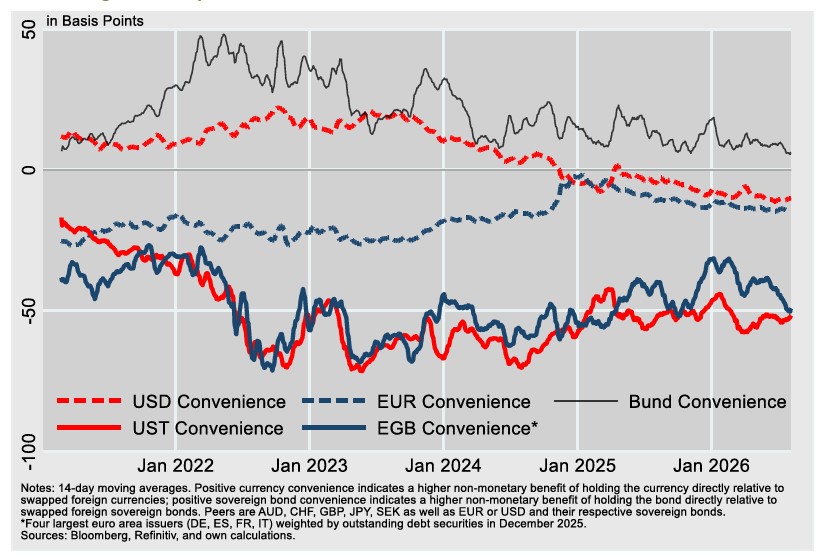
Unlike Du et al. (2026), who take a U.S. perspective and represent the euro area exclusively through German Bunds, we adopt a euro area perspective and consider the broader euro area sovereign bond market. This allows us to distinguish common euro area developments from Bund-specific scarcity. Figure 1 therefore reports a debt-weighted aggregate of the European government bond market including the largest issuers France, Germany, Italy and Spain (EGB).
Interestingly, the EGB convenience closely tracks U.S. Treasury convenience and remains well below Bund convenience. Economically, combining the four largest euro area issuers creates a much larger pool of debt than Bunds alone and is therefore more comparable in scale to the Treasury market (although the volume of outstanding Treasuries remains roughly three times as large). The similar dynamics are therefore consistent with both markets being influenced by common global safe-asset demand, dealer balance-sheet conditions and relative sovereign bond supply, independent of their respective currency convenience.
Indeed, euro convenience has improved since mid-2023, but in the ten-year tenor it remains slightly negative relative to the selected peer currencies (see Figure 1, blue dashed line). This development is consistent with a moderate strengthening of the euro’s international role in 2025: Foreign portfolio inflows provide complementary evidence of increased international demand for euro assets.4
The direct bilateral euro area to U.S. comparison in Figure 2 sharpens this distinction. The euro’s ten-year convenience disadvantage to the dollar has largely disappeared since late 2024. At the sovereign-bond level, however, the picture depends strongly on the euro area benchmark used. Bund convenience remains clearly positive relative to U.S. Treasuries throughout the sample, whereas EGB convenience relative to Treasuries was negative but recently moved towards zero. Given that the EGB-to-UST convenience differential closely tracks the euro-to-dollar convenience differential, the bond-specific components of EGB and Treasury convenience appear broadly comparable. The broader EGB market therefore resembles the Treasury market much more closely in relative-pricing terms than the Bund-only comparison suggests, indicating that the stronger convenience of Bunds alone is not representative of the broader market.5 Finally, the fact that Treasury convenience remains close to EGB convenience despite an outstanding volume roughly three times as large is consistent with a persistent safe-haven role of U.S. Treasuries.
Figure 2. 10-year Euro Area Convenience Yields Relative to USD and USTs
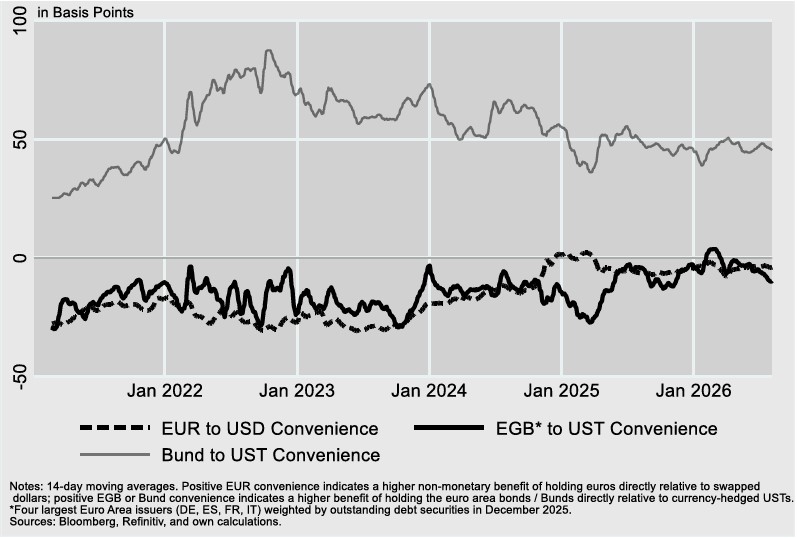
Bund convenience against Treasuries rose markedly until 2022/23 but has declined since then (see Figure 2, black line), consistent with a reduction in Bund scarcity. The Eurosystem’s balance-sheet normalization increased the availability of Bunds in the market. Expectations of higher German defense and infrastructure spending, which became increasingly salient before the 2025 fiscal decisions, may also have contributed by pointing to greater future Bund supply. The persistent gap between Bund and EGB convenience therefore supports the interpretation that Bunds retain a distinct safe-haven premium, even as broader EGB convenience has strengthened.
Periods of heightened geopolitical uncertainty have coincided with renewed demand for Bunds as safe assets and high-quality collateral leading to sustained positive Bund convenience. This creates an important policy tension. A larger supply of Bunds can reduce their scarcity premium and thereby raise relative borrowing costs for the issuer, but it may also improve the benchmark status by deepening the market and increasing collateral availability. A lower Bund convenience yield should therefore not automatically be interpreted as a deterioration. It can signal lower scarcity and fewer collateral frictions, which supports the benchmark status of the bond, but also a smaller safe-asset premium, which means relatively higher borrowing costs for the issuer.
The distinction between currency and sovereign bond convenience has a direct policy implication: strengthening the international role of the euro is not the same as increasing the convenience yield of euro-area sovereign bonds. The former primarily reflects the value of euro liquidity, funding markets, and the institutional stability of the currency area. The latter is additionally influenced by the availability of EGBs compared to foreign sovereign bonds. Progress in one area can support the other, but neither follows mechanically from the other. Initiatives such as the recent reform of the Eurosystem’s repo facility (EUREP 2.0) illustrate this interaction by providing non-euro area central banks with backstop euro liquidity against high-quality euro-denominated collateral, thereby supporting both the collateral value of eligible EGBs and the international usability of the euro. Importantly, strengthening the euro at the currency level may generate broader benefits than increasing sovereign bond convenience alone, as any associated funding advantage could extend to all governments, banks, and firms issuing in euro.
A higher bond convenience yield is not unambiguously preferable: it may reflect strong safe-asset demand, but also a scarce supply. Conversely, greater bond supply can ease scarcity and thereby reduce bond convenience. By deepening markets and expanding the collateral base, a higher bond supply may create deeper and more liquid markets and thereby strengthen the international usability of the euro. These potentially opposing effects should be considered when seeking to strengthen the euro area’s international financial attractiveness, although establishing their (relative) importance requires further research.
The close co-movement of the EGB and U.S. Treasury convenience adds a further policy perspective. It suggests that the EGB market can already provide many of the same safe-asset benefits as Treasuries despite its more fragmented structure and often lower euro convenience. Further improvements in market integration and trading infrastructure could help strengthen these characteristics.
Du, W., Keerati, R. and Schreger, J. (2026), Decoupling Dollar and Treasury Privilege, NBER Working Paper No. 35000.
ECB (2026), International role of the euro increased moderately in 2025. Press Release, June 2026.
ECB (2026), Global safe assets and their convenience yields, The international role of the euro, June 2026.
Jiang, Z., Krishnamurthy, A. and Lustig, H. (2021), Foreign Safe Asset Demand and the Dollar Exchange Rate, Journal of Finance, 76(3), 1049-1089.
Jiang, Z., Lustig, H., Van Nieuwerburgh, S. and Xiaolan, M. (2026), Bond Convenience Yields in the Eurozone Currency Union, The Review of Financial Studies.
AUD, CHF, GBP, JPY, SEK, as well as EUR or USD.
The red lines correspond to the convenience yields reported in Du et al. (2026), except against the median of six instead of ten other currencies. The blue lines use the same method but from the euro area’s point of view.
Recent ECB estimates using an alternative methodology following Jiang, Krishnamurthy, and Lustig (2021) reinforce the importance of separating currency from sovereign-bond convenience. They suggest that in 2025 around 90% of the foreign convenience yield on U.S. Treasuries and 85% of that on German Bunds reflect their currency denomination rather than bond-specific safety and liquidity benefits. This supports the view that a currency may retain substantial international convenience even when the relative specialness of the sovereign bonds issued in that currency declines; see ECB (2026) Global safe assets and their convenience yields.
ECB (2026), International role of the euro increased moderately in 2025.
For complementary evidence on sovereign bond convenience and fiscal fundamentals within the euro area, see Jiang, Lustig, Nieuwerburgh, and Xiaolan (2026).