

This policy brief is based on ECB Working Paper No 3231. This paper represents the views of the authors. It does not necessarily reflect the views of the European Central Bank.
Abstract
The economic costs of wildfires extend beyond the assets that burn. Using the 2017 wildfires in Portugal, the largest burned area recorded in any European country in a single year, we show that physically intact hotels whose surrounding landscape burned saw cashflows fall by 5–6% in 2017–2018, roughly two-thirds of the loss recorded by hotels that burned. Where the share of burned area within 1 km was in the top quartile, revenues fell by 27% in 2018. The two groups adapt differently: hotels that were themselves burned borrow long term and, where financially sound, rebuild, whereas hotels whose landscape burned cut investment and draw down cash, with the cut concentrated in hotels facing higher recovery uncertainty. Relief designed around physical damage therefore misses a material share of wildfire losses, and where natural capital is slow to recover, private adaptation may stall unless restoration reduces uncertainty about the return of demand.
Wildfires impose economic costs well beyond the assets that burn. Regional output and employment fall, particularly in tourism (Meier et al., 2023), and supply chains propagate losses across sectors: the 2018 California wildfires cost about 1.5% of state GDP, 59% of which arose from indirect supply-chain disruptions (Wang et al., 2021). Less attention has been paid to how firms are affected, and how they adapt, when instead the landscape burns, destroying natural capital they neither own nor control. Yet the destruction of biodiversity and natural capital can impair the productive capacity of firms that depend on it (Flammer et al., 2025), and ecosystems may take years to recover.
This gap matters because a large share of economic activity depends on natural capital located outside firms’ boundaries: 72% of euro area non-financial corporations exhibit a high dependency on at least one ecosystem service (Boldrini et al., 2023). Unlike the physical capital a firm owns, natural capital appears nowhere on the balance sheet: it is neither capitalised, nor depreciated, nor insured. Its impairment reduces the firm’s earnings capacity while generating no accounting entry that records the loss. Such losses also tend to fall outside damage assessments, property insurance and post-disaster relief, which typically hinge on physical damage to the claimant’s own assets.
The distinction also shapes how firms adapt. When a firm’s own assets burn, recovery is a replacement investment whose timing and cost the firm controls. When the surrounding landscape burns, recovery depends on public investment and ecological processes the firm cannot influence, so any investment must be made under uncertainty about whether, and when, demand will return. Investment theory predicts that, under such uncertainty, firms holding irreversible assets will delay investment (Dixit & Pindyck, 1994).
This brief summarises new evidence (Dreher & Marques, 2026) on three questions. How large are the losses of firms that are not physically damaged by a wildfire but lose surrounding natural capital, relative to firms inside the fire perimeter? How do the two groups adapt, in terms of investment, liquidity and financing? And what does the difference imply for the design of post-disaster support?
The 2017 wildfire season in Portugal burned almost 540 thousand hectares, around 5.9% of the country’s land area and the largest annual burned area recorded for any European country, causing over 100 fatalities. The Centre Region accounted for 78.7% of the burned area, and 12 national parks and 88 special regime forests were affected. The region is specialised in nature-based tourism, where visitors travel for the landscape, and burned area is known to reduce tourist arrivals in Portugal (Otrachshenko & Nunes, 2022). Other indirect channels seem to have played a limited role: road closures were short-lived, and air quality in 2017 was not materially different from 2016.
We combine the establishment-level location of hotels in the Centre Region with official fire perimeters, land-use maps, firm-level public recovery support and financial statements for 2015–2019. This allows us to separate hotels inside the fire perimeter whose own assets were exposed (directly affected, 33 hotels) from hotels that remained physically intact but whose surrounding landscape within 1 km burned (indirectly affected, 97 hotels). Each affected hotel is compared with matched unaffected hotels of similar wildfire risk, surrounding forest cover, size and asset structure, before and after the fires.
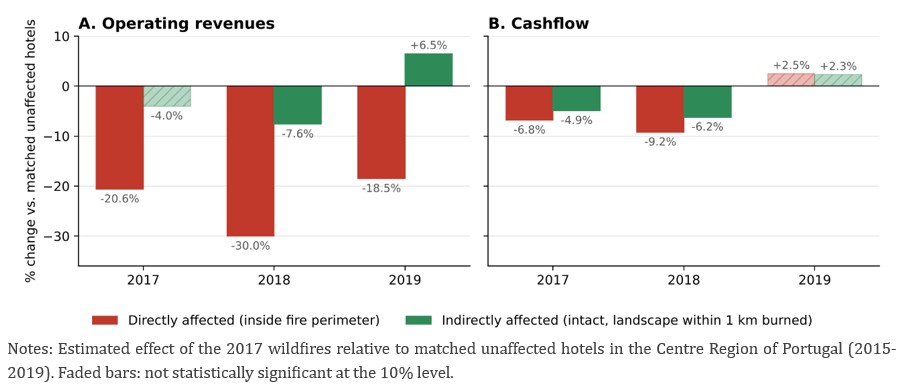
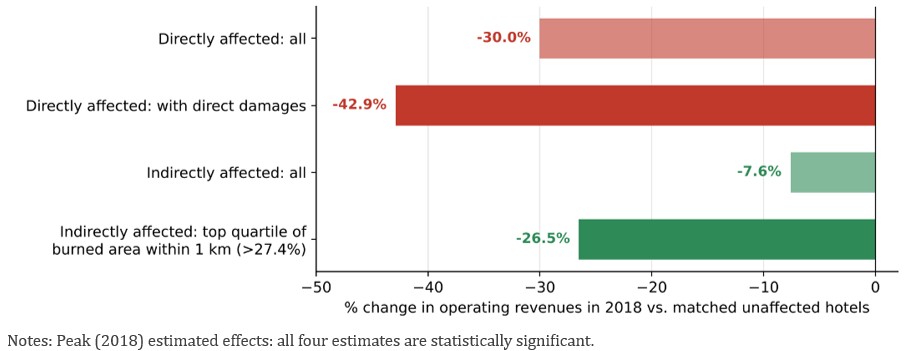
Hotels that burned: Directly affected hotels experienced a significant and persistent drop in operating revenues, peaking at -30.0% in 2018 (-42.9% for hotels with direct damages, proxied through government subsidies awarded in the aftermath of the wildfires). They cut staff and external supply costs, but not by enough to prevent a significant fall in cashflows (-6.8% in 2017 and -9.2% in 2018). The short-lived nature of the cashflow drop could partly reflect the extensive support measures implemented by the Portuguese government to assist directly affected businesses. A back-of-the-envelope estimate puts their accumulated revenue loss at EUR 7.0 million in 2017–19, or 21.4% of the 2016 accommodation turnover of the municipalities where they are located, and more than 50% in the six most exposed municipalities.
Hotels whose landscape burned: Indirectly affected hotels also faced a short-term cashflow disruption (-4.9% in 2017 and -6.2% in 2018). Despite not sustaining physical damages, these hotels suffered cashflow losses equating to roughly two-thirds of those recorded by hotels that burned (Figure 1). Revenues fell by 7.6% in 2018 and recovered in 2019, but higher operating costs prevented a similar recovery in cashflows. The overall loss of turnover (EUR 4.3 million) represents only 2.4% of the local hotel market, but in about a tenth of the municipalities (5 in 51) it exceeds 10% of local turnover.
Figure 1. Hotels whose landscape burned also lost cashflow, about two-thirds as much as hotels that burned
The landscape is the channel. Losses were concentrated where the landscape itself burned: hotels in the top quartile of the share of burned area within 1 km recorded a 26.5% fall in revenues in 2018 (Figure 2), and cashflow falls of 14.6% and 12.1% in 2017 and 2018. We find no comparable evidence for damage to nearby protected areas as tourist attractions, and the effects disappear when the radius is extended to 2 km: indirect effects are bound by proximity to the fire perimeter. A material share of wildfire losses therefore falls on firms that suffer no physical damage at all.
Figure 2. Where most of the surrounding landscape burned, revenue losses approach those of hotels that burned
The two groups diverge sharply in how they respond to the same shock (Table 1).
Table 1. How hotels adapted to the 2017 wildfires
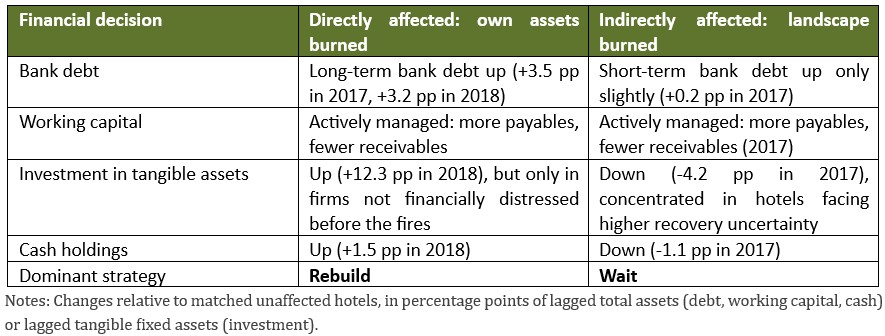
Hotels that burned rebuild. Directly affected hotels increased their reliance on long-term bank debt and combined reinvestment in tangible assets with higher cash holdings, consistent with evidence that firms hit by disasters turn to debt financing (Koetter et al., 2020). Long-term loans may also have served as bridge financing: for hotel firms that received government support, the process took on average 210 days, and part of the subsidies was only paid in 2019. The reinvestment, however, is confined to firms that were not financially distressed before the fires, consistent with investment–cashflow sensitivity (Almeida & Campello, 2007).
Hotels whose landscape burned wait. Indirectly affected hotels absorbed the shock mainly by drawing down cash and cutting investment; together, these roughly match their 2017 cashflow loss. Contrary to what financing constraints would predict, the cut is driven by financially healthy firms, and it is concentrated among hotels facing greater recovery uncertainty (Figure 3), as real options theory predicts. For these hotels, all three conditions that make waiting valuable hold: their investments are location-specific and hard to reverse; the return of demand depends on the regeneration of natural capital they cannot control; and, being physically intact, they can postpone investment.
Figure 3. Hotels whose landscape burned cut investment only where recovery is more uncertain
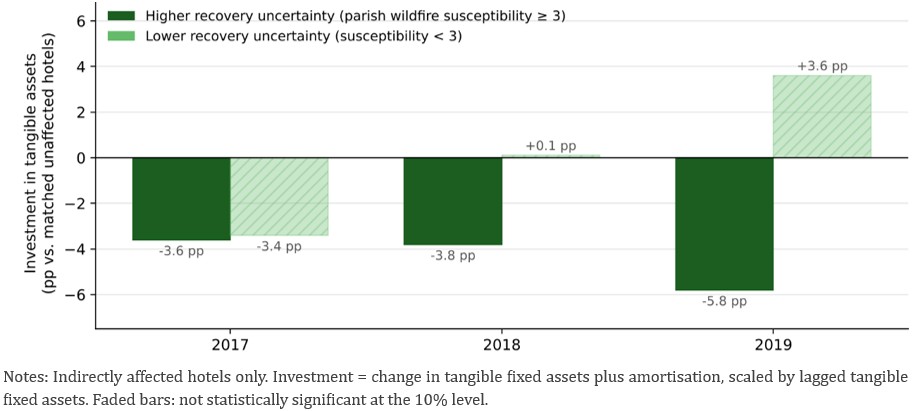
When recovery depends on an ecological process outside the firm’s control, private adaptation takes the form of waiting rather than rebuilding. It is therefore likely to be slowest precisely where the shock lasts longest. Supplementary evidence suggests that wildfire risk matters even without fire: hotels in high-risk areas far from the 2017 fires saw no change in cashflows, but recorded lower debt growth and lower investment, pointing to tighter credit conditions.
Relief designed around physical damage misses a material share of wildfire losses. In Portugal, public recovery programmes were directed primarily at physically damaged firms, and by July 2018 insurers had paid EUR 127.5 million to affected firms, of which only EUR 64 thousand covered business interruption. Policymakers could consider extending support to indirectly affected firms, but eligibility would need to rest on verifiable evidence of the channel through which a firm is affected. Geospatial exposure measures such as those used here offer a practical basis for this, beyond case-by-case assessment of claims.
For firms whose landscape burned, the binding constraint is uncertainty about recovery, not only liquidity. Liquidity support alone may therefore do little to unlock their investment. Timely restoration of burned landscapes, and credible information on restoration plans and timelines, may matter more. Landscape restoration is in this sense also economic recovery policy for nature-dependent regions, alongside continued investment in wildfire prevention and resilience.
Financial resilience needs to be built in advance. Recovery investment by firms that burned depends on their pre-existing financial health, and support takes months to arrive. With an insurance protection gap among the highest in the EU (Benalal et al., 2023), insurers that may reduce coverage in high-risk areas and governments facing fiscal constraints, firms exposed to wildfire risk may benefit from preserving liquidity, diversifying revenue sources, and keeping borrowing capacity available for emergencies.
Almeida, H., & Campello, M. (2007). Financial constraints, asset tangibility, and corporate investment. The Review of Financial Studies, 20(5), 1429–1460.
Benalal, N., et al. (2023). Policy options to reduce the climate insurance protection gap. ECB and EIOPA Discussion Paper, April 2023.
Boldrini, S., Ceglar, A., Lelli, C., Parisi, L., & Heemskerk, I. (2023). Living in a world of disappearing nature: physical risk and the implications for financial stability. ECB Occasional Paper Series No. 333.
Dixit, A. K., & Pindyck, R. S. (1994). Investment under uncertainty. Princeton University Press.
Dreher, F., & Marques, B. (2026). When the landscape burns: Wildfires, natural capital loss and firm adaptation. Working paper; earlier version published as “Wildfire cashflow shocks”, ECB Working Paper Series No. 3231.
Flammer, C., Giroux, T., & Heal, G. M. (2025). Biodiversity finance. Journal of Financial Economics, 164, 103987.
Koetter, M., Noth, F., & Rehbein, O. (2020). Borrowers under water! Rare disasters, regional banks, and recovery lending. Journal of Financial Intermediation, 43, 100811.
Meier, S., Elliott, R. J., & Strobl, E. (2023). The regional economic impact of wildfires: Evidence from Southern Europe. Journal of Environmental Economics and Management, 118, 102787.
Otrachshenko, V., & Nunes, L. C. (2022). Fire takes no vacation: Impact of fires on tourism. Environment and Development Economics, 27(1), 86–101.
Wang, D., Guan, D., Zhu, S., et al. (2021). Economic footprint of California wildfires in 2018. Nature Sustainability, 4(3), 252–260.