

The views expressed are those of the author and do not necessarily reflect those of Banca d’Italia.
Abstract
Central banks that accept corporate loans as collateral must be able to judge, quickly and reliably, the creditworthiness of thousands of non-financial firms that have no public rating. This brief draws on a recent volume on Banca d’Italia’s in-house credit assessment system (ICAS) to argue that corporate credit analysis is a macro-relevant function: it mitigates information asymmetries, underpins monetary policy implementation, supports financial stability, reduces reliance on rating agencies, and keeps the central bank operationally ready for a crisis. The system now in use shows high and stable discriminatory power. Artificial intelligence can strengthen it further, provided it is introduced step by step, explained, supervised by human judgement, and governed under sound risk management and regulation.
The answer becomes evident from a few figures. At the height of the Covid-19 crisis, in 2021, counterparties’ use of Eurosystem liquidity peaked at €2.2 trillion, about €1.6 trillion more than before the pandemic. These operations were backed by €2.8 trillion collateral, and nearly one third of it consisted of credit claims, mainly loans to non-financial corporations. At peak, this type of collateral had grown by €0.5 trillion. Other central banks that accept corporate loans in their refinancing frameworks adopted similar measures to keep credit flowing. Each of those loans had to be valued, and most of the borrowers had no public rating. In stressed markets, the ability to assess the credit quality of non-financial companies reliably and quickly is therefore a precondition for the conduct of monetary policy, not a back-office detail.
The Eurosystem draws on three sources of credit assessment for collateral: external credit assessment institutions (ECAIs, i.e. rating agencies), banks’ internal ratings-based (IRB) systems, and in-house credit assessment systems (ICASes) run by several national central banks (Auria et al., 2021). Banca d’Italia launched its ICAS in 2013. In November 2024, the ECB Governing Council gave ICAS ratings priority over the other two sources, and as of 2026 purely statistical ICAS ratings may be used to assess small and medium-sized enterprises (SMEs) within the general collateral framework (ECB, 2025; Duarte et al., 2025).
A recent volume (Scalia, 2026), drawing on contributions from multiple authors, documents the Banca d’Italia’s system, benchmarks it against rating agencies and commercial banks, and presents new research on artificial intelligence (AI) applications to corporate analysis and to emerging risks such as climate change and cyber threats. This brief summarizes its main messages for a macro and monetary policy audience: why corporate credit analysis matters for macro policies (Section 2), how well the current system performs (Section 3), and how AI can be introduced responsibly (Section 4). Researchers in credit risk management and professional experts will find detailed descriptions of methods, advancements, and empirical results in the book.
Agency problems and information asymmetry. As argued in the Overview Chapter by the author of this brief, corporate credit analysis (CCA) exists because lenders know less about a firm than its managers do. By producing an independent estimate of the probability of default (PD), CCA reduces the information asymmetry in lending relationships and lowers the agency costs of the corporate sector (Jensen and Meckling, 1976). In the financial accelerator view, these costs depend on borrowers’ net worth and move with the cycle, so better information on balance sheets supports a more efficient allocation of credit and more stable growth (Bernanke and Gertler, 1989). A central bank that accepts loans as collateral faces the same asymmetry twice: it knows less than the pledging bank, which in turn knows less than the borrowing firm. An independent rating is the central bank’s defense against adverse selection in the collateral it receives.
Monetary policy implementation. Since the great financial crisis, the Eurosystem has supplied liquidity largely through refinancing operations with full allotment. Banks obtain all the liquidity they request, provided they pledge enough eligible collateral, including credit claims. Prepositioning loans with the national central bank carries no stigma, and the opportunity cost of encumbering them is low, so euro area banks use loan pools as cheap insurance against liquidity shocks. This differs markedly from the US framework (Gorton et al., 2025). In a bank-based economy such as Italy, the eligibility and valuation of corporate loans therefore shape how far, and how evenly, policy impulses reach firms through the bank lending channel. The credit assessment determines eligibility and haircuts and, ultimately, how much liquidity each bank can raise.
Financial stability. Collateral mobilization is also a crisis-management tool. The March-April 2023 turmoil involving four mid-sized US banks and a major Swiss institution showed that a bank’s ability, or inability, to pledge collateral to the central bank at short notice can decide its fate (BCBS, 2023). A ready-made, credible assessment of the corporate loans on banks’ balance sheets widens the pool of assets available for standard operations and, if needed, for emergency liquidity assistance.
Reducing reliance on rating agencies. After the great financial crisis, the Financial Stability Board called on authorities to reduce their mechanistic reliance on external ratings (FSB, 2010). Rating agencies cover only a small fraction of firms, mainly large bond issuers, while most euro area corporate credit goes to unrated companies. As argued in the Chapter on “IRB Systems” by F. Orsini and A.M. Rossi, relying on banks’ own IRB models raises a different concern: the pledging bank rates the collateral it pledges, and it may have an incentive to understate risk (Behn et al., 2022). ICASes answer both problems1. They extend coverage to unrated firms and give the central bank an independent benchmark. The Chapter on “IRB and ICAS: A Comparative Analysis” by F. Columba, F. Orsini, and S. Tranquillo examines IRB and ICAS ratings for Italian borrowers and finds only mild evidence, of low economic significance, that banks may manage the ratings of pledged loans strategically. On average, banks’ models are slightly less conservative than the central bank’s, and banks that draw more central bank liquidity do not assign more lenient PDs.
Operational readiness. The 2021 figures show how quickly collateral needs can grow. A central bank cannot build a rating system in the middle of a crisis. It needs, in advance, the data infrastructure, models, trained analysts and governance to rate thousands of firms at scale, as argued in the Chapter on “The Statistical Model” by S. Narizzano, M. Orlandi, and A. Scalia. At the Bank of Italy this rests on two automated data repositories: a financial statement archive for Italian companies, and the National Credit Register, which provides monthly data on each firm’s credit performance. Recent Eurosystem decisions raised the bar further. ICAS ratings now come first in the collateral framework, statistical ICAS ratings extend coverage to SMEs, and all of this entails full risk sharing across the Eurosystem. Harmonized principles, transparent methodologies, and rigorous oversight are therefore prerequisites, not options. Publishing the methodology, as the volume does, is part of that accountability.
The Bank of Italy’s ICAS follows industry best practice: a statistical model combined with expert judgement, overseen by a rating committee. As shown in the Chapter on “The Expert Assessment” by L. Esposito, M. Guglielmi, F. Monterisi, S. Narizzano, and M. Orlandi, both components were comprehensively reviewed in 2023.
The evidence on performance is reassuring on four counts.
The system also produces a macro-relevant by-product: a granular, timely picture of corporate credit quality. Over 2013-2024, S-ICAS PDs for Italian firms fell steadily after the sovereign debt crisis, rose unevenly across sectors during the pandemic, and declined again by end-2022. The slight deterioration in 2023 is entirely attributable to the macroeconomic environment. The projected default rate for 2025 was about 3 per cent, reflecting higher financing costs, weak growth, and geopolitical risk (see the Chapter on “The Credit Risk of Italian Firms and Collateral” by S. Di Virgilio, A. Iannamorelli, F. Monterisi, and S. Narizzano).
Opportunities. AI makes it possible to exploit new types of information, including unstructured text and big data, with unprecedented efficiency and depth. Under certain conditions, machine learning (ML) models outperform traditional approaches in estimating corporate credit risk. They also help capture emerging risk sources that financial statements miss. The volume reports experimental results along several lines, summarized in Table 1; although none is yet part of the operational system, some developments are well advanced and others are under study.
Table 1. AI applications and emerging risks: research results in Scalia (2026)
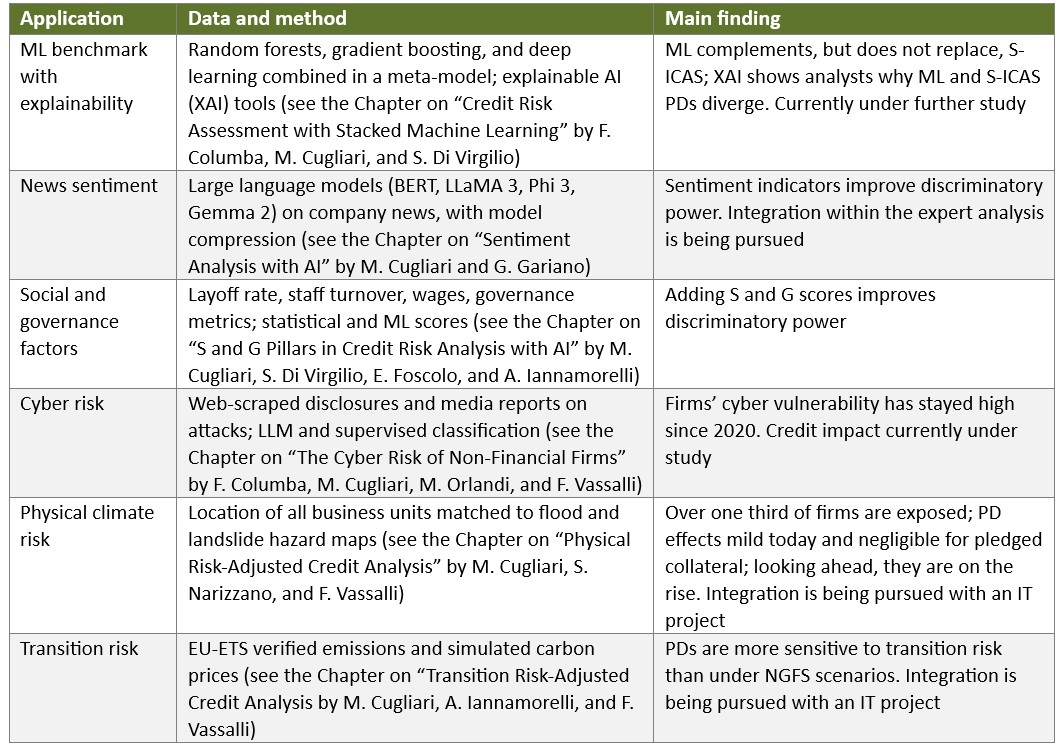
Challenges. Three stand out. The first is explainability. ML models make few assumptions about the data and capture complex non-linear relationships, but their opacity is hard to reconcile with the transparency a public authority owes to counterparties and to its Eurosystem partners. The second is data: firm-level information on emissions, physical asset locations or cyber incidents is scarce, which is why Banca d’Italia has been running its own climate survey of firms since 2024 (see the Chapter on “The Climate Risk Survey” by F. Colletti, F. Columba, M. Cugliari, A. Iannamorelli, P. Parlamento, and L. Tozzi). The third is cost: LLMs are computationally demanding, and their benefits must outweigh development and running costs. More generally, like any new technology, AI carries potential risks, such as bias, unstable outputs, and overreliance on automated decisions, which sound governance must keep in check.
Regulation. The EU AI Act sets out general principles for all AI systems and stricter requirements for high-risk uses; creditworthiness assessment of natural persons is classified as high-risk. Corporate ratings are not explicitly listed, but the volume proposes a risk management framework aligned with the Act. As illustrated in the Chapter on “A SAFE Model for AI Risk Management” by P. Giudici, such framework rests on four principles: security, accuracy, fairness and explainability. Supervisory guidance on ML in internal ratings points the same way (EBA, 2023).
The Banca d’Italia’s approach is therefore incremental. New AI tools enter the rating process only after a period of calibration and testing, and only if they meet three conditions: compliance with Eurosystem standards for collateral valuation; performance gains that justify their costs; and compliance with the AI Act’s principles, above all that AI processes remain supervised by human intelligence (Angelini, 2025). The current hybrid model, which uses decision trees inside a transparent logistic framework, is an example of this approach.
Corporate credit analysis has become part of the central bank’s core infrastructure for monetary policy and crisis management. Five implications follow.
In his Foreword to the volume, Paolo Angelini notes that Banca d’Italia wants to expose its techniques to external challenge so that they remain fit for purpose in a rapidly changing environment. This brief extends that invitation to the community of macro and monetary policy experts.
Angelini, P. (2025), “Data science in central banking”, closing remarks at the 4th IFC and Banca d’Italia Workshop, Rome, 20 February.
Auria, L. et al. (2021), “Overview of central banks’ in-house credit assessment systems in the euro area”, ECB Occasional Paper No. 284.
BCBS (2023), Report on the 2023 banking turmoil, Basel Committee on Banking Supervision, October.
Behn, M., R. Haselmann and V. Vig (2022), “The limits of model-based regulation”, Journal of Finance, 77(3), 1635-1684.
Bernanke, B. and M. Gertler (1989), “Agency costs, net worth, and business fluctuations”, American Economic Review, 79(1), 14-31.
Duarte, C., J. Engel, O. Reichmann, and T. Džaja (2025), “Introducing statistical in-house credit assessment systems (S-ICASs) as an additional source of credit assessments under the general collateral framework”, ECB Economic Bulletin, 3/2025.
EBA (2023), Machine learning for IRB models: follow-up report, EBA/REP/2023/28.
ECB (2025), “Changes to the Eurosystem collateral framework to foster greater harmonization”, ECB Economic Bulletin, January.
FSB (2010), Principles for reducing reliance on CRA ratings, Financial Stability Board, October.
Gorton, G.B., C.P. Ross and S.Y. Ross (2025), “Where collateral sleeps”, NBER Working Paper No. 34266.
Jensen, M. and W. Meckling (1976), “Theory of the firm: managerial behavior, agency costs and ownership structure”, Journal of Financial Economics, 3(4), 305-360.
Scalia, A. (ed.) (2026), Corporate credit analysis and AI. Advancing the rating system at a central bank, Springer.
See also the Chapter on “The Credit Assessment of Large Firms” by L. Esposito, M. Franzoni, M. Guglielmi, A. Iannamorelli, and R. Sorgente.