

This policy brief is based on “Europe’s Digital Transformation Supports Economic Resilience”. The views expressed are those of the authors and not necessarily those of the institutions the authors are affiliated with. The views expressed here are the independent opinions of S&P Global Ratings’ economics group, which is separate from but provides forecasts and other input to S&P Global Ratings’ analysts. S&P Global Ratings’ analysts use these views in determining and assigning credit ratings in ratings committees, which exercise analytical judgment in accordance with S&P Global Ratings’ publicly available methodologies. This report does not constitute a rating action.
Abstract
Europe’s digital buildout is expanding steadily, rather than spectacularly. Digital transformation in Europe is service-heavy and dispersed across countries, unlike the boom in the U.S. Nevertheless, the shift in the information and communication technology (ICT) sector is real and increasingly visible in trade, investment, employment, and productivity. Trade in computer services and rising investment in software, databases, and ICT equipment are helping to support the European economy’s resilience to recent global shocks (see “Economic Outlook Europe Q4 2026: Resilient Demand Meets Persistent Pressure,” published Sept. 23, 2026).
The ICT sector accounts for about 5.2% of total EU value added – this is more than the construction sector and similar to the financial and insurance sector. ICT services contribute 4.5% of total value added, while ICT manufacturing accounts for less than 1%. (Unless otherwise stated, the trade, employment and enterprises figures we use refer to the EU-27.)
The exact contribution of digitalization to the European economy is difficult to measure. Under Eurostat’s standard ICT-sector definition, the sector added 1.7 percentage points to cumulative euro area GDP growth since the pandemic – almost one-quarter of the total increase. That definition is only a proxy, however, because it excludes ICT manufacturing while retaining standard (nondigital) publishing activities.
Data based on an enhanced definition of the sector – including ICT manufacturing and excluding standard publishing activities – remain incomplete. Combining the available data, we can fairly estimate that digital activity contributed about 0.2 percentage point to annual GDP growth over the past five years, primarily through ICT-services trade and, increasingly, investment in ICT-related equipment. This is our estimate rather than a directly observed national-accounts contribution.
The labor market points in the same direction. The ICT sector (in its enhanced definition) created almost 1 million EU jobs over the past five years, lifting its share of total employment to 3.4% and accounting for about 15% of net job creation. All the increase came from ICT services.
Employment in computer programming, consultancy, and related activities rose by more than 33% between 2020 and 2025. Job creation in this sector also coincided with stronger productivity: apparent labor productivity in the ICT sector is significantly higher than in the business economy.
Job creation went hand in hand with business creation. The number of enterprises in the ICT sector has grown by 200,000 (up 17%) to 1.3 million between 2021 and 2024 in the EU, most of them in ICT services.
Services overwhelmingly dominate manufacturing in Europe’s ICT trade. Data centers require physical infrastructure, but much of the value they generate is recorded as services, including computer programming, software publishing, data processing, and cloud services. In 2024, EU-27 trade with the world in ICT goods – exports plus imports – totaled €302 billion, compared with €468 billion for ICT services. ICT goods represented about 6% of total EU goods trade, while ICT services accounted for roughly 33% of total EU services trade.
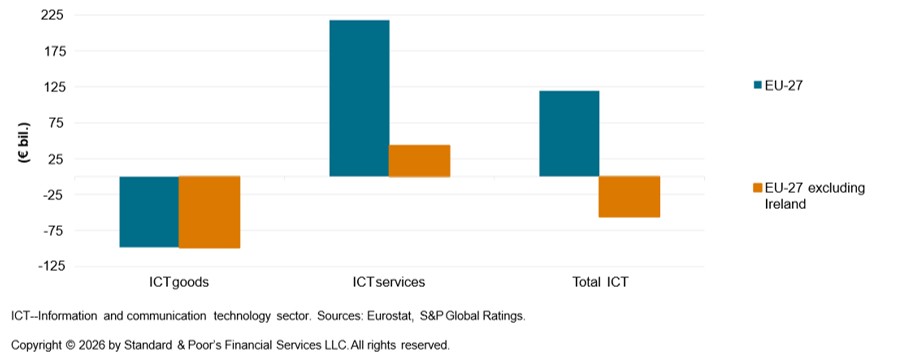
The balance is more revealing than the gross flows. The EU-27 recorded a €98 billion deficit in ICT goods, with the largest bilateral deficit vis-à-vis China, but a €218 billion surplus in ICT services. Computer services accounted for 88% of these services.
Ireland – a major hub for U.S. tech companies – generated most of the surplus and materially affects the aggregate. Even excluding Ireland, however, the EU-27 still recorded a €37 billion surplus in computer services (see chart 1). Ireland therefore changes the scale of the result but not its direction.
Chart 1. Ireland helps narrow the EU 27´s ICT trade gap through its services surplus
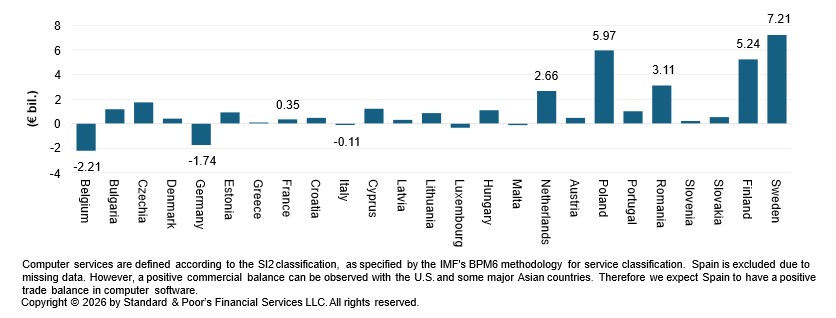
Beyond Ireland, the export base for computer services extends across the Nordics, Central and Eastern European Countries, and Southwestern Europe (see chart 2). This is a larger export base than for ICT-related goods (mostly the Netherlands for trade in wafer steppers and Germany for trade in printed circuit board assemblies).
Three channels stand out on the service side. First, digitally delivered consumer services, including gaming and streaming, support cross-border receipts – for instance, Spotify out of Sweden. Second, Poland’s large pool of software engineers supplies development and outsourcing services to global customers. Third, telecommunications-equipment producers such as Nokia and Ericsson increasingly sell network-management and software services alongside hardware. In addition, AI-related activities at established European IT consulting and services companies are growing faster than their other business, according to Reuters. Examples include Capgemini, Dassault, and Atos. In France, business creations in the ICT sector are up 56% year over year, according to INSEE data.
Nevertheless, Germany recorded a deficit in computer services in 2024. This occurred despite growth at companies such as SAP and partly reflects the economy’s manufacturing concentration and its reliance on non-European cloud and software providers, particularly U.S. hyperscalers. As AI raises computing demand across sectors, a dependence on U.S. providers could weaken Europe’s trade balance and is likely to feature prominently in European digital-sovereignty discussions.
Chart 2. Computer services trade is in surplus in 22 EU countries
(Excluding Ireland)
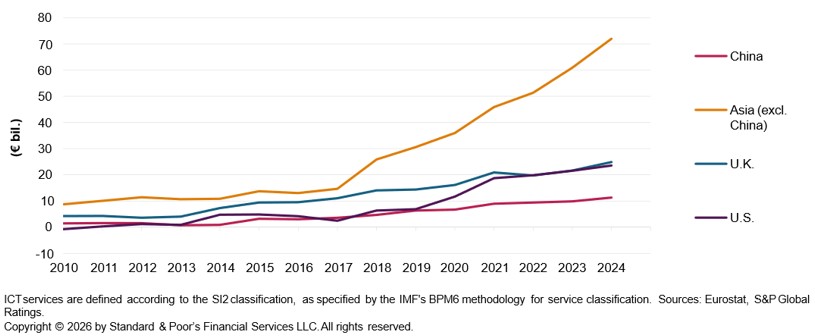
By destination, EU-27 exports of ICT services are concentrated in Asian economies excluding China, followed by the U.S. and the U.K. (see charts 3-5). The U.S. dominates imports, often routed through the Irish hub, while the EU-27 records its largest regional surplus with Asian economies excluding China.
The value of imports from the U.S. may vary with the prices that U.S. hyperscalers charge, potentially creating pressure on the EU trade balance in computer services in the future, unless European service providers can pass on higher costs to final users.
Chart 3. EU-27 exports of ICT services are titled toward Asian countries
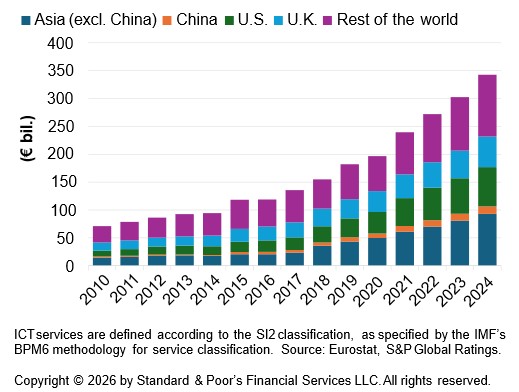
Chart 4. EU-27 imports of ICT services are tilted toward the U.S.
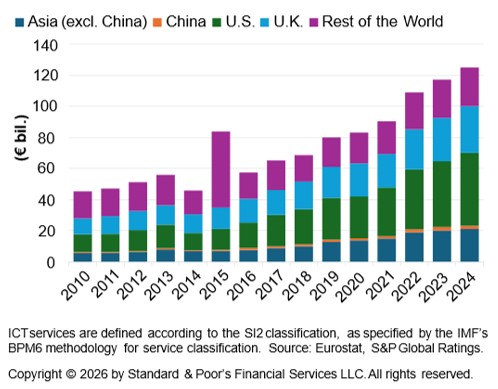
Chart 5. Most of the EU-27´s ICT services surplus is earned in Asia
The acceleration in ICT trade has coincided with firmer investment in digital-intensive assets. European quarterly national accounts do not report data centers or ICT equipment as separate categories, so the scale of the shift must be approximated.
We construct a broad proxy by subtracting construction, transport equipment, cultivated biological resources, and intellectual-property products from total fixed investment. The residual includes ICT equipment alongside other machinery, equipment, and weapons systems, so it is best viewed as an upper-bound proxy rather than a direct measure of ICT investment. Conversely, it excludes special buildings constructed by ICT companies and therefore does not capture the nondigital building components of data centers. With a likely increase in building data centers in Europe next year, according to forecasts from 451 Research by S&P Global, that portion of investment might become more meaningful. Conversely, the tech hardware (i.e, expensive graphics processing units and tensor processing units from the U.S.) that will go into these data centers could widen the ICT goods trade gap.
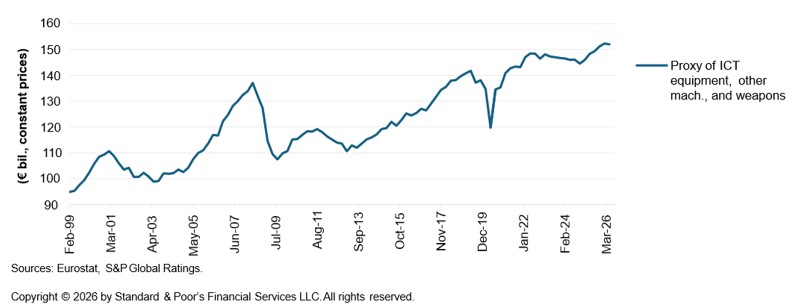
On this basis, investment in the broad equipment proxy reached about €152 billion by mid-2026 at constant prices (see chart 6). It grew by 4.2% year on year in the second quarter of 2026 and represented almost 30% of growth in total fixed investment in the eurozone. The recent acceleration is significant but remains below the annual growth of about 10% during the 2000 internet boom.
Chart 6. ICT equipment investment is picking up, though slower than in the early 200s
(Data for the eurozone)
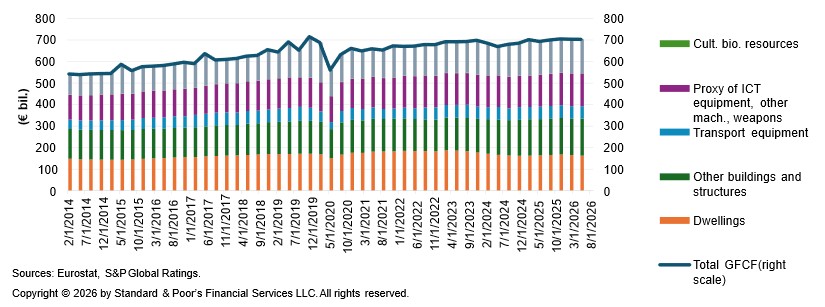
Investment in digital intangibles such as software and databases usually makes up around 40% of investment in intellectual property products (with the rest mostly research and development). Both tangible and intangible fixed investment in digital-related assets comes to about €220 billion in constant prices. That means digital assets are contributing 40%-45% of total fixed investment growth (see chart 7). By contrast, the rest of the investment aggregate has shown only limited momentum, which suggests that digital-intensive assets are doing the heavy lifting in supporting recent resilience in investment growth in Europe.
Chart 7. Close to half of fixed investment growth is driven by digital assets
(Data for eurozone)
Appendix
Asia (excl. China): Afghanistan, Bangladesh, Bhutan, Brunei Darussalam, British Indian Ocean Territory, Cambodia, Hong Kong, India, Indonesia, Japan, Kazakhstan, North Korea, Kyrgyzstan, Lao People’s Democratic Republic, Macao, Malaysia, Maldives, Mongolia, Myanmar, Nepal, Pakistan, Philippines, Singapore, South Korea, Sri Lanka, Taiwan, Tajikistan, Thailand, Timor-Leste, Turkmenistan, Uzbekistan, and Vietnam.
From bricks to clicks: an assessment of euro area digital investment, Malin Andersson, Sara Colombo, Valerie Jarvis and Richard Morris, ECB Economic Bulletin, Issue 2/2026