

The views expressed are those of the authors and do not necessarily reflect those of Danmarks Nationalbank or any other institutions they are affiliated with.
Abstract
Europe’s lack of globally successful firms is not only a question of whether start-ups have access to risk capital. Discussions at a recent Danmarks Nationalbank Symposium suggest that Europe’s scale-up gap reflects a complex set of factors, including a shortage of private-equity investors with experience and networks, an incomplete single market and a risk-averse culture.
By many measures, Europe performs strongly. It delivers living standards at least as high as those in the USA (OECD, 2024), has ample savings to finance investment (figure 1; Harr and Krogstrup, 2026) and educates world-class engineers and scientists (OECD, 2025). Taken together, Europe lacks neither the financial nor the human capital needed to support economic growth.
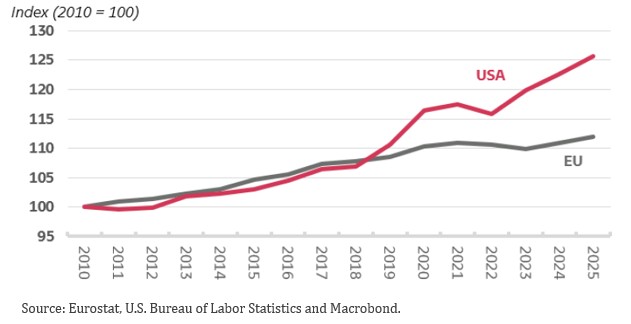
Yet, European growth has persistently lagged the USA, highlighting the difficulty in turning these strengths into productivity growth (figure 2). Productivity growth is important because it underpins wealth, fiscal and financial sustainability, and hence the long-term strength and resilience of the economy. It is for these reasons also a topic of key importance for Danmarks Nationalbank and our mandates of price and financial stability.
One dimension of the European productivity challenge is the inability of young firms to scale and become global firms: too often, promising European start-ups fail to scale or end up doing so in the USA. To understand this challenge better, Danmarks Nationalbank hosted a High-Level Symposium in May, bringing together 35 entrepreneurs, venture capitalists, institutional investors, academics, regulators and policymakers from Europe and the USA.
We summarise the discussions and insights of the Symposium in this note. Overall, the discussion revealed that the standard answer to why young European firms do not scale well in Europe, a shortage of risk capital, is not wrong, but it is incomplete. While Europe has the financial and human capital as well as the ideas and startups needed to create globally successful firms, it struggles to connect them in ways that help young firms scale. This failure notably reflects a shortage of private-equity investors with experience and networks, an incomplete single market and a risk-averse culture. The distinction matters for policy: focusing only on increasing risk capital overlooks the broader conditions needed to transform European strengths into globally competitive firms.
Figure 1. Savings as a share of GDP are higher in the EU than in the USA
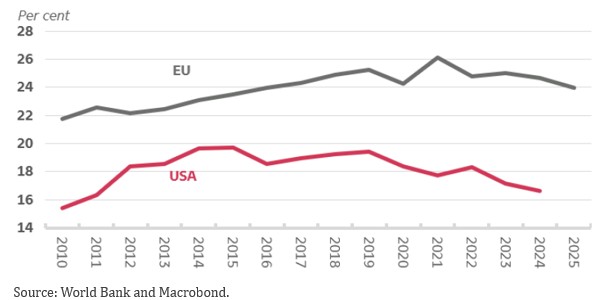
Figure 2. Output per hour has grown faster in the USA than in the EU since 2019
Participants at the Symposium underscored that young firms need different types of capital at different stages: seed capital to validate a product, Series A capital to build a business model, growth capital to expand internationally and exit capital through trade sales or public listings. The relevant question is therefore not whether Europe has enough risk capital, but whether firms can access the right capital at the right stage.
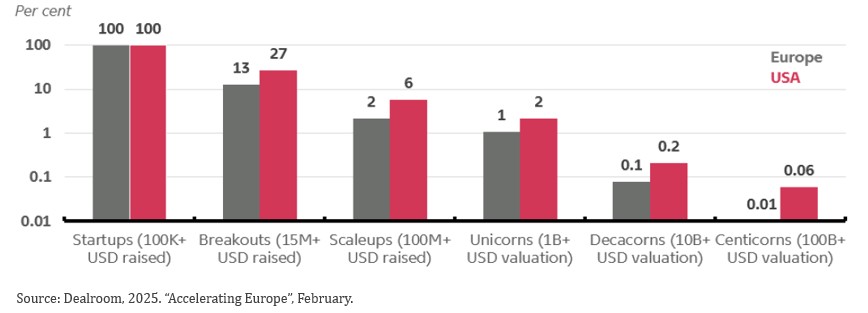
Evidence discussed suggests that financing gaps are modest at the earliest stages but become pronounced in the so-called “valley of death”, that is, when firms move from early-stage funding towards broad commercialisation and require scale-up finance (figures 3-4; EIB, 2024; IMF, 2024; Dealroom et al., 2026). As a case in point, around 70 per cent of late-stage deep-tech financing comes from investors outside Europe, with US investors accounting for most of that share (Dealroom et al., 2026).
Figure 3. Venture capital investment into startups was higher in the USA than in Europe
at every funding stage in 2024, with the gap widening at later stages
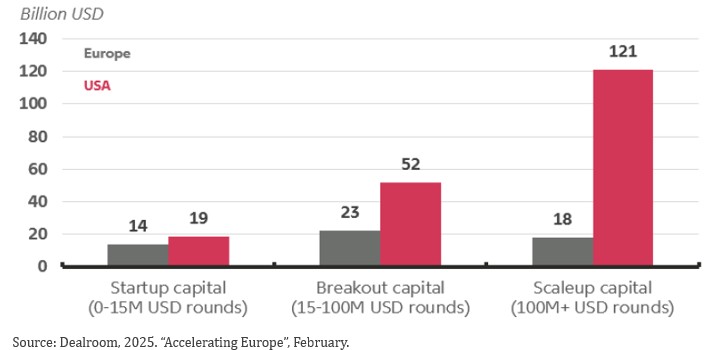
Figure 4. Fewer startups have gone beyond raising breakout and scaleup capital in Europe
than in the USA since 1970
Equity financing is widely recognised as better suited to the needs of young firms than bank financing (Draghi, 2024; IMF, 2024), a view also echoed at the Symposium. Equity investors can diversify across a broad range of investments and provide patient capital. Yet, Europe continues to rely heavily on banks for corporate financing (figure 5), constraining the ability of its firms to scale.
Beyond this need for more equity financing, the Symposium underscored that not all equity capital is equally valuable. Participants argued that venture investors contribute governance, strategic guidance, operational expertise and networks to the firms they invest in. Thus, in successful firm ecosystems, experienced founders reinvest not only capital but also their own experience and networks into young firms (Hellmann and Puri, 2002; Sørensen, 2007; Bernstein et al., 2016; Accel and Dealroom, 2025). Silicon Valley is a prominent example, where one generation of founders supports the next within clusters around specific new technologies, e.g. payments and fintech.
Europe continues to have fewer experienced founders and investors with scale-up experience than the USA (Draghi, 2024; EIB, 2024; ECB, 2026). The challenge is therefore not only the volume of equity capital but also whether investors bring the experience. Successful entrepreneurs in Europe may play an important role in this regard.
Figure 5. Firm financing is bank-based in Europe, whereas equity and investment funds play a larger role in the USA
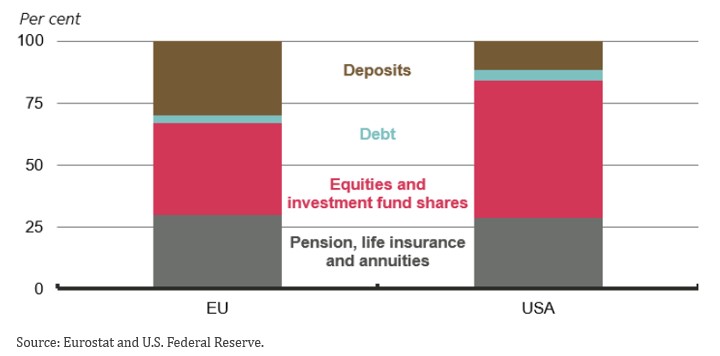
The equity financing gap is striking because it cannot easily be explained by a lack of savings to finance investment, as mentioned above, nor by portfolio theory. In fact, standard portfolio theory suggests that investors can benefit from exposure to assets, such as young scaling firms, whose returns are not perfectly correlated with the rest of their portfolio (Markowitz, 1952). In this case, investments in young firms may improve portfolio diversification relative to traditional asset classes, such as global equity indices. Yet, only a small share of Europe’s savings is allocated to the forms of risk capital needed by young firms that are ready to scale.
Symposium participants pointed to high-net-worth individuals with entrepreneurial experience as an underutilised source of experienced equity capital in Europe. Some participants suggested that tax rules could be adjusted to allow investors to defer capital gains when proceeds from the sale of small businesses are reinvested in other small businesses.
The Symposium also discussed the potential for pension funds, sovereign wealth funds and other institutional investors to provide equity capital. Participants highlighted the defined-contribution schemes of Nordic pension funds as examples of how household savings can be channelled into listed equity (Danmarks Nationalbank, 2025b). At present, however, much of this capital is channelled to US technology firms, where returns have been high in recent years. Participants argued that more integrated European equity markets could make European listed equities more attractive to institutional investors, leading to higher valuations of European firms. This could narrow the valuation gap with comparable US firms (Becker et al., 2026) and make IPO exits in Europe more attractive for founders and investors.
The discussion equally addressed whether institutional investors could play a greater role in financing unlisted young firms. Participants noted that venture investing seems to be costly and difficult to scale in Europe. If so, this may constrain institutional participation in venture markets, as these investors are required to focus on risk-adjusted returns.
The Symposium also highlighted a potential tension. While institutional investors are rightly required to focus on risk-adjusted returns, investments in young firms may generate broader societal benefits that are not captured by the return to private investors. The Symposium therefore covered the role of public capital in scaling firms. Participants agreed that public capital can be relevant, e.g. if investments involve knowledge and other public-good spillovers, long investment horizons and substantial uncertainty (Arrow, 1962; Stiglitz and Weiss, 1981). In these cases, public capital should mobilise private capital, rather than substituting for it, by demonstrating commercial viability through co-investments and other risk-sharing arrangements.
Participants mentioned a potential gap in Europe’s public financing. Innovation programmes often provide early-stage funding in relatively small amounts, while promotional banks finance at a later stage when firms have reached a sufficient scale. Between these stages, many firms face a shortage of growth capital. As a result, some European firms seek financing abroad. Some participants expressed scepticism about the ability of public institutions to pick good investments. The risk is that public capital supports ultimately unviable business models, or weakens competition, perhaps due to political preferences and special interests. This underlines the importance of clear mandates and a robust investment process.
Participants agreed that even if Europe were to solve its capital-market problems tomorrow, significant barriers to firm scaling would remain: A firm founded in California can access a domestic market of more than 300 million consumers under broadly unified rules. By contrast, cross-border expansion in Europe involves navigating up to 27 different cultures and languages, administrative systems and business practices. Model-based estimates indicate that such frictions are, on average, equivalent to an implicit tariff of 40-60 per cent on trade across EU member states (Airaudo et al., 2025; Danmarks Nationalbank, 2025a; IMF, 2025; Santamaria et al., 2023). These frictions limit firms’ ability to scale. As a result, European listed firms’ size is strongly correlated with home-country GDP, whereas U.S. listed firms’ size is unrelated to home-state GDP (Becker et al., 2026).
Participants noted that completing the Single Market is a priority. On the non-financial side, participants pointed to divergent product standards, tax rules, consumer protection and business regulations, and highlighted the potential of a 28th regime to provide common rules. On the financial side, progress on the Savings and Investment Union agenda, including integrated capital markets and banking systems, harmonised insolvency regimes and efficient listing frameworks, would increase the capital available to scaling firms.
However, participants also stressed the need for realism. As a union rather than a nation or federation, Europe will never function fully as a single national market.
A final message from the Symposium was that risk-averse cultural norms reduce the pool of talented workers willing to become entrepreneurs. Economies with strong entrepreneurial cultures typically combine rewards for success with acceptance of failure (GEM, 2025).
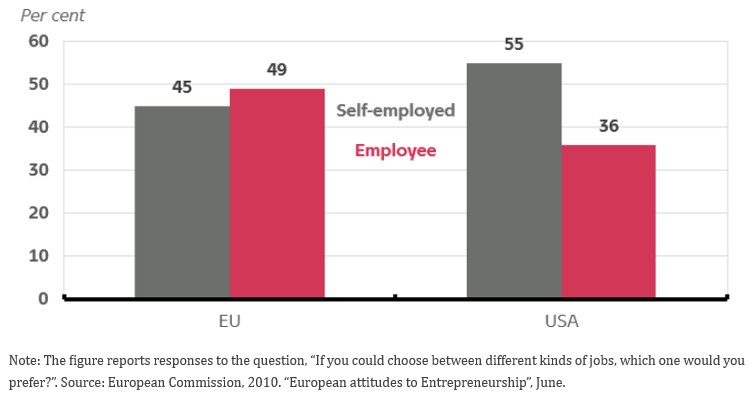
Europe’s challenge in this area is, in some respects, a paradox. Europe generally offers stronger social safety nets than the USA, reducing the personal economic cost of failure. Yet, participants suggested that Europeans are generally less willing to pursue entrepreneurship and more likely to favour stable employment than Americans (figure 6; GEM, 2025). Participants argued that bankruptcy laws impose greater costs on failed entrepreneurs in Europe than in the USA, and that tax systems reduce the rewards to successful risk-taking. These factors may make entrepreneurship a less attractive career option relative to salaried employment. Together with risk-averse cultural norms, they reduce the pool of talented individuals willing to start firms and foster complacency about the status quo.
The discussion highlighted increasing financial literacy among young people, exposure to entrepreneurship in higher education, as well as bankruptcy and tax reforms, as possible avenues for policy action.
Figure 6. More Americans prefer entrepreneurship to salaried employment, whereas the opposite is true for Europeans
The scale-up challenge is complex. If Europe succeeds, the gains in productivity are substantial. Initiatives are underway, including the Scaleup Europe Fund, the European Tech Champions Initiative, the French Tibi initiative and Germany’s pension reforms. Progress, however, is unlikely to happen overnight: developing deeper pools of experienced equity capital, larger markets and a more productive risk culture requires patience.
The Nordic countries are well positioned to lead by example. Strong institutions, high savings, active venture-capital markets and a tradition of cross-border collaboration have helped make the Nordic region one of Europe’s strongest performers. Recent private initiatives, such as Nordic Compass, illustrate ongoing efforts to strengthen cross-border cooperation across capital markets, deep tech, defence and energy (Nordic Compass, 2026). Their ultimate impact remains to be seen, but they reflect a recognition that many of Europe’s competitiveness challenges are more effectively addressed at a regional scale than within national borders alone.
Accel and Dealroom, 2025. “Europe and Israel’s founder factories: 25th Anniversary Edition”, March.
Florencia Airaudo, Francois de Soyres, Alexandre Gaillard and Ana Maria Santacreu, 2025. “Recent evolutions in the global trade system: from integration to strategic realignment”, ECB Forum on Central Banking, June.
Kenneth Arrow, 1962. “Economic welfare and the allocation of resources for invention”, National Bureau of Economic Research.
Bo Becker, Efraim Benmelech and Joao Monteiro, 2026. “The value gap: Europe cannot scale”, NBER Working Paper No. 35577, August.
Shai Bernstein, Xavier Giroud and Richard Townsend, 2016. “The impact of venture capital monitoring”, The Journal of Finance, vol. 71(4), August.
Danmarks Nationalbank, 2025a. “Fewer barriers in the EU single market could increase Danish welfare”, Danmarks Nationalbank Analysis, August.
Danmarks Nationalbank, 2025b. “The road to more risky assets in the Danish pension sector”, Danmarks Nationalbank Analysis, September.
Dealroom, Lakestar, Walden Catalyst and Hello Tomorrow, 2026. “The European deep tech report 2026”, March.
Mario Draghi, 2024. “The future of European competitiveness”, European Commission, September.
ECB, 2026. “Europe’s venture capital gap and the financing of high-growth firms”, ECB Economic Bulletin, issue 5/2026.
EIB, 2024. “The scale-up gap: Financial market constraints holding back innovative firms in the European Union”, EIB Thematic Studies, June.
GEM, 2025. “Global Entrepreneurship Monitor 2024/2025 Global Report: Entrepreneurship reality check”, Global Entrepreneurship Research Association, February.
Thomas Harr and Signe Krogstrup, 2026. Global imbalances then and now: Should we be concerned?, Paris Report 4: The New Global Imbalances, CEPR, April.
Thomas Hellmann and Manju Puri, 2002. “Venture capital and the professionalization of start-up firms: Empirical evidence”, The Journal of Finance, vol. 57(1), February.
IMF, 2024. “Stepping up venture capital to finance innovation in Europe”, IMF Working Paper, July.
IMF, 2025. “Europe’s productivity weakness: Firm-level roots and remedies”, IMF Working Paper, February.
Harry Markowitz, 1952. “Portfolio selection”, The Journal of Finance, vol. 7(1), March.
Nordic Compass, 2026. “Major industry leaders launch new Nordic alliance to implement joint initiatives in four critical areas”, press release, May.
OECD, 2024. “How’s Life? 2024: Well-being and resilience in times of crisis”, November.
OECD, 2025. “Education at a glance 2025: OECD indicators”, September.
Marta Santamaria, Jaume Ventura and Ugur Yesilbayraktar, 2023. “Exploring European regional trade”, Journal of International Economics, vol. 146, 103747.
Joseph E. Stiglitz and Andrew Weiss, 1981. “Credit rationing in markets with imperfect information”, American Economic Review, vol. 71(3), June.
Morten Sørensen, 2007. “How smart is smart money? A two-sided matching model of venture capital”, The Journal of Finance, vol. 62(6), December.