

This policy note is based on the SNB Working Papers 8/2026. The views expressed in this note are those of the authors and do not necessarily reflect those of the Swiss National Bank. The authors thank Morten O. Ravn, SNB seminar participants and an anonymous referee for comments on the underlying working paper.
Abstract
Firms never observe current inflation or aggregate demand; they see them with a lag and must meanwhile infer the state of the economy from noisy private signals. We show that this fact alone makes prices sticky and makes the lags of monetary policy long, variable and state-dependent, even though firms are fully rational and changing a price costs nothing. Firms combine an infrequent, precise forecast with a continuous, noisy nowcast: the forecast sets how far inflation must move before a price is changed, the nowcast decides when that threshold is crossed. Repricing is therefore a real option whose value of waiting depends on three distinct channels: The policy rate, the expected drift of inflation, and the firm’s own forecast uncertainty. Firms sort into three pricing regimes. Transmission lags shorten when inflation is rising or rates are high, and lengthen when rates are low, inflation is stable and uncertainty is high. The model reproduces Swiss inflation from 2016 to 2024 and predicts, out of sample, the size of price changes across 139 CPI categories.
Sixty-five years after Friedman (1961) described the lags of monetary policy as “long and variable”, the phrase still summarizes most of what central banks are willing to say about the timing of monetary policy transmission. The inflation surge of 2021–2023 showed how variable these lags can be. Across advanced economies, prices responded to cost and demand shocks within months rather than quarters, the frequency of price changes rose sharply, and large shocks travelled fast (Cavallo, Lippi and Miyahara, 2024). The subsequent disinflation was more gradual. In an economy where shocks are transmitted quickly in one episode and sluggishly in another, the lags of the transmission mechanism depend on the state of the economy.
The workhorse explanations of price stickiness rely on frictions imposed from outside the firm’s decision problem: a physical cost of changing the price tag (Golosov and Lucas, 2007), a random opportunity to adjust (Calvo, 1983), an adjustment hazard that rises with the gap between a firm’s price and an observable reference price (Caballero and Engel, 1993; Alvarez, Lippi and Oskolkov, 2022), or a marginal cost of processing information (Sims ,2003; Turen, 2023). These models are powerful, but they leave the question of timing largely to the assumed friction: lags are variable to the extent that the friction is calibrated to make them so.
In Hager and Reynard (2026) we start from a different observation. Firms do not know current inflation. The consumer price index for a given month is published in the following month, and the demand conditions that will drive the next reading are observed only indirectly, through a firm’s own sales. A firm that wants to set the profit-maximizing price therefore has to estimate a state it cannot see. It does so with two instruments that differ in frequency and purpose: a forecast of where the economy is heading, updated when new statistics are released, and a nowcast of where the economy is right now, updated continuously from noisy private signals. This note explains how the interaction of these two predictions, and nothing else, generates sticky prices, asymmetric adjustment and systematically state-dependent transmission lags. The note then summarizes the Swiss evidence and sets out what the model implies for monetary policy.
The informational problem is the same for policymakers and price setters. Central banks nowcast because the latest inflation and activity data describe the recent past. Firms face the same lag in a narrower form: a retailer observes customer flows, order books and, occasionally, competitors’ prices, all of which respond to local factors, for example, weather, demographics, advertising, travel costs and so on, as well as aggregate demand. The signal is continuous but noisy. The precise information, that is, published inflation and the central bank’s policy stance, arrives only on discrete dates.
Our model formalizes this environment as simply as possible. A large number of firms in a small open economy respond to an aggregate demand that is unobserved and evolves continuously with a drift and volatility. The drift captures the medium-term influence of the policy stance and of macroeconomic trends. The volatility captures macroeconomic noise outside the central bank’s control. Aggregate demand and inflation become public only at the end of each period. In the interim, each firm observes a noisy, firm-specific signal of the change in aggregate demand. A firm’s profit depends on how closely its price tracks the optimal price implied by demand conditions. Every deviation costs profits continuously. We impose no cost of changing the price: firms may reprice at any instant.
Two features of the setup define what the model does and does not claim. First, the central bank is not modelled as an optimizing agent. We assume only that its policy stance is correlated with aggregate demand, abstracting from any particular transmission channel, and that firms’ individual demand curves slope downwards. Second, each firm’s reference point is its own. Standard price-gap models assume that firms adjust towards an aggregate reference price. We instead let firms align the rate of change of their price with the rate of change they expect for the economy. Firms do not track the price levels of others, as these may not fit their specific circumstances and are already outdated once observed.
A forecast and a nowcast answer different questions, and they are built differently.
The forecast is formed at the start of each period. At the same time as the latest inflation figure, summarizing what competitors did, and the latest information on the policy stance become available. The firm uses these low-frequency series to update its estimate of the trend in excess demand, and hence of the drift of inflation over the coming period, and to update the record of its own past prediction errors. The forecast filters slowly moving information and is deliberately unresponsive to short-lived noise: it is stable, but it can be stale.
The nowcast is formed continuously. Within the period the firm tracks its private demand signal and updates its estimate of where the target price currently stands, weighting each new observation by how informative its signal has proved to be. The nowcast is designed to capture the current state, including movements that may turn out to be noise: it is timely, but noisy.
The order matters. The forecast must come first, because it provides the reference frame within which the nowcast can be interpreted: the same downtick in sales means something different if the firm expects inflation to rise than if it expects prices to be flat. This is the sense in which one cannot navigate from a position one does not know. Without a forecast of the trend, the firm has no way to judge whether a change in its signal reflects a persistent shift in the economy or a transitory fluctuation, and hence no way to decide whether the change warrants a reaction. Both predictions are formed rationally with standard filtering methods. The friction in the model is not a failure of rationality but the timing of information.
Why would a firm that can change its price at zero cost ever leave it unchanged when its nowcast says the target has moved? Because changing the price is the exercise of an option (McDonald and Siegel, 1986). Within the period, the firm’s estimate of the trend is fixed. Only its estimate of the current level, and its confidence in that estimate, evolve. If the firm reprices now, it resets its reference expectation based on noisy information and forgoes the possibility of making that adjustment later, when the monthly data release will reveal whether the movement in its signal was persistent. The opportunity cost of acting is sunk. The firm therefore holds a portfolio of two real options: A call option to raise its price and a put option to lower it. The firm exercises whichever becomes optimal first.
The optimal policy takes a familiar form: an inaction band. Around the current price lie an upper and a lower boundary. As long as the nowcast remains inside the band the firm waits, and it changes its price the first time the nowcast crosses a boundary. Unlike in menu-cost models, however, nothing in the band is exogenous. Its width and its asymmetry are chosen by the firm on the basis of its forecast, and they are revised whenever the forecast is revised. Price stickiness emerges because the value of waiting for the precise signal exceeds the value of a marginal, mid-period correction based on the noisy signal and emerges even though the firm is fully rational and faces neither menu costs nor costs of acquiring information.
Figure 1 summarizes the mechanism. The forecast determines the position of the boundaries and therefore the size of the price change when one occurs: this is the intensive margin of price adjustment, and it moves only when forecasts are updated at the discrete data releases. The nowcast determines when a boundary is hit and therefore the timing and frequency of price changes: this is the extensive margin, and it responds instantly to new high-frequency information. The two margins are governed by different information flows, and this separation is the source of the paper’s main results.
Figure 1. Forecasts set the band, nowcasts pull the trigger
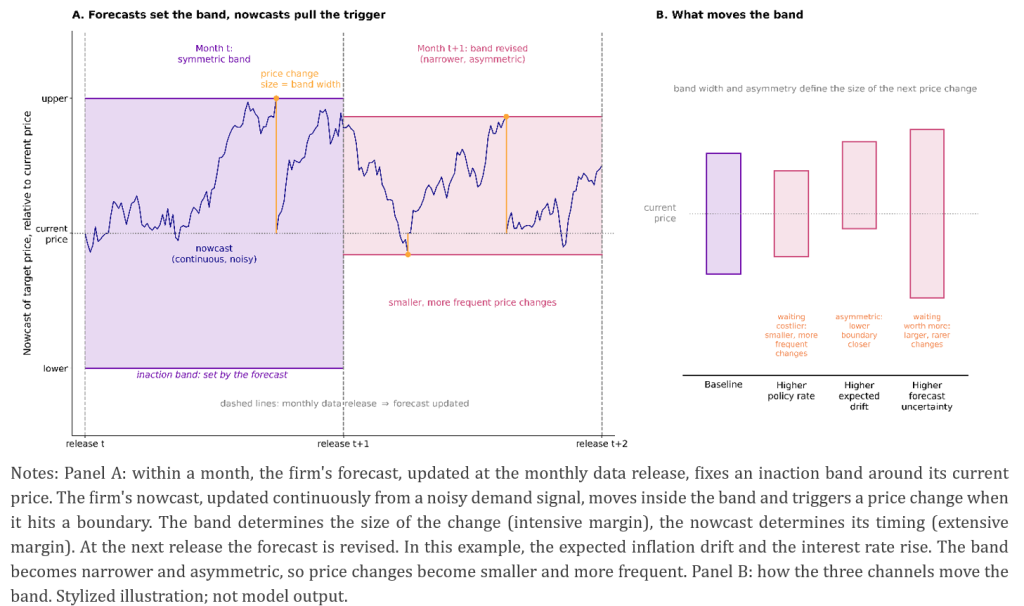
Given their forecast for the environment, firms would prefer to reprice at regular intervals. Unscheduled revisions are triggered by high-frequency information the forecast did not anticipate. Price changes are therefore lumpy and asymmetric. Wide bands absorb transitory noise in tranquil periods. In inflationary periods the bands compress and upward adjustments accelerate, in line with the micro evidence (Lach and Tsiddon, 1992; Peltzman, 2000; Alvarez, Beraja, Gonzalez-Rozada and Neumeyer, 2019).
The width and asymmetry of a firm’s inaction band depend on how the firm perceives its environment. Three channels need to be kept apart, because they operate through different economic logic and because they need not move together.
The policy rate. The nominal short-term interest rate influences the return on the alternative to waiting. Together with the expected drift of inflation, net of the variance of inflation, it defines the opportunity cost of every instant spent with a misaligned price. A higher policy rate raises this cost and compresses the band towards zero. Firms then react to smaller movements in their nowcasts, price changes become smaller and more frequent, and whatever medium-term pressures exist pass through to prices faster. This is a direct, short-run effect of the interest rate on the extensive margin, and it is distinct from the conventional medium-term influence of the policy stance on the trend in aggregate demand.
Expected inflation drift. When a firm expects inflation to rise, it expects its relative price to erode predictably if it waits. The option value of waiting collapses and the band compresses. The compression is asymmetric: a firm anticipating a strong positive drift places its lower boundary closer to its current price than its upper boundary. This adaptation has two effects: hedging against signals that contradict its forecast and preserving repricing frequency. In the aggregate, this state-dependence amplifies inflation volatility during accelerations and attenuates it during decelerations, a pattern consistent with the micro evidence from the recent surge (Cavallo, Lippi and Miyahara, 2024; Karadi, Schoenle and Wursten, 2024).
Forecast uncertainty. A firm whose recent predictions have been poor expects large forecast errors in the period ahead. Acting on a noisy nowcast then carries a high risk of mispricing, the option value of waiting rises, and the band widens. Uncertainty is a brake on transmission in its own right. Whatever the level of inflation or the policy rate. It interacts with market structure: a firm with little pricing power pays more for misaligned price and is correspondingly more prudent. Forecast uncertainty should not be confounded with the volatility of aggregate inflation, which enters separately and less cleanly: it lowers the opportunity cost of waiting, which by itself widens the band, but it also affects the risk of mispricing; its net effect is state-dependent and depends on pricing power and on how well the firm’s expectations track the economy.
Two points follow: First, low inflation drift and high uncertainty are different conditions, even though both lengthen transmission lags. In 2021, Swiss firms combined a high expected drift with small forecast errors, that is, high inflation drift expectations with low uncertainty. In 2023 they combined a low expected drift with large forecast errors. The model treats these as distinct states, and the data bear this out. Second, heterogeneity in forecasting ability generates an endogenous distribution of price stickiness. Firms that predict poorly set wider bands and adjust less often. This is the pattern that Karadi, Schoenle and Wursten (2024) identify as a puzzle for selection effects: The firms whose prices are furthest from their targets are not the ones adjusting first.
Depending on how it perceives these channels, each firm falls at any point in time into one of three regimes (Table 1). Firms move between regimes as their forecasts and their track records evolve, and the distribution of firms across regimes determines the speed of monetary transmission.
Table 1. The three pricing regimes
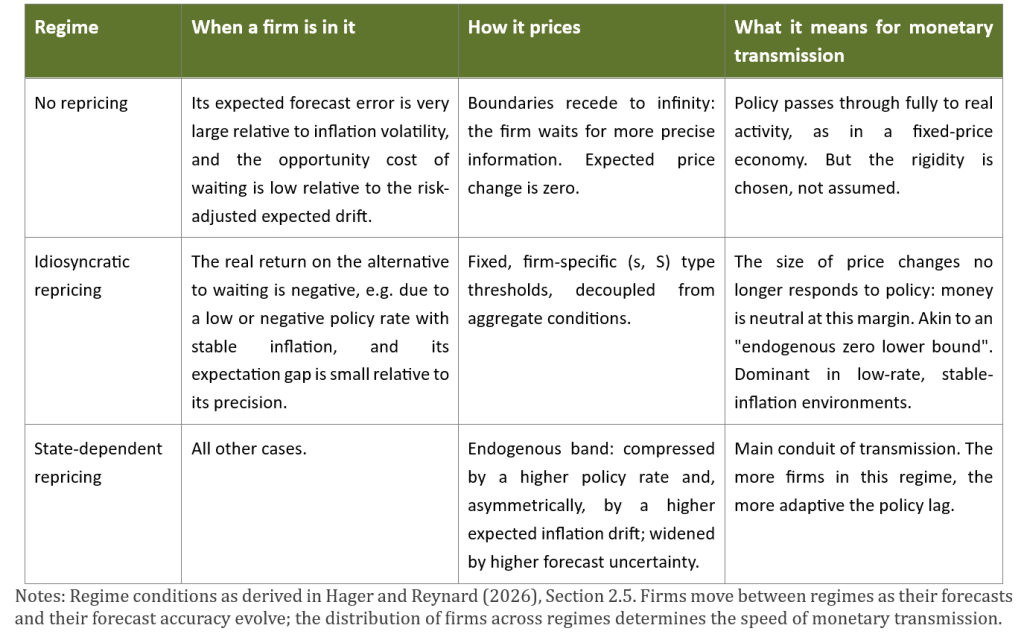
In the no-repricing regime, the firm’s expected forecast error is so large relative to the volatility of inflation, and the opportunity cost of waiting. So low relative to the risk-adjusted expected drift, that the boundaries recede to infinity: the firm prefers to wait for information rather than commit. If all firms were in this regime, monetary policy would pass through fully to real activity, as in a fixed-price economy (Barro and Grossman, 1971), but the rigidity would be a rational choice rather than an assumption.
In the idiosyncratic repricing regime, the real return on the alternative to waiting is negative. Because of a low or negative nominal rate combined with low and stable expected inflation, for example. Firms whose drift of the nowcast is small relative to their precision then follow fixed, firm-specific thresholds of the (s, S) type (Sheshinski and Weiss, 1977), decoupled from aggregate conditions. Price changes still occur, but their size no longer responds to policy signals. Money is neutral at this margin (Caballero and Engel, 2007), and monetary policy loses its traction on real activity. We call this an endogenous zero lower bound: not a bound on the interest rate, but a state in which the interest rate has lost its grip on the size of price adjustments. The model predicts that this regime dominates in low- or negative-rate environments with near-constant inflation.
In the state-dependent repricing regime, the residual case. Here the boundaries are fully endogenous and respond to all three channels. This regime is the conduit of monetary transmission. A higher policy rate compresses the band and forces firms to react to smaller changes in their nowcasts, a higher expected drift compresses it asymmetrically, higher uncertainty widens it.
Put the pieces together and the “long and variable” lag acquires structure. When inflation is low, expectations are stable and the policy rate is low, the opportunity cost of waiting is small or negative, a large mass of firms sits in the idiosyncratic regime or operates with wide bands, the extensive margin is muted, and a shift in the medium-term policy stance takes a long time to show up in aggregate prices. The lag is long. During an inflationary surge, elevated drift expectations compress the bands asymmetrically, a critical mass of firms shifts into the state-dependent regime, the extensive margin dominates, price flexibility rises and the lag shortens. The lag is therefore state-dependent, and the state that governs it is observable: the policy rate, the recent trend in inflation, and the accuracy with which firms have been able to forecast it.
The dynamics around a shock follow from the separation of the two margins. A shock that is widely recognized: an energy price jump, a tariff, a currency move, appears immediately in firms’ nowcasts. It does not change the band, which is fixed within the period, but it raises the probability that either boundary is hit, and so it moves through the economy quickly along the extensive margin. Widely observed shocks travel fast. The size of the price changes they trigger adapts slowly, by contrast, because it is governed by forecasts that are revised only when new data arrive.
The second-round effects run through the data themselves. The price changes triggered in one month appear in the next inflation release. That release feeds the next round of forecasts, shifting drift expectations and perceived volatility and hence the bands. The new bands change the frequency of repricing in the month after. In the simulations of Section 8, the acceleration of repricing in 2021 begins with a minority of accurate forecasters. Their price changes raise realized inflation, which forces the laggards to update, which raises inflation further. This is the feedback that can produce avalanche-like surges (Nirei and Scheinkman, 2023) and the de-anchoring of expectations (Carvalho, Eusepi, Moench and Preston, 2023). It is generated here by rational firms reading the published data. What triggers a change in perceptions is the rate of change of inflation, not its level, which suggests that a sharp rise is more likely to shift firms across regimes than a gradual one of the same cumulative size.
The reverse process is not symmetric. Once the surge has passed, drift expectations fall, while expected forecast errors remain low from the previously aligned rise of inflation. The first change makes price changes more symmetric, the second compresses the bands. Repricing slows, the mass of small price changes near zero increases, especially for price increases, and inflation returns to its earlier pattern only gradually. The model thus predicts that disinflation after a surge is slower than the surge itself, for reasons that require neither wage indexation nor de-anchored expectations: a rational price setter who has just been surprised waits longer before acting again.
Switzerland between July 2010 and May 2024 is an unusually laboratory. The economy moved from a long period of low inflation and negative interest rates into the 2021–2023 surge and back, and as a small open economy whose production sector is heavily exposed to global competition, its supply conditions can be treated as exogenous, which isolates domestic price-setting behavior. We map the model to four monthly series: year-on-year CPI inflation, which is the metric of SNB’s price stability definition and therefore a plausible reference frame for firms’ expectations; the three-month compounded SARON as the opportunity cost of waiting; from the cumulated net balance of firms expecting to raise prices in the KOF business surveys we derive the high-frequency, noisy signal that firms process; and the excess liquidity measure of Reynard (2006, 2007). Excess liquidity is defined by the gap between broad money and the level consistent with prices, potential output and the trend in long-term interest rates. We use it as proxy for unobserved excess demand. Excess liquidity is correlated with Swiss economic activity and inflation (Kugler and Reynard, 2022).
The model has five free parameters, which we estimate with Bayesian methods on the aggregate series. The estimates are stable across rolling 108-month windows that span the transition from deflation to surge, so the framework retains its predictive validity without recalibration and is fully simulable in real time from three observed series. The estimated parameter linking movements in excess liquidity to inflation is close to its upper bound, which is itself a finding: for the Swiss economy, broad monetary aggregates remain an accurate gauge of excess demand and a leading indicator of inflation.
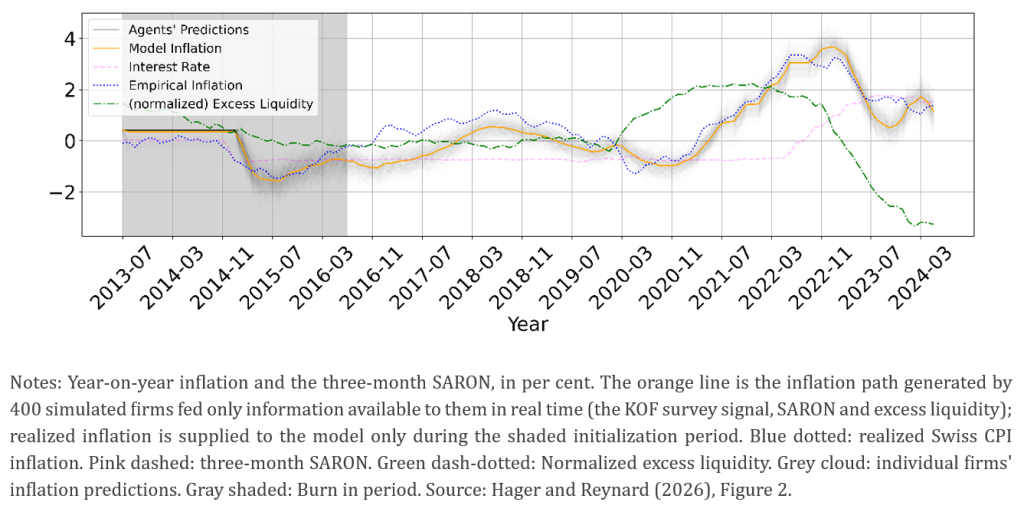
We validate the calibrated model in two ways. First, we simulate 400 firms making pricing decisions at 4,320 points per month, feeding them only what they could have observed in real time: the KOF signal, SARON and excess liquidity. Realized inflation is provided only during an initial burn-in period. Thereafter the inflation series is generated entirely by the simulated firms’ decisions. Figure 2 shows that the endogenous inflation path tracks Swiss inflation closely including the rise from 2020, the peak in 2022 and the decline in 2023 using only information that firms potentially had.
Figure 2. Model-generated inflation versus realized Swiss inflation, 2013–2024
Second, we test the intensive margin out of sample. Using parameters estimated only on data available up to the previous month, we compute the model’s predicted adjustment boundaries and compare them with the distribution of observed price changes across 139 CPI categories published by the Federal Statistical Office. Because the model is calibrated purely on aggregate data, this is a genuine out-of-sample test. A bootstrap procedure that compares the model’s boundaries with 1,000 randomly placed boundaries yields a harmonic-mean p-value of 0.028 across 68 monthly tests: The boundaries predict the size of observed price changes significantly better than chance.
The simulations also reproduce the changing shape of price adjustment over the cycle. Model-implied repricing frequency rises markedly from 2021, initially among a minority of accurate forecasters, and falls back after inflation plateaus in early 2022, when firms lower their drift expectations and raise their expected forecast errors. The cross-sectional distribution of price changes: A pronounced left tail in 2018, symmetry during the 2021 acceleration, and a heavy concentration near zero in 2023 matches the empirical distribution across the three episodes. Standard tests do not reject that model-implied and observed price changes come from the same distribution. The heavy-tailed inflation distributions that López-Salido and Loria (2024) document as “inflation at risk” emerge here from the path- and state-dependence of the mechanism rather than from any distributional assumption, which suggests that the cross-section of price changes carries usable information about the future path of inflation.
The framework contains no policy rule and does not rank instruments, so it cannot say what a central bank should do. It does say what the transmission of a given policy action will look like in a given environment, and several of these implications differ from the standard picture.
The speed of transmission is a function of the state, and the state is observable. Transmission is fast when inflation is rising and expected to keep rising, and when the policy rate is high; it is slow when inflation is stable, the policy rate is low and firms’ forecast errors are large. These conditions can be inferred from the data. The same policy action will therefore have different effects on inflation in an environment like 2021 than in one like 2016, and the difference is predictable rather than random.
The interest rate acts on two horizons. Beyond its conventional medium-term effect on demand, the policy rate changes the cost of waiting and therefore the frequency of price adjustment in the short run. Holding the medium-term stance fixed, the model implies that a rate increase during a period of rising inflation shortens the lag with which prevailing inflationary pressures reach prices, while a rate cut in the same environment reduces repricing activity by lowering the cost of waiting. This is an effect on the timing of price changes, not on their direction, and its size depends on the environment in which the rate is changed.
Persistently low or negative rates with stable inflation weaken the grip of policy on prices. When interest rates are sufficiently low the real return on the alternative to waiting turns negative, a large share of firms migrates into the idiosyncratic regime, and the size of their price changes stops responding to policy. This is the endogenous effective lower bound: monetary policy is not constrained by the level of the rate but decoupled from price setting by the regime it has induced. The model implies that the duration of a low-rate period, not only its depth, matters for how prices later respond.
Uncertainty lengthens lags independently of inflation. Whatever the level of inflation or rates, an environment in which firms cannot forecast the medium-term trend well widens their price adjustment inaction bands and delays adjustment; conversely, conditions under which firms can forecast the trend with confidence shorten the lag. The model thereby gives a precise meaning to the idea that the predictability of the environment, which includes the policy stance, affects transmission: it operates through firms’ expected forecast errors, which are measurable.
Widely observed shocks are transmitted fast and can leave a lasting mark. Because they enter nowcasts immediately, they move prices within the period. Because they then enter the next inflation release, they can shift firms’ perceptions of drift and volatility and thereby the size and frequency of subsequent price changes. It is the rate of change of inflation that triggers this re-evaluation.
Disinflation is asymmetric. After a surge in inflation, the combination of lower drift expectations and higher forecast errors widens bands and slows repricing. The model predicts a period in which price changes cluster near zero and inflation returns to its previous pattern only gradually, without invoking any change in the anchoring of long-run expectations.
Two caveats apply. The model is partial equilibrium: it abstracts from wage-price dynamics, input-output networks and strategic complementarities, which would more likely amplify than offset the informational friction in a general-equilibrium setting. And the evidence is based on data from Switzerland. However, we have presented a general mechanism of forecasting problems with unknown current state.
The contribution of Hager and Reynard (2026) is a rational-agent microfoundation for time variation in the lags of monetary policy transmission that requires no menu costs, no random adjustment opportunities and no cost of acquiring information. It rests on one observation: current inflation is unknown and on the two mechanisms, fore- and nowcasting, firms make in response. Forecasts set the size of price changes while nowcasts set their timing. Because the two are updated at different frequencies, prices are sticky, adjustment is asymmetric, and the transmission lag of monetary policy depends on the policy rate, on the expected drift of inflation and on firms’ forecast uncertainty as three distinct channels. Swiss data confirm that these channels, and the five parameters that govern them, are stable enough to reproduce a decade of inflation dynamics, including a surge and its aftermath, from real-time information alone. The same dual reliance on forecasts and nowcasts characterizes inventory, investment and hiring decisions. Hence, the informational friction studied here is likely to shape the transmission lags of many more policies than the one examined in this note.
Alvarez, F., Beraja, M., Gonzalez-Rozada, M. and Neumeyer, P. A. (2019). From hyperinflation to stable prices: Argentina’s evidence on menu cost models. Quarterly Journal of Economics, 134(1), 451–505. https://doi.org/10.1093/qje/qjy022
Alvarez, F., Lippi, F. and Oskolkov, A. (2022). The macroeconomics of sticky prices with generalized hazard functions. Quarterly Journal of Economics, 137(2), 989–1038. https://doi.org/10.1093/qje/qjab042
Barro, R. J. and Grossman, H. I. (1971). A general disequilibrium model of income and employment. American Economic Review, 61(1), 82–93. https://www.jstor.org/stable/1910543
Caballero, R. J. and Engel, E. M. R. A. (1993). Microeconomic adjustment hazards and aggregate dynamics. Quarterly Journal of Economics, 108(2), 359–383. https://doi.org/10.2307/2118335
Caballero, R. J. and Engel, E. M. R. A. (2007). Price stickiness in Ss models: New interpretations of old results. Journal of Monetary Economics, 54, 100–121. https://doi.org/10.1016/j.jmoneco.2007.06.020
Calvo, G. A. (1983). Staggered prices in a utility-maximizing framework. Journal of Monetary Economics, 12(3), 383–398. https://doi.org/10.1016/0304-3932(83)90060-0
Carvalho, C., Eusepi, S., Moench, E. and Preston, B. (2023). Anchored inflation expectations. American Economic Journal: Macroeconomics, 15(1), 1–47. https://doi.org/10.1257/mac.20200080
Cavallo, A., Lippi, F. and Miyahara, K. (2024). Large shocks travel fast. American Economic Review: Insights, 6(4), 558–574. https://doi.org/10.1257/aeri.20230454
Friedman, M. (1961). The lag in effect of monetary policy. Journal of Political Economy, 69(5), 447–466. https://www.jstor.org/stable/1828534
Golosov, M. and Lucas, R. E. (2007). Menu costs and Phillips curves. Journal of Political Economy, 115(2), 171–199. https://doi.org/10.1086/512625
Hager, D. M. and Reynard, S. (2026). Forecasts, nowcasts and monetary policy lags. SNB Working Paper 8/2026, Swiss National Bank. https://doi.org/10.2139/ssrn.7088199
Karadi, P., Schoenle, R. and Wursten, J. (2024). Price selection in the microdata. Journal of Political Economy Macroeconomics, 2(2), 228–271. https://doi.org/10.1086/730220
Kugler, P. and Reynard, S. (2022). Money and inflation in Switzerland. Swiss Journal of Economics and Statistics, 158(1). https://doi.org/10.1186/s41937-021-00081-1
Lach, S. and Tsiddon, D. (1992). The behavior of prices and inflation: An empirical analysis of disaggregated price data. Journal of Political Economy, 100(2), 349–389. https://doi.org/10.1086/261821
López-Salido, D. and Loria, F. (2024). Inflation at risk. Journal of Monetary Economics, 145, 103570. https://doi.org/10.1016/j.jmoneco.2024.103570
McDonald, R. and Siegel, D. (1986). The value of waiting to invest. Quarterly Journal of Economics, 101(4), 707–727. https://doi.org/10.2307/1884175
Nirei, M. and Scheinkman, J. A. (2023). Repricing avalanches. Journal of Political Economy, forthcoming. https://doi.org/10.1086/727286
Peltzman, S. (2000). Prices rise faster than they fall. Journal of Political Economy, 108(3), 466–502. https://doi.org/10.1086/262126
Reynard, S. (2006). Money and the great disinflation. SNB Working Paper, Swiss National Bank [number and link to confirm].
Reynard, S. (2007). Maintaining low inflation: Money, interest rates, and policy stance. Journal of Monetary Economics, 54(5), 1441–1471. https://doi.org/10.1016/j.jmoneco.2007.06.018
Sheshinski, E. and Weiss, Y. (1977). Inflation and costs of price adjustment. Review of Economic Studies, 44(2), 287–303. https://doi.org/10.2307/2297067
Sims, C. A. (2003). Implication of rational inattention. Journal of Monetary Economics, 50(3), 665-690.
Turén, J. (2023). State-Dependent Attention and Pricing Decisions. American Economic Journal: Macroeconomics, 15(4), 1–34.