

This paper is based on IMF Working Paper 26/216 “Does Foreign Borrowing Lift Growth?”. The views expressed are those of the authors and do not necessarily reflect those of the IMF, its Executive Board, or IMF management.
Abstract
Does access to foreign credit by governments raise growth? The question is difficult to answer because government borrowing responds to economic conditions. Our new research finds that foreign government borrowing does not automatically strengthen growth: institutional quality determines whether greater access to external credit supports productive investment and sustainable economic outcomes. Institutional absorptive capacity is therefore central to realizing the potential benefits of external financing. Capacity development and technical assistance in public investment management and fiscal institutions can help strengthen the conditions under which external borrowing is used productively and supports growth.
Should capital-scarce countries’ governments borrow abroad? Standard neoclassical models suggest they should: foreign financing can support investment and speed convergence. Yet capital does not consistently flow to countries with the greatest growth potential (Gourinchas and Jeanne 2013). A growing literature also argues that foreign credit can weaken fiscal discipline, appreciate the real exchange rate, and delay productivity-enhancing reforms (e.g., Aguiar and Amador 2011; Aguiar 2025).
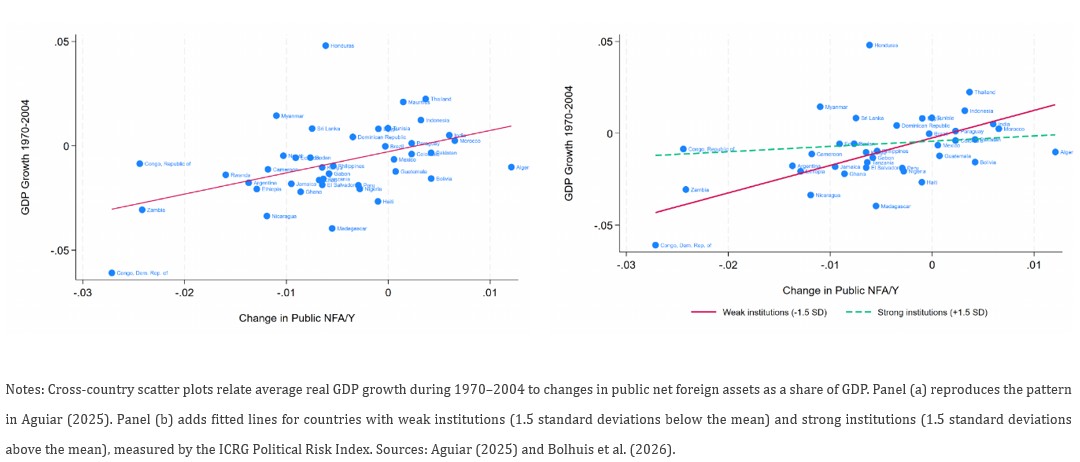
Cross-country evidence partly supports this concern. Following Aguiar (2025), Figure 1(a) relates average GDP growth during 1970–2004 to changes in countries’ public net foreign asset positions: countries that borrowed more abroad grew less. But institutional capacity may shape countries’ ability to channel foreign credit into productive uses. Figure 1(b) explores this possibility using the ICRG Political Risk Index. The relationship between external borrowing and growth is steep among countries with low scores but nearly flat among those with high scores, suggesting that institutions influence the returns to external borrowing.
Figure 1. Public external borrowing, growth, and institutional quality
These correlations are not necessarily causal. Governments may borrow more when growth is weak or fiscal pressures are high, while creditors adjust lending in response to perceived risk. Because observed borrowing reflects both credit demand and credit supply, it is difficult to distinguish the effects of borrowing from the conditions that prompt it.
In a recent paper, we tackle this identification problem directly (Bolhuis et al. 2026). Our approach builds on a defining feature of international public lending: borrowing relationships are both concentrated and persistent. World Bank data covering the external public debt of 134 emerging market and developing economies (EMDEs), owed to 302 creditors during 1970–2023, show that a country’s three largest creditors typically hold 50–75 percent of its external debt. In a typical year, about 85 percent of net borrowing also occurs through existing relationships.
Adapting methods developed for bank lending (Amiti and Weinstein 2018; Amiti et al. 2019), we separate net borrowing in each borrower–creditor relationship into global, borrower-specific demand, and creditor-specific supply components. We construct each country’s credit supply shock by weighting the creditor-specific component by its pre-existing exposure to that creditor. Thus, when a creditor expands or contracts lending across its portfolio, countries with greater exposure experience a larger change in borrowing capacity—one unrelated to their own financing needs.
The shocks perform as intended. Lagged GDP growth predicts the demand component but not the supply shock. On impact, a one-standard-deviation supply shock increases net borrowing by about 8 percent, and the external debt stock continues to rise in subsequent years. We use local projections to trace the resulting effects on fiscal, real, and external variables.
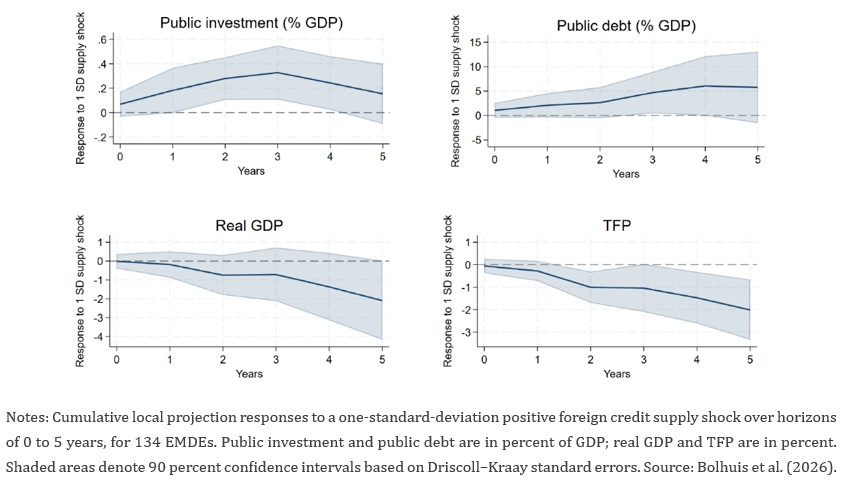
Figure 2 presents the average response to a positive credit supply shock, broadly confirming the account in Aguiar (2025). After three years, public investment is about 0.3–0.4 percentage points of GDP higher; after four to five years, the public debt ratio is roughly six percentage points higher. Larger fiscal deficits, rather than increased revenues, finance this expansion. At longer horizons, real GDP and total factor productivity (TFP) decline—significantly so for TFP—while private investment falls over the medium term, suggesting some crowding out. The real exchange rate appreciates and the current account worsens. Thus, although exogenous access to external public finance eases financing constraints and raises government investment, it does not, on average, produce stronger medium-term growth.
Figure 2. Average responses to a foreign credit supply shock
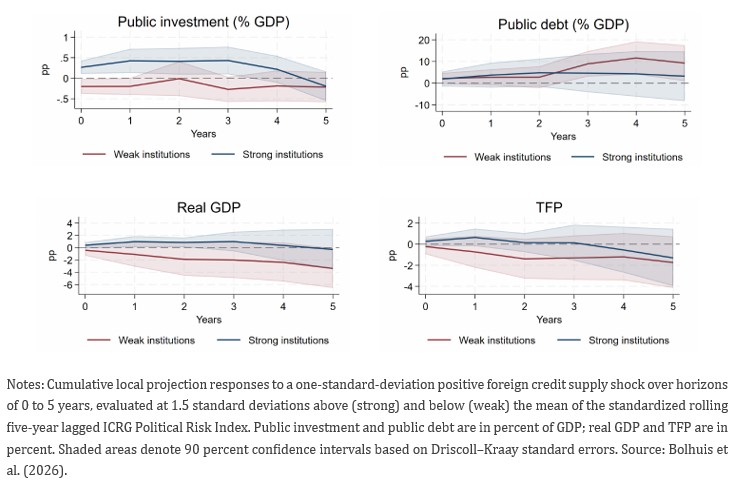
These averages conceal substantial cross-country variation, consistent with Figure 1(b). To examine the role of institutions, we interact the credit supply shock with the lagged five-year rolling average of the ICRG Political Risk Index, ensuring that institutional quality is predetermined. We then compare outcomes for countries 1.5 standard deviations above and below the mean (Figure 3).
Countries with stronger institutions make more effective use of additional credit. Public investment rises more and remains elevated longer, while revenues and the overall fiscal balance remain stable and debt accumulate more slowly. These governments also replace domestic with external financing, limiting the crowding out of private credit. By contrast, in countries with weaker institutions, public investment shows no increase, while revenues and the fiscal balance deteriorate. Real outcomes display a similar divide: GDP and TFP remain broadly stable in stronger-institution countries but decline in weaker-institution countries.
Figure 3. Responses to a foreign credit supply shock, by institutional quality
Our findings temper both the neoclassical view that external public finance accelerates development and the argument that it can weaken growth (Aguiar and Amador 2011; Aguiar 2025). Isolating the exogenous, creditor-driven component of government borrowing, we find that it raises public investment and debt on average, but not growth. Its benefits depend on the absorptive capacity created by political institutions. In countries with stronger institutions, additional external credit finances public investment and replaces domestic borrowing; in countries with weaker institutions, it does not. Institutional absorptive capacity is therefore an important consideration in assessing the likely benefits of additional external financing. Capacity development and technical assistance, particularly in public investment management and fiscal institutions, can strengthen the conditions under which external finance is used productively. Finance may create opportunities, but absorptive capacity determines whether they translate into growth.
Aguiar, M (2025), “The Costs and Consequences of Sovereign Borrowing,” IMF Economic Review 73: 1–19.
Aguiar, M and M Amador (2011), “Growth in the Shadow of Expropriation,” Quarterly Journal of Economics 126(2): 651–697.
Amiti, M, P McGuire and D E Weinstein (2019), “International Bank Flows and the Global Financial Cycle,” IMF Economic Review 67(1): 61–108.
Amiti, M and D E Weinstein (2018), “How Much Do Idiosyncratic Bank Shocks Affect Investment? Evidence from Matched Bank-Firm Loan Data,” Journal of Political Economy 126(2): 525–587.
Bolhuis, M A, T Krahnke and P N’Diaye (2026), “Does Foreign Borrowing Lift Growth?”, IMF Working Paper 26/216, Washington D.C.
Gourinchas, P-O and O Jeanne (2013), “Capital Flows to Developing Countries: The Allocation Puzzle,” Review of Economic Studies 80(4): 1484–1515.