

This policy brief is based on Menna, Moura, and Tobal (2025), published in Finance Research Letters. It has been newly written for SUERF’s policy audience and does not reproduce the journal article in its published form. The views expressed are those of the authors and do not necessarily reflect those of Banco de México.
Abstract
This note examines whether global financial tightening is more disruptive for emerging market and developing economies when financial assets in major centers are priced above fundamentals. Using a monthly dataset for 15 EMDEs from 1999 to 2025, the analysis shows three results. First, a tightening in global financial conditions raises sovereign spreads materially. Second, this effect is significantly larger when equity valuations in the United States or Europe are stretched. Third, stronger current account positions partly offset the damage, especially during periods of overvaluation. The evidence suggests that external-balance buffers and global valuation indicators should be monitored jointly when assessing sovereign risk.
Tightening in global financial conditions does not always have the same implications. It may occur after a period of buoyant market sentiment, when asset prices in major financial centers are more likely to have deviated from fundamentals. In such cases, the effects may be more severe, as corrections in asset prices can be sharper, risk appetite can retreat more quickly, and external financing conditions can tighten more abruptly.
This distinction matters for policy-making. International institutions such as the IMF, the BIS, the OECD, and the World Bank have long monitored asset valuation indicators as part of their surveillance of global vulnerabilities. Yet policy discussions do not always account for the possibility that the effects of global tightening depend on the level of asset valuations in major financial centers. For EMDE policymakers, this is a particularly relevant consideration.
This note addresses that issue directly. Based on the evidence found by Menna, Moura, and Tobal (2025), it examines whether tightening in global financial conditions leads to larger increases in EMDE sovereign spreads when assets in the United States and Europe appear overvalued. It also asks whether stronger external balances in EMDEs mitigate this amplification. The findings suggest that they do: tighter global financial conditions raise sovereign spreads, the effect is larger when valuations in major financial centers are stretched, and current account surpluses provide a measurable cushion for EMDEs.
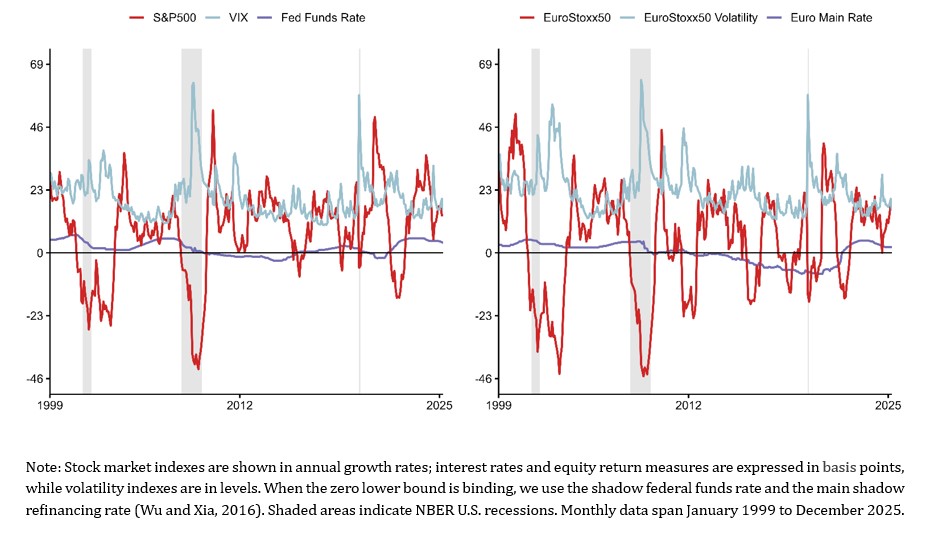
The evidence is based on a monthly dataset covering global and country-specific variables for 15 EMDEs over 1999–2025. Sovereign risk is measured using EMBI spreads. Global financial conditions are summarized by a parsimonious index constructed from major-market interest rates, equity returns, and implied volatility (VIX). In early 2025, financial conditions tightened amid heightened protectionist trade rhetoric, culminating in the so-called “Liberation Day,” and were accompanied by sharp market declines and elevated volatility across economies. Overvaluation measures in the United States and Europe are captured by valuation-gap indicators based on deviations from fair value and the cyclical component of CAPE-type measures Our empirical approach then traces the response of EMDE spreads to a tightening shock in global financial conditions under different valuation and external-balance scenarios.
Three results stand out. First, tighter global financial conditions raise EMDE sovereign spreads even when valuations in major financial centers are broadly aligned with fundamentals. At the peak response, a one-standard-deviation tightening increases spreads by about 67.5 basis points using the U.S. valuation measure and by about 60.34 basis points using the European measure. Second, stretched valuations amplify that baseline effect. When asset prices in major financial centers are above fair value, the same shock adds roughly 24 to 26 basis points to the increase in spreads. In this sense, overvaluation does not merely coincide with vulnerability; it amplifies the transmission of adverse global financial shocks to EMDE sovereign risk.
Third, stronger external balances cushion these effects. EMDEs with current account surpluses experience a meaningful moderation in the impact of global tightening, and that buffering role becomes stronger when valuations in major financial centers are elevated. In the paper’s calibration, the combined mitigating effect reaches about 12 basis points during periods of stress and overvaluation.
Figure 1. Variables Used in GFC Index Construction
An important implication is that asset overvaluation should be treated as a state variable in global surveillance, not merely as a background condition. When major financial centers appear stretched, the same adverse news can generate larger movements in EMDE borrowing costs and, more generally, macro-financial variables.
This matters for at least three policy communities. For policymakers across emerging market economies, the findings underscore the value of strong external balances as a first line of defense against volatility in international financial markets. For central banks and financial-stability teams, the results support monitoring valuation indicators and standard measures of global financial conditions. For reserve managers and macroprudential authorities, the evidence reinforces the value of policy space and external buffers before volatility spikes rather than after.
The results also help refine the discussion about external resilience. Stronger current account positions do not eliminate exposure to global shocks, but they make countries less vulnerable precisely when global shocks hit a fragile valuation backdrop. That makes external balances more than a slow-moving macroeconomic indicator; they become part of a state-contingent defense mechanism.
A practical response is to embed global valuation indicators into routine sovereign-risk monitoring. For example, a dashboard that jointly tracks global financial conditions, valuation gaps in major financial centers, the current account, external financing needs, and reserve adequacy can materially improve awareness.
Second, authorities can use this evidence in undertaking stress testing. They could compare at least two cases instead of applying a single generic global tightening scenario: one in which global tightening occurs under broadly fair valuations and another in which it occurs after a prolonged period of overvaluation. The latter should generate larger spread responses and tighter financing conditions for EMDEs.
Third, the findings have communication value. The framework in this paper offers a clear narrative: the same external shock becomes more damaging when the global system has accumulated valuation risk, while stronger external balances help absorb part of the shock. This narrative can be helpful in supporting different sorts of macroeconomic policies in EMDEs, not only regulatory frameworks.
This evidence is best interpreted as a risk-amplification framework. It does not claim that every episode of elevated valuations will be followed by a sharp tightening, nor that current account surpluses immunize countries from stress. Rather, it shows that when a tightening in global financial conditions occurs, the surrounding valuation environment and the strength of external balances meaningfully shape the sovereign-risk outcome.
That distinction is useful for policy design. The right lesson is not to treat valuation indicators as mechanical triggers, but to use them to scale prudence, strengthen contingency planning, and interpret adverse moves in spreads more effectively.
It is also worth keeping the sample and measurement choices in mind. The article focuses on EMDEs with sufficiently long EMBI histories and uses valuation-gap indicators for the United States and Europe. Even so, the message is robust and operationally relevant: global tightening is more costly for EMDEs when it hits an already stretched financial system.
For EMDE policymakers, the question is not only whether global financial conditions are tightening, but also what kind of global financial environment that tightening is hitting. This note shows that overvaluation in major financial centers makes global tightening more damaging for sovereign spreads, while stronger current account positions provide a partial buffer.
That combination of findings has a straightforward policy message. Monitoring global financial conditions without monitoring valuation risk can understate vulnerability. Monitoring valuation risk without looking at domestic external buffers can overstate it. The more useful approach is to assess both jointly and to treat external resilience as especially valuable when the global system appears stretched.
Menna, L., Moura, R., and Tobal, M. (2025). “Beyond the literature: what policymakers reveal about financial asset overvaluation?” Finance Research Letters, 86, 108577.
Bank for International Settlements (2024). BIS Quarterly Review.
International Monetary Fund (2024). Global Financial Stability Report: Steadying the Course.
International Monetary Fund (2025). Global Financial Stability Report: Enhancing Resilience amid Uncertainty.
OECD, 1998. Economic Outlook. https://www.oecd.org/en/publications/oecd-economic-outlook-volume-1998-issue-2_eco_outlook-v1998-2-en.html.
World-Bank. Global economic prospects. Technical report, World Bank, June 2024.