

This policy brief is based on Deutsche Bundesbank Discussion Paper 12/2026. The views expressed are those of the authors and do not necessarily represent those of the Deutsche Bundesbank or the Eurosystem.
Abstract
Macroprudential capital buffers are designed to contain bank-credit risk inside the country that activates them, and the Basel framework’s mandatory reciprocity rule closes the most obvious cross-border channel by tying the applicable buffer to the borrower’s host country rather than the lender’s home country. But a country can only regulate the banks that lend on its territory, not the multinational firm that borrows there. Using German credit-register and direct-investment microdata around the staggered activation of the countercyclical capital buffer (CCyB) in ten European host countries between 2014 and 2019, we trace a complete firm-side leakage chain through the internal capital markets of multinational corporations: bank credit to the affected foreign subsidiary contracts; the parent fully replaces the lost credit with internal debt; the parent refinances at home, where Germany kept its CCyB at zero throughout; and parent and consolidated-group default probabilities rise in parallel by roughly a quarter and a fifth of their respective unconditional means. The risk that the foreign buffer was designed to contain abroad has migrated to the parent’s home jurisdiction. Reciprocity prices the bank-side spillover; the firm-side spillover stays free.
The countercyclical capital buffer is one of the post-crisis era’s most prominent macroprudential instruments. Each national authority calibrates it to credit and macroeconomic conditions in its own jurisdiction, and the Basel framework attaches a critical safeguard: under mandatory reciprocity, the applicable buffer rate is determined by the borrower’s host country, not the lender’s home country. A German bank lending to a Norwegian firm applies the Norwegian rate, regardless of what its German supervisor has set. Without that safeguard, banks could book the same loan from a more permissive jurisdiction and defeat the policy; with it, the bank-side margin of arbitrage is closed.
But a country can only regulate the banks that lend on its territory; it cannot regulate the multinational firm that borrows there. A multinational corporation operates an internal capital market that moves funds across borders outside the direct reach of any single prudential regulator, so the same regulatory tightening that compresses bank credit to a foreign subsidiary can re-route through the multinational’s internal structure and re-emerge in the parent’s home country, on the home country’s banks, and outside the activating country’s policy perimeter. Whether this firm-side channel is empirically real, how large it is, and where the resulting risk migration lands are open questions that bank-side reciprocity, by construction, does not address. This brief reports the evidence.
Our setting is the staggered activation of CCyBs across European host countries of German multinationals’ foreign subsidiaries between 2014 and 2019. Ten of twenty-nine sample countries activated a positive buffer over this window, with rates ranging from 0.25 per cent in France to 2.5 per cent in Norway and Sweden. Germany kept its own CCyB at zero throughout, so a buffer shock reaches a German multinational only through one of its foreign subsidiaries. Two proprietary Bundesbank micro-datasets let us observe both ends of the chain and the conduit between them: the credit register records quarterly bank and nonbank lending to individual firms together with lender-reported probabilities of default, and the direct-investment statistics identify German parents, their foreign subsidiaries, ownership links, and parent-provided internal debt.
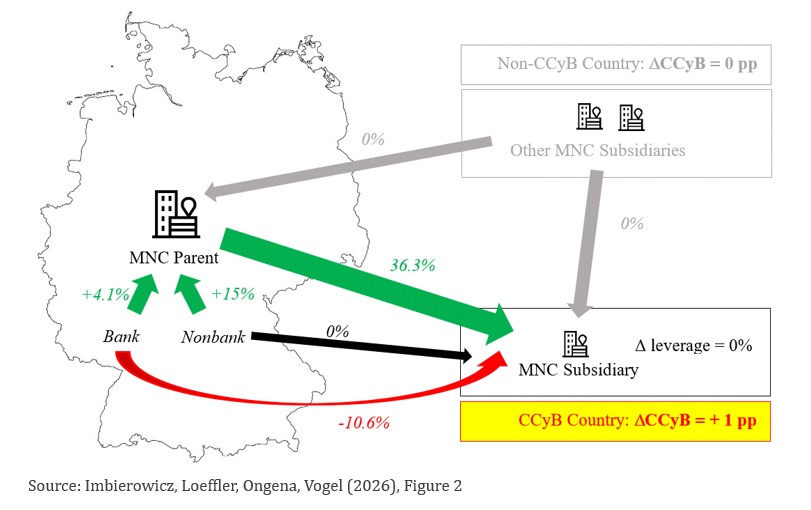
The chain has four links and a single arithmetic, all per percentage-point host-country CCyB. Bank credit to the affected foreign subsidiary contracts by approximately 10.6 per cent in our most saturated specification, while nonbank credit to the same subsidiaries does not respond. A complementary country-quarter specification that holds standard macroeconomic conditions constant confirms the supply reading: the regulated bank channel contracts and the unregulated nonbank channel does not. The parent then fully replaces the lost subsidiary bank credit with internal debt, raising parent-provided internal debt to the affected subsidiary by approximately 36 per cent and the share of parent-provided debt in subsidiary total liabilities by 2.3 percentage points; the adjustment runs through debt rather than equity, and subsidiary total liabilities and the subsidiary’s lender-reported probability of default are statistically unchanged. From the subsidiary’s perspective, the buffer has been neutralised by the parent.
The parent then refinances the additional internal support in its own home credit market: parent bank borrowing in Germany rises by approximately 4.1 per cent and parent nonbank borrowing by approximately 15.0 per cent. The parent does not redirect funds from other subsidiaries; it taps domestic markets, and it does so on terms that carry the corresponding risk. The parent’s own probability of default rises by 9 to 10 basis points, roughly a quarter of the parent’s unconditional default probability. At the level of the consolidated multinational group, German lender exposures rise by 5.2 per cent in bank credit and 17.0 per cent in nonbank credit, and the credit-weighted group probability of default rises by 7.7 to 9.3 basis points, roughly a fifth of the group’s unconditional default probability. The buffer that activated abroad reappears on the consolidated balance sheet of the parent’s domestic lenders as both higher exposure and higher risk on that exposure.
Figure 1. Summary of the Changes in Lending
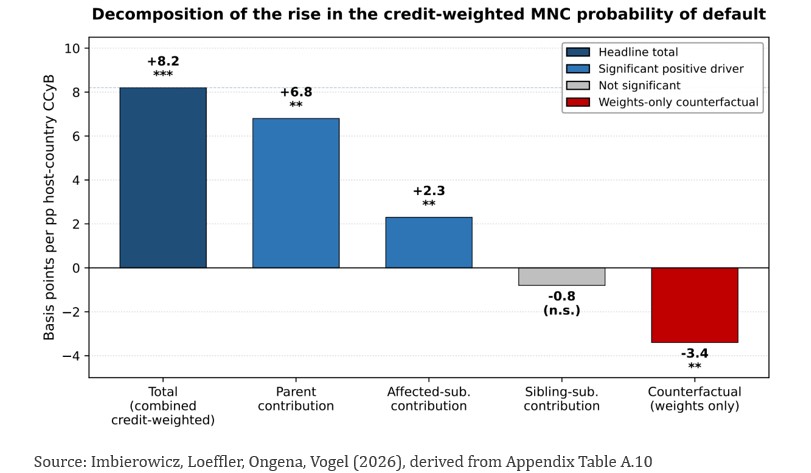
A natural question is whether the rise in the consolidated group’s credit-weighted default probability reflects a real deterioration in member-level risk or merely a re-weighting of the group’s credit composition toward riskier members. Our paper decomposes the rise unambiguously: of the combined 8.2-basis-point rise per percentage-point CCyB, 6.8 basis points come from movements in the parent’s own probability of default, 2.3 basis points from the affected subsidiary’s, and the contribution of sibling (unaffected) subsidiaries is statistically indistinguishable from zero. A counterfactual that holds member-level default probabilities fixed at their pre-CCyB averages and lets only the credit weights move predicts a decline of 3.4 basis points; the observed rise is therefore a real deterioration, not a re-weighting artefact, and it lands predominantly at the parent. The bank-side reciprocity rule transfers the regulatory bite to the activating host country; the firm-side channel transfers the consequent risk migration back to the parent’s home country, and the migration lands on the parent’s own balance sheet rather than on the affected subsidiary’s. The two transfers cancel only if the supervisor of the parent’s home jurisdiction knows, monitors, and prices the resulting consolidated-group exposure on its own home-country banks’ balance sheets, which at present it does not.
Figure 2. Decomposition of the Changes in Probability of Default (bps)
The chain rests on a staggered difference-in-differences design exploiting the heterogeneous timing of CCyB activations across the ten host countries. Recent work in econometrics (Borusyak, Jaravel and Spiess 2024; Sun and Abraham 2021) has shown that the standard staggered design can be biased when treatment effects are heterogeneous across cohorts; we apply both the Borusyak–Jaravel–Spiess imputation estimator and the Sun–Abraham interaction-weighted estimator to the three central outcomes. Pre-event coefficients are statistically indistinguishable from zero, post-event coefficients align with the static estimates, and the cohort-heterogeneity concern is ruled out.
The parent-side magnitudes also survive on a propensity-matched parent sample. We match treated parents to never-treated parents on pre-period parent size, foreign-subsidiary count, and a manufacturing-sector indicator, restricting the match pool to parents that already held at least one foreign subsidiary in 2013 so that treated and controls share the same foreign-presence structure. Eighty-nine of ninety-one eligible treated parents are matched on common support, and the headline magnitudes are preserved: parent nonbank borrowing rises by 18.5 per cent, and the parent’s probability of default rises by 13 to 15 basis points, both highly statistically significant. The risk migration we identify is therefore neither an artefact of a specific econometric estimator nor a consequence of dynamic selection of parents into foreign-subsidiary networks.
The cross-border-spillover literature on bank capital regulation has, until now, focused on the bank as the routing agent: foreign branches shift credit across borders, lenders in non-activating jurisdictions substitute into the activating market, and reciprocity prices these bank-side effects. Our contribution is to identify a separate firm-side cross-border channel that reciprocity, by construction, does not address. Internal capital markets in multinational firms have been studied in tax contexts (Desai, Foley and Hines 2004) and in crisis contexts that propagate parent shocks outward to affiliates (Biermann and Huber 2024); our setting is different. The shock is policy-driven rather than crisis-driven, the direction of transmission runs inward from the affiliate to the parent’s home credit market rather than outward, and the affiliate-side adjustment is financial (internal debt) rather than real (employment). The novelty is that an internal capital market can absorb a small, granular, policy-driven foreign shock at a high enough frequency to neutralise the policy at the affiliate level and reallocate its risk to the parent’s home jurisdiction.
Three implications follow. First, the bank-side reciprocity rule is not the binding constraint, and adjusting it will not address the channel we identify. The constraint is the missing rule at the consolidated-multinational-group level: reciprocity tells a German bank that it must apply the Norwegian buffer to its Norwegian exposure, but no rule tells the German parent of a Norwegian subsidiary that it must internalise the cost of routing the group’s funding back through Germany. The natural symmetric rule would coordinate at the consolidated-group level rather than at the bank level alone.
Second, the supervisory information set required to price the channel is currently fragmented. The host-country supervisor sees the bank-side contraction; the parent-country supervisor sees the parent-side refinancing; neither sees the intra-group debt flow that connects the two. Adding intra-group debt flows of multinational borrowers to the information-sharing agenda within the European Systemic Risk Board and similar fora is a concrete, implementable next step that does not require a new instrument.
Third, the instruments that could price the firm-side channel at the consolidated-group level already exist in spirit: large-exposure limits applied at the consolidated-group rather than consolidated-bank level, group-wide leverage caps on multinational borrowers, and supervisory attention to cross-border internal-debt patterns. None of these requires relaxing reciprocity or the bank-side framework; they are complementary to it.
Capital buffers were designed to contain credit-risk consequences inside the jurisdictions that activate them, and the bank-side reciprocity rule closes the most obvious arbitrage channel. The firm-side channel we document is a separate mechanism through which the policy’s incidence migrates back across borders: a foreign capital buffer that compresses bank credit to a foreign subsidiary reappears, in our data, as additional leverage and risk on the parent’s home-country balance sheet. The next step is to make the consolidated multinational group a unit of supervisory observation, information sharing, and ultimately instrument calibration.
Borusyak, K., X. Jaravel, and J. Spiess. 2024. Revisiting Event Study Designs: Robust and Efficient Estimation. Review of Economic Studies 91: 3253–3285. https://doi.org/10.1093/restud/rdae007
Desai, M. A., C. F. Foley, and J. R. Hines Jr. 2004. A Multinational Perspective on Capital Structure Choice and Internal Capital Markets. Journal of Finance 59: 2451–2487. https://doi.org/10.1111/j.1540-6261.2004.00706.x
Biermann, M., and K. Huber. 2024. Tracing the International Transmission of a Crisis Through Multinational Firms. Journal of Finance 79: 1789–1829. https://doi.org/10.1111/jofi.13338
Imbierowicz, B., A. Loeffler, S. Ongena, and U. Vogel. 2026. How CCyBs Travel? Internal Capital Markets & Domestic Borrowing. Deutsche Bundesbank Discussion Paper No. 12/2026; SSRN Working Paper 6802158. https://papers.ssrn.com/sol3/papers.cfm?abstract_id=6802158
Sun, L., and S. Abraham. 2021. Estimating Dynamic Treatment Effects in Event Studies with Heterogeneous Treatment Effects. Journal of Econometrics 225: 175–199. https://doi.org/10.1016/j.jeconom.2020.09.006