

This policy brief is based on ECB Working Paper No. 3245. The views expressed are those of the authors and not necessarily those of the institutions the authors are affiliated with.
Abstract
Much evidence on what drives foreign direct investment (FDI) is based on data that is aggregated to the country level. A new sector-level dataset allows us to investigate sector-specific determinants of FDI based on a gravity model for 184 countries over the period 2010 to 2020. We find that the relationship between FDI and distance (between source and host country) varies considerably across sectors. FDI policies should hence be sector-specific to effectively attract FDI and leverage its potential economic benefits.
Foreign direct investment (FDI) is an important type of cross-country capital flows. It mostly reflects investment of multinational firms and is widely believed to have favorable effects on employment, economic growth, and other macroeconomic development outcomes. Many policy actors hence aim to attract FDI to their country through policies such as investment liberalization, tax incentives, or through specialized investment promotion agencies (IPAs).
To be effective and efficient, FDI policies need to be informed by evidence about what drives FDI. A large literature in international economics and business has analyzed FDI determinants and highlights the role of factor endowments, institutions, geography, and cultural factors (see Schneider and Wacker, 2022). Those determinants also interact with firms’ motive to perform FDI. For example, if FDI is market-seeking, it is attracted by high income levels and associate purchasing power in the host economy. Conversely, if FDI is efficiency-seeking, high wages are a deterrent to FDI.
This suggests that determinants of FDI vary across sectors. In some manufacturing sectors, for example, the potential for globally slicing up value chains is large and intermediate inputs like a wire, conductor, or microchip travel long distances before they reach the consumer in a final product like a cell phone or car. There is hence more scope for efficiency-seeking motives in those sectors. In other sectors, like some services, the potential for efficiency-led global unbundling is much smaller and FDI in those sectors tends to be more market-seeking.
Geographic distance plays a decisive role in understanding the nature of FDI. For efficiency-seeking FDI, distance should be negatively correlated with FDI (holding everything else equal). Distance is associated with trade costs and hence limits possible efficiency gains from slicing up value chains. Conversely, market-seeking FDI should be positively associated with distance. The economic rationale for this positive association is that FDI competes with exporting as a market-entry mode. If an attractive foreign market is close, trade costs are low and exporting is more attractive. The further away the host country is, the more attractive FDI becomes as an entry mode. Hence the expected positive association of market-seeking FDI increases with distance.
The role of distance is relatively poorly understood in the literature: On the one hand, evidence clearly suggests a negative association between FDI and distance. On the other hand, this conflicts with the prevailing view that FDI is predominantly market-seeking. One possible solution to this puzzle is that even market-seeking FDI contains a relevant degree of intra-firm division of labor. For example, if there are a lot of transactions between headquarters and affiliates, those transactions costs may rise with distance, such that distance also deters market-seeking FDI.
No study so far has looked into sector-specific FDI determinants across a comprehensive set of countries, despite the fact that firm-internal transaction costs and FDI motives should vary across sectors. This lack of evidence reflects the absence of comprehensive sector-specific FDI data – an issue that has been resolved through the recent MREID data (Ahmad et al., 2025). Prior to their contribution, most studies were based on aggregate bilateral FDI data or on firm-level data from a single country.
We leverage this new sector-level dataset in a gravity model for FDI that relates bilateral FDI stocks to the economic sizes of countries, the distance between them, and other factors influencing cross-border investment decisions, such as trade costs, colonial and cultural ties, institutional distance, exchange-rate regimes, and financial development. Our analysis covers 25 NAICS 2-digit sectors for 184 countries over the period 2010 to 2020 and provides the following main results:
Figure 1. Relationship between FDI and distance across sectors
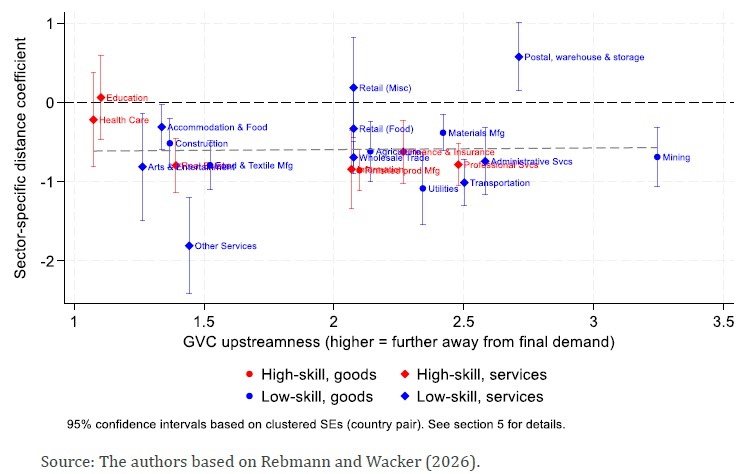
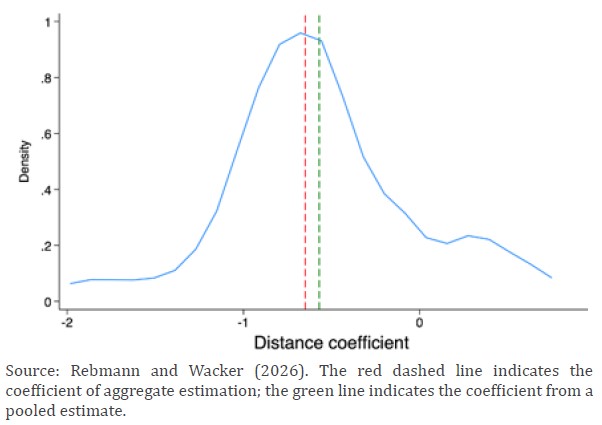
Figure 2. Distribution of distance coefficient across sectors
Ahmad, S., Bergstrand, J., Paniagua, J. & Wickramarachi, H. (2025). The Multinational Revenue, Employment, and Investment Database (MREID). Review of International Economics, 33(4), 817-836.
Kleinert, J. & Toubal, F. (2010). Gravity for FDI. Review of International Economics, 18(1), 1-13.
Neary, J.P. (2009). Trade costs and foreign direct investment. International Review of Economics and Finance, 18(2), 207-218.
Rebmann, N. & Wacker, K.M. (2026). FDI, gravity, and aggregation: revisiting the distance elasticity with sector-level FDI data. ECB Working Paper No. 3245.
Schneider, S.T. & Wacker, K.M. (2022). Explaining the global landscape of foreign direct investment: Knowledge capital, gravity, and the role of culture and institutions. The World Economy, 45(10), 3080-3108.