

This policy brief is based on ECB Working Paper No. 3209. The views expressed are those of the authors and do not necessarily reflect those of the European Central Bank or the Eurosystem.
Abstract
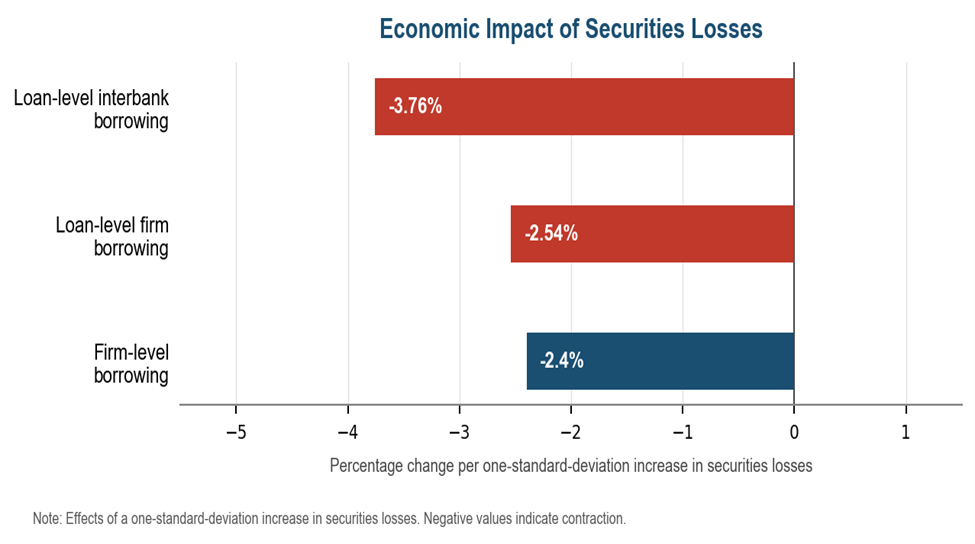
We show that losses on banks’ securities portfolios impair monetary policy transmission through a collateral channel, even when banks remain well capitalised. Using granular euro area data on securities holdings, interbank transactions, and firm-bank credit relationships, we find that banks suffering larger valuation losses obtain significantly less repo funding, and subsequently reduce corporate lending. A one-standard-deviation increase in securities losses is associated with a 3.8% decline in interbank borrowing and a 2.5% decline in lending to firms. Internal capital markets within banking groups partially offset these effects, but only for domestic subsidiaries. Foreign subsidiaries are left exposed, pointing to incomplete banking integration along national lines. These findings reveal a collateral-based bank lending channel of monetary policy that operates independently of bank capital constraints.
The collapse of Silicon Valley Bank in 2023 brought securities losses to the forefront of the financial stability debate. When interest rates rise, the market value of banks’ bond portfolios falls, especially for longer-duration instruments. If a bank is poorly capitalised or relies heavily on uninsured deposits, such losses can trigger runs and even insolvency. But what happens when banks remain well capitalised, and regulatory capital is not directly affected? This question has received far less attention. In a recent paper (ECB Working Paper No. 3209), we show that securities losses materially shape banks’ lending behaviour and amplify the effects of monetary tightening on credit to firms — even in the absence of financial stability concerns. The mechanism operates not through bank solvency, but through the collateral channel: the erosion of the value of securities that banks pledge to obtain liquidity.
Banks routinely use securities as collateral to borrow in the interbank market, particularly through repurchase agreements (repos). This secured borrowing is central to liquidity management: it allows banks to absorb unexpected deposit withdrawals, payment shocks, and other short-term funding needs.
When monetary policy tightens and securities prices fall, the value of the collateral that banks can pledge declines accordingly. This weakens their ability to raise liquidity through repos. Anticipating that their capacity to insure against future liquidity shocks has diminished, banks respond by reducing their exposure to illiquid assets — most notably corporate loans. The result is a contraction in credit supply that operates through collateral constraints rather than through bank capital.
We study the ECB’s monetary tightening cycle that began in mid-2022. Between July 2022 and September 2023, the ECB raised its key policy rates by 450 basis points, while also beginning quantitative tightening. This triggered sharp repricing of securities across euro area banks’ portfolios, with banks holding longer-duration instruments experiencing the largest losses.
Our analysis draws on three uniquely granular datasets. First, the ECB’s Securities Holdings Statistics provide security-by-security information on each bank’s portfolio, including market values, book values, and accounting classifications. Second, AnaCredit — the euro area’s credit registry — records individual interbank and corporate loans, allowing us to track credit flows at the loan level. Third, bank-level regulatory data provide information on capital ratios, liquidity positions, and hedging activities. The sample covers 2,862 bank subsidiaries belonging to 498 banking groups across all 19 euro area countries.
On average, euro area banks suffered securities losses amounting to about 1% of total assets, or 12% of total equity, by the third quarter of 2023. Crucially, these losses varied substantially across banks, depending on the duration composition and size of their securities portfolios.
We find that banks with larger securities losses obtain significantly less funding in the interbank market. A one-standard-deviation increase in losses is associated with a 3.8% decline in interbank credit received. The effect is concentrated in secured borrowing: losses reduce access to repo funding but have no impact on unsecured interbank loans. This pattern is inconsistent with a mechanism operating through deteriorating creditworthiness or regulatory capital, which would affect unsecured borrowing as well.
Three additional pieces of evidence support the collateral interpretation. First, only losses on securities eligible as ECB collateral (“pledgeable” securities) matter; losses on non-pledgeable securities have no effect. Second, the impact is larger for banks that had already pledged a high share of their securities before the tightening, suggesting that the constraint becomes binding as collateral values fall. Third, losses on securities recorded at historical cost (held-to-maturity) affect interbank access just as much as losses on securities marked to market (available-for-sale) — even though only the latter reduce regulatory capital. This confirms that the mechanism runs through collateral availability, not through bank solvency.
The collateral squeeze translates directly into reduced credit supply to firms. Controlling for credit demand at the firm level, we find that a one-standard-deviation increase in securities losses is associated with a 2.5% contraction in bank lending. Banks with larger losses also charge higher interest rates and offer shorter maturities on new loans. Firms are generally unable to substitute toward less affected lenders, so the contraction leads to a comparable decline in total firm-level borrowing.
Consistent with the collateral channel, the lending contraction is sharper for banks with high collateral utilisation rates, weaker liquidity positions, and less stable funding. Banks with abundant excess reserves are partially shielded, echoing the complementary role of central bank liquidity documented in the literature.
Figure 1. Economic impact of securities losses on interbank and corporate lending
A distinctive feature of the euro area banking landscape is the prevalence of banking groups with subsidiaries across multiple countries. We find that internal capital markets within these groups partially offset the collateral channel. When a subsidiary experiences large securities losses, other entities in the same group extend larger unsecured loans to compensate, but only if the subsidiary is located in the same country as the group’s headquarters.
Foreign subsidiaries — those located in a different country from the headquarters — do not receive comparable support. They contract lending just as much as stand-alone banks with similar losses. This segmentation is striking: it suggests that national deposit insurance schemes and local liquidity requirements create firewalls that limit cross-border liquidity redistribution even within the same corporate group.
For the real economy, these patterns imply that monetary policy tightening transmits unevenly. Stand-alone banks and foreign subsidiaries pass through collateral losses fully to borrowers, while domestic subsidiaries of large banking groups are partially shielded. In countries where foreign-owned banks account for a large share of lending — such as Portugal, Belgium, Slovakia, and the Baltic states — this asymmetry may amplify the local effects of monetary tightening.
Our findings carry several implications for policymakers. First, they highlight that securities losses can tighten credit conditions even when banks are well capitalised and financial stability is not at risk. The collateral channel means that changes in bond prices effectively alter the monetary policy stance through a mechanism that standard bank capital monitoring may not capture. Policymakers should therefore account for how fluctuations in collateral values affect the strength and distribution of monetary policy transmission.
Second, the interaction between securities losses and quantitative tightening deserves attention. As central banks shrink their balance sheets and reduce excess reserves, banks become more reliant on interbank markets for liquidity — precisely where collateral constraints bind. The combination of rate hikes and balance sheet reduction may therefore produce a credit contraction larger than either policy action alone would suggest.
Third, the evidence of segmented internal capital markets within banking groups underscores a fundamental weakness in the euro area’s institutional architecture. Cross-border banking consolidation has been promoted as a means of deepening financial integration. Yet our results show that, in the absence of a common deposit insurance scheme, banking groups do not redistribute liquidity across borders to offset asymmetric shocks. The completion of the Banking Union — including a European Deposit Insurance Scheme — would help ensure that monetary policy transmits more evenly across member states.
Altavilla, C., M. Boucinha, L. Burlon, M. Giannetti, and J. Schumacher (2025). Central Bank Liquidity Reallocation and Bank Lending: Evidence from the Tiering System. Journal of Financial Economics 168, 104058.
Bianchi, J. and S. Bigio (2022). Banks, Liquidity Management, and Monetary Policy. Econometrica 90, 391–454.
Drechsler, I., A. Savov, and P. Schnabl (2017). The Deposits Channel of Monetary Policy. Quarterly Journal of Economics 132, 1819–1876.
Giannetti, M., M. Jasova, C. Mendicino, and D. Supera (2026). Securities Losses and the Bank Collateral Channel of Monetary Transmission. ECB Working Paper No. 3209.
Greenwald, D., J. Krainer, and P. Paul (2024). Monetary Transmission Through Bank Securities Portfolios. National Bureau of Economic Research.
Jasova, M., L. Laeven, C. Mendicino, J.-L. Peydró, and D. Supera (2024). Systemic Risk and Monetary Policy: The Haircut Gap Channel of the Lender of Last Resort. Review of Financial Studies 37, 2191–2243.
Jiang, E.X., G. Matvos, T. Piskorski, and A. Seru (2024). Monetary Tightening and US Bank Fragility in 2023: Mark-to-Market Losses and Uninsured Depositor Runs? Journal of Financial Economics 159, 103899.
Khwaja, A.I. and A. Mian (2008). Tracing the Impact of Bank Liquidity Shocks: Evidence from an Emerging Market. American Economic Review 98, 1413–42.