

This Policy Brief is based on Beqiraj, Bik and Di Bartolomeo (2026), CIMEO Working Paper Series No. 208. The views expressed are those of the authors and not necessarily those of their affiliated institutions.
Abstract
Why do some inflationary disturbances fade while others become broad inflation? We argue that labor-market pressure is only one part of the answer. In a state-dependent Phillips curve, labor-market conditions determine the pressure that reaches marginal cost, while the pricing environment determines how much of that pressure enters current inflation and how long it persists. Estimated on U.S. quarterly data, post-1965 U.S. inflation surges concentrate in a high-pass-through pricing state, especially when labor-market pressure is strong. The state with the strongest immediate response is not the most persistent one. For central banks, this means that inflation surveillance should separate the formation of cost pressures, the pass-through of those pressures into prices, and the persistence of the resulting inflation response.
The post-pandemic inflation surge revived the debate over nonlinear Phillips curves. Recent work stresses that when vacancies are abundant relative to job seekers, new-hire wages and hiring costs become especially responsive to labor-market conditions. This helps explain why inflation can steepen sharply after long periods in which the Phillips curve appears flat.
But tightness does not by itself determine how much pressure reaches prices. Our framework adds a second state variable: the price-setting environment. Labor-market conditions select the wage branch that feeds marginal cost; the price-setting state maps that pressure into current and future inflation. A surge therefore requires both pressure and transmission. The same shock can therefore be benign in one environment and inflationary in another, even before the shock itself is reclassified or made larger.
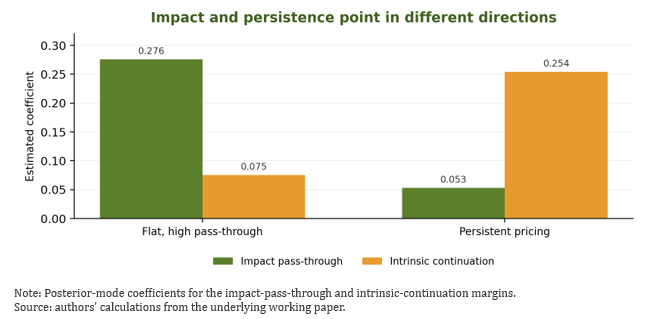
The estimated price-setting states lie on an impact-persistence frontier. In the flat, high-pass-through state, firms reset prices frequently even when prices are young, so current marginal cost receives a large weight. In the persistent state, young prices adjust less often, and repricing becomes more likely as prices age, spreading adjustment over time.
At the posterior mode, impact pass-through is about 5.2 times larger in the flat state, whereas intrinsic continuation is about 3.4 times larger in the persistent state. High current inflation and high intrinsic persistence are therefore distinct outcomes. A central bank observing a sharp rise in inflation should not automatically infer that the economy is in a state with the longest-lived intrinsic response. This distinction also changes the interpretation of forecast errors: an unexpectedly large impact can reflect a high-transmission state rather than a permanently more persistent inflation process.
Figure 1. Impact and persistence are different dimensions of the pricing environment
Bayesian evidence supports the two-dimensional state structure. Allowing labor-market pressure to switch raises the log marginal data density by about 35 points relative to a constant-state benchmark; adding variation in the pricing environment contributes a further 5 points. The joint model is therefore about 40 log points above the benchmark. The ordered comparison also gives the two margins a clear quantitative hierarchy: labor-state variation delivers the first-order improvement in fit, while pricing-state variation completes the transmission mechanism.
The pricing dimension is not simply a relabeling of persistent shocks. When we re-estimate a nested model in which reset probabilities can differ across states but do not depend on price age, duration dependence improves pre-2020 model evidence and the 2020-22 joint predictive density even after aggregate-shock persistence is re-estimated. The price-vintage distribution contains independent information about transmission. In the holdout, the predictive gain appears before inflation reaches its eventual peak, suggesting that the pricing-age structure helps the model read a changing transmission environment rather than merely fit the most visible phase of the surge after it occurs.
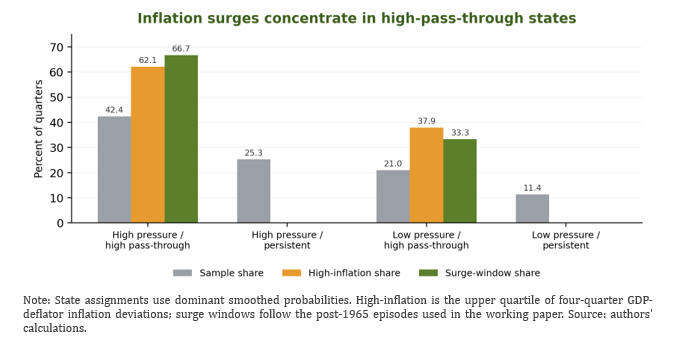
Historical concentration is striking. The high-pressure/high-pass-through state accounts for 42.4% of the sample but 61.4% of inflation volatility, 62.1% of high-inflation quarters, and 66.7% of surge-window quarters. Persistent-pricing states account for more than one third of the sample but contain none of the baseline high-inflation or surge-window observations. These states matter for continuation, but they are not the usual location of inflation onset. The historical episodes also differ in the shocks that arrive in the vulnerable environment: demand pressure is prominent in the late 1960s and Great Inflation, while the policy-rule residual and markup innovations are more prominent after 2020. The common feature is therefore the transmission state, not a single universal shock.
Figure 2. Inflation vulnerability across the estimated joint states
Threshold experiments make the same point under a common disturbance. Using the high-pressure/high-pass-through state as the reference, persistent-pricing states require roughly 18–21 percent larger impulses for a demand shock and 30–33 percent larger impulses for an expansionary monetary-policy shock to reach the same surge boundary. These are joint-state comparisons, not pure pricing-state effects at a fixed labor-market state. Within either pricing state, high labor-market pressure raises the model-implied new-hire wage response by roughly 50–60 percent relative to low-pressure conditions. The pricing state then determines how much of that extra pressure becomes current inflation.
The policy implication is not a mechanical rule that links interest rates to a single indicator. It is a measurement and risk-management implication: inflation risk should be assessed along three separate margins – pressure, pass-through and persistence – and scenario analysis should allow the transmission environment to change. This is especially relevant near a turning point, when aggregate inflation may still look contained even as pressure and pass-through are becoming more favorable to a surge.
Inflation takes hold through a sequence. Shocks generate pressure; labor-market conditions determine how strongly that pressure enters wages and marginal cost; the pricing environment determines how much becomes current inflation and how long the response survives. The evidence places post-1965 U.S. inflation surges on the high-impact side of the pricing frontier, especially when labor-market pressure is strong. For central banks, the key message is simple: monitor the pressure, monitor the transmission mechanism, and do not confuse the onset of inflation with its persistence.
Benigno, P. and Eggertsson, G. B. (2024), “The Slanted-L Phillips Curve”, AEA Papers and Proceedings, 114, 84-98.
Benigno, P. and Eggertsson, G. B. (2025), “It’s Baaack: The Surge in Inflation in the 2020s and the Return of the Non-linear Phillips Curve”, revised version.
Beqiraj, E., Bik, M. and Di Bartolomeo, G. (2026), “When Inflation Takes Hold: Labor-Market Pressure and Price Transmission”, CIMEO Working Paper Series No. 208.
Sheedy, K. D. (2010), “Intrinsic Inflation Persistence”, Journal of Monetary Economics, 57(8), 1049-1061.