

This policy brief is based on Bank of Greece Working Paper No. 341. The views expressed in this article are those of the authors and do not necessarily reflect the views of the University of Piraeus and the Bank of Greece.
Abstract
This Policy Brief provides a non-technical summary of the paper “Does Primary and Secondary Education Contribute to Environmental Degradation? Evidence from the EKC Framework”. Our results show that economic development follows an N-shaped Environmental Kuznets Curve for CO₂, NOₓ, and greenhouse gas emissions, while higher primary and secondary education enrolment is associated with higher emissions across the three indicators. These findings suggest that the environmental effects of education depend on the stage and structure of economic development, as expanding education can initially accompany industrialization and economic activity.
Education is generally viewed as one of the foundations of economic and social development. Higher educational participation can improve human capital, productivity and employment opportunities, while strengthening individuals’ capacity to understand complex social and environmental challenges (Barro, 2001; Gylfason & Zoega, 2003). Yet the environmental consequences of expanding education may be less straightforward than commonly assumed.
The relationship between economic development and environmental degradation has traditionally been discussed through the Environmental Kuznets Curve (EKC). The conventional EKC hypothesis suggests that pollution initially increases as economies develop, but eventually declines after countries reach a sufficiently high level of income (Grossman & Krueger, 1995; Cole et al., 1997; Stern, 2004). Economic expansion can initially increase pollution through industrialisation, urbanisation and greater energy consumption. At later stages, however, higher incomes may allow countries to adopt cleaner technologies, strengthen environmental regulation and shift towards less pollution-intensive economic activities (Grossman & Krueger, 1995; Cole, 2004; Stern, 2004).
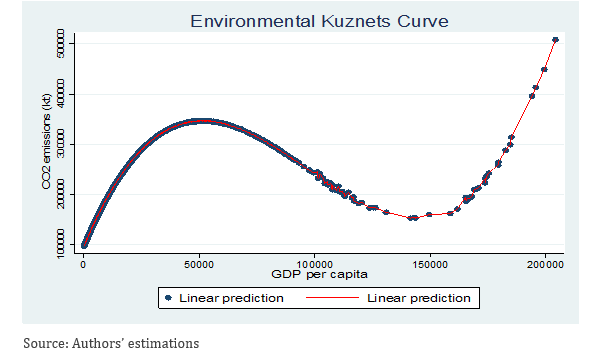
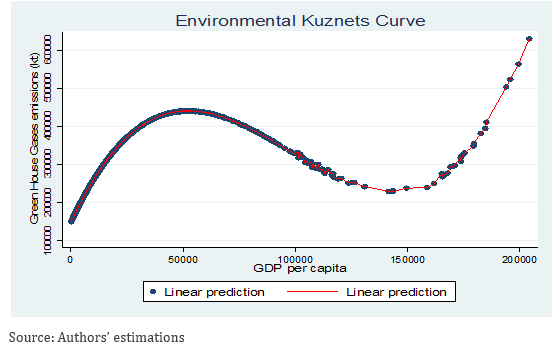
The evidence examined in this study points to a more complex pattern. Across a global sample of 167 countries, the relationship between income and environmental degradation is consistent with an N-shaped rather than simply inverted-U-shaped EKC. Emissions rise during the earlier stages of development, subsequently decline, but may increase again at higher income levels. This pattern appears for CO₂, NOₓ and total greenhouse gas emissions.
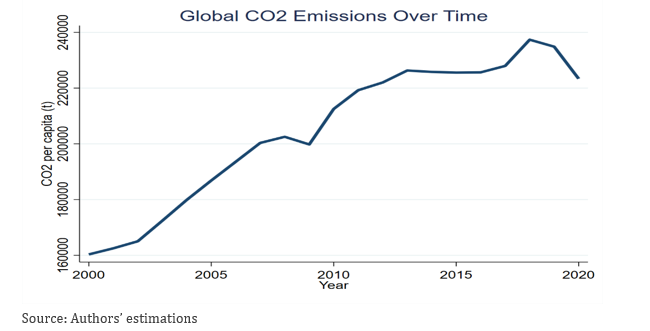
Figure 1. Global CO2 Emissions Over Time
The role of education is particularly important within this process. The empirical evidence shows a positive association between primary and secondary school enrolment and emissions. This relationship is observed across CO₂, NOₓ and greenhouse gas emissions, although the strength of the association differs across pollutants and educational levels. For CO₂, the relationship with primary-school enrolment is particularly strong, while the association with secondary-school enrolment is weaker. For NOₓ, both primary and secondary enrolment display positive and statistically significant associations. The same positive pattern is observed for greenhouse gas emissions.
At first sight, these results may appear counterintuitive. Education is usually expected to support environmental awareness and sustainable behaviour (Hines et al., 1987; Wals, 2011). However, the observed positive association should not be interpreted as evidence that education itself damages the environment.
One explanation is that educational expansion is closely connected to the process of economic development. As more people enter and remain in education, economies can experience greater labour-force participation, productivity and industrial activity (Barro, 2001; Gylfason & Zoega, 2003). In developing economies in particular, educational expansion can therefore occur alongside urbanisation, industrialisation and increasing energy demand. The environmental cost observed in the data may consequently reflect the broader development process accompanying educational expansion rather than schooling itself (Cole & Neumayer, 2004).
Education can increase environmental awareness, encourage sustainable consumption and strengthen the capacity of societies to adopt and develop cleaner technologies (Hines et al., 1987; Cole & Neumayer, 2004; Wals, 2011). Secondary education may be particularly relevant because it can provide individuals with the skills needed to understand more complex environmental problems and technological solutions (Barro, 2001; Gylfason & Zoega, 2003). The environmental benefits of education may therefore emerge gradually rather than immediately.
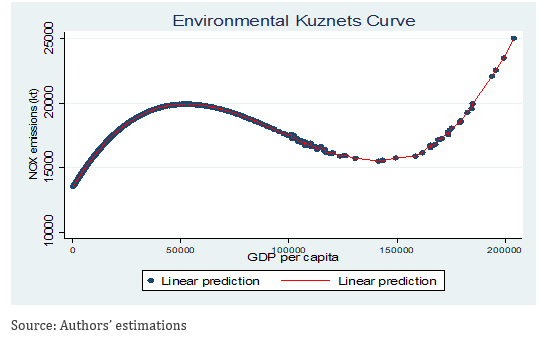
The finding of an N-shaped EKC provides an important qualification to the conventional environmental transition story. For CO₂ emissions, the estimated relationship suggests that emissions initially increase with income, subsequently decline, and then increase again at higher income levels. Similar patterns are found for NOₓ and total greenhouse gas emissions, although the income-related relationship for NOₓ is less pronounced.
The first phase is consistent with the scale effects of development: expanding production, industrialisation and energy use increase environmental pressure. The subsequent decline is compatible with the adoption of cleaner technologies, more efficient production methods and stronger environmental regulation (Grossman & Krueger, 1995; Cole et al., 1997; Stern, 2004). The final upward movement suggests that environmental improvements achieved during the middle stages of development cannot simply be assumed to continue indefinitely (Stern, 2004).
This creates a policy challenge. Countries cannot rely exclusively on reaching a particular income level and expecting environmental degradation to decline automatically. Environmental improvements need to be reinforced by institutions, technological change and behavioural adaptation (Stern, 2004).
Figure 2. Environmental Kuznets Curve (CO2-GDP per capita)
The policy objective should therefore move beyond educational expansion alone towards the integration of sustainability into education systems. Environmental education should be incorporated systematically into primary and secondary curricula. Climate change, biodiversity, sustainability, resource efficiency and environmental responsibility should not be treated as isolated topics but integrated into broader educational programmes (UNESCO, 2017; Wals, 2011). Such an approach can begin at an early age by developing environmental awareness and responsible behaviour. At higher educational levels, it can increasingly focus on critical thinking, technological innovation and the practical skills required for a low-carbon economy (UNESCO, 2017; Wals, 2011; Stevenson, 2007).
The study therefore supports an approach in which educational policy and environmental policy are designed jointly. Educational expansion without complementary environmental measures may initially coincide with higher emissions as economies industrialise. Conversely, education that develops environmental knowledge, technological capabilities and green skills can help economies move towards cleaner production and consumption patterns (Cole & Neumayer, 2004; Wals, 2011).
Figure 3. Environmental Kuznets Curve (NOX-GDP per capita)
i) Integrate sustainability into core education policy
Environmental sustainability should become an integral component of primary and secondary education. Curricula can incorporate climate change, biodiversity, resource efficiency and environmental responsibility across subjects rather than relying exclusively on standalone environmental courses (UNESCO, 2017; Wals, 2011). Teacher training is equally important. Educators need the knowledge and tools to translate environmental issues into practical learning. Assessment systems can also incorporate relevant environmental competencies.
ii) Build green skills into vocational education
Educational policy should respond to the labour-market requirements of the green transition. Vocational and technical training can focus on areas such as renewable energy, energy-efficient construction, sustainable agriculture, environmental management and resource efficiency. This approach allows education to contribute directly to the transformation of production rather than functioning only as a long-term source of environmental awareness.
iii) Make schools examples of environmental sustainability
Schools themselves can become practical laboratories for sustainable behaviour. Public investment in energy-efficient buildings, renewable energy, sustainable materials and efficient waste-management systems can reduce the environmental footprint of educational infrastructure while allowing students to observe sustainability practices directly (UNESCO, 2017; Wals, 2011).
iv) Coordinate education, environmental and economic policy
The environmental consequences of educational expansion cannot be managed by education ministries alone. Coordination between education, environment, labour and economic authorities is particularly important in rapidly developing economies. Educational expansion should therefore be incorporated into wider climate and development strategies.
v) Do not rely on income growth alone
The N-shaped EKC suggests that environmental improvements achieved at intermediate levels of development may subsequently be reversed. Governments should therefore not assume that increasing income will automatically resolve environmental degradation. Policies such as carbon pricing, emissions limits and incentives for clean-energy adoption can complement educational reforms and help separate economic development from environmental deterioration (Stern, 2004). Education can strengthen the effectiveness of these measures by increasing awareness, skills and technological capacity (Wals, 2011; UNESCO, 2017).
Figure 4. Environmental Kuznets Curve (Green House Gases-GDP per capita)
The central policy message is therefore not that education creates environmental damage. Instead, the evidence indicates that the environmental consequences of educational expansion depend on the stage and structure of economic development in which that expansion occurs. In the earlier stages of development, wider access to education may accompany industrialisation, higher employment and greater energy consumption. This can coincide with higher emissions. At the same time, education creates capabilities that can become increasingly valuable as economies move towards cleaner technologies, stronger environmental institutions and more sustainable patterns of production and consumption (Cole & Neumayer, 2004; Wals, 2011). This creates an important opportunity for policymakers. Educational systems should be designed not simply to produce a more productive workforce, but also to equip that workforce to participate in the environmental transition.
The N-shaped EKC suggests that environmental progress is neither automatic nor necessarily permanent. Cleaner technologies and stronger environmental institutions can produce improvements, but renewed increases in emissions at higher income levels demonstrate the need for continuous policy attention (Stern, 2004). The long-run relationship identified between education, economic development and environmental outcomes reinforces the importance of treating these areas as interconnected policy objectives rather than separate domains.
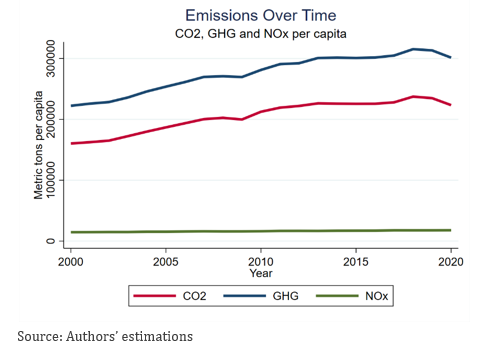
Figure 5. Emissions Over Times per Variable of Pollution
Educational expansion and environmental sustainability should be pursued together. The evidence shows that higher educational enrolment is associated with higher emissions across the three environmental indicators examined. This association is consistent with the scale effects of development, particularly in economies undergoing industrialisation (Cole & Neumayer, 2004). Economic growth does not guarantee a permanent reduction in emissions. The N-shaped relationship identified for CO₂, NOₓ and greenhouse gases indicates that environmental improvements can be followed by renewed increases in emissions at higher income levels (Stern, 2004).
The content of education matters. Environmental knowledge, critical thinking, green skills and technological capabilities can help transform education from a factor accompanying the environmental costs of development into an instrument supporting the transition to cleaner growth (Hines et al., 1987; UNESCO, 2017; Wals, 2011). Climate and education policies should therefore be designed together. Curriculum reform, teacher training and green vocational education can be complemented by clean-energy incentives, emissions policies and environmentally sustainable educational infrastructure. The broader lesson is straightforward: education can help economies move towards environmental sustainability, but this outcome should not be taken for granted. It needs to be built into the design of educational and economic policy from the outset.
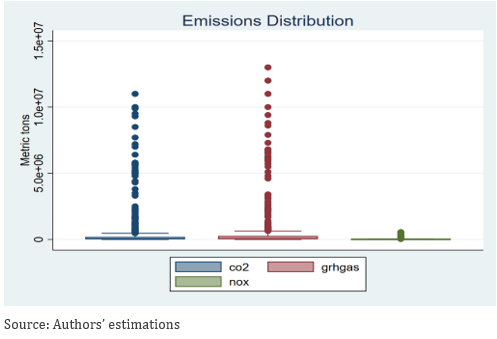
Figure 6. Emissions Distribution
Barro, R. J. (2001). Human capital and growth. American Economic Review, 91(2), 12–17. https://doi.org/10.1257/aer.91.2.12
Bragoudakis, Z., & Gazilas, E. T. (2025). Does primary and secondary education contribute to environmental degradation? evidence from the EKC framework. http://dx.doi.org/10.2139/ssrn.5220753
Cole, M. A. (2004). Trade, the pollution haven hypothesis and the environmental Kuznets curve: Examining the linkages. Ecological Economics, 48(1), 71–81. https://doi.org/10.1016/j.ecolecon.2003.09.007
Cole, M. A., & Neumayer, E. (2004). Examining the impact of demographic factors on air pollution. Population and Environment, 26(1), 5–21. https://doi.org/10.1023/B:POEN.0000039950.85422.eb
Cole, M. A., Rayner, A. J., & Bates, J. M. (1997). The environmental Kuznets curve: An empirical analysis. Environment and Development Economics, 2(4), 401–416. https://doi.org/10.1017/S1355770X97000211
Grossman, G. M., & Krueger, A. B. (1995). Economic growth and the environment. The Quarterly Journal of Economics, 110(2), 353–377. https://doi.org/10.2307/2118443
Gylfason, T., & Zoega, G. (2003). Education, social equality and economic growth: A view of the landscape. CESifo Economic Studies, 49(4), 557–579. https://doi.org/10.1093/cesifo/49.4.557
Hines, J. M., Hungerford, H. R., & Tomera, A. N. (1987). Analysis and synthesis of research on responsible environmental behavior: A meta-analysis. The Journal of Environmental Education, 18(2), 1–8. https://doi.org/10.1080/00958964.1987.9943482
Jayanthakumaran, K., & Liu, Y. (2012). Openness and the environmental Kuznets curve: Evidence from China. Economic Modelling, 29(2), 566–576. https://doi.org/10.1016/j.econmod.2011.12.011
Stern, D. I. (2004). The rise and fall of the environmental Kuznets curve. World Development, 32(8), 1419–1439. https://doi.org/10.1016/j.worlddev.2004.03.004
Stevenson, R. B. (2007). Schooling and environmental education: Contradictions in purpose and practice. Environmental Education Research, 13(2), 139–153. https://doi.org/10.1080/13504620701295726
UNESCO. (2017). Education for sustainable development goals: Learning objectives. UNESCO.
Wals, A. E. J. (2011). Learning our way to sustainability. Journal of Education for Sustainable Development, 5(2), 127–138. https://doi.org/10.1177/097340821100500208
Zsóka, Á., Szerényi, Z. M., & Kocsis, T. (2013). Greening education and changing behavior: The impact of environmental education on students’ pro-environmental behavior and environmental knowledge. Sustainability, 5(11), 4189–4204