

This policy brief is based on Drehmann and Fu (2026) “Hard to Shift, Easy to Reshape: Central Bank Reserve Demand and Frictions”. The views expressed are those of the authors and do not necessarily reflect those of the BIS or its member central banks.
Abstract
How far can central banks shrink their balance sheets? The answer sets the limits to quantitative tightening (QT), and depends critically on the demand for reserves and whether the drivers widely thought to have increased it over the past decade actually do so. We assess the impact of three such drivers: post-crisis liquidity regulation, monetisation frictions, and fragmented interbank markets. Building on the canonical Poole (1968) model, we show that these drivers tend to reshape, rather than horizontally shift, reserve demand. Liquidity regulation, such as the Liquidity Coverage Ratio (LCR), does not raise reserve demand when banks can substitute reserves with other high-quality liquid assets (HQLA). Over some regions of the curve, the LCR even reduces demand. Frictions in monetising non-reserve HQLA into reserves change both the slope of the reserve demand curve and the satiation point when demand flattens. With fragmented interbank markets, the mapping from aggregate reserve supply to the interbank rate becomes non-unique. In this case, the effective reserve demand curve also shifts outward following negative supply shocks, and more so the greater the initial level of supply. These findings have direct implications for balance sheet normalisation, especially for central banks operating floor or ample reserves frameworks near the satiation point of the reserve demand curve.
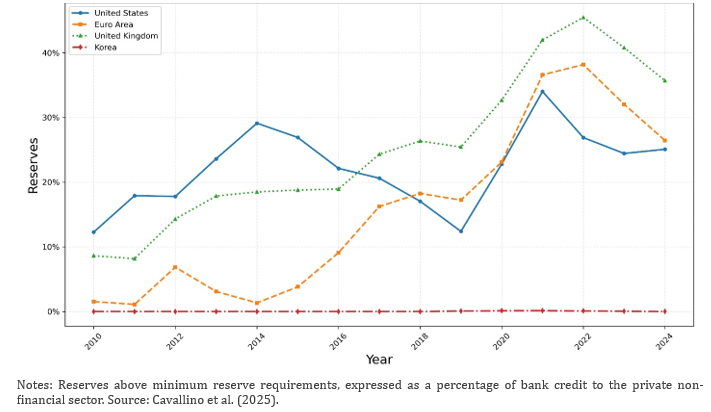
A key question for many advanced economy central banks is how far they can shrink their balance sheets after nearly 15 years of expansion following the Great Financial Crisis (GFC) and the pandemic. The answer hinges on whether reserve demand has shifted outward compared with pre-expansion levels. Three possible explanations are central to the policy debate: post-crisis liquidity regulation; frictions in monetising government bonds into reserves; and the atrophy of interbank markets after years of abundant reserves, which has led to fragmented interbank markets. But why has demand seemingly shifted in response to these factors in the United States, the United Kingdom and the euro area, whereas Korea has operated with no reserves above requirements for the last 20 years (Figure 1)?
In a recent BIS working paper (Drehmann and Fu, 2026), we show that these forces generally reshape reserve demand rather than shift it. Liquidity regulation does not raise demand when banks can use other liquid assets to satisfy the requirements, as is the case under the Liquidity Coverage Ratio (LCR) in Basel III. Monetisation frictions make demand more elastic and especially raise the satiation point when the reserve demand curve flattens. Fragmentation breaks the one-to-one link between aggregate reserve supply and the money market rate and can amplify the outward shift in effective demand following a negative reserve supply shock.
Figure 1. Reserves above minimum requirements across countries differ substantially across jurisdictions
We build on the canonical Poole (1968) model of reserve demand and extend it in three directions to derive how the potential drivers affect the demand for reserves. Banks choose reserves before late-day payment shocks are realised. If there is a reserve shortfall relative to the minimum requirement at the end of the day, banks need to borrow from the central bank’s lending facility. If they have excess reserves, these are deposited at the deposit facility. The marginal value of reserves is therefore close to the lending rate when reserves are scarce and to the deposit rate when they are abundant, generating the familiar S-shaped demand curve.
In our work, we assess whether and how liquidity regulation, monetisation frictions and fragmentation shift or reshape the reserve demand curve. Specifically, we first capture the institutional design of the LCR , which is a requirement on total holdings of high-quality liquid assets rather than on reserves. Hence, we let banks optimise across reserves, government bonds and higher-yielding non-HQLA assets. Second, we allow for monetisation frictions, so that reserves and other liquid assets are imperfect substitutes for meeting payment outflows. Third, we model atrophied interbank markets in which some banks stop participating altogether.
We start by considering regulation that requires banks to hold reserves, such as binding intraday liquidity requirements. These are economically equivalent to reserve requirements, and their effect is well understood: they shift the reserve demand curve outward. The novel feature of our analysis is to consider the LCR.
The LCR is widely assumed to have shifted reserve demand outward, but this does not hold once the rule is modelled realistically. The LCR is a requirement on total HQLA, reserves plus other eligible assets such as government bonds, rather than on reserves alone. Banks can thus adjust the composition of HQLA while maintaining their unconstrained holdings of higher-yielding non-HQLA assets as long as the LCR is not the binding constraint. In this case, reserve demand is unchanged.
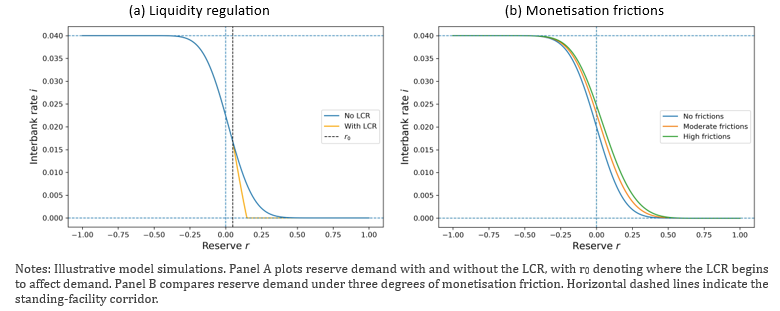
Above a threshold, the LCR becomes the tighter effective constraint when an additional unit of reserve crowds out non-HQLA assets. Its opportunity cost consequently includes the return forgone on that asset. Reserve demand thus falls below the benchmark and flattens earlier (Figure 2, panel A). Hence, the LCR reshapes the curve and moves its satiation point inward, rather than shifting demand outward.
Figure 2. Liquidity regulation and monetisation frictions reshape reserve demand
Monetisation frictions make reserves valuable as insurance not only against today’s payment shocks but also against future outflows. Monetisation frictions thus raise reserve demand, but they reshape the curve rather than shift it.
The effect is most pronounced around the satiation point, where the current-period marginal liquidity benefit of reserves is small and their future insurance value becomes relatively more important (Figure 2, panel B): the curve becomes more elastic and flattens only at a higher level of reserves. Consistent with the mechanism, US bank treasurers report that the Federal Reserve’s 2024 Regulation YY clarification on acceptable HQLA monetisation channels contributed to a reduction in their reserve holdings (Nelson et al., 2026).
When there are abundant reserves, the interbank market fragments as some banks withdraw from the market (eg Markets Committee, 2019). For example, half of the banks in Sweden have never participated in the interbank overnight market since 2020, when the Riksbank has operated with excess reserves (eg Asberg Sommar et al., 2026).
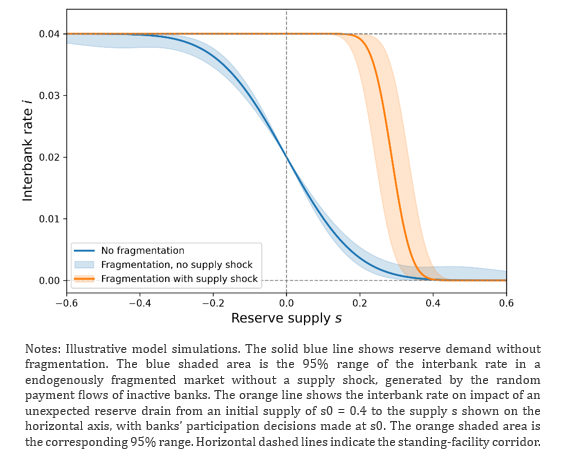
Interbank fragmentation generates two related results. First, it breaks the one-to-one mapping between aggregate reserve supply and the equilibrium money market interest rate (Figure 3, blue shaded area). In fragmented markets, inactive banks become in the parlance of central banks autonomous factors, which change the aggregate supply of reserves independent of central bank monetary policy operations. Once banks become inactive, they rely on their central bank accounts to passively absorb or settle payment flows and their payment flows act as reserve supply shocks for active banks. For example, a net inflow to inactive banks leaves active banks with fewer reserves, shifting the effective reserve demand curve. Because payment flows are essentially random, these shifts are uncertain, and their volatility increases as the share of active banks declines. This share in turn falls as the initial level of reserves rises, because the gains from trading shrink.
Second, fragmentation also implies that reserve demand shifts outward when there are negative supply shocks, and the more so, the greater the initial level of reserve supply (Figure 3, orange line). The reason is that active banks must absorb not only the random payment shocks but also the change in the supply. This is equivalent to an outward shift in the effective reserve demand curve if there is a negative supply shock, such as large payments to the treasury account. Again, the implied shift in the reserve demand curve is larger, the smaller the fraction of active banks, ie the larger the initial level of reserves.
Figure 3. Reserve demand can shift unexpectedly in a fragmented market
Our findings have several implications for central banks, but these can differ depending on their operational framework. In particular, it can matter whether the central bank implements monetary policy in the steep part of the reserve demand curve, as in a traditional corridor system, or on the flat part of the reserve demand curve close to the satiation point, such as with ample reserves.
First, reserve demand can be reduced by removing requirements or supervisory practices that act as implicit, unobservable reserve requirements. Changing liquidity requirements like the LCR that can be met with non-reserve HQLA has, however, no first-order effect on reserve demand. It may matter at the margin for central banks operating close to the satiation point, which the LCR can lower.
Second, reducing monetisation frictions, for instance by improving the depth and resilience of repo and government bond markets, allows central banks to operate with fewer reserves. As monetisation frictions move the satiation point outward, this is especially relevant for central banks operating ample reserve regimes.
Third, minimising fragmentation reduces the risk of endogenous shifts in the reserve demand curve. Fragmentation can be minimised by giving banks incentives to participate in the interbank market.
Our results also allow for a radical interpretation. None of the analysed frictions prevents a return to a pre-GFC scarce-reserves framework, leaving aside other factors that may determine the optimal level of reserves. Korea’s experience supports this. And Norway’s transition away from a floor system in 2011 shows that reserve supply can be cut significantly without negative side effects in practice (Norges Bank, 2014).
Asberg Sommar, Per, Mathias Drehmann, Denise Hansson and Vatsala Shreeti (2026). What Determines Banks’ Excess Demand for Reserves? BIS Working Papers, no 1376. Bank for International Settlements.
Cavallino, Paolo, Mathias Drehmann, Richard Finlay and Julie Remache (2025). “Monetary Policy Operational Frameworks: A New Taxonomy.” BIS Quarterly Review, September.
Drehmann, Mathias and Xuewen Fu (2026). Hard to Shift, Easy to Reshape: Central Bank Reserve Demand and Frictions. BIS Working Papers, no 1372. Bank for International Settlements, August. https://www.bis.org/publications/working-paper-1372-hard-shift-easy-reshape-central-bank-reserve-demand-and-frictions.
Markets Committee (2019). Large Central Bank Balance Sheets and Market Functioning. Report prepared by a Study Group chaired by Lorie Logan and Ulrich Bindseil. Bank for International Settlements, October.
Nelson, Bill, Laurence Bristow and Brett Waxman (2026). What Determines Banks’ Demand for Reserve Balances? Bank Policy Institute, 14 January.
Norges Bank (2014). Banks’ Assessment of Norges Bank’s Liquidity Management System. Norges Bank Papers, no 4/2014.
Poole, William (1968). “Commercial Bank Reserve Management in a Stochastic Model: Implications for Monetary Policy.” Journal of Finance, vol 23, no 5, pp 769–791.