

This policy brief is based on Leyva, Panzica and Rancan (2026) “Oil Shocks, Energy Dependence and the Corporate Credit Channel” Bank of Portugal Working Paper Series, No 202606. The views expressed are those of the authors and do not necessarily reflect those of the Bank of Portugal.
Abstract
This study examines how oil shocks affect Portuguese firms and how banks transmit these effects. Following an oil supply news shock, as defined by Känzig (2021), more energy-dependent firms expand their balance sheets less and reduce investment relative to other firms. Using bank–firm-level data, we show that banks with loan portfolios more exposed to energy reduce lending and tighten loan terms, including interest rates, thereby amplifying the shock for the real economy. Our findings indicate that the effects of oil shocks extend beyond oil-dependent industries through broader transmission channels affecting firms.
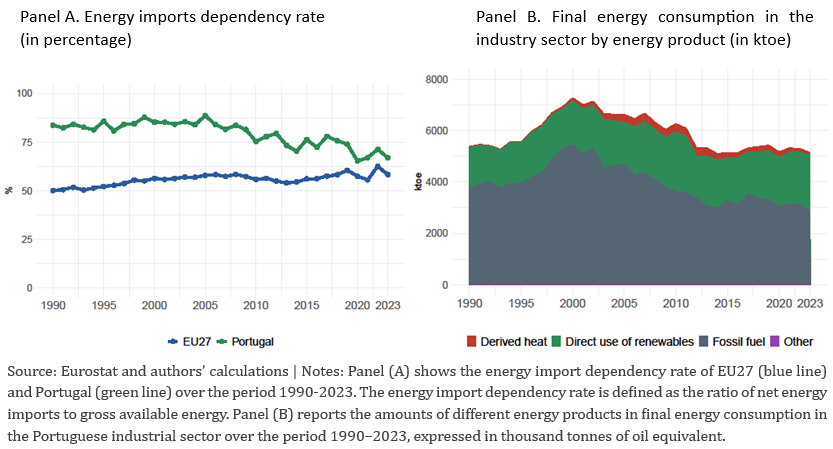
Oil price shocks have significant implications for firms, banks and the broader economy. Recent geopolitical tensions, such as the war in Ukraine and the conflicts in the Middle East, have renewed concerns about energy, particularly for countries that remain highly dependent on imported fossil fuels. In line with EU policy objectives, Portugal has implemented a broad range of measures to reduce its reliance on imported energy, notably through the development of domestic renewable energy sources. While the dependency rate stood at around 85% in 2000, it had declined to 67% in 2023 (Figure 1, Panel A, green line).
According to Eurostat, renewable sources accounted for around 98% of the energy produced in Portugal in 2023. Nonetheless, domestic production remains insufficient to meet total energy demand, leaving the country structurally dependent on external suppliers. Fossil fuels continue to be a key component of energy supply, including as inputs to firms’ production processes. In the industry sector, reliance on fossil fuels fell from 71% in 1990 to 55% in 2023, while renewables accounted for 43% of energy use in 2023. Nevertheless, the fossil-fuel share remains significant (Figure 1, Panel B),1 leaving Portuguese industry vulnerable to fossil-fuel price fluctuations.
Figure 1. Energy market in Portugal
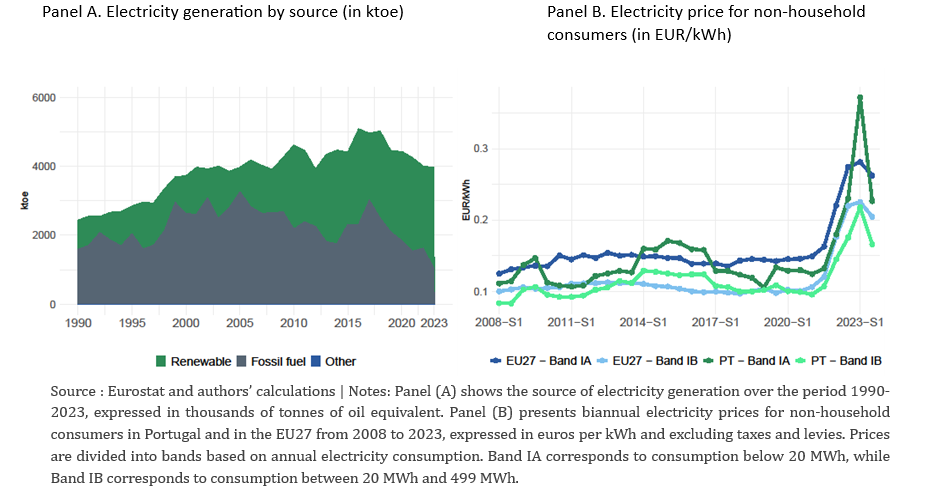
Beyond the direct use of fossil fuels in industry, it is also important to consider their role in electricity generation as additional channel through which they affect the economy. In Portugal, dependence on fossil fuels in electricity production has steadily declined from 65% in 1990 to 26% in 2023 (Figure 2, Panel A). Although several developments, including the integration of the Portuguese and Spanish electricity markets and the increasing share of renewable energy in electricity generation (74% in 2023; Figure 2, Panel A), have contributed to greater market efficiency and helped contain electricity costs, retail electricity prices remain exposed to a range of factors, including wholesale energy prices, network costs and taxes.
The link between retail and wholesale electricity prices largely reflects the merit-order mechanism that structures the wholesale electricity market. Wholesale electricity prices are determined by the marginal cost of the last power plant needed to meet demand. In practice, this often means fossil-fuel plants set the market-clearing price, even when the bulk of electricity generation comes from renewables. As a result, fluctuations in fossil fuel prices or supply shocks can strongly influence electricity prices, an exposure that is likely to remain as long as the wholesale market structure remains unchanged.2 In the retail market, prices recorded a sharp spike at the end of 2022, coinciding with the period of high oil prices (Figure 2, Panel B). This increase was particularly pronounced for the lowest consumption band (IA; dark green line), typically associated with smaller enterprises, where the rise was markedly stronger than the EU-27 average (IA, dark blue line). The band corresponding to consumption between 20 MWh and 499 MWh (IB, light green line), which broadly captures a wider range of firms including small and medium-sized firms, also experienced a price increase at the end of 2022, but in this case the dynamics were broadly aligned to the EU-27 average (IB, light blue line).3
Figure 2. Electricity market in Portugal
To assess firms’ vulnerability to energy shocks, we measure energy dependence4 as the share of energy expenditures in total production costs. Using firm-level panel data, we examine how oil supply news shocks affect firms’ balance sheet variables and whether these effects vary with firms’ pre-existing levels of energy dependence, measured in the previous year. To this end, we estimate panel regressions in which the variable of interest is the interaction between the oil supply news shock and firm-level energy dependence.
The regressions include macroeconomic and firm-level controls, as well as firm fixed effects. The supply news shock measure, proposed by Känzig (2021), isolates unexpected changes in oil supply expectations around OPEC announcements and is normalized so that a one-unit shock increases oil prices by 10% on impact.
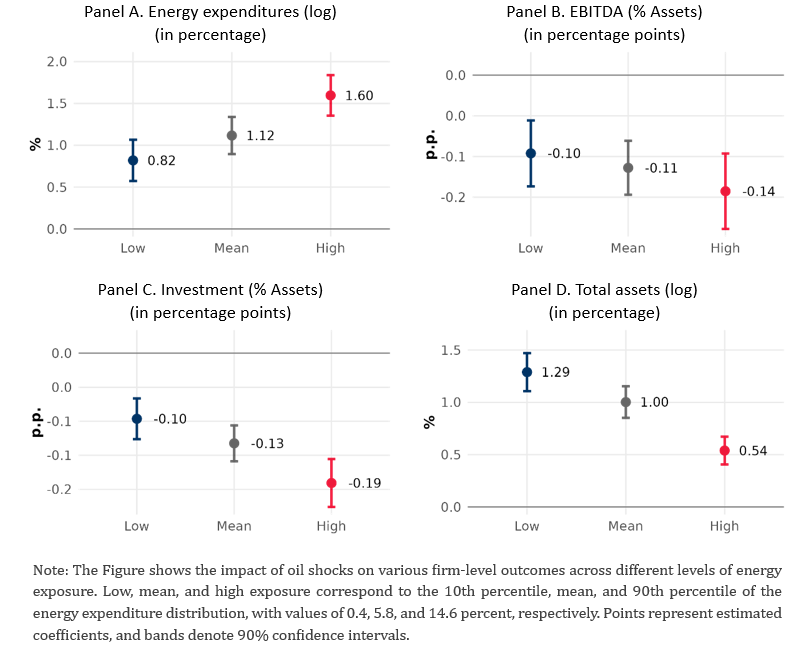
The results below show how oil shocks affect firms. Figure 3 examines operating performance and real activity, while Figure 4 presents liquidity needs and financing responses. Energy expenditure rises after the shock, particularly among highly energy-dependent firms (Figure 3, Panel A). Their energy expenditure increases by about 1.6%, compared with 0.8% for less energy-dependent firms, increasing the cost associated to the energy dependence during oil shocks. When firms do not fully pass these costs on to customers, higher energy costs squeeze operating earnings. Accordingly, EBITDA relative to total assets falls after the shock, with a larger estimated decline among highly energy-dependent firms (Panel B).
The adjustment also affects investment: highly energy-exposed firms cut investment more than firms with lower energy dependence (Figure 3, Panel C), consistent with scaling back productive capacity as operating conditions deteriorate. Total assets nevertheless rise after the shock, but by less among highly energy-dependent firms—0.54%, compared with 1.29% for less energy-dependent firms (Figure 3, Panel D).
Figure 3. Oil shocks: Effects on firms by energy dependence
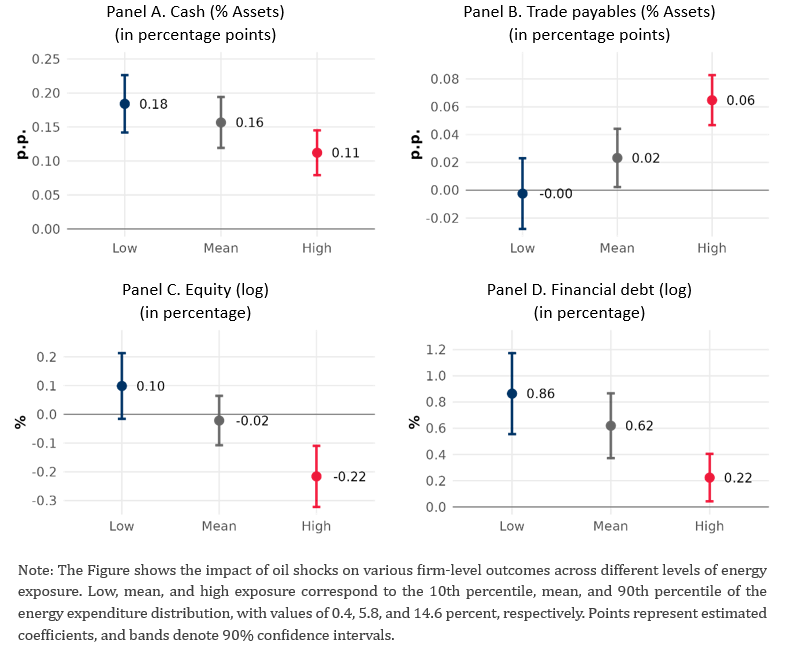
Turning to liquidity needs and financing responses, firms shift their asset composition towards more liquid components, such as cash and deposits. However, highly energy-dependent firms increase their cash holdings relative to assets less than other firms, indicating a smaller expansion of their liquidity buffers (Figure 4, Panel A). At the same time, their trade payables relative to assets rise more sharply (Figure 4, Panel B), indicating greater reliance on supplier financing.
Financing responses also vary across firms. Highly energy-exposed firms experience a weaker equity response, with book equity declining after the shock (Figure 4, Panel C), which may reduce their capacity to absorb future losses. Financial debt rises for both groups, but substantially less for highly energy-dependent firms—around 0.2%, compared with 0.9% for less energy-dependent firms (Panel D). This additional borrowing helps explain the balance-sheet expansion shown in Figure 3. Combined with the increase in cash relative to assets, it suggests that firms borrow to strengthen liquidity buffers, possibly for precautionary reasons or to meet greater liquidity needs. Highly energy-dependent firms, however, increase debt and liquidity buffers less, consistent with their smaller rise in total assets.
All in all, these results suggest that energy-dependent firms face larger increases in energy costs and have less capacity to expand external financing, limiting their ability to smooth the shock. This motivates a deeper analysis at the bank–firm level
Figure 4. Oil shocks: Effects on firms by energy dependence
We analyse the firm-bank lending relationships to investigate the weaker increase in bank lending among energy-dependent firms following an oil shock. To this end, we use a panel regression analysis at bank-firm level where the dependent variable is the annual amount borrowed by the firm from a given bank.5 The econometric specification includes firm and bank controls as well as firm, bank, and year fixed effects.
Credit dynamics during oil shocks may reflect both supply and demand factors. Banks may reduce lending to energy-dependent firms, while these firms may seek alternative financing or postpone borrowing until conditions improve. To disentangle the two channels, we sequentially introduce time-varying fixed effects. Bank×year fixed effects absorb bank-specific supply factors and isolate credit demand, whereas firm×year fixed effects absorb firm-specific demand factors and identify credit supply effects.
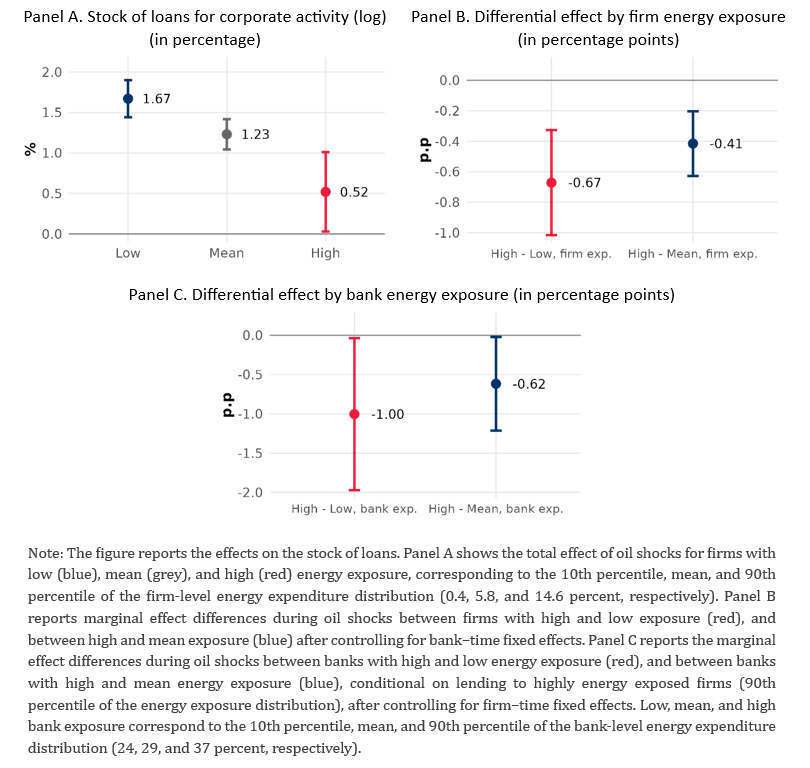
The results show that, during positive oil shocks, energy-exposed firms experience weaker credit dynamics due to both credit supply and demand effects. In particular, firms increase their borrowing by 1.2% following an oil shock. However, the response varies across firms. The most energy-exposed firms increase their stock of loans by 0.52%, compared with 1.67% for less exposed firms. This is consistent with Figure 4 Panel D, which shows that firms with higher energy exposure increase their financial debt less than other firms following an oil shock. (Figure 4, Panel A).
The effect on the stock of loans remains statistically significant when isolating the credit demand channel, specifically, during an oil shock, highly exposed firms experience a 0.67 p.p. reduction in access to credit compared with less exposed firms (Figure 5, Panel B), showing that this pattern reflects lower credit demand by these firms. However, supply constraints also play a role. When isolating credit supply, the results indicate that, during oil shocks, banks with high energy exposure6 reduce their lending to highly exposed firms by 1 p.p. more than banks with low energy exposure (Figure 5, Panel C).
Figure 5. Firm-bank level analysis, bank lending to firms
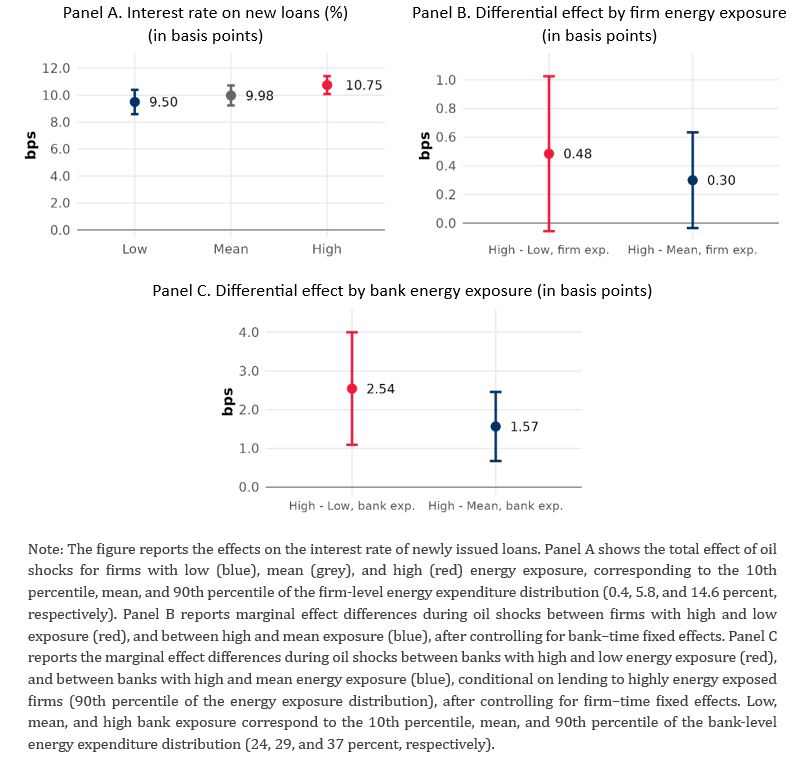
The weaker credit growth among energy-dependent firms also reflects banks’ lending behaviour. We therefore examine the terms that banks set on new loans to Portuguese firms.Using data on newly issued loans from 2012 to 2023, we find that banks impose tighter and more costly borrowing conditions on more energy-dependent firms during oil shocks. A shock that raises an increase of oil prices by 10% increases spur interest rates on new loans by around 9.98 basis points (bps).
The interaction with energy exposure further amplifies this effect, raising interest rates to 10.75 bps for firms with higher energy dependence during the shock (Figure 6, Panel A). However, these effects appear to be primarily driven by credit supply. Once credit demand is isolated, the effect becomes statistically insignificant (Figure 6,Panel B). Consistent with this interpretation, Panel C shows that energy-exposed banks charge higher interest rates during positive oil shocks. In particular, banks with high energy exposure charge around 2.5 bps more than less exposed banks when lending to highly energy-dependent firms. This may reflect the fact that banks price firms’ energy dependence into their lending models, which makes these firms appear riskier, especially during oil shocks.
Figure 6. Interest rate on new loans
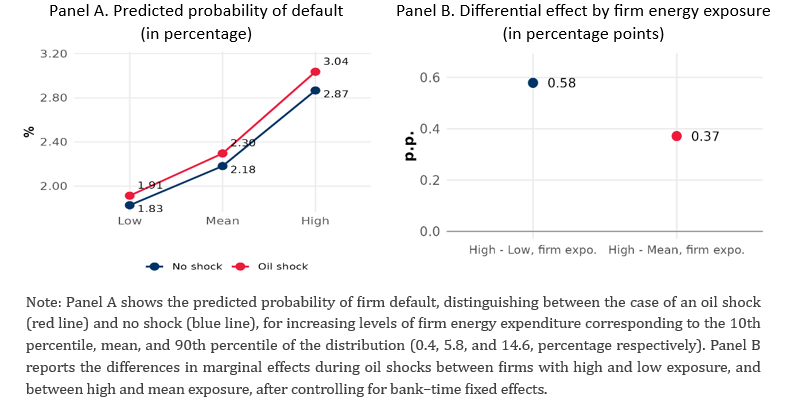
The purpose of the following analysis is to assess whether the reduction in bank lending to more energy-dependent firms during oil shocks is associated with higher credit risk. To this end, we estimate a logit model at the bank-firm level, over the period 2009–2023, where the dependent variable is an indicator equal to one if a bank reports past-due credit exposures of at least 90 days for a given firm, and zero otherwise.7 The results show that, on average, an oil shock increases the firms’ probability of default. Moreover, higher firm-level energy exposure further raises this likelihood, particularly during oil shocks, by 0.17 p.p. compared with the absence of an oil shock (0.08 for firms with low energy exposure). Highly exposed firms show a predicted probability of default of 3%, compared with 1.9% for firms with low energy exposure (Figure 7, Panel A).
When isolating credit demand, the marginal effect on the predicted probability of default is 0.58 p.p. higher for firms with high energy exposure than for those with low exposure, as shown in Figure 7, Panel B.
Figure 7. Probability of Default
This analysis examines the impact of oil shocks on the Portuguese firms and how banks may exacerbate their negative effects through their lending behavior. This is particularly relevant in a geopolitical context marked by heightened tensions, including the war in Ukraine and escalating tensions in the Middle East,that have destabilized energy markets, especially for a country like Portugal, given its dependency on energy imports.
Oil shocks increase Portuguese firms’ energy expenditure, with the effect varying from 0.8% for less exposed firms to 1.6% for highly energy-exposed firms. In response, firms adjust their balance sheets by shifting towards more liquid assets, such as cash, and by increasing their reliance on external funding, which in turn expands total assets. However, energy dependence constrains firms’ ability to respond to these shocks, as highly exposed firms experience a 0.64 percentage point smaller increase in financial debt than less exposed firms.
This result is confirmed when we analyse annual bank-firm lending relationships. During oil shocks, firms rely more heavily on bank lending. However, the effect is weaker for energy-dependent firms, which obtain 1.15 percentage points less credit than less exposed firms.
The lower credit growth is associated with tighter credit conditions imposed by banks on more energy-dependent firms. Using data on new loans over 2012-2023, we identify an additional transmission channel: banks charge higher interest rates to highly energy-dependent firms, further constraining their access to credit. This pattern may reflect banks’ heightened perception of credit risk among energy-dependent firms during oil shocks. Indeed, we find that oil shocks increase the probability of loan defaults, particularly for loans extended to energy-dependent firm.
Data on firms’ energy exposures provide valuable insights for economies with high energy dependence, with several important implications. First, at the macro level, countries with a higher reliance on energy imports are more vulnerable to shocks; therefore, policies aimed at reducing import dependence and increasing energy diversification should be encouraged. Second, in case of a prolonged and severe energy shock, assistance to the most energy-intensive firms may be assessed to help to contain their distress and limit spillovers to the real economy. Finally, from a macroprudential perspective, it is important to monitor banks’ exposures to energy-intensive firms to avoid excessive risk concentration.
“SUERF_References” – Antunes, A., Gonçalves, H., and Prego, P. (2016). “Firm default probabilities revisited”. Economic Bulletin and Financial Stability Report Articles, 21–45.
Garicano, L., Rohner, D. and Di Mauro, B. W. (2022). “Global economic consequences of the war in Ukraine: Sanctions, supply chains and sustainability”. CEPR Press.
Känzig, D. R. (2021). “The macroeconomic effects of oil supply news: Evidence from OPEC announcements”. American Economic Review, 111 (4), 1092–1125.
Leyva, J., Panzica, R. and Rancan, M. (2026). “Oil Shocks, Energy Dependence and the Corporate Credit Channel”. Banco de Portugal Working Paper Series, No 6/2026. https://www.bportugal.pt/sites/default/files/documents/2026-04/WP202603.pdf
To assess the industry sector’s dependence on fossil fuels, final energy consumption is adjusted by excluding the consumption of road transport, commercial and public services, and households. Furthermore, as electricity constitutes an energy product, the calculation considers the fuel sources used in gross electricity generation and reallocates them accordingly across categories.
https://www.consilium.europa.eu/en/policies/electricity-market-reform/
To mitigate the spike in electricity prices in 2022, the Portuguese government adopted Decree-Law No. 33/2022. This introduced an exceptional and temporary mechanism to adjust electricity generation costs within the Iberian Electricity Market. The measure resulted from an agreement between Spain and Portugal and set a reference price for natural gas used in electricity generation traded in MIBEL, with the aim of reducing wholesale electricity prices.
The terms energy dependence and energy exposure are used interchangeably throughout this policy brief.
The amount includes only loans associated with corporate financing activities closely linked to firms’ investment and production decisions.
Banks’ energy exposure is defined as the share of loans granted to energy-intensive firms relative to their total corporate loan portfolio.
Although a firm may experience multiple default events over the sample period, we exclude all observations following the first default to avoid biasing the sample toward firms with recurrent defaults, according to Antunes et al. (2016).