

This policy brief is based on Banca d’Italia Working Paper No. 1536. The views expressed are those of the authors and not necessarily those of the institutions the authors are affiliated with.
Abstract
The 2022-23 monetary tightening reached euro-area firms at different speeds depending on how much of their outstanding bank debt was at floating rates. Firms with greater floating-rate exposure cut investment significantly more than firms relying exclusively on fixed-rate debt: the 450-basis-point increase in the three-month Euribor during the tightening episode is estimated to have reduced the investment growth rate by 14.8 percentage points for firms at the 75th percentile of the floating-rate exposure distribution relative to firms with no floating-rate debt. The investment channel is visible across manufacturing, construction and services. Beyond investment, floating-rate exposed smaller firms also show declines in employment, sales, profits and liquidity, while the corresponding effects for similarly exposed larger firms are limited. Fixed- vs floating-rate debt composition therefore matters for the speed and distribution of monetary policy transmission.
The euro area’s 2022-23 tightening cycle involved an exceptionally rapid and sizeable increase in policy rates. Yet the rise in debt-service costs did not reach all firms at the same speed. Firms financed mainly with fixed-rate loans remained partly insulated until loans matured or were renegotiated. Firms relying on floating-rate borrowing saw the cost of existing debt rise much sooner as reference rates increased.
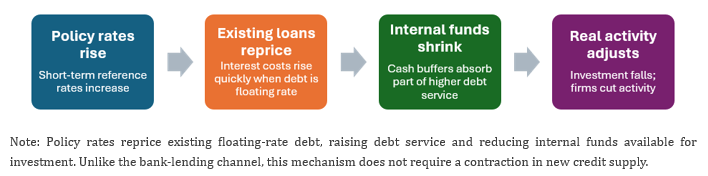
This difference lies at the heart of the floating-rate channel of monetary policy. Unlike the traditional bank-lending channel, which operates through the terms and availability of new credit, the floating-rate channel works through the stock of debt already on firms’ balance sheets. It can therefore affect investment by raising debt-service costs, even if the supply of new credit is not affected.
The distinction is particularly relevant in the euro area, where the mix of fixed- and floating-rate corporate debt differs across countries and firms. A common change in policy rates can therefore generate heterogeneous cash-flow effects and different speeds of transmission.
Figure 1. The floating-rate channel
Firms do not choose floating- or fixed-rate loans at random. Their debt structure may reflect size, sector, risk, investment opportunities or expectations about interest rates. A simple comparison between floating- and fixed-rate borrowers would therefore mix the effect of repricing with pre-existing differences between firms.
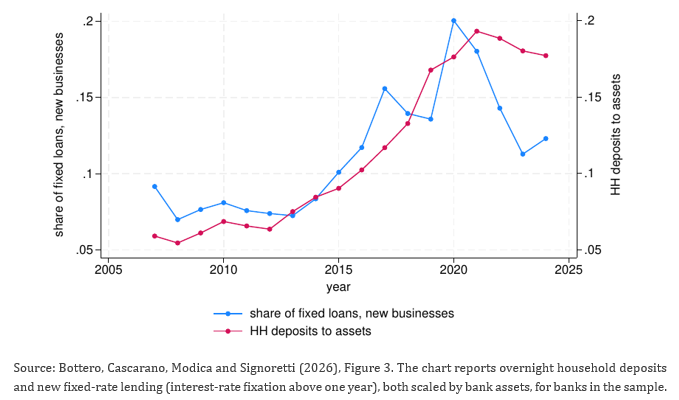
The analysis addresses this problem using plausibly exogenous variation in lenders’ funding generated by APP-related deposit inflows. When assets purchased under the ECB’s Asset Purchase Programme were sold by non-banks, commercial banks received both reserves and corresponding household deposits. These deposits, in particular, provide relatively stable funding whose remuneration responds only weakly to market rates. Banks experiencing larger APP-related deposit inflows therefore had an incentive to increase fixed-rate lending, to better align the interest-rate sensitivity of their assets and liabilities. Figure 2 provides a descriptive illustration of this mechanism: household deposits and the share of new fixed-rate loans moved together over much of the period studied.
This lender-driven variation is used to isolate the effect of firms’ debt composition. The analysis combines loan-level AnaCredit data, bank balance-sheet information and Orbis firm accounts, covering roughly three million firm-year observations for about 700,000 non-financial companies in Belgium, Germany, Italy, the Netherlands and Spain over 2018-231.
Figure 2. Household deposits and the share of new fixed-rate loans
The central result is economically substantial. The 450 basis point increase in three-month Euribor during the 2022-23 tightening is estimated to have reduced the annual growth rate of fixed assets by an additional 14.8 percentage points for a firm at the 75th percentile of floating-rate exposure (97 per cent of bank debt), relative to a firm financed only at fixed rates. The sample’s average investment growth rate is 14 per cent.
The estimate indicates that the repricing mechanism illustrated in Figure 1 has economically substantial effects on firms’ investment.
The investment effect is found in manufacturing, construction and services, suggesting that the mechanism is not confined to one narrow part of the economy. The broader response, however, differs by firm size.
To assess heterogeneity by firm size, the analysis estimates the floating-rate channel separately for firms below and above the sample median of total assets. The investment response is visible in both groups. For smaller firms, the tightening also reduces employment, labour costs, cash flow, sales, profits and liquid assets. Larger firms reduce investment and cash holdings, while the effects on employment, sales and profits are not precisely estimated. This pattern is consistent with smaller firms having fewer alternative funding sources and less room to absorb an unexpected rise in debt-service costs.
First, assessments of monetary transmission should consider the repricing profile of the outstanding stock of credit, not only the volume and price of new lending. Measures of floating-rate exposure, interest-rate fixation periods and loan maturities can help assess how quickly policy changes reach firms’ debt-service costs.
Second, differences in debt structure can generate heterogeneous transmission within a monetary union. Where floating-rate corporate debt is prevalent, changes in reference rates can pass through to existing borrowers more quickly. Aggregate credit quantities and average lending rates may therefore conceal important differences in timing across firms and economies.
Third, firm heterogeneity matters. In the estimates, the floating-rate channel affects investment across firm sizes, but the response of employment, sales, profits and liquidity is stronger among smaller firms. Monitoring debt composition together with firm size and financial buffers can therefore improve the assessment of transmission.
Finally, the results underline the importance of assessing the interest-rate risk embedded in corporate debt structures, alongside leverage and refinancing needs.
The mechanism is also relevant when rates fall: floating-rate debt reprices sooner, while fixed-rate borrowers benefit only as contracts reset or mature. This is relevant for assessing the transmission during the easing cycle that followed the tightening of 2022-2023.
The main lesson is that the amount of debt is only part of the story. The interest-rate fixation structure of outstanding credit helps determine both the speed of transmission and the breadth of firms’ adjustment.
Bottero, M., Cascarano, M., Modica, A. and Signoretti, F. M. (2026), “The real effects of monetary policy transmission via the floating-rate channel”, Bank of Italy Working Paper No. 1536.
Ippolito, F., Ozdagli, A. K. and Perez-Orive, A. (2018), “The transmission of monetary policy through bank lending: The floating rate channel”, Journal of Monetary Economics, 95, 49-71.
Drechsler, I., Savov, A. and Schnabl, P. (2017), “The deposits channel of monetary policy”, Quarterly Journal of Economics, 132(4), 1819-1876.
Altavilla, C., Rostagno, M. and Schumacher, J. (2025), “When banks hold back: credit and liquidity provision”, ECB Working Paper No. 3009.
The working paper provides the full identification strategy and robustness analysis.