

This policy brief is based on ESM Working Paper Series, 77. The views expressed are those of the author and not necessarily those of the institutions the author is affiliated with.
Abstract
This paper evaluates the impact of COVID-era asset purchase programs (APPs) by 23 emerging markets (EMs) and seven ex-U.S. advanced economies (AEs) on the bilateral dollar exchange rate. Using a high-frequency event study analysis and controlling for Federal Reserve actions, monetary policies of other AEs, and simultaneous domestic policies, I find that APPs appreciated EM currencies. This effect operates through a reduction in sovereign credit risk, where the underlying risk-free rate does not necessarily decrease. These results suggest that APPs can help EMs stabilize exchange rates during periods of distress without direct foreign-exchange intervention.
Since the global financial crisis, asset purchase programmes (APPs) have become a central part of the monetary policy toolkit in advanced economies (AEs). AE central banks resorted to these policies when policy rates approached the zero lower bound to provide additional monetary stimulus to the economy. More recently, during the COVID-19 pandemic, emerging market (EM) central banks also adopted APPs, often while policy rates remained above the zero lower bound and mainly to address financial stability concerns. The pandemic thus broadened both the range of economies implementing APPs and the policy objectives motivating their use.
The transmission of monetary policy to exchange rates is a long-standing question, studied extensively for both conventional and unconventional policies, particularly in AEs. However, exchange rate plays a special role in EMs for two reasons. First, greater reliance on foreign currency borrowing makes domestic financial stability more sensitive to exchange rate fluctuations. Second, the larger share of tradable goods in consumption baskets makes inflation more responsive to exchange rate movements (Alberola et al., 2021). Understanding how APPs affect exchange rates is therefore central to assessing their implications for price and financial stability in EMs.
Evidence from AE asset purchase programmes following the global financial crisis generally associates asset purchases with currency depreciation (Rogers, Scotti and Wright, 2014, 2018; Dedola et al., 2021). By contrast, studies of COVID-era purchases in EMs document currency appreciation or an easing of depreciation pressures (Rebucci, Hartley and Jiménez, 2022; De Leo et al., 2025; Mimir and Sunel, 2025). These contrasting findings raise questions about whether the exchange rate transmission of APPs differs across emerging and advanced economies and what are the potential drivers of these differences.
Against this background, I ask two main questions. First, how did COVID-era APPs affect exchange rates in EMs relative to AEs? Second, what explains the differences in their transmission? To address these questions, I construct an event set of APP announcements and use a high-frequency event study to estimate their exchange rate effects, accounting for simultaneous domestic policy measures and international monetary policy interventions.
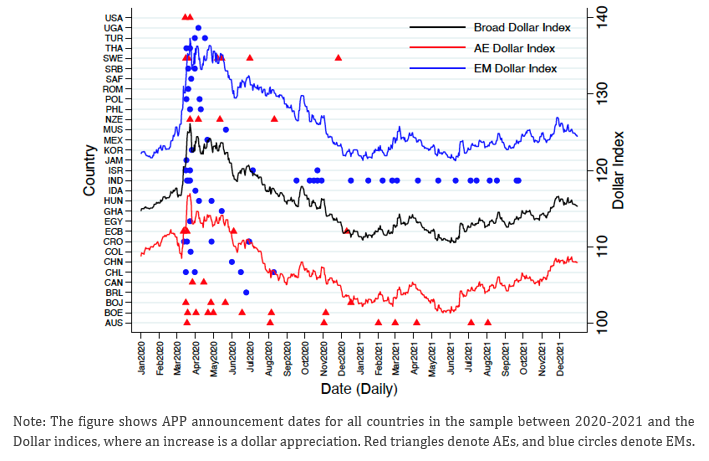
To examine the exchange rate effects of asset purchase programmes, I construct an event set covering 23 EMs and seven AEs that implemented APPs during 2020–2021.1 The main criteria for the selection of event dates is whether the announcements release new information about purchases, which gives me a total of 98 announcements: (i) the introduction of purchases of government or private securities; (ii) the expansion or extension of an existing programme, including increases in its scale or the addition of eligible securities; or (iii) clarification of previously unspecified programme details. I also account for simultaneous policy announcements made on the day of each APP announcement.2 Figure 1 shows the timing of APP announcements across countries alongside dollar indices.
Figure 1. Asset purchase program announcements and the Dollar Index
To evaluate the exchange rate response to APPs, I utilize an event study analysis, which is based on the idea that asset prices adjust in response to unexpected information. (Kuttner, 2001). Building on Rogers, Scotti and Wright (2018), I apply a two-step methodology. First, I regress changes in 10-year government bond yields on corresponding changes in short-term government bond yields, focusing on a two-day window. This window accommodates cross-country differences in trading hours and slower information transmission in EMs, while enabling a causal interpretation. The residuals from this regression represent the variation in long-term rates beyond short-term rate changes, serving as a proxy for asset purchase surprises (APSs). Second, I regress exchange rate changes on these APSs, using bootstrapped standard errors to address estimation uncertainty inherent in the APSs.
The baseline estimates indicate currency appreciation following purchase easing surprises in both country groups. For EMs, an unexpected 10 basis point reduction in the long-term yield is associated with approximately 0.11–0.16% appreciation. For AEs, the corresponding estimate is around 0.55%.3 The AE appreciation contrasts with the conventional post-crisis result and hence motivates closer investigation of the policies announced at the same time.
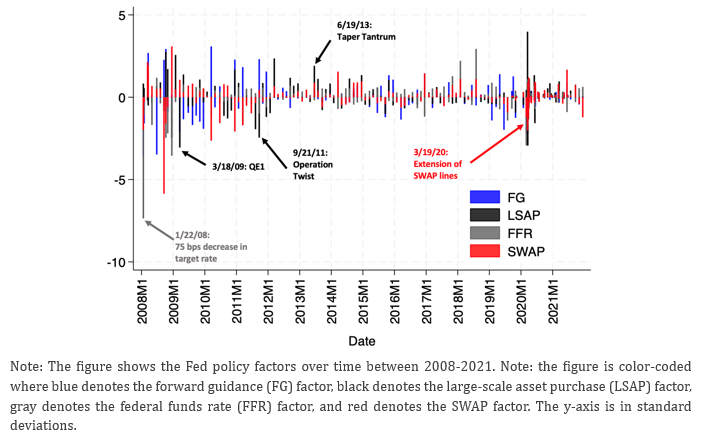
In order to make a causal statement on the country-specific asset purchase surprises, I account for three main confounding factors in my analysis: (i) actions of the Federal Reserve (Fed),4 (ii) monetary policy actions by other major AE central banks, and (iii) simultaneous policy actions taken by the country itself on the day of the APP announcement. In particular, I employ a factor-based approach building on Swanson (2021) to account for the multidimensionality of the Federal Reserve policy actions. I extend the information set to identify a swap factor alongside factors capturing the federal funds rate, forward guidance and large-scale asset purchases. This extension is important because, during both the global financial crisis and the pandemic, the Fed introduced or expanded swap lines to alleviate dollar liquidity shortages.
Figure 2 highlights the importance of capturing the SWAP factor during the pandemic, when the Federal Reserve expanded swap lines to alleviate dollar liquidity shortages, potentially confounding the exchange rate effects attributed to domestic APPs. In the AE sample covering government and private securities, currency appreciation remains significant when controlling for three Fed policy dimensions but loses significance once the SWAP factor is included. For purchase of government bonds alone, appreciation loses significance when the ECB announcement is excluded. This sensitivity suggests a possible role for sovereign credit risk within the euro area, as the Pandemic Emergency Purchase Programme extended eligibility to Greek government securities, which carried relatively higher credit risk. In EMs, appreciation survives these controls and remains robust to excluding individual countries, restricting the sample to 2020, and including a broader set of monetary policy announcements.
Figure 2. Fed policy factors over time
I interpret the differences in exchange rate transmission through the lens of long-run uncovered interest rate parity (LR-UIP) deviations, motivated by two complementary findings in the literature.5 First, while UIP is generally rejected at short horizons in both AEs and EMs, Rebucci, Toraman, Valente and Capirone (2026) find that it holds at longer horizons in AEs but fails in EMs, primarily because of sovereign credit risk. Second, De Leo et al. (2025) show that APPs can appreciate EM currencies through a correlated-flows channel. Departures from LR-UIP are key to generating this appreciation, whereas models developed to study APP transmission in AEs inherently impose LR-UIP (Greenwood et al., 2023; Gourinchas et al., 2025).
Building on these findings, I hypothesize that APPs transmit to EM exchange rates primarily through a reduction in the sovereign credit risk. To examine this mechanism, I develop a no-arbitrage asset-pricing framework with incomplete markets that incorporates sovereign credit risk and convenience yields as key sources of deviations from the UIP, drawing on Jiang, Krishnamurthy and Lustig (2021), Du and Schreger (2016), and Corsetti et al. (2023).
The evidence supports a sovereign credit risk channel in EMs. An asset purchase surprise that lowers long-term government bond yields by 100 basis points reduces sovereign CDS spreads by approximately 43–46 basis points at five- and ten-year maturities, respectively. I also find no strong evidence of a convenience-yield channel in AEs during the pandemic, while adjusting for credit risk largely removes the response of the five-year convenience-yield measure in EMs.
After accounting for credit risk and convenience yields, APP easing surprises do not necessarily lower the underlying long-term risk-free rate in EMs and may even increase it at longer horizons. In AEs, these surprises reduce the underlying risk-free rate. This evidence helps explain how APPs can appreciate the domestic currency.
The analysis suggests that EMs can potentially use APPs during financial distress to stabilize their exchange rates without necessarily implementing foreign exchange interventions. By reducing sovereign credit risk, purchases can support the domestic currency without necessarily lowering the underlying long-term risk-free rate. Exchange rate stabilization could therefore, in principle, require less reliance on scarce and costly-to-accumulate reserves, swap lines available to a limited group of countries, or conditional IMF lending.
The distinction between asset purchases conducted for financial stability and monetary stimulus purposes are relevant beyond EMs. In their blog post, Rebucci and Toraman (2022) document an appreciation of the pound following the Bank of England’s announcement of temporary gilt purchases in September 2022. Although this episode does not establish the same causal mechanism, it motivates further investigation of the effects on the exchange rate of asset purchase programmes undertaken for financial stability concerns. Future research could also compare APPs with foreign exchange intervention in EMs and swap-line provision in AEs and examine how programme duration and design shape their transmission.
Alberola, E., Cantú, C., Cavallino, P., and Mirkov, N. (2021). Fiscal regimes and the exchange rate. BIS Working Papers, No. 950. Bank for International Settlements.
Corsetti, G., Lloyd, S., Marin, E., and Ostry, D. (2023). U.S. risk and Treasury convenience. Working paper.
De Leo, P., Keller, L., Simoncelli, G., Villamizar-Villegas, M., and Williams, T. (2025). Global investors in local-currency bond markets: Implications for bond yields and exchange rates. Working paper.
Dedola, L., Georgiadis, G., Gräb, J., and Mehl, A. (2021). Does a big bazooka matter? Quantitative easing policies and exchange rates. Journal of Monetary Economics, 117, 489–506.
Du, W., and Schreger, J. (2016). Local currency sovereign risk. The Journal of Finance, 71(3), 1027–1070.
Gourinchas, P.-O., Ray, W., and Vayanos, D. (2025). A preferred-habitat model of term premia, exchange rates, and monetary policy spillovers. American Economic Review, 115(11), 3788–3824.
Greenwood, R., Hanson, S., Stein, J. C., and Sunderam, A. (2023). A quantity-driven theory of term premia and exchange rates. The Quarterly Journal of Economics, 138(4), 2327–2389.
Jiang, Z., Krishnamurthy, A., and Lustig, H. (2021). Foreign safe asset demand and the dollar exchange rate. The Journal of Finance, 76(3), 1049–1089.
Kuttner, K. N. (2001). Monetary policy surprises and interest rates: Evidence from the Fed funds futures market. Journal of Monetary Economics, 47(3), 523–544.
Mimir, Y., and Sunel, E. (2025). Fear (no more) of floating: Asset purchases and exchange rate dynamics. Journal of Economic Dynamics and Control, 177, 105136.
Rebucci, A., Hartley, J. S., and Jiménez, D. (2022). An event study of COVID-19 central bank quantitative easing in advanced and emerging economies. In A. Chudik, C. Hsiao, and A. Timmermann (eds.), Essays in honor of M. Hashem Pesaran: Prediction and macro modeling (Advances in Econometrics, Vol. 43A, pp. 291–322). Emerald Publishing.
Rebucci, A., and Toraman, S. Y. (2022, 3 October). Financial-stability QE can appreciate the exchange rate. Center for Financial Economics, Johns Hopkins University. Blog post.
Rebucci, A., Toraman, S. Y., Valente, G., and Capirone, N. (2026). Long-run uncovered interest parity in emerging markets. Working paper.
Rogers, J. H., Scotti, C., and Wright, J. H. (2014). Evaluating asset-market effects of unconventional monetary policy: A multi-country review. Economic Policy, 29(80), 749–799.
Rogers, J. H., Scotti, C., and Wright, J. H. (2018). Unconventional monetary policy and international risk premia. Journal of Money, Credit and Banking, 50(8), 1827–1850.
Swanson, E. T. (2021). Measuring the effects of Federal Reserve forward guidance and asset purchases on financial markets. Journal of Monetary Economics, 118, 32–53.
The set of AEs include Australia, Canada, the euro area, Japan, New Zealand, Sweden and the United Kingdom. The set of EMs include Brazil, Chile, China, Colombia, Croatia, Egypt, Ghana, Hungary, India, Indonesia, Israel, Jamaica, Korea, Mauritius, Mexico, the Philippines, Poland, Romania, Serbia, South Africa, Thailand, Turkey and Uganda. Israel and Korea are classified as EMs following the Federal Reserve’s Emerging Market Economies Dollar Index.
Simultaneous announcements can be classified into five broad categories: foreign exchange intervention (FXI), swap agreements, repo operations, measures targeting the banking sector or corporate sector, and policy rate decisions.
When accounted for the average change in yield movements—around 10 basis points in EMs and 2 basis points in AEs— this implies a comparable currency appreciation of approximately 0.1% in both country groups. The smaller EM coefficient may also reflect the greater role of sovereign credit risk in measured purchase surprises, so a given change in government bond yields need not represent an equivalent change in underlying risk-free rates.
Figure 1 also demonstrates that accounting for the Fed’s policy actions is crucial, where the initial appreciation of the dollar at the onset of the COVID-19 pandemic is followed by a depreciation of the Dollar indices immediately after the APP announcements by the Fed. This sequence underscores the significant impact of the Fed’s interventions on global markets, necessitating careful consideration of Fed policy actions when analysing the effects of country-specific APPs.
Specifically, the LR-UIP states that the difference between k-year interest rates in two countries should match the expected change in the exchange rate over the same k-year horizon, where k typically spans several years.