

This policy brief is based on DNB Working Paper No.871, “Do Markets Dream of Artificial Intelligence? Macroeconomic Effects and International Spillovers of AI News Shocks”. The views expressed are those of the author and do not necessarily reflect those of the European Central Bank, De Nederlandsche Bank or the ESCB.
Abstract
Artificial intelligence is expected to raise productivity, but its macroeconomic effects may emerge only gradually. Financial markets can provide an earlier signal, as AI-related information is priced before it appears in conventional data. A daily equity factor and a Bayesian VAR are used to identify AI news shocks, whose macroeconomic effects are then estimated with monthly local projections. In the United States, favourable AI news leads to an investment-led adjustment, with capital-goods orders rising before broader activity and producer prices before consumer prices. In the euro area, financial and inflationary spillovers materialise in the short- to medium-run. Overall, AI news combines expectations of future productivity gains with near-term investment and resource pressures, creating a timing challenge for monetary policy.
Artificial intelligence is increasingly regarded as a general-purpose technology with potentially significant implications for productivity, investment, labour markets and inflation. At the same time, its macroeconomic effects are difficult to assess in real time. Technological progress unfolds gradually, adoption depends on complementary investment and organisational adjustment, and economically relevant information may reach firms and investors well before it is reflected in conventional measures of productivity or output.
One way to address this measurement challenge is to use financial markets to identify changes in expectations about the economic value of AI (Pagliari, 2026). This is particularly relevant in the context of generative AI, where information on model capabilities, commercialisation, regulation and complementary investment can be incorporated into asset prices within minutes, while the associated productive gains may take years to materialise. The key question is therefore not only whether AI ultimately raises productivity, but also how the economy adjusts in the period between the arrival of favourable news and the realisation of those gains.
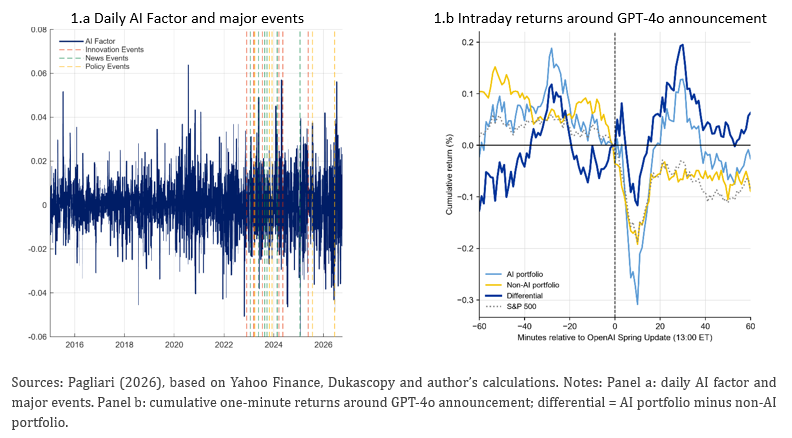
The empirical analysis starts from a daily long-short equity factor (Figure 1). The long portfolio comprises firms directly involved in AI computing, platforms and software, while the short portfolio consists of adjacent technology firms with more limited exposure to AI. Both legs are constructed using time-varying market-capitalisation weights. This factor is intended to capture AI-specific relative repricing, rather than broader movements in technology stocks or equity markets.
The factor is validated against 31 major AI-related announcements covering technological breakthroughs, adoption and commercialisation news, and policy actions. For the 24 events to which an ex ante directional effect can be assigned, the factor moves in the expected direction in every case. A high-frequency analysis around OpenAI’s GPT-4o presentation on 13 May 2024 provides a further validation: the relative repricing of AI-exposed stocks evolves in line with the information disclosed during the presentation, rather than simply tracking movements in the S&P 500.
Figure 1. Identifying AI news in financial markets
In a second step, a six-variable daily Bayesian VAR is used to isolate a structural AI news shock. The model includes the AI factor, broad US equity returns, the VIX, the US two-year Treasury yield, the 10-year minus 2-year yield spread and the US dollar nominal effective exchange rate. Identification combines sign restrictions, a magnitude restriction requiring the AI factor to respond more strongly than the broad equity market, and narrative restrictions around salient AI-related events. Greater posterior weight is then assigned to structural decompositions in which the AI shock accounts for a larger share of the AI-factor innovation on those dates. The resulting daily shocks are aggregated to monthly frequency and used in Bayesian smooth local projections, while preserving uncertainty associated with the first-stage structural identification.
The US results point to an investment-led adjustment rather than an immediate productivity boom (Figure 2). Core capital-goods orders begin to rise significantly around eight months after a positive AI news shock, reaching about 0.7% above baseline by month 11 and peaking at roughly 1.2% around month 29. Aggregate industrial production, by contrast, responds more gradually and with considerably greater uncertainty.
Price pressures also emerge progressively. Producer prices react before consumer prices, with the PPI response turning positive within the first year and peaking at around 0.8% after approximately three years. Headline and core consumer prices increase later. This sequencing is consistent with firms expanding investment and increasing demand for complementary inputs, energy and implementation capacity before the associated expansion in productive capacity is fully realised.
The shock therefore differs from a conventional productivity innovation that immediately lowers production costs. Favourable AI news contains information about future productivity gains, but the transition towards a higher-productivity state can itself be resource-intensive. The near-term macroeconomic impulse thus combines expectations of future supply gains with current investment and demand pressures.
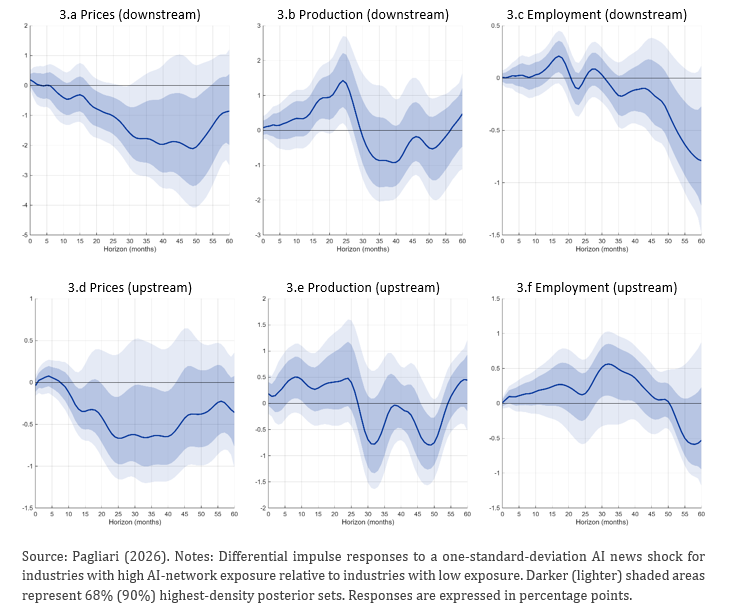
Aggregate results mask substantial differences across sectors (Figure 3). Using the 2023 US BEA input-output table, the analysis measures the extent to which each industry is connected to a set of AI-related sectors, distinguishing between industries that supply inputs to the AI ecosystem (upstream exposure) and those that use AI-related inputs in production (downstream exposure).
Over roughly the first two years following a positive AI news shock, production performs relatively better in industries with high exposure to the AI production network. At the same time, producer-price increases are smaller in these sectors than in less-exposed industries. Highly exposed upstream suppliers also display a particularly strong employment response. This pattern is consistent with favourable supply or productivity effects being most visible in sectors close to the AI ecosystem, while the associated investment expansion raises demand for complementary inputs and production capacity.
Over time, however, the relative production advantage of highly exposed sectors diminishes and eventually reverses. Activity becomes increasingly stronger in less-exposed industries, where price pressures are also more pronounced. The production network therefore serves not only as an amplification channel but also as a diffusion mechanism, through which an initially concentrated AI-related impulse gradually spreads across the broader economy.
Figure 2. US transmission of a positive AI news shock
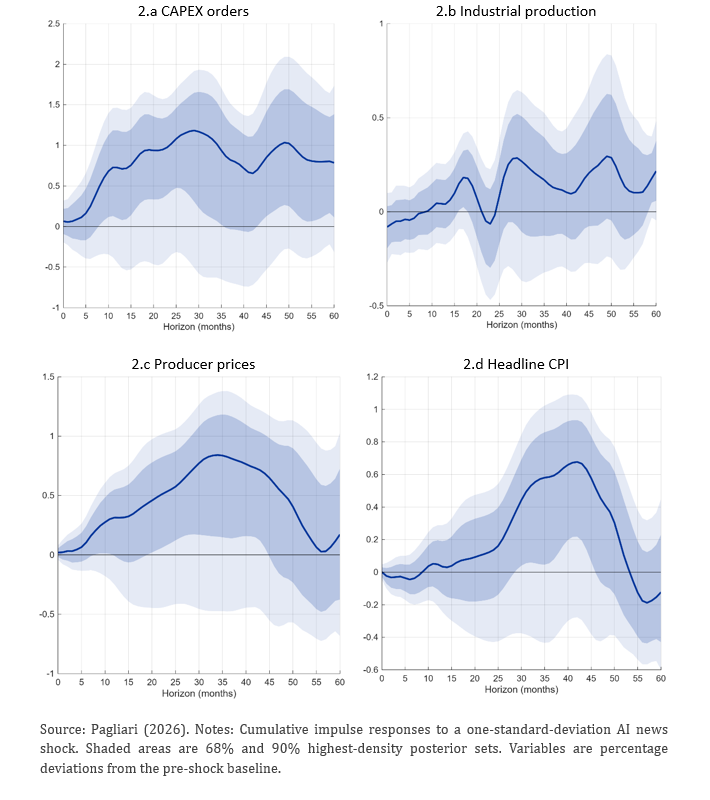
Figure 3. Differential impact of AI news shock on US sectors
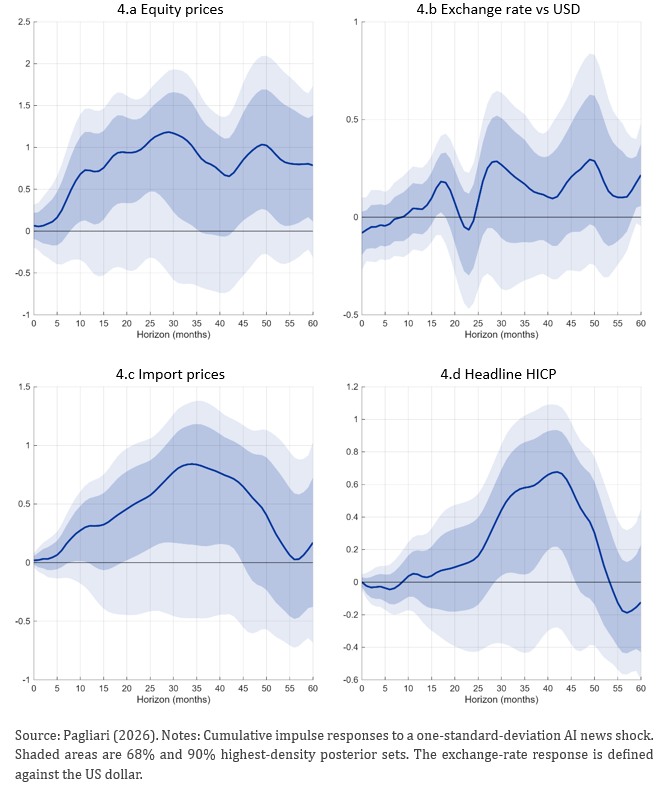
The shock originates in US financial markets but also generates sizeable spillovers to the euro area (Figure 4). Financial variables and external prices respond before domestic real activity. Equity prices increase, the euro depreciates against the dollar, import and energy prices rise. Headline inflation strengthens before core inflation, while industrial production responds only with a delay. Short-term inflation expectations and nominal interest rates also increase.
This sequencing points to a two-speed transmission mechanism. At short horizons, US AI news is transmitted through the global financial cycle and external-cost channels: relative asset valuations adjust rapidly, the dollar appreciates, and higher import and energy costs are transmitted to the euro area. At longer horizons, the productive benefits depend more strongly on domestic adoption and complementary investment by European firms.
For monetary policy, this creates a timing challenge. A strong policy response to the initial increase in interest rates, the exchange-rate depreciation and inflation could restrain activity before the productive benefits of AI adoption materialise. At the same time, simply looking through the shock could allow imported price pressures to broaden and become more persistent. The appropriate policy assessment therefore depends on whether the observed inflationary pressures reflect a temporary external-cost impulse or a more persistent interaction between investment demand, supply bottlenecks and underlying inflation.
Figure 4. Selected euro area responses to a US-originated AI news shock
Three implications emerge from the analysis. First, favourable AI news should not automatically be interpreted as a conventional positive supply shock. Even if AI ultimately raises productivity, the adoption phase can generate inflationary pressures because it requires capital deepening, greater energy use, additional intermediate inputs and organisational adjustment.
Second, the international distribution of AI-related effects matters. Economies at the technological frontier may experience the investment response earlier, while adopter economies can initially be affected through financial markets, exchange rates and imported costs. Monitoring AI-related financial repricing can therefore provide useful information before conventional measures of economic activity begin to respond.
Third, it is important to distinguish between expectations and realised adoption. The identified shock captures revisions in the expected economic value of AI rather than a direct measure of realised productivity. The results should therefore be interpreted as evidence on the transition from news to adoption, rather than as an estimate of AI’s long-run productivity dividend. For central banks, the main challenge lies precisely in this transition: financial and inflationary effects can materialise quickly, while the productive gains are slower to emerge and remain more uncertain.
Acemoglu, D. (2025), “The Simple Macroeconomics of AI”, Economic Policy, 40(121), 13–58.
Acemoglu, D. and Restrepo, P. (2019), “Automation and New Tasks: How Technology Displaces and Reinstates Labor”, Journal of Economic Perspectives, 33(2), 3–30.
Christensen, J. H. E. and Rudebusch, G. D. (2026), “Can Fiscal, AI, or Monetary News Explain the Rise in r*?”, Federal Reserve Bank of San Francisco Working Paper 2026-19.
Eisfeldt, A. L., Schubert, G. and Zhang, M. B. (2023), “Generative AI and Firm Values”, NBER Working Paper 31222.
Gazzani, A. and Natoli, F. (2026), “The Macroeconomic Effects of AI-based Innovation”, Banca d’Italia Temi di Discussione 1542.
Hartmann, P. and Maver, V. (2025), “Implications of Artificial Intelligence for Monetary Policy: A First Conceptual Assessment”, SUERF Policy Brief 1080.
International Energy Agency (2025), Energy and AI, Paris.
Miranda-Agrippino, S. and Rey, H. (2020), “U.S. Monetary Policy and the Global Financial Cycle”, Review of Economic Studies, 87(6), 2754–2776.
Pagliari, M. S. (2026), “Do Markets Dream of Artificial Intelligence? Macroeconomic Effects and International Spillovers of AI News Shocks”, DNB Working Paper No 871.
Rey, H. (2015), “Dilemma not Trilemma: The Global Financial Cycle and Monetary Policy Independence”, NBER Working Paper 21162.