

The views expressed are those of the author.
Abstract
The ECB estimates that euro-area households hold approximately €440 billion of equity exposure to US technology firms through funds and ETFs. Separately, European insurers hold €211 billion in private credit. From 30 January 2027, the revised Solvency II framework will reduce capital charges on securitisations, increasing insurer demand for structured AI infrastructure debt at a time when US regulators have removed the legal floor for risk retention on data centre bonds. This brief maps three distinct channels through which European financial stability could be affected by a correction in US AI infrastructure valuations: equity pass-through via retail funds, credit absorption via insurers, and borrowing-cost transmission via the euro bond market. It identifies the macroprudential gap and proposes three interventions using existing EU institutional mandates.
The construction of AI computing infrastructure in the United States is now the largest capital expenditure programme relative to GDP since the postwar highway system. Van Nieuwerburgh (2026) projects cumulative investment of $10.3 trillion from 2025 to 2032, averaging 3.63 per cent of US GDP per year. A growing share of this investment is financed through off-balance-sheet structures: special-purpose vehicles (SPVs), joint ventures with private credit funds, and long-term lease commitments that do not appear on hyperscaler balance sheets.
Estimates of the off-balance-sheet component vary by perimeter. Morgan Stanley reports that disclosed commitments by seven firms (five hyperscalers plus Nvidia and Broadcom) exceed $3.1 trillion, comprising $1.1 trillion in lease obligations and $1.7 trillion in procurement commitments. Goldman Sachs calculates $1.5 trillion in active and future data centre leases, of which $725 billion relates to leases not yet commenced. BIS Bulletin 120 documents that of the $2.9 trillion projected AI capital expenditure for 2025–2028, approximately $1.5 trillion requires external financing, with private credit funds originating over $40 billion in AI-related loans in 2025 alone.
The BIS finding that AI-related loans are priced at 6.2 per cent — identical to non-AI loans of comparable rating — suggests that lenders are not charging a risk premium for sectoral concentration. The revenue base supporting this investment remains narrow: Senate Banking Committee minority staff estimate that $400 billion in AI capital expenditure in 2025 generated approximately $60 billion in direct revenue. The illustrative case is Meta’s Hyperion joint venture with Blue Owl Capital: a bankruptcy-remote SPV raised $27 billion in A+-rated debt (yielding 6.58 per cent at issue, maturing 2049), with the debt entirely off Meta’s consolidated balance sheet.
An important counterfactual must be noted. Cloud revenue among hyperscalers grew 48 per cent year-on-year in Q2 2026, accelerating from 39 per cent in Q1. This suggests real demand, not purely speculative investment. The question is not whether AI generates revenue, but whether the financial structure supporting the buildout is resilient to a deceleration in that growth — particularly given the opacity and scale of the off-balance-sheet component.
On 29 July 2026, the SEC Division of Corporation Finance issued a no-action letter concurring that fixed-income securities issued in data centre securitisations are not asset-backed securities under Section 3(a)(79) of the Exchange Act, because data centre assets are actively managed operating infrastructure rather than self-liquidating financial claims. The practical consequence is that such securitisations are exempt from Regulation AB disclosure requirements and from the 5 per cent risk retention mandated by Dodd-Frank Section 941.
This does not mean issuers retain no risk. Current market practice, as Latham & Watkins noted in their request letter, involves voluntary retention of approximately 30 per cent, and loan-to-value ratios capped at 70 per cent. The significance is structural: the legal floor has been removed at precisely the moment issuance is scaling. US data centre bond issuance grew from $2.4 billion in 2020 to over $25 billion in 2025. Without a statutory retention requirement, the discipline depends entirely on market norms, which historically erode in late-cycle conditions. The originate-to-distribute model now has no statutory backstop.
European financial stability is exposed to US AI infrastructure risk through three distinct channels, each operating through a different asset class, regulatory framework, and investor base. The table below summarises the transmission mechanism.
Table 1.
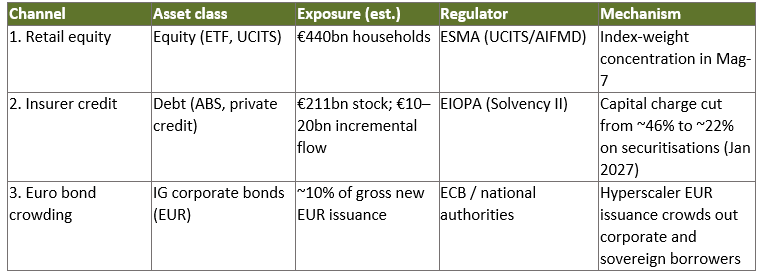
Channel 1: Equity pass-through via retail funds. ECB economists estimate that euro-area households hold approximately €440 billion of exposure to US technology equities, predominantly through mutual funds and ETFs. Eighty per cent of European households have no direct equity holdings; their exposure is entirely intermediated. This channel transmits valuation corrections in US AI-related equities to European household wealth. It is an equity risk, distinct from the credit risk in channels 2 and 3, but correlated through the balance sheets of the same hyperscaler firms that issue the off-balance-sheet debt documented above.
Channel 2: Insurer absorption of US structured AI debt. European insurers hold approximately €211 billion in private credit, representing 2.3 per cent of assets. From 30 January 2027, the revised Solvency II framework under Commission Delegated Regulation 2026/269 will reduce the spread-risk capital charge on securitisations: illustratively, from approximately 46 per cent to 22 per cent for a three-year non-STS position. This makes US data centre ABS significantly more capital-efficient for European insurers.
An illustrative estimate suggests the order of magnitude. If the capital charge reduction induces European insurers to increase their allocation to securitised debt by 5–10 per cent of the existing €211 billion private credit stock, the incremental flow would be in the range of €10–20 billion. This is not enormous relative to total insurer assets, but it would be concentrated in a single infrastructure sector, US-originated, and arriving precisely when the US legal floor for risk retention has been removed. The Solvency II reform was designed to revive the European securitisation market as part of the Capital Markets Union agenda. Its interaction with US AI infrastructure debt is an unintended consequence, not a deliberate policy choice, but the prudential effect is the same.
Channel 3: Euro bond market pressure. US hyperscalers now account for nearly 10 per cent of gross new euro-denominated bond issuance, led by Amazon and Alphabet. ECB data show they represented 15 per cent of the increase in domestic euro corporate bond holdings in the year to March 2026 . Reuters analysis raises the concern that this issuance volume may crowd out European corporate and sovereign borrowers, pushing up financing costs across the market. The channel is less direct than the first two but operates through the same underlying driver: hyperscaler capital needs for AI infrastructure financed increasingly in European currency.
The ECB has documented the risk with unusual intensity. In a 48-hour period in September 2026, four separate ECB publications addressed AI-related financial stability concerns: President Lagarde’s Vienna speech quantifying European savings exposed to US tech; Executive Board member Cipollone on stablecoin-driven deposit outflows; Executive Board member Schnabel on fiscal fragility in a shock-prone world; and an ECB blog post on household savings concentration.
However, the ECB is not the competent prudential authority for the three channels identified. Retail equity exposure through UCITS funds falls under ESMA’s mandate. Insurer solvency is supervised by EIOPA under the Solvency II framework. The European Systemic Risk Board (ESRB) has the cross-sectoral mandate to identify and warn of systemic risks, but has not issued any assessment of AI infrastructure concentration. This is not unusual: the ESRB rarely issues sector-specific warnings. But the distinguishing feature of AI infrastructure exposure is its extreme concentration. A single sector, dominated by five to seven firms, appears simultaneously in equity indices, private credit portfolios, and euro bond markets, creating correlated losses across all three channels in a correction scenario.
No existing macroprudential buffer or stress-testing framework captures cross-border, cross-asset-class concentration in a single infrastructure sector. The tools exist. The application does not.
Three interventions are feasible within existing EU institutional mandates, without new legislation:
(a) ESRB sectoral risk assessment before 30 January 2027. The ESRB should assess the combined European exposure to US AI infrastructure across equity, credit, and bond channels before the revised Solvency II capital charges take effect. The ESRB has issued cross-sectoral assessments on commercial real estate (2022) and leveraged finance (2023); AI infrastructure concentration warrants comparable treatment. The 30 January 2027 implementation date provides a natural window for action.
(b) EIOPA stress test on AI-related structured exposures. EIOPA’s biennial insurance stress tests should include a scenario testing insurer exposure to US-originated data centre securitisations under the revised capital framework. EIOPA has incorporated sectoral concentration scenarios in past exercises (e.g., the 2021 cyber underwriting scenario). A dedicated AI infrastructure module would quantify the risk before insurers increase their allocations.
(c) ESMA disclosure guidance on sectoral concentration in passive funds. Under the PRIIPs KID framework and UCITS prospectus disclosure rules, ESMA has the authority to issue guidance on enhanced disclosure of sectoral concentration in index-tracking funds. Current disclosure requirements do not alert retail investors to the degree of AI-sector concentration embedded in standard global equity indices. ESMA could require that funds with more than a specified threshold of exposure to a single infrastructure sector disclose this in investor-facing documents.
The financial structure supporting the US AI infrastructure buildout is characterised by opacity, scale, and regulatory facilitation on the US side. Europe is not originating this risk but is positioned to absorb it through at least three measurable channels. The interaction between the SEC’s removal of the legal risk-retention floor (July 2026) and the EU’s reduction of insurer capital charges on securitisations (January 2027) creates a cross-jurisdictional regulatory gap that no current macroprudential framework addresses.
Whether the AI buildout produces sustained returns or a correction remains genuinely uncertain — cloud revenue growth of 48 per cent suggests real demand, while the capex–revenue gap and zero risk premium in lending suggest mispricing. The purpose of this brief is not to predict which outcome materialises, but to identify that European financial stability is exposed in either case, and that the tools to assess that exposure already exist within EU institutions but have not yet been applied to this risk.
Van Nieuwerburgh, S. (2026). ‘Financing the AI buildout.’ Brookings Papers on Economic Activity, Fall 2026 conference draft. https://www.brookings.edu/articles/financing-the-ai-buildout/
Morgan Stanley Research (2026). ‘AI-Related Off-Balance-Sheet Commitments Top $3 Trillion.’ Bloomberg Law, September 2026. https://news.bloomberglaw.com/capital-markets/ai-related-off-balance-sheet-commitments-top-3-trillion-ms
Goldman Sachs (2026). Cited in The Times, ‘Debt warning as tech giants spend $1trn on future data centre leases.’ https://www.thetimes.com/business/companies-markets/article/big-tech-ai-data-centres-debt-fkdx5dzzx
Aldasoro, I., Doerr, S., and Rees, L. (2026). ‘Financing the AI boom: from cash flows to debt.’ BIS Bulletin No. 120, 7 January 2026. https://www.bis.org/publ/bisbull120.htm
US Senate Committee on Banking, Housing, and Urban Affairs, Democratic Staff (2026). ‘The AI Industry’s Addiction to Debt Poses Risks to Our Economy.’ https://senatebankingdemocrats.substack.com/p/the-ai-industrys-addiction-to-debt
Steffen, S. (2026). ‘Inside Nvidia’s $500 Billion AI Debt Machine: A Credit Analysis.’ Frankfurt School of Finance & Management, 10 August 2026. https://www.sascha-steffen.de/updates/nvidia-500bn-ai-financing-credit-risk
Macrostream Q2 2026 hyperscaler earnings analysis. Combined cloud revenue growth +48% YoY (AWS, Azure, Google Cloud).
SEC Division of Corporation Finance (2026). No-Action Letter re: Data Center Securitizations, 29 July 2026. https://www.sec.gov/files/corpfin/no-action/dcs-interp-letter-072326.pdf
Andersson, M. et al. (2026). ‘Concentration risk in AI-related equities.’ ECB Blog, 17 August 2026.
https://www.ecb.europa.eu/press/blog/date/2026/html/ecb.blog20260817~754a8a4418.en.html
Commission Delegated Regulation (EU) 2026/269 amending Delegated Regulation (EU) 2015/35 as regards the calculation of the spread risk sub-module for securitisation positions. OJ L, 2026. See also UBS, ‘Solvency II Reform 2027: CLO Capital Charges Explained,’ https://www.ubs.com/dk/en/assetmanagement/campaigns/solvency-ii-reform.html
ECB Markets Operations analysis, cited in Reuters, ‘US tech firms may crowd out others in euro bond market and raise credit risk,’ 2 September 2026. https://www.reuters.com/legal/transactional/us-tech-firms-may-crowd-out-others-euro-bond-market-raise-credit-risk-2026-09-02/
Dolan, M. (2026). ‘US hyperscalers’ euro thirst — lifeblood or vampire?’ Reuters Open Interest, 3 September 2026. https://www.reuters.com/commentary/reuters-open-interest/us-hyperscalers-euro-thirst-lifeblood-or-vampire-mike-dolan-2026-09-03/
Lagarde, C. (2026). ‘A New Age of Capital.’ Speech, Vienna, 14 September 2026.
https://www.ecb.europa.eu/press/key/date/2026/html/ecb.sp260914_2~a3f0efbee4.en.html
Cipollone, P. (2026). Remarks on stablecoin deposit displacement, September 2026.
Schnabel, I. (2026). ‘Macroeconomic and fiscal stability in a shock-prone world.’ BMWE Symposium, September 2026.
ECB Blog (2026). ‘Household savings in the euro area,’ 15 September 2026.
https://www.ecb.europa.eu/press/blog/date/2026/html/ecb.blog20260915~dacebb4a6f.en.html