

This policy brief is based on the research presented in the NBS Working Paper 3/2026. The views expressed are those of the authors and not necessarily those of the institutions the authors are affiliated with.
Abstract
Upgrading Europe’s housing stock is essential to meeting EU climate goals, but borrower-based measures (BBMs) designed to protect financial stability can sometimes unintentionally restrict access to finance for housing upgrade projects. Drawing on experiences from Slovakia, Latvia, and Hungary, this brief examines how well-calibrated BBM easings can potentially expand lending for housing upgrades without undermining financial stability. Survey evidence from these countries shows that targeted easings pose minimal risk to financial stability but have had a limited impact on loan volumes. We explain this low uptake by the fact that BBM easings affect only a narrow group of borrowers and provide no direct financial incentive for renovations. To achieve meaningful impact, we suggest pairing BBM adjustments with fiscal measures, simplified administrative processes, and public awareness campaigns.
Upgrading the energy efficiency of Europe’s homes is a cornerstone of the European Union’s strategy to achieve climate neutrality. Despite important progress in housing energy efficiency over the last two decades, buildings still account for about a third of the EU’s energy-related greenhouse gas emissions, and more than 75% of the current building stock remains energy inefficient. With roughly 90% of today’s buildings expected to still be in use by 2050, accelerating renovation is central to achieving EU objectives. The European Commission estimates that an additional EUR 275 billion in renovation investments are needed each year to meet the 2030 emission-reduction target.1
In addition to emissions reductions, housing energy upgrades also deliver important social co-benefits. Nearly 20% of the European population lives in dwellings that are not comfortably warm during winter. This share rises to over 30% among those at risk of poverty.2
Homeowners are at the centre of this challenge. Nearly 70% of people in the EU own their homes and are therefore responsible for undertaking renovation work.3 Yet ownership does not necessarily mean financial capacity. Across the EU, about one-third of homeowners are willing to renovate but lack the necessary funds, a share that rises sharply among low-income households (Causse et al., 2021). In Germany, nearly 70% of low-income homeowners cite financial constraints as the main barrier to energy upgrades, compared with 40% of homeowners on average (Römer and Salzgeber, 2023). For these households, access to bank loans is a critical enabler for upgrading housing.
Whether a household can secure the loan it needs to upgrade its home may depend on complying with borrower-based measures (BBMs), such as, among others, loan-to-value (LTV), debt-to-income (DTI), and debt-service-to-income (DSTI) limits. These limits can be in place for good reason: macroprudential authorities apply them to safeguard financial stability and protect borrowers from over-indebtedness. BBMs have generally proven effective in strengthening bank resilience (Biljanovska et al., 2023), and they are in place, in some forms, across almost all EU member states. Yet, BBMs can also unintentionally restrict access to finance for housing upgrades, particularly for lower-income or already-indebted households willing to invest but constrained by these limits. This raises a critical question: can BBMs be adapted to enable more housing upgrades without undermining financial stability?
In some cases, BBMs can be adjusted to support housing upgrades without necessarily undermining financial stability. The key idea is that energy-efficiency improvements can strengthen household finances and, in some cases, reduce credit risk. Renovations can lower monthly energy bills, effectively freeing up disposable income to help service a loan. Upgrades may also increase a property’s market value, improving collateral quality for banks and reducing losses in the event of default. In addition, public subsidies that households can get during and after renovation work further reduce credit risk. An easing of borrowing limits for upgrading loans that carefully account for these effects can be “risk-neutral” – i.e., it can expand financing opportunities without materially increasing financial stability risks.
Macroprudential authorities in Slovakia, Latvia, and Hungary – their respective central banks – have implemented such a risk-neutral approach and eased BBM limits for housing upgrade loans (see Table 1). These easings aim to support environmental objectives and are thus tied to measurable energy-efficiency improvements from the projects funded by eligible loans.
Table 1. Housing upgrade BBMs easings in Slovakia, Latvia and Hungary
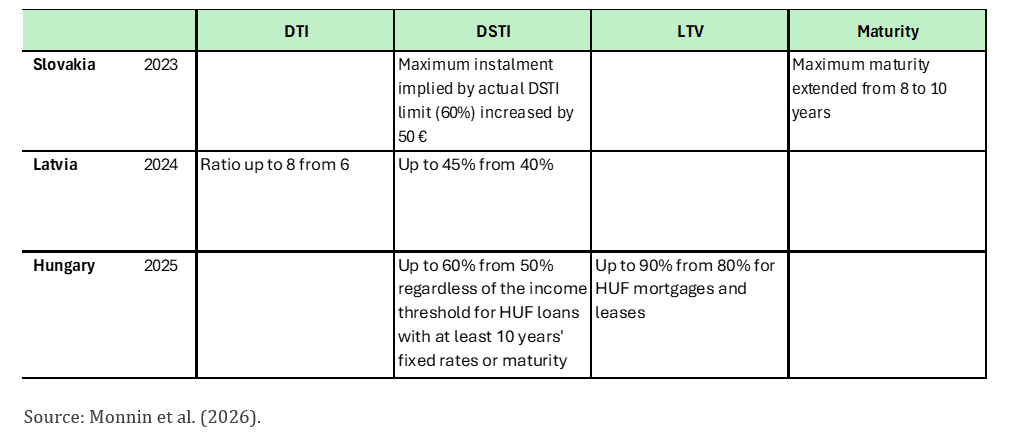
Crucially, in all countries, macroprudential authorities carefully weighed the consequences of these measures for financial stability and calibrated them to remain risk-neutral for the banking sector. In Slovakia and Latvia, macroprudential authorities estimated potential energy bill savings for households and incorporated them into the calculation of alleviated BBM limits. In Hungary, the macroprudential authorities estimated the potential loan growth generated by the measure and its impact on aggregate credit growth and real estate prices, concluding that the systemic impact would be limited.4
To assess the impact of these measures, the authors surveyed 17 major banks in Slovakia, Latvia and Hungary, accounting for approximately 58-87% of banking assets across the three countries. The results offer a nuanced picture. Banks did not report – nor do they expect – any significant change in the credit risk of their loan portfolio. Most banks assess the probability of default and the loss given default for green loans as similar to those for other loans. This aligns with a risk-neutral approach: these measures did not increase systemic credit risk for the banking sector.
However, uptake has been modest. Half of the banks saw no significant change in green loan demand since the BBM easings, while the other half experienced increases but attributed them to only a marginal role of the easing. Banks indicated that easings were especially relevant for purchasing energy-efficient real estate, but less for financing renovation work. Only three banks report that easings allowed some households to enter the credit market. This indicates that the measures have only marginally contributed to achieving housing energy-efficiency objectives.
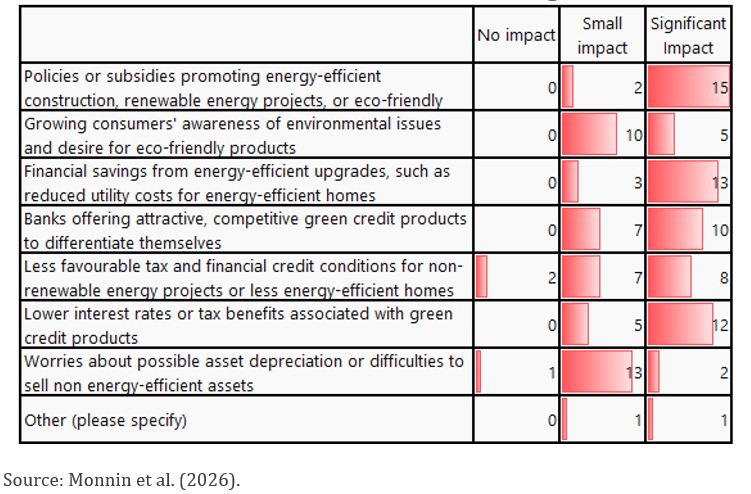
When describing the current barriers to green loan market growth (Table 2) and its future drivers (Table 3), banks highlight the importance of clear government support and subsidies, as well as the role of attractive pricing for green loans to borrowers, such as reduced interest rates or fees. Banks cite the significant upfront expenses of green projects, even when a loan is available, and the low supply of green projects and real estate as barriers to market growth. They also see the financial savings from energy-efficient upgrades as one key driver of future growth.
Table 2. Barriers to green loans market growth
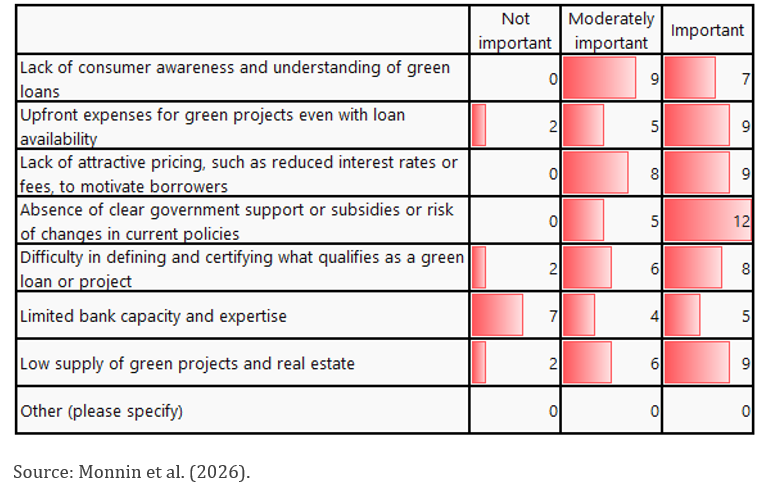
Table 3. Drivers of loans market future growth
Two main obstacles explain the limited impact of BBM easings on the uptake of housing upgrade loans. First, easing BBMs does not constitute a financial incentive for households to undertake housing upgrade projects. It does not make these projects more economically attractive; it just increases the amount households can borrow for the projects that are already profitable. Easing BBMs does not fundamentally change banks’ cost-benefit analysis of housing upgrade loans, either.
Second, only a narrow subset of households – those already close to BBM limits and willing to invest in energy-efficiency upgrades – benefit from these measures. If this narrow scope aligns with financial stability objectives, as it prevents large and potentially risky credit growth, it is not likely to trigger large-scale upgrades. Without additional policies, BBM easings remain useful but insufficient in the face of these obstacles.
To best support housing upgrade efforts, policymakers should combine BBM easings with broader measures. Fiscal measures are at the forefront. Public subsidies, tax incentives, and fiscal releases improve the household’s cost-benefit balance when assessing the economic benefit of undertaking housing upgrade projects. Unlike a BBM easing, they constitute a real financial incentive for households. Public guarantees can also reduce banks’ risk exposure to housing upgrade loans and support the supply of such loans. Monetary measures, such as targeted refinancing operations – provided they align with central banks’ mandates – could also support the growth of the housing upgrade loan market.
Measures to reduce administrative complexity could also support the uptake of housing upgrade loans. Banks suggest simplifying the definition of green projects, developing unified tools to assess compliance with the EU taxonomy, providing banks with online access to central energy performance certificate registers, and creating sector-specific templates. Digital solutions are emerging to lower the cost of managing green eligibility data (Zhang et al., 2025). Public outreach campaigns can also boost household awareness, as banks’ marketing efforts remain limited.
Finally, there may be room for further calibration. Given that housing upgrade loans remain marginal in banks’ portfolios and most banks assess green loans as posing no greater risk, macroprudential authorities could consider progressively increasing limits while monitoring outcomes (Hiebert and Monnin, 2023).
The evidence from Slovakia, Latvia, and Hungary demonstrates that carefully designed BBM easings that reflect energy-cost savings and increased property values can expand access to credit without threatening financial stability. However, the impact of these measures on housing upgrade loan volumes has been modest. BBM adjustments provide no direct financial incentive for housing upgrade projects and affect only households near existing limits who are willing to undertake such projects.
To achieve meaningful progress, BBM adjustments must be embedded in a comprehensive policy framework that combines fiscal support, administrative simplification, and public awareness. Only through coordinated action across fiscal, regulatory, and monetary domains can Europe achieve the scale of housing upgrades needed for a sustainable future.
Biljanovska, N., Chen, S., Gelos, G., Igan, D., Martinez Peria, M. S., Nier, E. and Valencia, F. (2023). Macroprudential policy effects: evidence and open questions. IMF Departmental Paper.
Causse, E., Figueira, M., Gutiérrez, B. and Panagiotopoulou, I. (2021). European Property Owners’ readiness and capacity to renovate – UIPI survey final report. International Union of Property Owners.
Hiebert, P. and Monnin, P. (2023). Climate-related systemic risks and macroprudential policy. INSPIRE Policy Briefing Papers, no 14.
Monnin, P., Banai, Á., Bojāre, K., Klacso, J., Martin, R. and Szakács, J. (2026). Upgrading housing: the potential and limits of borrower-based measures. NBS Working papers.
Römer, D. and Salzgeber, J. (2023). KfW Energy Transition Barometer 2023 – Energy transition caught between need for action and financial possibilities. KfW Research.
Zhang, J, Knaack, P. and Shao, D. (2025). Inclusive green finance for small companies: a case study of pilot cities in China’s Zheijiang province. CEP Discussion Note.
The figures in this paragraph are from the European Environment Agency’s and the European Commission‘s websites and European Commission (2020).
Source: Eurostat – Living conditions in Europe – energy efficiency in households.
For more details on how these measures were calibrated, see Monnin et al. (2026)