

This policy brief is based on Bank of Albania Working Paper 08 (104) 2026. The views expressed herein are of the author and do not necessarily represent the views of the Bank of Albania.
Abstract
This study analyzes the impact of macroeconomic and banking indicators on bank profitability in Albania over the period 2002-2024. By employing the Mixed Data Sampling (MIDAS) panel methodology, we address the challenge of incorporating high-frequency data with low-frequency data using flexible distributed lag functions. Our empirical findings indicate that NPLs negatively impact profitability, whereas economic activity and capital adequacy ratio have a positive influence on it. Explanatory variables affect profitability differently across time horizons. The lagged effects of credit risk and interest rate gradually decrease, implying that the effects die off slowly. The impact of exchange rate is more complex, which is negative in the short run, and partially reverses at longer horizons. The study contributes to the existing literature by highlighting the timing and persistence of macro-financial drivers of bank profitability, while illustrating how mixed-frequency data can be incorporated in a parsimonious framework avoiding over-parameterization.
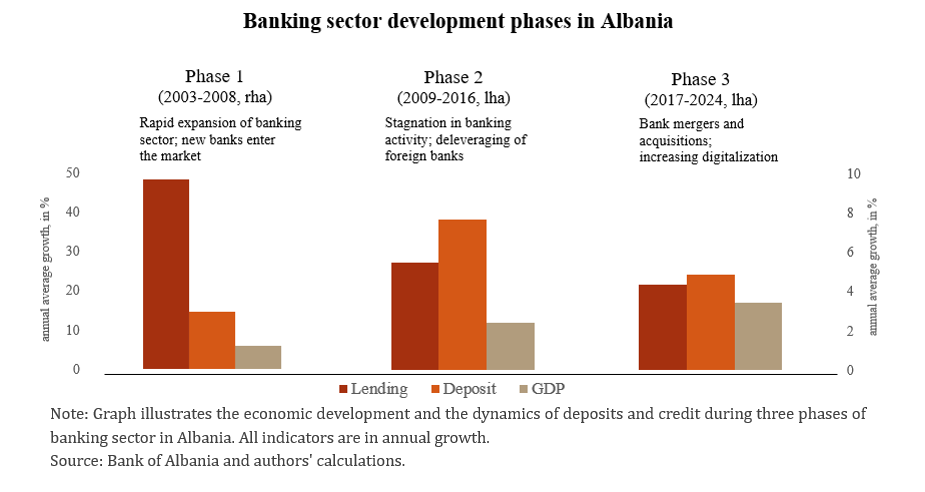
Bank profitability plays a central role in financial stability, as it underpins banks’ capacity to build capital buffers, absorb losses, and sustain credit provision, thereby supporting effective monetary transmission. This is particularly relevant for Albania, which has a relatively young banking system that has undergone significant structural and institutional reforms since the early 2000s (Sejko, 2021). The development of Albanian banking system has undergone three main phases as illustrated in Figure 1. During phase 1 the banking sector grew rapidly with new domestic and international banks entering the market. Phase 2 was marked by stagnation in banking activity, largely due to the deleveraging of foreign banks in response to the Greek sovereign debt crisis. Phase 3 is characterized by bank mergers and acquisitions, digitalization, and improved financial infrastructure. However, the banking sector in Albania has remained relatively simple and concentrated.
Figure 1. Economic growth and banking sector
As a small open transition economy with strong financial and economic linkages to the euro area, Albania remains exposed to external shocks. In this context, understanding the drivers of bank profitability is critical not only for domestic financial stability and policy design, but also from a broader regional and international perspective. Accordingly, the analysis focuses on three core dimensions: the sign and economic magnitude of the key determinants of bank profitability, the timing and persistence of their effects, and the role of major crisis episodes over the past two decades.
The dataset mixes quarterly low-frequency data with monthly high-frequency data covering the period from 2002 to 2024. Bank profitability is measured by return on assets (ROA) (Demirgüç-Kunt & Huizinga, 1999) and is explained by standard bank (i.e., capital adequacy ratio, credit risk and bank size) and macroeconomic indicators (i.e., economic activity, inflation, exchange rate and interest rate) (Lohano & Kashif, 2022; Ahmad et al., 2020; Athanasoglou et al., 2008; Pasiouras & Kosmidou, 2007). Three crisis dummy variables capture the impact of the GFC, the Greek sovereign debt crisis, and the COVID-19 pandemic. High-frequency financial and macroeconomic indicators enter the ROA equation without temporal aggregation allowing the model to exploit higher-frequency information while preserving parsimony.
Most empirical studies on bank profitability rely on annual or quarterly data and implicitly assume that all explanatory variables are observed at the same low frequency. In practice, however, many relevant financial and macroeconomic indicators are available at higher frequencies, such as monthly, weekly, or even daily data. Aggregating these high-frequency variables to match low-frequency outcomes leads to a loss of valuable information and obscures underlying dynamics. Conversely, incorporating all high-frequency observations directly into the model requires the inclusion of many lags, resulting in over-parameterization and multicollinearity. To address these challenges, we adopt a mixed-frequency approach using a MIDAS framework with polynomial lag distributions as introduced by Ghysels et al. (2020) for financial applications.
Quarterly ROA is modeled as a function of standard quarterly covariates and a weighted sum of past monthly indicators, where the lag weights follow a smooth polynomial distribution governed by a small set of parameters. This approach allows the model to exploit the full information content of high-frequency data while keeping the number of estimated parameters low. As a result, through the MIDAS framework we avoid over-fitting and provide an explicit lag profile for each determinant, enabling an assessment of whether effects are front-loaded, hump-shaped, or highly persistent over time.
The estimated signs and statistical significance of the key determinants are fully consistent with standard banking theory. Stronger economic activity supports bank returns, and higher capital adequacy ratios are linked to more robust ROA. The dynamic responses illustrated in Figure 2 show that the effects of NPLs and interest rates are front-loaded, with the strongest impact occurring at short horizons and then declining smoothly rather than instantaneously. The exchange rate profile highlights an initial deterioration in profitability followed by a gradual recovery. Likely reflecting valuation effects and increased credit risk, which tends to reverse over longer horizons as banks adjust through pricing, hedging and risk repricing. Most effects fade out within approximately six months. These features are particularly relevant for forward-looking profitability projections.
Figure 2. Dynamic patterns from MIDAS
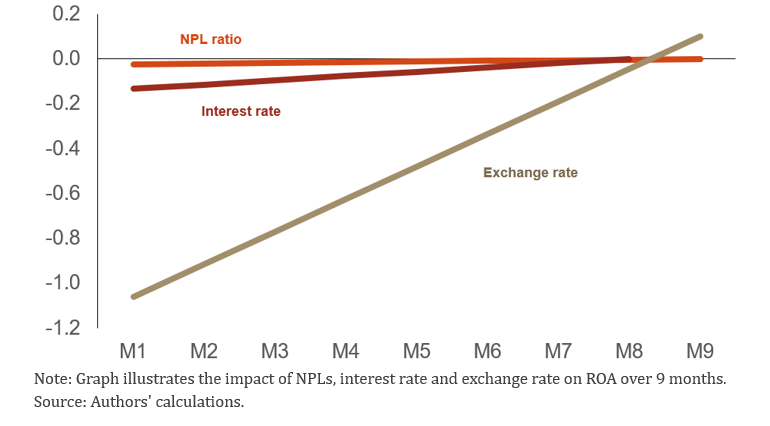
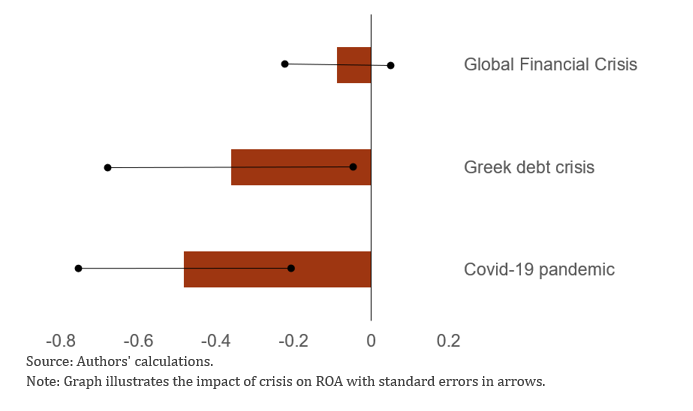
Figure 3 shows the negative impact of the GFC, the Greek sovereign debt crisis and the COVID-19 pandemic in ROA. In the case of Albania, the impact of the GFC is relatively small and statistically insignificant, reflecting the limited financial integration at the time, whereas the COVID-19 episode represents a more recent stress period, partially mitigated by substantial policy support.
Figure 3. Crisis Effects
By incorporating the MIDAS methodology, we overcome key limitations of traditional panel data models, which often struggle to capture the dynamic linkages between high- and low-frequency variables, while reducing over-parameterization and enhancing model stability.
The results presented in this analyze affirm that bank profitability in Albania is positively influenced by economic activity, capital adequacy and bank efficiency, while negatively impacted by credit risk, currency depreciation and monetary policy tightening. Inflation, by contrast, appears to play a limited role. Most bank-specific and macroeconomic indicators exert an immediate impact on profitability, with their impact largely absorbed within two to three quarters. The study also identifies negative shocks in profitability during crisis periods.
Ahmad, N., Naveed, A., Ahmad, S., & Butt, I. (2020). Banking Sector Performance, Profitability, And Efficiency: A Citation-Based Systematic Literature Review. Journal of Economic Surveys, 34(1), 185-218. doi: https://doi.org/10.1111/joes.12346
Athanasoglou, P., Brissimis, S., & Delis, M. (2008). BBank-specific, industry-specific and macroeconomic determinants of bank profitability. Journal of International Financial Markets, Institutions and Money, 18, 121-136.
Demirgüç-Kunt, A., & Huizinga, H. (1999). Determinants of commercial bank interest margins and profitability: Some international evidence. World Bank Economic Review, 13(2), 379-408.
Lohano, K., & Kashif, M. (2022). actors Affecting the Profitability of Banks in Developing Countries. International journal of business and management , 14(2). doi:10.5539/ijef.v14n6p56
Pasiouras, F., & Kosmidou, K. (2007). Factors influencing the profitability of domestic and foreign commercial banks in the European Union. Research in International Business and Financ, 21(2), 222-237. doi: https://doi.org/10.1016/j.ribaf.2006.03.007
Sejko, G. (2021). Banka qendrore dhe politikat e saj në kohën e COVID-19. Banka e Shqipërisë. Retrieved from https://www.bankofalbania.org/rc/doc/banka_qendrore_dhe_politikat_e_saj_n_koh_n_e_covid_19_final_web_20312.pdf