

This policy brief is based on NBER Working Paper 35239. The views expressed are those of the authors and not necessarily those of the institutions the authors are affiliated with.
Abstract
The same increase in policy rates can have markedly different effects on bank lending depending on whether banks lend at fixed or variable rates. We show that these differences matter only when a significant share of banks operates close to solvency thresholds. In our euro-area calibration, a 100-basis-point rate increase reduces new lending by about one-third more in fixed-rate systems than in variable-rate systems. The reason is that fixed-rate banks experience net interest margin compression when funding costs rise, whereas variable-rate banks can reprice legacy loans and rebuild capital. The same mechanism has financial-stability consequences: tightening raises bank failure risk in fixed-rate systems but lowers it in variable-rate systems. The findings support closer coordination between monetary and macroprudential policy and strengthen the case for gradual rate hikes when fixed-rate lending is prevalent.
The euro area offers a natural laboratory for studying heterogeneous monetary transmission. Loan-pricing conventions differ sharply across countries: banks in Belgium, France, Germany, and the Netherlands predominantly lend at fixed rates, whereas banks in Austria, Finland, Ireland, Italy, Portugal, and Spain rely much more on variable-rate contracts. This matters because it determines who bears interest-rate risk: following a monetary policy tightening, banks in fixed-rate systems continue to earn the contractual rates embedded in legacy loans while their funding costs rise, whereas banks in variable-rate systems can reprice existing loans. Empirical evidence shows that banks’ hedge against interest-rate risk is limited. The question is whether institutional differences in loan pricing translate into systematically different responses to a common monetary tightening.
Our paper shows that the answer is not automatic. If banks were sufficiently well capitalized, fixed-rate and variable-rate loan contracts would mainly reallocate the timing of repayments between banks and borrowers, with limited implications for aggregate credit supply. The question is, under what conditions do differences in interest-rate risk exposure alter the bank lending channel of monetary policy? To answer it, we develop a quantitative model of heterogeneous banks with long-term loans, capital and liquidity requirements, and idiosyncratic default shocks, and calibrate it to the euro area. The calibration combines institutional discipline from regulation and external evidence with a joint fit to the key balance-sheet, pricing, and transmission moments of the euro-area banking sector.
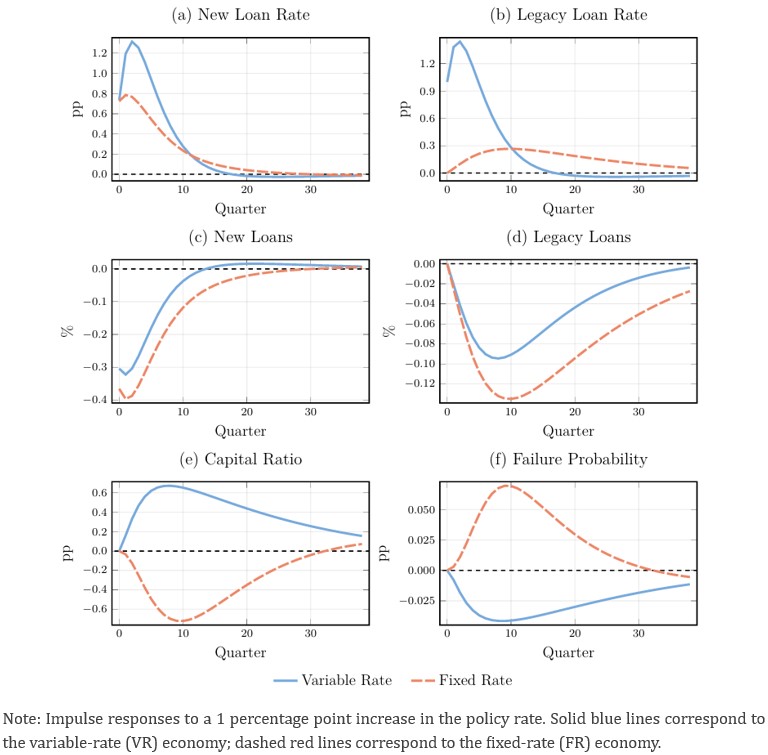
Figure 1 summarizes the main quantitative result. A 100-basis-point monetary tightening reduces new lending by about one-third more in the fixed-rate economy than in the variable-rate economy. Tightening also raises bank failure risk in fixed-rate systems while lowering it in variable-rate ones. The model also matches the empirical pattern that loan rates reprice more strongly in variable-rate countries, yet lending contracts more in fixed-rate ones.
Figure 1. Aggregate impulse response functions
The mechanism is easiest to understand through an irrelevance benchmark. When banks remain sufficiently far from binding regulatory thresholds, the distinction between fixed-rate and variable-rate lending mainly affects the timing of cash flows, not the overall profitability of lending. In that benchmark, monetary tightening still reduces credit by raising funding costs, but it does so by roughly the same amount in both systems.
That benchmark breaks down when many banks operate close to solvency thresholds. In fixed-rate systems, a rate hike compresses net interest margins because deposit and wholesale funding costs rise while income from legacy loans stays unchanged. Equity is eroded, and the weakest banks move closer to regulatory minima. In variable-rate systems, the opposite happens: legacy loan rates reprice upward, margins improve, and vulnerable banks rebuild capital buffers. The same monetary shock therefore amplifies the contraction in credit supply in one system while attenuating it in the other.
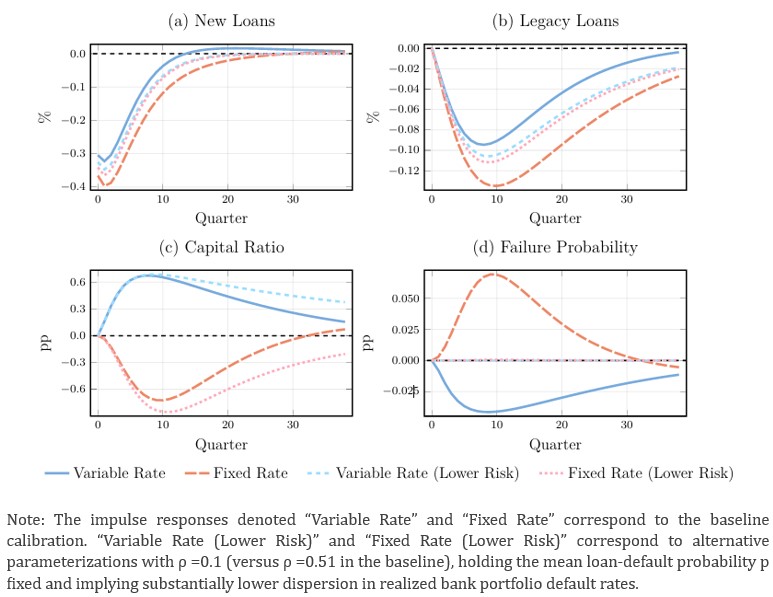
The key margin is therefore the cross-section of bank balance sheets. The aggregate gap between fixed-rate and variable-rate systems is driven by banks that begin close to the solvency threshold. In fixed-rate systems, these banks cut lending sharply as profitability deteriorates. In variable-rate systems, similarly weak banks react far less, and some even expand lending because higher interest income relaxes solvency pressure. Figure 2 shows that when we reduce the dispersion of bank default risk and keep banks farther away from the threshold, the difference between fixed-rate and variable-rate systems largely disappears. Contract structure alone is therefore not enough: what matters is the interaction between contract structure and the distribution of bank capital.
Figure 2. Impulse response functions – Lower idiosyncratic default-rate dispersion
These findings carry two immediate policy implications. First, macroprudential policy can offset part of the asymmetry created by a common monetary tightening. In the model, a temporary release of the countercyclical capital buffer increases regulatory headroom and narrows the lending gap between fixed-rate and variable-rate systems. This is especially relevant for a monetary union such as the euro area, where a single policy-rate path interacts with heterogeneous national banking structures.
Second, the path of monetary policy matters for financial stability, not only its cumulative size. Comparing tightening paths that deliver the same cumulative stance, we find that more gradual rate increases materially reduce peak bank failure rates in fixed-rate systems. Gradualism gives banks time to deleverage as legacy loans mature before the full increase in funding costs is transmitted to their balance sheets. The trade-off is much smaller in variable-rate systems, where the direct hit to bank profitability is absent.
The broader message is that the strength of the bank lending channel depends on the interaction between loan-rate fixation and the capitalization of the banking system. Whether loan-rate fixation matters depends less on contract form by itself than on how many banks are close to regulatory limits when policy tightens. In banking systems with widespread fixed-rate lending and limited capital buffers, monetary and macroprudential policy should be designed jointly rather than in isolation.
Abad, J., S. Bigio, S. Garcia-Villegas, J. Marbet, and G. Nuño (2026). “The heterogeneous bank lending channel of monetary policy,” CEPR Discussion Paper No. 21519.