

This policy brief is based on ECB Occasional Paper 397 “Prohibition of monetary financing: an economic perspective”. The paper has been prepared when the author was working at the ECB. The views expressed in this SUERF Policy Brief are those of the author and should not be reported as representing the views of the European Central Bank (ECB) or the Eurosystem.
Abstract
The European prohibition of monetary financing prohibits the central banks from purchasing government bonds directly at issuance or granting credit to governments. It aims to safeguard central bank independence in setting monetary policy to maintain price stability while also preserving fiscal discipline, preventing fiscal policies from hindering monetary policy. The ban is more stringent than the restrictions that existed in Europe before EMU, and than those applying in the UK and the US. Based on standards set by the ECB, the prohibition has generally been observed, with only a limited number of cases requiring corrective action. Periods of crisis, however, have prompted academic proposals to reinterpret/circumvent the ban, including central banks handing out “helicopter money” to the public. Such proposals would seem to jeopardize the prohibition of monetary financing, ultimately weakening price stability and sound public finances.
Financing of government debt has been an major reason for creating central banks. Nowadays, central banks usually play a very limited role in providing finance to governments given the adverse economic and financial consequences of engaging in monetary financing practices, as witnessed during past episodes of hyperinflation in Germany and elsewhere.
More than three decades ago, when establishing European Economic and Monetary Union (EMU), policymakers faced the question of what the prohibition of monetary financing in the European Union (EU) should look. The outcome was a strict one that does not allow for any central bank financing of government deficits, with no exception for voluntary financing of deficits or monetary financing in exceptional circumstances. Moreover, the prohibition was enshrined in a supranational Treaty (Article 123 (1) of the Treaty on the Functioning of the European Union) as a strict requirement, rather than merely a consideration. The text of the prohibition reads as follows:
Overdraft facilities or any other type of credit facility with the European Central Bank or with the central banks of the Member States (…..) in favour of Union institutions, bodies, offices or agencies, central governments, regional, local or other public authorities, other bodies governed by public law, or public undertakings of Member States shall be prohibited, as shall the purchase directly from them by the European Central Bank or national central banks of debt instruments.
The ban forbids the ECB and EU national central banks from purchasing government bonds at issuance, or granting credit to governments. The ‘other types of credit facility’ includes operations that are economically equivalent to credit such as non-reimbursable central bank loans or gifts to governments, and central bank financing of national obligations towards other parties. The prohibition applies to government in a broad sense, limiting opportunities for circumvention via government-liaised bodies. However, an exception applies to public sector banks that can participate in liquidity-providing monetary policy operations on the same terms as private sector banks.
Having such a ban in place helps to ensure that central banks can act independently in safeguarding price stability. At the same time, it incentivises governments to preserve fiscal discipline, thus preventing monetary policy from becoming constrained or hindered by fiscal policy. Cutting off access to central bank financing forces governments to finance their spending either by taxation or by issuing debt, being subject to the disciplinary forces of the market, much like private sector debt.
One material consequence of the prohibition in a monetary union with decentralised national fiscal policies is that the ECB cannot act as lender of last resort (LOLR) to governments. If a government’s solvency were to come under threat and markets were to lose confidence in its ability to repay its debt, the ECB would not be able to purchase that government’s bonds at issuance. Lacking a fiscal union in EMU, this institutional gap requires an even greater emphasis on maintaining fiscal sustainability than in other currency areas.
The ban is more stringent than those in place in Europe before the start of EMU, when nearly all EU central banks made cash advances to governments to cover seasonal fluctuations in government revenues and expenditures (Cottarelli, 1993). Also, some central banks used to purchase government debt up to specific limits or acted as residual buyers of government securities if private sector demand was insufficient (Bateman and van ‘t Klooster, 2023). The prohibition is also strict compared to, for instance, the UK and the US, where some form of monetary financing is usually permitted if certain exceptional conditions are fulfilled (Jacome et al., 2012). This is exemplified by Romelli’s (2024) classification of central bank limitations on lending to governments. Using a scale from 0 (monetary financing) to 1 (strict limitations), EU central banks scored 1.00 in 1998, just before the common monetary policy started, whereas the US Federal Reserve System scored 0.94, and the UK Bank of England 0.13.
This strict approach in the EU reflects a wish to inherit the credibility of the Deutsche Bundesbank. Moreover, leaving the door even slightly open to monetary financing could raise doubts over ECB’s anti-inflation commitment, especially as it was a new institution at that time. A strict approach also counters the risk of a larger deficit bias in EMU, as national monetary policy and exchange rates no longer are able to counter unsound national fiscal policies, while integrated financial markets facilitate government borrowing.
Forbidding central bank financing of public deficits is consistent with a range of macroeconomic theories. Monetarist ideas such as inflation “always and everywhere” being a monetary phenomenon (Friedman, 1969) and long-run neutrality of monetary policy strongly influenced central bankers’ contributions to the discussions, with a strict prohibition of monetary financing allowing the independent central bank to set money supply in line with medium-term price stability. Other theories, e.g. unpleasant monetary arithmetic (Sargent and Wallace, 1981) and the Fiscal Theory of the Price Level (Leeper, 1991) point to the need for “monetary dominance” by having sustainable public finances to avoid rising inflation, to which forbidding monetary financing can contribute. Yet, the prohibition is not undisputed, notably by Modern Monetary Theory (Mitchell et al., 2019) that strongly supports monetary financing, though the theory may be less relevant to EMU with national fiscal policies and a common monetary policy.
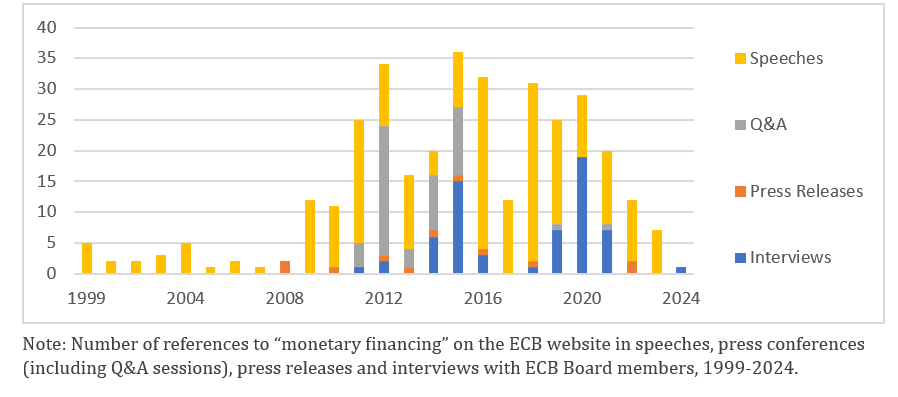
The ECB has been tasked with monitoring compliance with the prohibition. To that end, it developed certain standards for enforcing the ban, informed by definitions contained in an EU Regulation (Council Regulation No 3603/93, 1993) and by (legal) cases arisen over time. Interest in the implications of the prohibition rose when the ECB initiated purchases of government bonds on secondary markets, to support monetary policy transmission and/or to provide an additional monetary impulse when inflation was too low. Chart A shows the number of references to monetary financing in ECB communication, with high levels in 2012, 2015 and 2020, when the ECB introduced new purchase programmes including government bonds.
Chart A. References to “monetary financing” on ECB’s website
As to the secondary market purchases of government bonds, the European Court of Justice (ECJ) clarified that compliance with the prohibition requires that they have no equivalent effect to direct purchases of government bonds, and that sufficient safeguards are in place to ensure that the purchases do not reduce countries’ incentives to pursue sound budgetary policies (ECJ, 2015, 2018). Such safeguards can include limits on central bank holdings of a specific government bond and of the stock of government debt, and only purchasing bonds that satisfy a minimum credit quality. Secondary market purchases can have favourable effects on governments’ financing conditions but the same is true when a central bank lowers its key interest rates.
Standards have also been developed for other central bank activities, such as acquiring government bonds outside ECB monetary policy (e.g. central banks’ investment portfolios) for which quantitative monitoring thresholds have been set, the financing of obligations vis-à-vis the IMF, the remuneration of government deposits at central banks, and national tasks performed by central banks.
The prohibition in general has been well respected since its introduction in 1994, though with few exceptions requiring central banks to take corrective action. These notably include activities by Magyar Nemzeti Bank, Hungary’s central bank, falling outside the remit of a central bank (e.g. large-scale purchases of artwork), the Central Bank of Ireland’s acquisition of government bonds related to the liquidation of an Irish bank, and the financing by some central banks of debt relief for low-income countries via IMF trusts. Compliance with the prohibition is supported by the possibility of the ECB initiating infringement proceedings against national central banks where the ECJ can ultimately demand corrective measures and levy fines (Korencsi et al., 2013).
While some observers already considered ECB’s secondary market purchases of government bonds under its purchase programmes an indirect or hidden form of monetary financing (e.g. Hannoun et al., 2019), economic crises have given rise to several academic proposals to reinterpret or circumvent the ban. Suggestions made include the cancellation of part of the government debt held by central banks (e.g. Andor et al., 2021) and the central bank handing out “helicopter money” to households, either directly, by handing out money to the public (e.g. Hampl and Havranek, 2018), or indirectly, by purchasing government bonds and let governments transfer the funds to the public (De Grauwe, 2020).
Such ideas in general are not compatible with the prohibition of monetary financing. The resulting permanent increase in the money supply is not consistent with the flexibility needed to adjust monetary policy to maintain price stability, while their focus on providing cheap financing to governments or taking over a national task would be tantamount to monetary financing. Moreover, once introduced, governments would come to expect such central bank support more often, reducing their incentives to pursue healthy public finances ( “moral hazard”).
The prohibition is firmly anchored in an European Treaty for which revisions require consent of all participating countries. Yet, historically high government debt, low structural growth rates, a sequence of supply shocks, the rise of populism and threats to central bank independence worldwide may once again increase pressure on central banks to use monetary financing to address macroeconomic and fiscal challenges. It will be essential to keep these risks at bay to enable the ECB to fulfil its price stability mandate and maintain incentives for sound and sustainable public finances.
Andor, Laszlo, Piketty, Thomas and Magnette, Paul (2021), “Cancel the public debt held by the ECB and ‘take back control’ of our destiny”, Euractiv, 8 February. Available at: https://www.euractiv.com/section/economy-jobs/opinion/cancel-the-public-debt-held-by-the-ecb-and-take-back-control-of-our-destiny/.
Bateman, Will and van ’t Klooster, Jens (2023), “The dysfunctional taboo: monetary financing at the Bank of England, the Federal Reserve, and the European Central Bank”, Review of International Political Economy, Vol. 31, No 2, pp. 413-437; DOI: https://doi.org/10.1080/09692290.2023.2205656.
Cottarelli, Carlo (1993), “Limiting central bank credit to the government: theory and practice”, IMF Occasional Papers, No 110; DOI: https://doi.org/10.5089/9781557753588.084.
Council Regulation (EC) No 3603/93 specifying definitions for the application of the prohibitions referred to in Articles 104 and 104b (1) of the Treaty, OJ L 332/1 (1993). Available at: https://eur-lex.europa.eu/legal-content/EN/TXT/PDF/?uri=CELEX:31993R3603&from=E.
De Grauwe, Paul (2020), “The Need for Monetary Financing of Corona Budget Deficits”, Intereconomics, Vol. 55, No 3; DOI: https://doi.org/10.1007/s10272-020-0885-1.
European Court of Justice (2015), Judgment of the Court, Peter Gauweiler and Others v Deutscher Bundestag (Case C-62/14), 16 June. Available at: https://eur-lex.europa.eu/legal-content/EN/TXT/PDF/?uri=CELEX:62014CJ0062.
European Court of Justice (2018), Judgment of the Court, Weiss and Others (Case C-493/17), 11 December. Available at: https://eur-lex.europa.eu/legal-content/EN/TXT/PDF/?uri=CELEX:62017CJ0493.
Friedman, Milton (1969), The Optimum Quantity of Money, Aldine Publishing Company.
Hampl, Mojmir and Havranek, Tomas (2018), “Central Bank Capital as an Instrument of Monetary Policy”, Institute of Economic Studies Working Paper, No 25/2018. Available at: https://hdl.handle.net/10419/203204.
Hannoun, Hervé, Issing, Otmar, Liebscher, Klaus, Schlesinger, Helmut, Stark, Jürgen and Wellink, Nout (2019), Memorandum on the ECB’s Monetary Policy, October. Available at: https://www.centerforfinancialstability.org/research/Memorand.pdf.
Korencsi, Attila, Lakatos, Melina, and Pulai, György (2013), “Regulation on the prohibition on monetary financing − obligations and opportunities”, MNB Bulletin, Vol. 8 (special edition), pp. 91-97. Available at: https://ideas.repec.org/a/mnb/bullet/v8y2013ispecialp91-97.html.
Leeper, Eric M. (1991), “Equilibria under ‘active’ and ‘passive’ monetary and fiscal policies”, Journal of Monetary Economics, Vol. 27, No 1; DOI: https://doi.org/10.1016/0304-3932(91)90007-B.
Romelli, Davide (2024), “Trends in central bank independence: a de-jure perspective”, Baffi Carefin Centre Research Paper, No 217; DOI: http://dx.doi.org/10.2139/ssrn.4716704.
Sargent, Thomas and Wallace, Neil (1981), “Some Unpleasant Monetarist Arithmetic”, Federal Reserve Bank of Minnesota Quarterly Review, Vol. 5, pp.1-17. Available at: https://www.minneapolisfed.org/research/quarterly-review/some-unpleasant-monetarist-arithmetic.
Wolswijk, Guido (2026), “Prohibition of monetary financing: an economic perspective”, ECB Occasional Paper, No 397. Available at www.ecb.europa.eu/pub/pdf/scpops/ecb.op397.en.pdf.