This policy note is based on “Regulatory responses to the financial stability implications of stablecoins“. The views expressed are those of the author and not necessarily those of the institutions the author is affiliated with. Note: I would like to thank Inaki Aldasoro, Rhys Bidder, Stephanie Cabossioras, Charles Coste, Nicola Danese, Ulf Lewrick, Omid Malekan, Ousmène Mandeng, Patrick McConnell, Lewis McLellan, Bill Nelson, George Pantelopoulos, Daniela Russo, Martin Scheicher, Manmohan Singh, and Anton van der Kraaij for helpful comments. All remaining errors are mine.
Abstract
This policy note revisits financial stability risks created by stablecoins and remedies. We compare regulatory approaches across some jurisdictions and note that different directions have been taken, although authorities agree that stablecoins must in principle not be remunerated. We argue against prohibiting the remuneration of stablecoins because the related implicit tax on stablecoin is itself highly instable and will create cyclical flows into- and out of stablecoins (and vice versa, out of-, and into competing forms of money) across the interest rate cycles.
The following main financial stability issues have been identified in a scenario of substantial stablecoin adoption.
1. Inflows into the stablecoin at the expense of banks, i.e. draining bank deposits (e.g. Liao and Caramichael, 2022):
a.) Structurally, over time, when the stablecoin grows and reaches considerable size.
b.) In a bank stress scenario when the SC is considered safer than banks and when flows from bank deposits into SCs are abrupt and endanger acutely the liquidity of the bank.
2. Rapid outflows from a stablecoin which is itself subject to a run (Gorton and Zhang, 2023; Goel et al, 2025; Ma et al, 2025; Anadu et al, 2025): Contagion via fire sales of assets by the stablecoin issuer (if reserves are in the form of securities); Contagion via deposit withdrawals from banks (if reserves are in the form of deposits).
Issue 1a is associated with the idea of some structural positive externality of banking, i.e. of having lending and deposit taking/creation in one institution, which would be undermined if deposits flow into stablecoins. Issues 1b and 2 are agnostic on whether there is a positive externality of banking or not. This is about rapid, run-like outflows of short-term funding which can hit banks or stablecoin issuers depending on the type of triggering event (perceived bad news on banks, or bad news on stablecoins). Crisis can hit an entire sector (banking sector, or stablecoin sector), or more likely individual banks (one bank, or one stablecoin issuer). In the latter case, one natural destination of deposits outflows is the closest possible substitute, so for a bank that would be deposits with other banks, and for a stablecoin, that would be other stablecoins. As a general caveat, it should be recalled that financial stability issues relating to rapid outflows from any issuer of private monetary liabilities are universal and they have become more acute in a world of 24/7 and immediacy of transfers. This SURF Policy Note summarises Bindseil (2025), which also contains (i) a more detailed flow of funds analysis of the creation of stablecoins, and a discussion of prospective use cases of stablecoins.
What policy options are available to address structural and cyclical financial stability issues related to the emergence of large stablecoins? In the following, we will discuss various instruments that have been considered or legislated, and we will provide illustrations from the US, EU and Bank of England emerging frameworks. The first four instruments below can be considered to reduce the risks of runs on stablecoins and the severity and negative effects of those, while the other measures are more about protecting banks from the consequences of too successful stablecoins.
1.) Capital requirements on stablecoin issuers
Capital protects the solvency of the stablecoin against operational risks and losses arising in case of the need to fire-sell assets, making runs on the stablecoin less likely.
2.) Requirements regarding the stablecoin’s reserve holdings (liquidity requirements)
A high degree of liquidity of reserves (i) makes runs on the stablecoin less likely, and if nevertheless holders would for good or bad reasons initiate a run, the consequences are milder since (ii) fire sale losses for the stablecoin issuer will be lower (iii) the likelihood of insolvency of the stablecoin issuer will be lower; (iii) there will be less fire sale externalities or other negative externalities. Policy parameters could include:
a.) Minimum share in the form of very short-term deposits with financial institutions. If one assumes that for banks the liquidation of these deposits is not an issue, then this avoids the negative effects of fire sales of marketable assets in case of a run on a stablecoin. Bofinger (2025) sees major financial stability risks in stablecoins holding a large share of their funds in bank reserves.
b.) Granularity, maximum maturity, and rating requirements with regards to deposits with banks, such as to make less likely that the withdrawal of the funds by the stablecoin issuer from the banks could cause any secondary issue.
c.) Minimum share in the form of deposits with the central bank (and, first of all, allowing access to central bank deposits): withdrawing funds from the central bank does not cause any financial stability issues since the central bank is never liquidity-constrained and does not have to react to such withdrawals by having itself to liquidate assets.
d.) Eligibility criteria for securities holdings and portfolio constraints: granularity, maximum maturity, issuer rating requirements, etc. Short term and highly rated securities tend to remain liquid in financial turmoil situations, so that fire sales ideally do not lead to strong negative price effects and contagion.
3.) Access to central bank LOLR
The LOLR (lender of last resort) avoids fire sales in situations of market turmoil. Thanks to the unique properties of the modern central bank to (i) never be liquidity constrained and (ii) to be considered risk free from the perspective of borrowers having to provide collateral, the central bank can make a large difference by supplying liquidity in crisis situations without taking material risks for the tax-payer.
4.) Applying a deposit insurance scheme on stablecoins.
Deposit insurance has been accepted as key remedy to bank runs and it might be argued that in analogy, it should apply to stablecoins. However, for stablecoins the pseudonymity of holdings on public blockchains would cause some additional challenges. Moreover, such a system has administrative costs, and it distorts incentives, like any insurance scheme.
The following instruments control against too rapid structural and/or cyclical inflows into stablecoins from bank deposits.
5.) Limiting and/or disincentivizing the access of stablecoin issuers to central bank deposits
This would have two advantages from the perspective of banks: first, it avoids that bank deposits are absorbed ultimately by the central bank, and second, if central bank deposits are a large share of stablecoin reserves, that stablecoin issuers are perceived to be as secure as central bank money. This measure is obviously in opposition to point 2c above. Similar points have been made on deposit outflows from banks into retail central bank digital currency. Bindseil and Senner (2023) restate the belief that interest rates are generally an effective and elastic tool in preventing certain balance sheet liability items of the central bank to balloon in crisis situations if it is felt that this endangers financial stability. Moreover, policy makers can consider imposing a maximum share of the total reserve – say e.g. 30%, such as to prevent that stablecoin holders see the stablecoin as quasi-central bank money.
6.) Disincentivising too large stablecoins
Such disincentivizing can be achieved by imposing additional regulatory requirements on very large stablecoins. Those would be specified such that the potential negative externalities of such stablecoins are not higher than the ones of smaller volume stablecoins (in principle like in the case of systemic global banks).
7.) Imposing limits on stablecoin holdings.
Central banks have generally given in to demands that they should limit the size of holdings of CBDC per household and per firm. Remarkably, only the Bank of England has considered similar limitations to inflows into privately issued alternatives like stablecoins. It seems logical to make a link between the two, and it appears rather submissive that some central banks would happily discuss and accept limits on CBDC, while not also at least proposing similar limits on any other new form of monetary liabilities which may also impact the overall structure of money and finance. It may generally be argued that limits are a bad tool as they require significant IT and administrative efforts in implementation and are normally avoided in market economies for various obvious reasons. In the case of stablecoins, implementing limits appears to be challenging because of the vision that stablecoins would continue to be available via anonymous (non-KYCed) wallets.
8.) Regulate the remuneration that stablecoin issuers can grant to the holders of stablecoins.
Traditionally, and inspired by the technical challenges in remunerating paper-based means of payments such as banknotes, the assumption predominates that payment instruments are not remunerated. Overall, regulatory remuneration constraints on means of payments in a market-oriented and electronic world could however appear as anachronism and at least would deserve to be revisited. In a world of electronic account money, why would holdings of means of payments be unremunerated regardless of whether the short-term nominal market rate currently stands at -1%, 0%, 5% or 10%? The main reason why regulations prohibit the remuneration of stablecoins (and non-tokenized e-money) would appear to relate to the belief that it would facilitate further the structural disintermediation of banks. This would ideally be supported by a clearer identification of the positive externalities of the synergies achieved by banks between deposit issuance and loan provision. Under MiCAR, the relevant rules are particularly strict: not only paying interest directly, but any form of indirect remuneration are prohibited (articles 40, 48, 50, 58 of MiCAR). The GENIUS Act (Section 4(a)(11)) prohibits interest but contrary to MiCAR, the text does not expressly extend this prohibition to crypto exchanges, broker-dealers, or other crypto-asset service providers. All other jurisdictions surveyed by Garcia-Ocampo (2025), exclude in principle the remuneration of stablecoins (she does not provide an overview of who explicitly also prohibits exchanges to provide forms of remuneration, such as in MiCAR). Bermuda is amongst the exceptions which allow for a remuneration of stablecoins (Government of Bermuda, 2024). Moreover, there are in practice tendencies to circumvent the prohibition to remunerate stablecoins. Circumvention includes re-labelling or re-structuring yields (third-party rewards, earning through lending, etc.) and regulators have not taken comprehensive and forceful countermeasures. Garcia Ocampo (2025) reviews such techniques, including the reactions of authorities. US banking associations have identified the issue and have requested in a letter to Senators that loopholes in the Genius Act regarding the remuneration of stablecoins should be closed to protect the role of banks in the economy (US Banking Associations, 2025). Barbon et al (2025, 2) review remuneration rates of crypto lending protocols. They suggest that USD 86 billion out of a total of USD 290 billion stablecoin volume would be remunerated in September 2025 via lending protocols. The remunerated volumes would thus be around 30% while 70% would comply with the philosophy of the Genius Act and the more comprehensive rules under MiCAR that stablecoins (payment stablecoins; e-money tokens) must not be remunerated. Regarding the pass through of interest rates, they conclude that (p. 4) “DeFi rates on USD-pegged stablecoins are generally positively and significantly influenced by the US risk-free rate” with a “passthrough coefficient of approximately 0.5”.
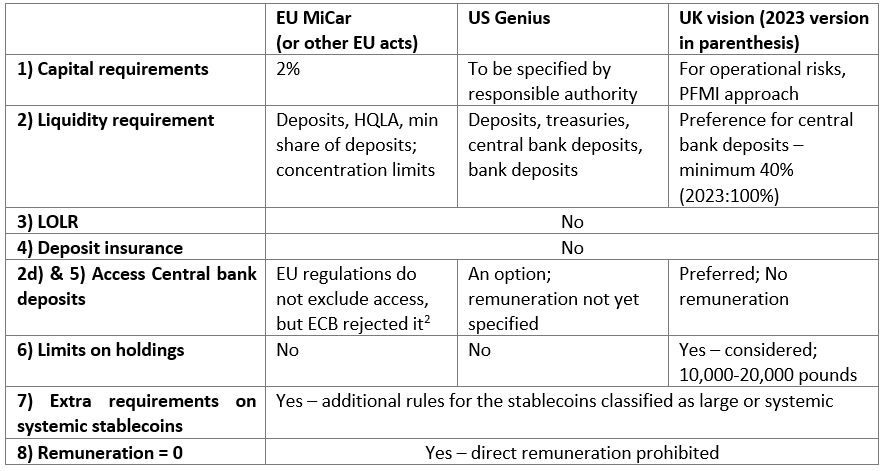
Table 1 compares briefly the effects of the interest rate level on the volume and intermediation spread of stablecoins. It suggests that the interest rate exposure of the business model of stablecoins could be relatively high under all envisaged approaches. On the regulation of the remuneration of stablecoin client positions, see also point 8) below. Under the old Bank of England preference, UK stablecoins were rather uncompetitive relative to the ones under a regime in which stablecoins can earn income on their reserve. The latter have a solid profit margin (once they reach some volume) which creates cash-flow and incentivizes investments into technology to be successful, and to find ways to circumvent the prohibition to pay income to stablecoin holders such as to outcompete those operating under a double no interest rate regime. The 2025 preference of the Bank of England moderates this competitive disadvantage but still preserves it to an extent that could make the difference. Table 2 summarizes the policies of the three jurisdictions reviewed regarding the eight policy options.
Table 1. Effects of an interest rate increase on stablecoin business model
(depending on regulatory constraints on the remuneration of stablecoins’ assets and liabilities1)
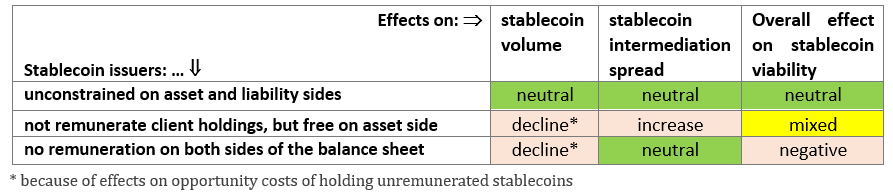
Table 2. Overview of emerging stablecoin regulation in three jurisdictions
 Footnote 2
Taking a step back, and assuming we would not be bound by path dependencies, what could be an unconstrained optimal policy to regulate stablecoins with a view to fostering financial stability? How to make use of the many theoretically available policy instruments that could be considered, and combine them in the best possible way? Designing regulation could start from the following principles.
First, regulatory instruments to address the fear that stablecoins would be too successful and excessively harm the assumed positive externalities of banking should not be dependent on the level of short-term risk-free interest rates. The level of short-term risk-free interest rates is steered by the central bank with a view to achieve its primary mandate (price stability). This implies that using non-remuneration as a sort of Pigouvian tax against stablecoins is crude and cyclical and can ultimately be counterproductive. Generally rejecting the remuneration of money could be considered as a sort of a regulatory “original sin” in the era of electronic money. As restated above, non-remuneration of electronic means of payment is more abnormal than economically meaningful. Non-remuneration of money was normal in the times of paper banknotes because of technical constraints. But in a world of electronic means of payments, in which there are no such technical constraints, and in which the substitutability between money and short term remunerated non-monetary assets intensifies, it seems counterproductive to legally restrict the remuneration of an important asset class to zero. Assets of highest liquidity (and high credit quality) will have lower yields than other assets. The unconstrained yield of these may be around 0% if, e.g., short-term highly rated government securities will yield 1% or even 3%. But in market conditions in which the latter will yield 8% (or -1%), e.g. because inflation stands at e.g. 6% (close to zero or maybe in deflationary territory), monetary assets should not be expected to keep an unchanged remuneration of 0%. Artificial constraints on remuneration will have negative, “cyclical” repercussions: they will complicate the transmission of monetary policy, and they imply strong, interest-level dependent unintended effects on the business model of private entities issuing such money, with obvious negative financial stability consequences. These unintended consequences on the issuers of such money will be mirrored in reverse effects on their competitors – such as banks and money market funds.
Ahmed and Aldasoro’s (2025) find (P. 2) “that 5-day stablecoin inflows of $3.5B, or 2 standard deviations, lower 3-month T-bill yields by about 2-2.5 basis points (bps) within 10 days.” Similar to the analysis of Barthelemy, Gardin, and Nguyen (2026) in the context of stablecoins, they note that an uncontrolled estimation of the impact of stablecoin inflows on 3M T-bill rates “is likely subject to severe endogeneity bias” (p. 3). This uncontrolled specification would suggest that a $3.5B inflow into stablecoins would imply a 3-month T-bill yields decline by up to 25 bps within 30 days. This would be “implausibly large” and would be explainable (emphasis added) “by the presence of endogeneity …, due to both omitted variable bias (as potential confounders are not controlled for) and simultaneity bias (as Treasury yields may affect flows into stablecoins)” (p. 4). Ahmed and Aldasoro’s (2025) stress the financial stability implications of their findings but seem to do so only against the effect of their controlled regression, and not against the uncontrolled one. However, while it is obviously correct to control against the large effects of short-term interest rate levels on stablecoin volumes when it comes to identify how exogenous shocks affecting stablecoin volumes affect treasury market yields, it is not necessarily right to then focus on these effects only when analyzing financial stability risks. Effects originating from changes of the short-term risk-free interest rate should also get attention in financial stability analysis as the implied inflows into, and outflows from stablecoins, if large, can be consequential.
A second, related, but more general principle of regulating stablecoins for achieving financial stability is that fears that stablecoins which accomplish credibility and stability would be too successful and thereby undermine financial stability by harming banks (by draining their deposits) are not a good reason for hesitating to use tools that make stablecoins credible in the first place. Controlling against excessive inflows into stablecoins (if felt to be necessary) must be done with tools that are compatible with the highest possible safety of stablecoins. Moreover, narrow balance sheet money issuers are not the only destination of deposit outflows from banks, in particular not at the level of individual banks (and competition between banks is increasing in the era of internet banking and the collaboration of banks with BigTechs).
A third principle, an obvious and universal one, is that economic and financial innovations should only be suppressed or constrained by regulation based on identified market failures. In the case of non-bank money issuers, two market failures could potentially be identified. First, one seems to attribute to banks a positive structural externality stemming from their joint, synergetic functions of loan provision and deposit and transaction services, whereby the banks are moreover assumed to be unable to reap themselves the full societal benefits of this synergy. This could be a justification for subsidizing banks, or for taxing competitors of banks which do not have this positive externality. Still, more analytical efforts should be made to identify better the nature and size of these positive externalities of banking. The second type of market failure that could be addressed is the negative externality of runs, be it on banks or on stablecoins (via fire sales- or liquidity related contagion). Because of the multitude of destinations of possible deposit outflows in an instantaneous, multi-asset, 24/7 world, the only way to address this problem in a systematic way is to make the entities which are potentially suffering from the run safer through regulating them (e.g. through more stringent capital and liquidity requirements), in line with principle 2.
A fourth principle that seems even more trivial than the previous one, is the one that authorities should not regulate but then watch passively circumvention taking place that undermines the effectiveness of the regulation. This would seem to be the case for the remuneration of stablecoin if services providers are allowed to generate indirect remuneration of stablecoins with schemes of which the sole purpose seems to be regulatory circumvention (see Garcia Ocampo, 2025).
What regulatory approaches are effective and comply with these four principles? The 2023 arguments of the Bank of England in favour of a 100% share of stablecoin reserves being held with the central bank have merits, but we doubt that this approach is compatible with not remunerating these reserves, as the viability of stablecoins would be rather weak under this approach (in particular if there is competition with stablecoins issued elsewhere which earn remuneration on their reserves). Consider two possible approaches which fulfil the four principles outlined above.
(1) Laissez-faire approach (beyond stringent liquidity and capital requirements on stablecoins)
One could impose stringent liquidity and capital requirements on stablecoins, but otherwise opt for laissez-faire on the basis of mainly two potential arguments: (i) the positive structural externalities of banking would be insufficiently proven3, and in the case of doubt, regulation should be avoided (in view of the general feeling that advanced economies have over-regulated themselves in many areas); (ii) as far as runs are concerned, anyway there would be many other destinations of deposit outflows from banks, and in particular at the level of individual banks, and going against one such destination would not make a particular difference (Bindseil and Senner, 2023). The laissez-faire approach – like approach (2) below – would not constrain the ability of stablecoin issuers to remunerate their liabilities (for the reasons indicated above).
(2) 100% reserves with the central bank with adequate remuneration approach
This approach follows the logic of the Bank of England preference, except for remuneration of the stablecoin issuer’s reserve (and, once more, remuneration of liabilities would be unconstrained). Reserves would be fully held with the central bank but not at a zero interest rate. Instead, remuneration of reserves would be referenced to policy interest rates. The remuneration rate would be somewhat lower than the one of banks’ excess reserves (assuming here that the latter is also the central bank policy rate). For example, it could be set in normal market conditions to be “central bank policy rate minus 1 percentage points, but not below 0%”. The spread would remain stable if policy interest rates change, but if structural factors change, it could be revisited. The spread acknowledges the need to protect structurally the business model of banks and is in this sense a Pigouvian tax component addressing an assumed market failure of the bank business model to appropriate all of its benefits, leading to a positive externality of banking.
In this paper we revisited the domestic and international liquidity effects of stablecoins. We then turned to the regulation of stablecoins, and how rules imposed on the reserves of stablecoins could contribute to financial stability. We noted the diversity of regulatory approaches across selected jurisdictions (EU, US, UK), although all approaches could be considered to have in common an “original sin” to generally impose zero remuneration on stablecoins. It implies that the viability and competitiveness of stablecoins is made dependent on the interest rate level in a peculiar way, with opposite effects on the competitors of stablecoins (i.e. banks and money market funds). The implied cyclical flows between stablecoins and its alternatives can hardly be expected to help financial stability.
Ahmed, Rashad and Iñaki Aldasoro (2025), “Stablecoins and safe asset prices”, BIS Working Papers No 1270
American Bankers Associations (2025), Letter to Senators to “address several loopholes identified in the recently enacted GENIUS Act”, 12 August 2025.
Anadu, Kenechukwu, Pablo D. Azar, Marco Cipriani,Thomas M. Eisenbach, Catherine Huang, Mattia Landoni, Gabriele La Spada, Marco Macchiavelli, Antoine Malfroy-Camine, J. Christina Wang (2024), “Runs and Flights to Safety: Are Stablecoins the New Money Market Funds?”
Bank of England (2023), “Regulatory regime for systemic payment systems using stablecoins and related service providers”, Discussion paper.
Bank of England (2025), “Proposed regulatory regime for sterling-denominated systemic stablecoins – Consultation paper”, 10 November 2025.
Barbon, Andrea, Jean Barthélemy, Benoit Nguyen (2925), “DeFi-ying the Fed? Monetary Policy Transmission to Stablecoin Rates”, Working Paper.
Barthélemy Jean, Paul Gardin, Benoit Nguyen (2026), “Stablecoins and short-term funding markets”, Journal of International Money and Finance, forthcoming.
Bindseil, Ulrich and Richard Senner (2023), “Destabilization of bank deposits across destinations: assessment and policy implications”, ECB WPS No. 2887.
Bindseil, Ulrich (2025), “Regulatory responses to the financial stability implications of stablecoins”, Working Paper, https://papers.ssrn.com/sol3/papers.cfm?abstract_id=5710762
Bofinger, Peter (2025), “Stablecoins and the future of money: economic principles and policy implications”, Macroeconomic Policy Institute, Hans-Böckler Stiftung.
Garcia Ocampo, Denise (2025), Stablecoin-related yields: some regulatory approaches, FSI Briefs, No 27, 23 October 2025
Gorton, Gary B. and Zhang, Jeffery Y., (2023), “Taming Wildcat Stablecoins”, University of Chicago Law Review, 90, 909
Government of Bermuda (2024), “Bermuda Government annual fintech report”, Prepared by the Ministry of Economy and Labour.
Liao, Gordon Y. and John Caramichael (2022). “Stablecoins: Growth Potential and Impact on Banking,” International Finance Discussion Papers 1334. Washington: Board of Governors of the Federal Reserve System
Rey, Hélène (2025), Stablecoins, tokens, and global dominance, F&D, Frontiers of Finance, September 2025.
The table does not cover the special effects that may occur if central bank policy rates and some market interest rates would move into negative territory (as they did in some European currencies in recent years).
https://www.ecb.europa.eu/press/intro/news/html/ecb.mipnews20240719.en.html?utm_source=chatgpt.com
Arguing that the positive externalities of banking are not sufficiently proven is not the same as saying that the synergies between loan provisions and deposit and payment services are not proven. The existence of the latter is only a necessary, but not sufficient condition for relevant positive externalities of these synergies.