

The views expressed are those of the authors and do not necessarily represent the views of the Oesterreichische Nationalbank, the European Central Bank or the Eurosystem. The Authors thank Geoff Kenny, Wolf Reuter and Julia Woerz for their comments.
Abstract
This policy brief examines consumer awareness of the Single Euro Payments Area (SEPA) using evidence from the OeNB Euro Survey in Central, Eastern and Southeastern Europe (CESEE). Despite SEPA’s relevance for everyday financial activities and its wide geographical reach, consumer awareness remains low both in countries where SEPA has been operational for many years and those where recent accession has attracted heightened media attention. Moreover, SEPA awareness is strongly patterned by financial literacy and broader financial capability.
For European policymakers, SEPA has never been merely a technical upgrade to the plumbing of payments. It is a core component of European financial integration, designed to create a single market for euro payments across borders.1 Crucially, SEPA establishes a single set of payment instruments and rules across both euro and non-euro countries, effectively integrating them into one payments market. Today, SEPA comprises 41 participating countries, including 20 euro area members and seven non‑euro area EU member states, alongside four EU candidate countries from the Western Balkans and a further ten non‑EU countries, creating one of the widest cross‑border payments areas in the world.
Policymakers have advanced SEPA as a flagship example that the Single Market delivers real, everyday benefits, such as lower costs for families sending money abroad, easier online payments, greater competitiveness for companies, and stronger ties between national economies and the EU as a whole. Yet the extent to which these promised benefits are recognised and understood by citizens and small businesses remains unclear. Limited awareness may reduce consumers’ willingness to use cross-border financial services or to switch away from more costly and cash-based payment methods.
In this analysis, we draw on data from the OeNB Euro Survey, which covers nine countries in CESEE that have not yet adopted the euro as their legal tender but are closely integrated with the euro area through trade, labour mobility, and financial linkages. In many of these countries, labour mobility vis‑à‑vis the euro area is a key driver of household finances, reflecting both sustained remittance flows, particularly in the Western Balkans, migration and cross‑border employment in several CESEE EU member states. Euro‑denominated transfers are therefore routinely used to finance consumption, housing investment, savings and debt repayment across borders. At the same time, for some countries, high levels of de facto euroisation imply that everyday payments, savings and loans are frequently denominated in euro. Against this backdrop, understanding consumer awareness of European payment infrastructures such as SEPA is important for assessing the effectiveness of financial integration at the household level.
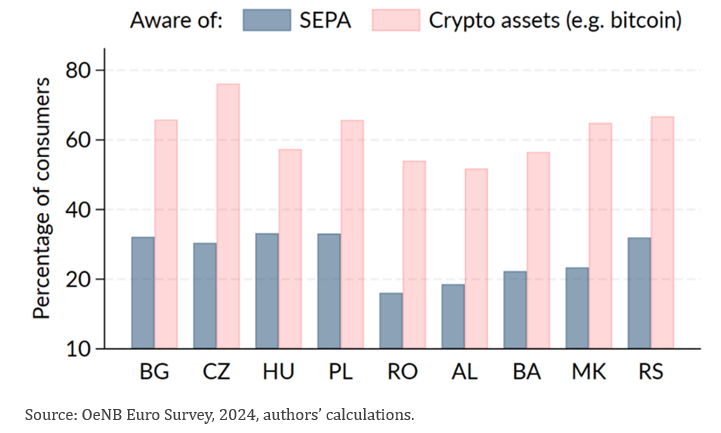
Figure 1 shows the percentage of consumers who are aware of SEPA, alongside a comparison with awareness of crypto‑assets. SEPA and crypto‑asset awareness are based on the survey question “Financial markets are changing fast. Could you please tell me whether you have heard about the following concepts and developments?”. Respondents answering “yes” to the items “Single Euro Payments Area (SEPA)” and “Crypto assets, e.g. Bitcoin” are classified as aware. Our sample spans a range of institutional settings. On the one hand, it includes countries that joined the SEPA geographical scope more than twenty or around fifteen years ago, namely Czechia, Hungary and Poland, as well as Bulgaria and Romania. On the other hand, it includes countries that joined only recently, with Albania and North Macedonia acceding in autumn 2024 and Serbia in October 2025. At the time of the autumn 2024 survey, SEPA was not yet operational in any of the countries in the second group; however, their accession received considerable media attention as a positive development in the context of EU accession. Bosnia and Herzegovina is not yet part of the SEPA geographical scope, but the central bank and other authorities are actively pursuing legal and technical reforms in preparation for a SEPA application planned for 2026.
Strikingly, awareness remains low regardless of institutional exposure. Fewer than 40 percent of consumers report having heard of SEPA in both long‑standing and recent or newly acceding countries. By contrast, in all countries a majority of the adult population has already heard of crypto‑assets, even though crypto‑asset ownership remains well below 10 percent everywhere2, with Czechia recording the highest share at 6 percent in 2025. The low levels of awareness observed even in countries where SEPA accession recently received substantial public attention suggest that institutional developments may diffuse only slowly into household awareness.
SEPA, by contrast, has the potential to affect a broad range of consumers with a bank account in ways that are directly observable in everyday payment behaviour: when fully operational, cross‑border euro transfers look and feel like domestic transfers, often with similar fees, faster execution, greater security and fewer frictions.
Figure 1. Percentage of consumers who heard about SEPA and crypto assets
There are several reasons why awareness may be low. Low awareness does not necessarily imply low usage. On the one hand, and consistent with models of rational inattention (Sims, 2003) and salience (Chetty et al., 2009), consumers may effectively use SEPA in practice when comparing prices for remittance transfers, for example across money transfer operators, banks and cash‑based transfers, without knowing what the acronym SEPA stands for. On the other hand, consumers may be unfamiliar not only with the acronym itself but also with the underlying concept. While these mechanisms cannot be directly disentangled, we seek to shed light on SEPA awareness by examining, in multivariate regression analyses, which consumer characteristics are associated with reported awareness; these relationships should be interpreted as correlations rather than causal effects.
Figure 2 reveals a modest gender gap of five percentage points in SEPA awareness, with little evidence of differences across other sociodemographic characteristics, including age and household characteristics. Consumers in households with income in the top tertile are about 10 percentage points more likely to have heard of SEPA than those in the bottom tertile.
Figure 2. SEPA awareness by socioeconomic characteristics
(results from pooled linear multivariate regression with country-interviewer fixed effects)
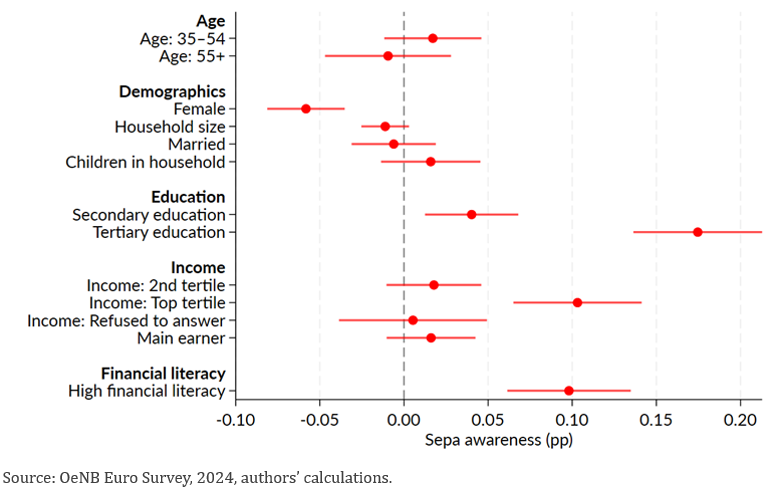
Figure 2 highlights a strong association between education and SEPA awareness. Consumers with tertiary education are about 17 percentage points more likely to have heard of SEPA than those with primary education. SEPA awareness is also positively correlated with financial literacy, as measured by the standard questions proposed by Lusardi and Mitchell (2011) on interest rates, inflation and risk diversification. Moreover, evidence presented by Allinger and Mingione (2026) shows that even in EU member states where SEPA has been operational for more than 15 years, a substantial share of remittances continues to be sent in cash. This raises the possibility that limited consumer awareness and understanding may hinder the uptake of SEPA‑based payment instruments and points to a potential role for targeted information and financial education measures to support more effective use of integrated European payment infrastructures. Existing literature shows that the choice between formal and informal remittance channels depends on transaction costs, access to banking services, and trust in financial institutions (e.g., Kosse and Vermeulen, 2014). Even when formal channels are cheaper, migrants often rely on cash-based or informal transfers. Against this background, our finding that awareness of SEPA remains substantially below 40 percent suggests that one factor, consumer knowledge of available infrastructure, may be missing.
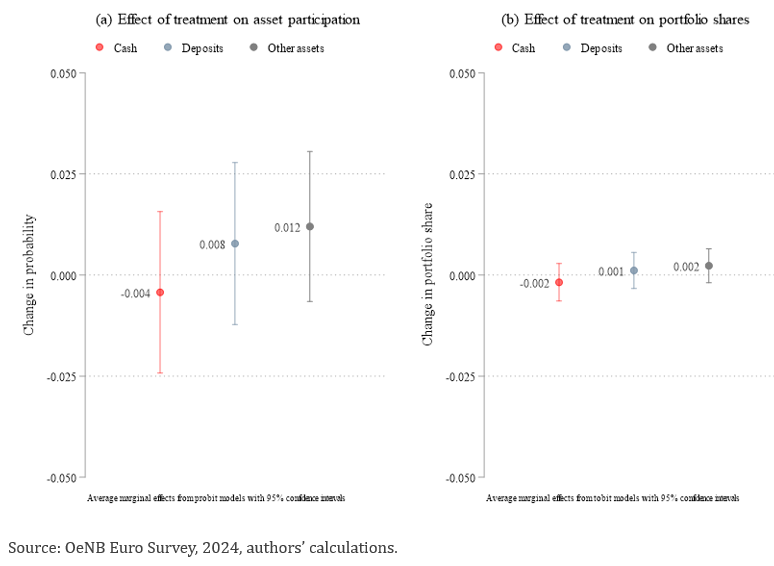
While raising awareness of SEPA may contribute to its more effective use, improved knowledge alone may not be sufficient to induce changes in financial behaviour. Evidence from a related information experiment embedded in the OeNB Euro Survey shows that enhancing households’ knowledge about financial institutions does not automatically translate into immediate adjustments in financial choices. Beckmann and Meyer (2026) study whether providing information about deposit insurance guarantees affects household saving behaviour in non‑crisis periods and find that, despite improving knowledge, a survey‑embedded information experiment has no strong effects on portfolio allocation decisions, preferences for saving at banks, or trust in deposit insurance, suggesting limited behavioural responses to one‑off information provision.
Figure 3 summarises these results, indicating that information provision on deposit insurance does not significantly affect consumers’ hypothetical portfolio allocation, either at the extensive or the intensive margin. In line with prior evidence that information provision alone often has limited effects on financial behaviour (e.g. Duflo and Saez, 2003), improving knowledge about SEPA may by itself not be sufficient to induce changes in consumers’ payment choices.
Figure 3. Effects of deposit insurance information
(Evidence from survey experiment by Beckmann and Meyer (2026))
From a policy perspective, SEPA illustrates a broader challenge: financial integration can succeed technologically while remaining largely invisible to consumers. Despite its direct relevance for everyday financial transactions, awareness of SEPA remains limited and concentrated among those with higher financial literacy and broader financial capabilities. At the same time, continued reliance on cash-based remittance channels points towards substantial untapped potential of the SEPA framework among consumers.
Taken together, these findings are consistent with a wider pattern in which limited consumer awareness constrains the effective use of financial infrastructures. Evidence from related information experiments, in similar institutional environments, highlights that improving knowledge of institutional features, in isolation, is unlikely to translate into meaningful changes in financial behaviour. This implies that policy efforts may need to go beyond the provision of information. In particular, increasing the salience, transparency and usability of SEPA at the point of decision-making for consumers may be more effective than one-off information campaigns.
Allinger, K. and Mingione, S. (2026). Remittances 101: what your love for Aunt Vesna has to do with central banks (Part 2). OeNB Blog, 27 January 2026. Available at: OeNB Blog.
Beckmann, E. and Meyer, J. (2026). Saving in cash or saving at banks: The role of deposit insurance guarantees. Mimeo.
Chetty, R., Looney, A. and Kroft, K. (2009). ‘Salience and taxation: Theory and evidence’, American Economic Review, 99(4), pp. 1145–1177.
Duflo, E. and Saez, E. (2003). ‘The role of information and social interactions in retirement plan decisions: Evidence from a randomized experiment’, Quarterly Journal of Economics, 118(3), pp. 815–842.
Kosse, A. and Vermeulen, R. (2014). ‘Migrants’ choice of remittance channel: Do general payment habits play a role?’, World Development, 62, pp. 213–227.
Lusardi, A. and Mitchell, O.S. (2011). ‘Financial literacy around the world: An overview’, Journal of Pension Economics and Finance, 10(4), pp. 497–508.
Sims, C.A. (2003). ‘Implications of rational inattention’, Journal of Monetary Economics, 50(3), pp. 665–690.
Zamora-Pérez, A. (2026). Who owns crypto in the euro area? Drivers of crypto adoption, payment use, and its interaction with fiat cash. ECB Working Paper Series No. 3215. European Central Bank.
See https://www.ecb.europa.eu/paym/retail/sepa/html/index.en.html.
These figures are comparable to the euro area (Zamora-Pérez, 2026), where the share of crypto owners is between 2% (Italy) and 7% (Austria).