This policy brief is based on the working paper “Effectiveness of a Soft LTV Limit” (Bruffaerts & Vander Vennet, 2025). The views expressed are those of the authors and not necessarily those of the institutions the authors are affiliated with.
Abstract
Can mortgage risk be reduced without making home ownership less accessible for first-time-buyers? Belgium’s 2020 soft loan-to-value (LTV) framework provides a useful test. Rather than imposing a hard cap, the National Bank of Belgium introduced limits combined with tolerance margins. For owner-occupied lending, this limit was set at 90%, with larger tolerance margins for first-time-buyers. Using loan-level data from a major Belgian bank, we show that both average LTV ratios and the share of loans above 90% declined after the reform. The adjustment is achieved mainly through higher down payments rather than a shift towards cheaper homes. Additionally, first-time-buyers remain relatively more present in the above-90% LTV segment than repeat buyers. Belgium’s experience suggests that soft LTV limits can reduce risky leverage while still allowing targeted flexibility.
For most households, buying a home is the largest financial decision they will ever make, and it usually requires a substantial mortgage. When housing markets boom and interest rates are low, both borrowers and lenders have incentives to push leverage higher. The Great Financial Crisis showed why this can be dangerous: when house prices fall, highly leveraged households are more vulnerable, defaults can rise sharply and the effects can spread through the financial system.
One response has been the wider use of borrower-based macroprudential tools, including Loan-To-Value (LTV) limits (Cerutti et al., 2017). The LTV limit caps the amount households can borrow relative to the value of the property they buy. A 90% LTV limit means that the buyer must finance at least 10% of the purchase price with their own funds. Through this limit policymakers want to curb risky leverage among households.
However, by introducing hard caps they risk excluding households who need high leverage to access the housing market, such as first-time-buyers (FTBs). In countries where mortgage defaults are rare, policymakers may be reluctant to tighten lending in a way that makes home ownership more exclusive. That is why some countries have chosen a softer approach. Instead of a strict cut-off, the limit is combined with tolerance margins that allow a certain share of loans to exceed it. While hard caps leave no room for discretion, soft limits introduce flexibility. This tension between financial stability and housing access is the central challenge in designing an effective LTV policy.
In January 2020, the National Bank of Belgium introduced supervisory expectations for mortgage LTV ratios. For owner-occupied mortgages, the limit was set at 90%. However, unlike a hard cap, the Belgian framework allows banks to exceed that threshold for a limited share of new lending. The tolerance margins are more generous for FTBs than for other owner-occupiers: up to 35% of FTB loans can exceed 90% (and 5% above 100%), while only 20% of other owner-occupied loans can exceed the 90% limit (and none could go above 100%). This matters because it gives banks discretion. The reform does not simply force every high-LTV borrower below the line; it allows banks to decide which borrowers would still receive an exception. Whether or not this balance is actually achieved in practice is the question our research addresses.
Table 1. NBB supervisory expectations for owner-occupied lending (January 2020)

Our analysis uses loan-level data on more than 85.000 mortgages granted by a major Belgian bank between 2016 and 2021. The main empirical focus is on 2019-2021, we stop at the end of 2021 to avoid the distortions from the sharp rise in interest rates from 2022 onward. We focus on owner-occupied loans granted for purchase or construction.
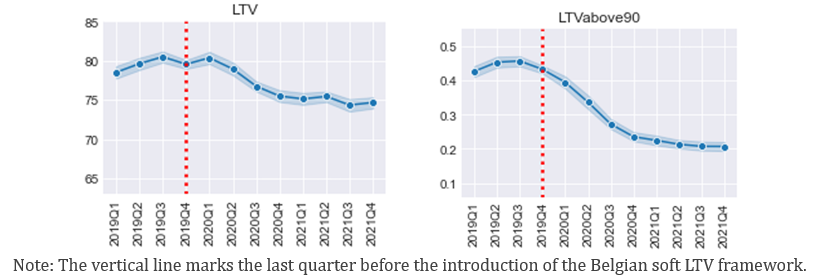
A first look at the data already points to a clear shift after the reform. Both average LTV ratios and the share of loans above 90% declined once the Belgian soft framework came into force, in line with the NBB’s objective. As Figure 1 shows, average LTV fell from around 80% in 2019 to 75% in 2021, and high-LTV lending declined from roughly 45% to almost 20% by the end of 2021. The adjustment was gradual, which is consistent with the Belgian setting. The measure took the form of supervisory expectations rather than a legally binding hard cap, so banks had time to incorporate the new framework progressively into their lending practice.
Figure 1. Quarterly evolution of the average LTV ratio and of the proportion of high-LTV loans
To assess whether the shift is caused by the reform rather than broader market developments, we conduct a more formal analysis. We compare borrowers who, based on standard Machine Learning techniques, were classified as likely to have borrowed above 90% LTV in the absence of the reform, with borrowers unlikely to be affected (constrained versus unconstrained borrowers). If the policy has an effect, constrained borrowers are the ones who should be impacted. This formal analysis confirms that the reform was effective. As shown by the first row of Figure 2, constrained borrowers reduced both their LTV ratios and their presence in the high-LTV segment relative to unconstrained borrowers. In other words, the decline in risky mortgages is not just a descriptive pattern, it is also consistent with a genuine policy effect.
Figure 2. Dynamic effects of the reform on borrowers most exposed to the new LTV framework
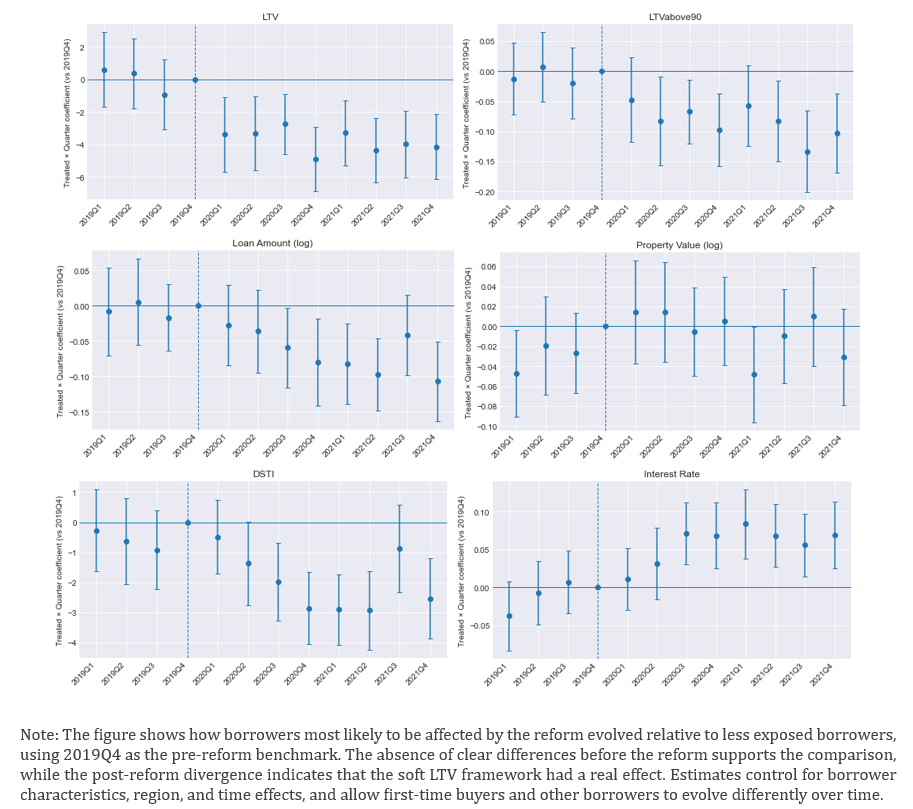
When a bank requires a lower LTV ratio, borrowers can respond in two ways. They can contribute more of their own funds as a down payment or shift to a cheaper property. The two routes have very different consequences. Raising a down payment is financially demanding but leaves housing choices intact. Buying a cheaper property may mean accepting a smaller or lower-quality dwelling. Belgium’s evidence strongly favours the first channel. As shown in the second row of Figure 2, constrained borrowers took out relatively smaller loans but did not move towards cheaper homes. In other words, they brought more of their own money to the purchase rather than trading down in the housing market. This pattern is similar across borrowers with different income and savings levels.
The reform also affected other loan terms. The third row of Figure 2 show that relative to unconstrained borrowers, the more constrained group recorded a decrease in debt-service-to-income (DSTI) ratios, alongside an increase in interest rates. At first sight, the relative rise in interest rates may seem surprising. A lower LTV usually reduces the credit risk for the bank, so one would normally expect interest rates to fall rather than rise. One explanation, in line with the literature, is that banks increased the difference in interest rates between high-LTV and low-LTV loans to incentivize borrowers to choose loans with lower LTVs. This could explain why constrained borrowers, whose average LTV is still well above the LTV of the unconstrained borrowers (and for some even above the limit), experience a relative increase in interest rates. In the Belgian case, however, this is less concerning because the relative repayment burden (DSTI) decreased. This contrasts with findings from other countries, where the relatively higher interest rates were accompanied by higher DSTI ratios (Abreu et al., 2024; Tzur-Ilan, 2023).
The most interesting feature of a soft LTV limit is not only whether or not leverage falls, but also which borrowers are still allowed above the threshold. Here the Belgian design matters. The National Bank of Belgium explicitly gave banks more room to exceed the 90% threshold for FTBs than for other owner-occupied borrowers. This reflects a social policy concern: a strict tightening could weigh most heavily on households trying to enter the housing market for the first time (Kinghan et al, 2022). The key question is then whether or not banks use that flexibility in the intended way.
Our results suggest that they did. The tightening in the above-90% segment was much stronger for other owner-occupied borrowers than for FTBs. Relative to the unconstrained borrowers, the share of loans above 90% fell by around 21 percentage points for constrained non-FTBs, and only about 3.5 percentage points for constrained FTBs. In other words, FTBs remained far more present among the exceptions than other borrowers. This is the clearest sign that the soft framework did not operate as a uniform cut-off. Instead, it allows banks to reduce risky leverage while still leaving room for households entering the housing market for the first time. This pattern may also reflect banks’ own incentives, since FTBs can become long-term clients for other financial products. In that sense, regulatory intent and business incentives reinforce each other.
Within the first-time-buyer group banks exercised further discretion. Constrained borrowers with low savings were afforded relatively more leeway, suggesting that banks recognise the inability of some households to raise their down payment. More broadly, the Belgian case shows that tolerance margins do not simply soften the average effect of a limit. They also shape which borrowers remain in the high-LTV segment, and therefore how the burden of adjustment is distributed across households.
Belgium’s experience offers a concrete answer to a question that runs through European macroprudential debates: does effective regulation of mortgage markets require hard, binding rules, or can supervisory guidance achieve comparable results? The evidence suggests that a soft Loan-To-Value framework can reduce risky mortgage leverage while still leaving banks with room for targeted exceptions. But that flexibility is not neutral, once tolerance margins are introduced, banks decide who remains above the threshold. It means that policymakers need to pay attention not only to the limit itself, but also to the size and use of the exception margins.
There is, however, an important limit to what this evidence can imply. Our data covers borrowers who successfully received a mortgage. We cannot observe households who postponed buying or whose application got rejected due to the policy change. The results should therefore be read as evidence on the terms and composition of granted mortgage loans, not as a complete account of mortgage access across the entire Belgian housing market. Even with this caveat, the central message is clear: a soft LTV framework can make mortgage lending safer without operating as a simple hard stop.
Additionally, the success of such a measure must be interpreted within the institutional setting. Belgium’s historically low mortgage default rates, full-recourse framework, and strong supervisory environment create favourable conditions for a discretion-based approach. In markets with weaker supervisory frameworks or more acute affordability pressures, a harder rule may be necessary to achieve a similar reduction in risk. The trade-off between financial stability and housing access is shaped by the institutional setting. The Belgian case nonetheless shows that with careful design, a macroprudential rule can reduce risk in the mortgage market while still allowing targeted flexibility within granted mortgage loans.
Abreu, D., Felix, S., Oliveira, V., & Silva, F. (2024). The impact of a macroprudential borrower-based measure on households’ leverage and housing choices. Journal of Housing Economics, 64. https://doi.org/10.1016/j.jhe.2024.101995
Bruffaerts, H., & Vander Vennet, R. (2025). Effectiveness of a Soft LTV Limit. Working Paper series of the Faculty of Economics and Business Administration of Ghent University (No. 25/1125). http://dx.doi.org/10.2139/ssrn.5929840
Cerutti, E., Claessens, S., & Laeven, L. (2017). The use and effectiveness of macroprudential policies: New evidence. Journal of Financial Stability, 28, 203–224. https://doi.org/10.1016/j.jfs.2015.10.004
Kinghan, C., McCarthy, Y., & O’Toole, C. (2022). How do macroprudential loan-to-value restrictions impact first time home buyers? A quasi-experimental approach. Journal of Banking and Finance, 138. https://doi.org/10.1016/j.jbankfin.2019.105678
Tzur-Ilan, N. (2023). Adjusting to Macroprudential Policies: Loan-to-Value Limits and Housing Choice. Review of Financial Studies, 36(10), 3999–4044. https://doi.org/10.1093/rfs/hhad035