

This brief is based on the paper by the same authors, entitled “Macroeconomic effects of the green transition in the euro area and critical minerals bottlenecks”, published as Banca d’Italia Working Paper No.1531, April 2026. The views expressed here are those of the authors and do not necessarily represent the views of Banca d’Italia or the Eurosystem.
Abstract
This policy brief presents findings from the paper by Bartocci et al. (2026), which analyzes the macroeconomic effects of disruptions in the international supply of critical minerals on the euro area economy. As the green transition progresses, access to critical minerals is becoming a strategic vulnerability for advanced economies, especially for the euro area, which relies heavily on imports from a highly concentrated global market. Using a three-country New Keynesian model calibrated to the euro area, China, and the rest of the world, the analysis shows that a reduction in the international supply of critical minerals raises their price and weakens any positive macroeconomic effects of green-energy subsidies supporting the green transition in the euro area. These adverse macroeconomic headwinds are mitigated when the euro area can diversify its import sources and when installed renewable energy capacity is sufficiently large. While supply shocks to critical minerals currently appear less disruptive than fossil-fuel shocks, their macroeconomic relevance is likely to increase as the green transition deepens and critical minerals become more pervasive in manufacturing and energy production.
The transition to low-carbon energy systems is transforming global commodity demand. Renewable energy technologies, battery storage systems, electric vehicles, and digital infrastructure all require large quantities of critical minerals such as lithium, cobalt, nickel, and rare earths. For the euro area (EA), domestic extraction and refining capacity remain limited. At the same time, global production is highly concentrated geographically, with China dominating several stages of the critical-minerals value chain, especially refining and processing activities. As a result, the EA is exposed to external supply disruptions that may affect inflation, production costs, and the effectiveness of climate policies. This brief summarizes the results of a simulation analysis based on a dynamic general equilibrium model, evaluating how the EA macroeconomic conditions respond to green-energy subsidies under alternative scenarios for the international supply of critical minerals. It also compares the macroeconomic effects of critical mineral shortages with those associated with fossil-fuel supply shocks.
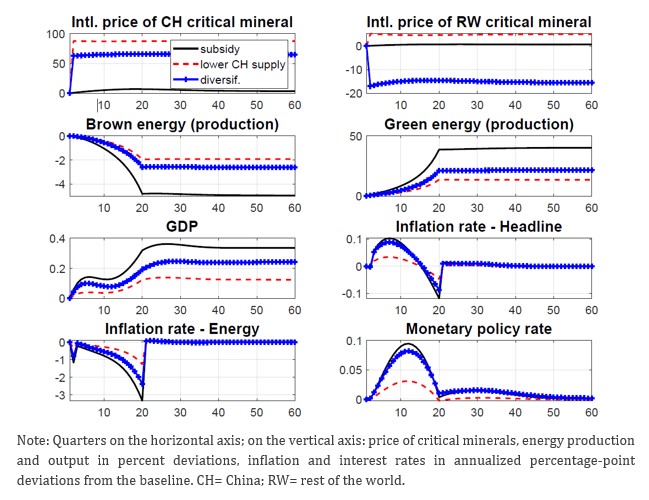
A first scenario considers the permanent increase in subsidies to green-energy production in the EA (black solid lines in Figure 1). The subsidies lower the cost of renewable energy production and stimulate demand for capital, labor, and critical minerals in this sector. The simulations show, as expected, that these subsidies increase green-energy production while reducing reliance on fossil-based energy. Moreover, GDP increases persistently, while energy inflation declines because renewable energy becomes cheaper. Higher demand for critical minerals raises their international price, but not enough to offset the positive macroeconomic effects of the subsidies. Inflation increases only slightly and temporarily, prompting limited monetary tightening.
A second scenario introduces a reduction in the international supply of critical minerals from China alongside the increase in EA green subsidies (red dashed lines in Figure 1). In this case, the international price of critical minerals rises sharply. Compared with the first scenario, the increase in production costs reduces the expansion of green energy production and lowers aggregate output gains from subsidies. Inflation also rises to a lower extent, as weaker pressures from aggregate demand outweigh the direct impact of higher production costs. Accordingly, the central bank raises the policy rate by less. As a net importer, the EA experiences a negative terms-of-trade effect (not reported). The scenario indicates that sufficiently large supply disruptions can offset the positive effects associated with green subsidies.
A further scenario evaluates the role of diversification (blue crossed lines in Figure 1). When the rest of the world partly compensates for the decline in Chinese supply, the increase in critical minerals’ prices becomes more limited and macroeconomic outcomes improve considerably in the EA relative to the second scenario. This suggests that diversification across suppliers remains essential for reducing the vulnerability of the EA economy to concentration risks in critical mineral markets.1
Figure 1. Impulse responses to green subsidy under alternative scenarios
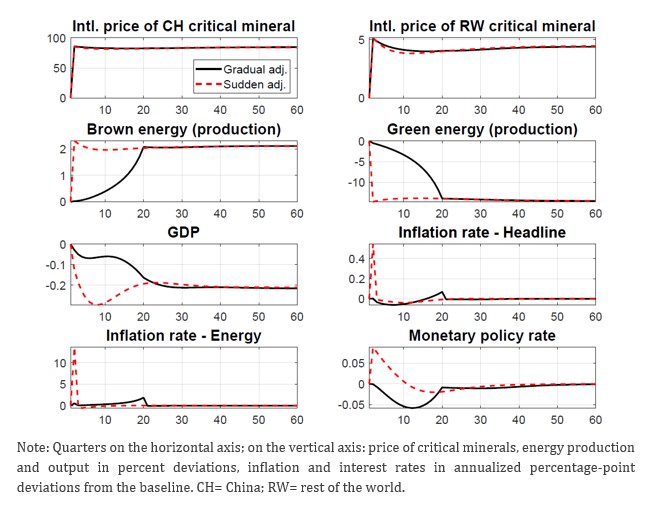
A key result highlighted by the paper concerns the role of installed green energy capacity. The degree of disruption caused by critical mineral supply shocks depends not only on their magnitude, but also on how much renewable energy capacity the EA has already built. Existing infrastructure operates independently of additional demand for critical mineral inputs, creating a natural buffer against price spikes.2 More specifically, the simulations show that when firms adjust production inputs slowly, as they can rely on already installed capacity, the short-run effects on EA GDP and inflation of sudden (supply-driven) increases in the international prices of critical minerals are significantly weaker (black solid lines in Figure 2). By contrast, if firms cannot rely on pre-existing installed capacity, the sudden adjustment in input costs generates significantly larger declines in output and sharper increases in inflation (red dashed lines). Therefore, a sufficiently large installed green energy capacity can shield the EA in the short run from higher critical mineral prices.
Figure 2. Impulse responses to higher international prices of critical minerals: the role of installed capacity
Finally, to gain further insights into the potential relevance of critical mineral supply disruptions, the analysis compares the transmission in the EA of a shock to the international supply of critical minerals with that of a similar shock to the international supply of fossil fuels (simulations are not reported here). Compared with critical minerals, fossil fuels currently continue to account for a larger share of energy production and consumption, implying stronger immediate effects on inflation and economic activity for a same-sized shock to their prices. However, this result is reversed when critical minerals become more widely used in manufacturing. Such a scenario is consistent with the most optimistic projections on the uptake of critical minerals by the International Energy Agency (2025), which suggest that demand for key critical minerals could roughly double by 2050.
Disruptions in the international supply of critical minerals may jeopardize the positive effects of the green transition in the EA. As a net importer of critical minerals, the EA is exposed to higher import prices and weaker economic activity following supply cuts. The analysis presented in this brief shows that diversification across suppliers can substantially mitigate these adverse effects. Moreover, installed renewable energy capacity can dampen the short-run transmission of critical minerals’ price shocks to output and inflation. Finally, while shocks to critical minerals currently appear less disruptive than fossil-fuel shocks, their macroeconomic relevance is likely to increase as these minerals become more widely used production inputs.
Bartocci, Anna, Alessandro Cantelmo, Pietro Cova, and Massimiliano Pisani (2026), “Macroeconomic effects of the green transition in the euro area and critical mineral bottlenecks”, Banca d’Italia, Temi di Discussione (Working Papers), No. 1531, April.
Concordel, Adrien, Phuong Ho, and Christopher R. Knittel (2026), “The Differential Impacts of Critical Mineral Prices and Oil Prices on the Economy”, NBER Working Paper No. w34847, February.
International Energy Agency (2025), “Global Critical Minerals Outlook 2025”, May.
Additional strategies to reduce strategic dependencies, not considered in the paper, include increasing recycling capacity, promoting material substitution, and strengthening domestic extraction and refining capabilities.
Specifically, in the model critical minerals enter as a durable in the production of green energy and firms in the green energy sector only gradually adjust their input demands relative to their installed capacity in response to supply (price) shocks to critical minerals. See also Concordel et al. (2026) for an alternative model setup that also accounts for a gradual pass-through of these shocks on the economy.