

This policy note is based on Giuzio, M., Rousová, L., Kapadia, S., Kumar, H., Mazzotta, L., Parker, M., and D. Zafeiris, 2026. “Climate change, catastrophes, insurance and the macroeconomy”, European Economic Review, Volume 182, 105210. This paper should not be reported as representing the views of the European Insurance and Occupational Pensions Authority (EIOPA) or of the European Central Bank (ECB). The views expressed are those of the authors and do not necessarily reflect those of EIOPA or of the ECB.
Abstract
This paper examines the role of insurance in mitigating the adverse macroeconomic effects of climate-related catastrophes. We develop a stylised growth model which incorporates natural catastrophes, climate change and insurance. It illustrates how insurance can mitigate the impact of catastrophes and articulates the potential effect of falling insurance coverage as global warming intensifies. The model also provides a basis for our empirical analysis exploring the link between insurance coverage and the macroeconomic impact of catastrophes for several thousand disaster events across 47 developed and middle-income countries between 1996 and 2019. The results confirm that higher insurance coverage is associated with less severe macroeconomic consequences of disasters. With climate-related catastrophes becoming more frequent and severe, our findings highlight the importance of policies to reduce the climate insurance protection gap.
Climate-related catastrophes are becoming more frequent and severe as global warming intensifies. These events can have significant macroeconomic implications by damaging capital, disrupting supply chains and productive capacity, generating output losses that extend well beyond the initial damage, and weakening economic growth.
While adaptation efforts and mitigation measures to transition to a low-carbon economy remain essential, insurance can also play an important role in reducing the macroeconomic and welfare costs of disasters. Yet insurance coverage remains limited, with less than a quarter of catastrophe losses insured in the EU and much lower shares in some countries. This protection gap may widen further as climate risks increase and insurance becomes more costly or less available, as rising expected losses and greater uncertainty prompt insurers and reinsurers to increase premiums or curtail supply (see Figure 1).
This raises an important policy question: to what extent can insurance mitigate the macroeconomic impact of climate-related catastrophes, and what are the implications of declining coverage?
Figure 1. Average share of insured economic losses in Europe and property catastrophe rate-on-line indices
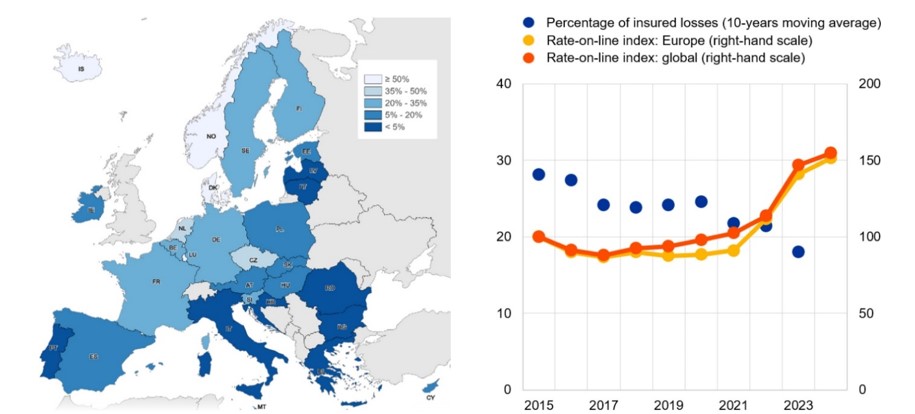
Notes: The chart shows the average share of insured economic losses caused by natural catastrophes in European Economic Area countries over the period 1980–2021 (map, left panel) and as the 10-year moving average across EU countries since 2015 (blue dots, right panel). The left chart is taken from ECB-EIOPA (2024). The lines in the right panel show Guy Carpenter’s Global and Continental Europe Property Catastrophe Rate On Line Indices (2015–2024, percentage growth). ‘Rate-on-line’ (ROL) is the ratio of reinsurance premium paid to loss recoverable in a reinsurance contract, reflecting how much money an insurer must pay to obtain reinsurance coverage. Guy Carpenter’s ROL indices are proprietary indices specific to property catastrophe reinsurance. Indices are normalised to 100 in 2015.
Sources: EIOPA dashboard on insurance protection gap for natural catastrophes, European Environment Agency (EEA) CATDAT, Guy Carpenter and Artemis.
Natural catastrophes reduce capital, disrupt production and generate prolonged economic losses. When a disaster strikes, the destruction of capital and productive capacity is only the first blow. Continued disruption, whether from severed supply chains or damaged infrastructure, can propagate costs far beyond the initial area of impact.
The initial phase of the disaster is typically followed by periods of rehabilitation and, eventually, reconstruction, which can take years to complete and may remain incomplete in the absence of sufficient financial resources. This creates a fundamental tension: reconstruction requires funds precisely when economic activity, profitability and wealth are most depressed.
Insurance plays a key role in resolving this tension. By providing timely payouts, it helps households and firms smooth consumption, maintain investment and accelerate reconstruction. The speed of reconstruction is itself a central determinant of the ultimate economic cost of a disaster: the longer recovery takes, the larger the cumulative output loss. In doing so, insurance reduces the duration and magnitude of those losses.
However, insurance coverage is incomplete and depends on both demand and supply factors. As climate risks increase, higher expected losses, greater uncertainty and reduced diversification may raise premiums and constrain supply. This can cause coverage to decline and the protection gap to widen, amplifying the macroeconomic effects of disasters.
To analyse these mechanisms, we develop a stylised growth model incorporating natural catastrophes, climate change and insurance.
The framework builds on rare-disaster growth models (Barro, 2006; Pindyck and Wang, 2013) and introduces a key innovation: it distinguishes explicitly between changes in average climatic conditions and changes in the frequency or severity of extreme climate-related catastrophes, allowing their differential effects on economic growth to be modelled separately.
Insurance enters the model through its effect on reconstruction speed: by providing the financial resources necessary for recovery, insurance shortens the time to full reconstruction and thereby reduces the cumulative output loss following a disaster. The model also shows that greater pooling of risks amplifies the beneficial effects of insurance, a finding with direct relevance to policy discussions about national and European-level risk-sharing mechanisms.
The model highlights three main conclusions:
As a result, the macroeconomic costs of climate change may be significantly underestimated by models that do not account for declining insurance coverage.
We complement the theoretical framework with an empirical analysis of several thousand disaster events across 47 developed and middle-income countries between 1996 and 2019.
The results suggest that:
For example, a disaster causing damage equivalent to 1% of GDP is estimated to reduce quarterly GDP growth by around 0.24 percentage points if there is no insurance coverage. However, if 25% of the losses are insured, the GDP growth rate is estimated to only decline by around 0.15 percentage points. The effect is even smaller, at around 0.06 percentage points, if half of the losses are insured. For unusually high shares of insured losses, our empirical model even suggests an almost immediate (within quarter) rebound in GDP growth.
Importantly, the evidence also points to faster subsequent recoveries in economies with higher insurance coverage, consistent with the theoretical mechanism of insurance accelerating reconstruction (see Figure 2). Where insurance coverage is low, major disasters are followed by materially lower growth. By contrast, where coverage is high, major disasters have no significant impact on national economic activity.
Figure 2. The impact of large-scale natural disasters with low and high shares of insured losses on the annual GDP growth rate
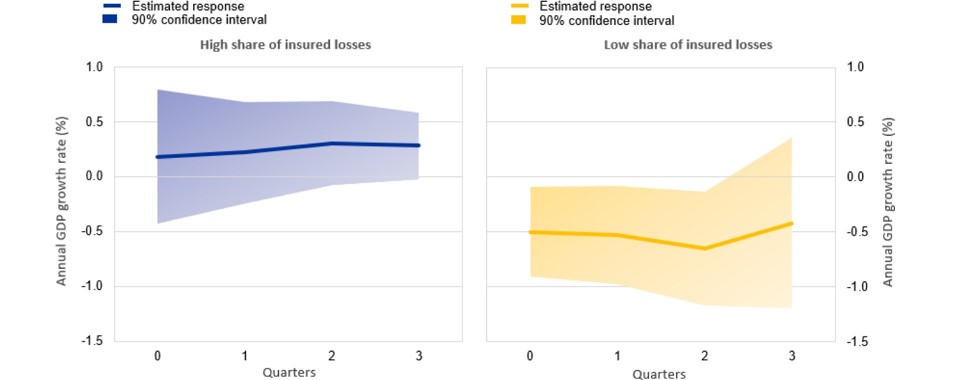
Notes: For the quarter including the date(s) of the disaster (t=0) and the three subsequent quarters, the y-axis measures the percentage point impact of the disaster on the year-on-year annual growth rate at the end of that quarter.
Source: Giuzio et al. (2026).
These findings have important implications for policymakers.
First, insurance can play a crucial role in enhancing macroeconomic resilience to climate-related catastrophes. Strengthening insurance coverage can reduce output losses, support recovery and improve welfare, by enabling faster reconstruction and sustaining aggregate demand.
Second, the climate insurance protection gap is likely to widen as global warming intensifies. As the frequency and severity of climate-related catastrophes increase, rising expected losses, greater uncertainty over tail risks, and reduced scope for geographical diversification are already prompting insurers and reinsurers to increase premiums or withdraw from certain markets altogether. Affordability pressures compound this dynamic, particularly in high-risk areas.
Third, while full insurance coverage is unlikely to be socially optimal, the currently low insurance levels underscore the need for policies to reduce the climate insurance protection gap (see also ECB-EIOPA, 2023, ECB-EIOPA, 2024). Options include:
For all such policies, effective design is vital to minimise moral hazard, set appropriate incentives for risk reduction and adaptation, and ensure that greater insurance coverage brings clear welfare benefits. At the same time, in some cases, particularly in highly exposed areas, managed retreat may be more appropriate than expanding insurance coverage.
Climate-related catastrophes pose increasing risks to economic growth and stability. This article discusses how insurance can significantly mitigate these risks. As climate change intensifies, declining insurance coverage may amplify the macroeconomic costs of disasters. Addressing the insurance protection gap should therefore be a key priority for policymakers seeking to strengthen economic resilience to climate change.
Barro, J., 2006. “Rare disasters and asset markets in the twentieth century”, The Quarterly Journal of Economics, Volume 121 (3), pp. 823-866.
ECB-EIOPA, 2023. “Policy options to reduce the climate insurance protection gap”.
ECB-EIOPA, 2024. “Towards a European system for natural catastrophe risk management”.
Giuzio, M., Rousová, L., Kapadia, S., Kumar, H., Mazzotta, L., Parker, M., and D. Zafeiris, 2026. “Climate change, catastrophes, insurance and the macroeconomy”, European Economic Review, Volume 182, 105210.
Pindyck, R.S, and Wang, N., 2013. “The economic and policy consequences of catastrophes”, American Economic Journal: Economic Policy, Volume 5 (4), pp. 306-339.