

The views expressed in the paper are solely those of the authors and do not necessarily represent the views of the Eurosystem or the Deutsche Bundesbank.
Abstract
The EU Instant Payments Regulation, fully implemented in 2025, aims to accelerate the adoption of instant payments by mandating equal pricing, removing transaction limits, and requiring all PSPs to offer instant payment services. This paper analyses the regulation’s effects on German PSPs in TIPS. Results show increasing volumes and values throughout 2025, particularly after the removal of transaction limits, with varying level of activity across participants. Settlement efficiency has been stable in volume terms but faced temporary declines in value, reflecting initial operational challenges. Additionally, new risks, such as increased timeouts due to shorter processing times, have emerged. These findings highlight the positive impacts and the challenges associated with the regulation, particularly regarding the need to adapt existing processes, thus offering insights into the evolving landscape of instant payments in Europe.
Instant payments, defined as credit transfers that are finally and irrevocably processed within ten seconds after initiation, were introduced in 2014 with the aim of establishing a “new normal” in European retail payments.1 The provision of instant settlement for retail payments, previously a long-established standard for large-value payments, has been seen as a significant step towards greater integration and competition in the European payments landscape. However, the slow and insufficient adoption of instant payments, with only one third of payment service providers (PSPs) offering such services, jeopardized the achievement of strategic goals.2 In response, the European Parliament and the European Council adopted the Regulation on Instant Payments in 2024, hereafter referred to as Instant Payments Regulation, to accelerate the uptake of instant payment services.
A key element of the regulation mandates that all European PSPs offering Single Euro Payments Area (SEPA) credit transfers in euro must also provide instant payments at no additional cost. The implementation followed a staggered approach: PSPs located in the euro area (excluding payment and e-money institutions) had to be able to receive instant payments by 9 January 2025 and to send them by 9 October 2025, with equal fee requirements applicable from 9 January 2025. Since 9 October 2025, sanctions list checks on the debtor and creditor are required only once per day, and a mandatory IBAN-name comparison has been introduced to enhance security. Finally, if the payee’s PSP has not received a response within ten seconds, the amount must be re-credited to the payer. In compliance with the Instant Payments Regulation, the €100,000 transaction limit for SEPA Instant Credit Transfers (SCT Inst) was removed on 5 October 2025.
This regulatory framework is expected to impact instant payment settlement in several direct and indirect ways:
This paper empirically explores the impact of the revised regulatory environment on instant payment settlement and evaluates whether the Instant Payments Regulation has achieved its intended outcomes, using data from TIPS, the Eurosystem’s instant payment system.3 TIPS is one of two pan-European payment systems for instant payment settlement, alongside RT1.4 By December 2025, TIPS connected over 15,000 reachable PSPs,5 with higher transaction volumes in RT1.6 Despite limitations in data availability, the TIPS network is expected to accurately capture structural changes in PSP availability, while changes in transaction volumes should be observable in both systems. It is important to note that the present paper only covers the impact of the Instant Payments Regulation on TIPS. The underlying dataset comprises daily aggregated volumes and values of settled and unsettled transactions by German PSPs in TIPS, disaggregated by credit and debit sides, covering the period from October 2024 to December 2025.7
The analysis shows that the Instant Payments Regulation triggered notable and intended structural changes in transaction volumes and values, PSP activity, and settlement efficiency within TIPS in 2025. At the same time the analysis reveals potential for improvement, particularly regarding the adaptation of internal processes and routines The removal of price discrimination and transaction limits significantly increased instant payment transactions, particularly in late 2025. The level of activity between sending and receiving sides varies across PSPs and direct participants, likely shaped by overall payment routing decisions and rules. While settlement efficiency was largely stable in volume terms, temporary declines in value indicate initial operational challenges for PSPs. New risks such as increased timeouts have also emerged due to shorter processing times.
The paper is organized as follows: Section 2 analyses the development in transaction volumes and values, based on a structural break analysis to substantiate descriptive observations. Section 3 presents the changes in the activity of PSPs. Section 4 shows the developments in settlement efficiency in TIPS and delves into the reasons for settlement failures. Section 5 concludes.
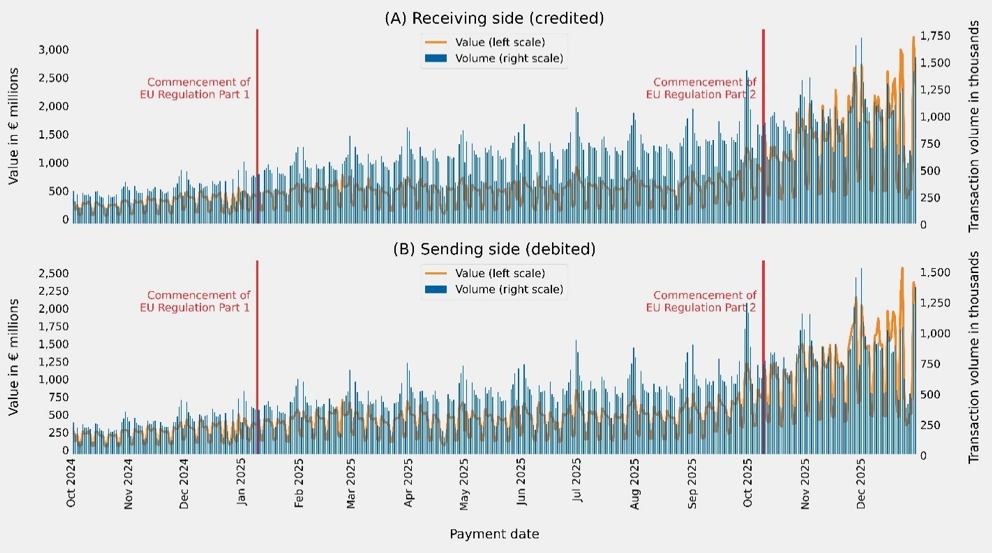
Throughout 2025, both the settlement volume and the value of received and sent transactions increased steadily (see Figure 1). In January 2025, German PSPs received approximately 500,000 transactions per business day, with a total value of €480 million. By December 2025, these figures had risen to an average of 1.2 million transactions and €2.2 billion in total value. A similar upward trend is observed regarding payments sent, although the absolute numbers remain lower than those for transactions received. In December 2025, an average of one million transactions with a total value of €1.8 billion were sent per weekday. Cyclical variations between weekdays and weekends are also apparent.
The implementation dates in January and October 2025 do not exhibit immediate shift effects in transaction dynamics. However, these events are associated with medium-term changes in transaction patterns. A structural break analysis on the trend component in daily transaction volumes and values empirically assesses whether the two regulatory measures coincide with changes in the underlying dynamics of the series.8 The analysis focuses on payments sent, as the regulatory framework primarily targets the obligations and behaviors of PSPs in initiating and processing payments, which directly affect transaction volumes, settlement outcomes, and compliance with the mandated requirements.
Figure 1. Development of volume and value of settled instant payments
After accounting for time-varying weekly seasonality, no statistically significant structural breaks are detected in transaction volumes, revealing that transaction volumes followed a steady upward trend throughout the year.9 In contrast, the analysis of transaction values identifies statistically significant regime shifts that closely align with the implementation of the two regulations in January and October 2025 (see Figure 2). The first regime change is associated with a moderate upward adjustment, while the second marks a more pronounced change in the growth trajectory.10 Notably, the final segment along with the October implementation does not satisfy stationarity, reflecting continued upward movement rather than a stabilized level, which highlights that the dynamic effects of the regulatory change unfolded progressively over the final months of 2025 in response to the removal of the maximum limit for instant payments.
Table 1. Chow tests for regression parameter stability
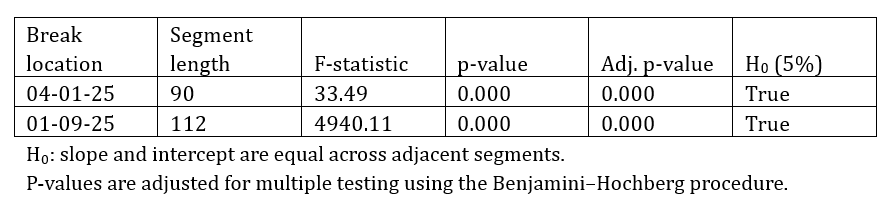
Figure 2. Structural breaks with time-varying seasonality
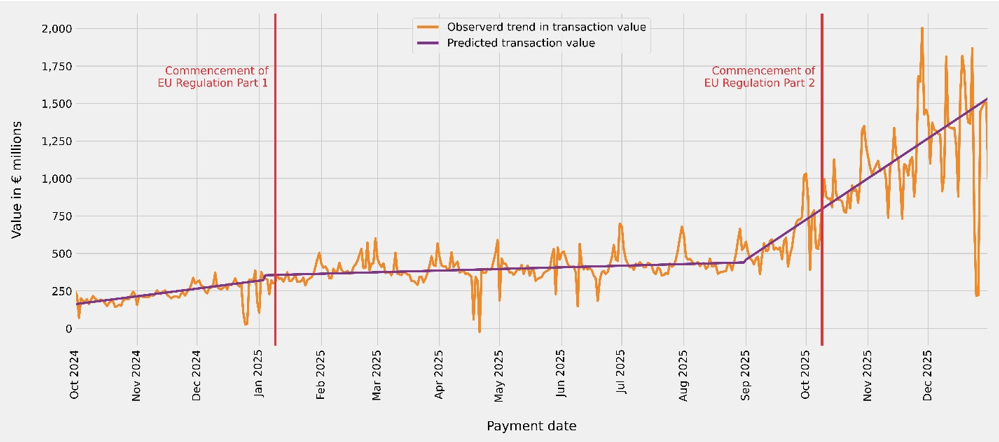
Overall, these results indicate that the policy interventions did not generate abrupt, immediate reactions, but instead led to gradual changes in transaction behavior that unfolded over subsequent months, consistent with gradual adoption and adjustment effects. The pronounced increase in transaction values relative to volumes since October 2025 appears to be driven by the removal of the maximum limit for instant payments rather than an overall increase in transactions. In the absence of detailed transaction value distributions, the average transaction amount for payments sent is used as a proxy. Between September and December 2025, the average transaction amount increased from €962 to €1,625.
The active and widespread provision of instant payments by PSPs, and consequently their adoption by payers, was a key objective of the Instant Payments Regulation. Following the initial implementation phase, a clear structural increase in the number of active PSPs on the receiving side was observed, accompanied by a sustained upward trend (see Figure 3A).11 On the sending side, a similar upward trend is evident, although a distinct structural increase is not apparent. Shortly before the second phase of the regulation, another shift in the overall level occurred, although it was less pronounced than in January 2025. The obligation to offer instant payments on the sending side subsequently resulted in a structural increase in active PSPs.
Between October 2024 and December 2025, the average number of active PSPs on the receiving side increased from 1,933 to 2,269 and the number of active PSPS on the sending side increased from 1,509 to 1,684. Relative to the 3,595 reachable German Bank Identifier Codes (BICs) in TIPS in December 2025, only 63% were active on the receiving side and only 47% were active on the sending side.12
The higher number of active BICs on the receiving side may be attributed to banks’ strategic decisions regarding payment routing. Specifically, a greater number of BICs, such as those at branch level, are enabled to receive instant payments directly, while sending activity is concentrated on selected BICs to simplify liquidity management.
Figure 3. Activity and participation
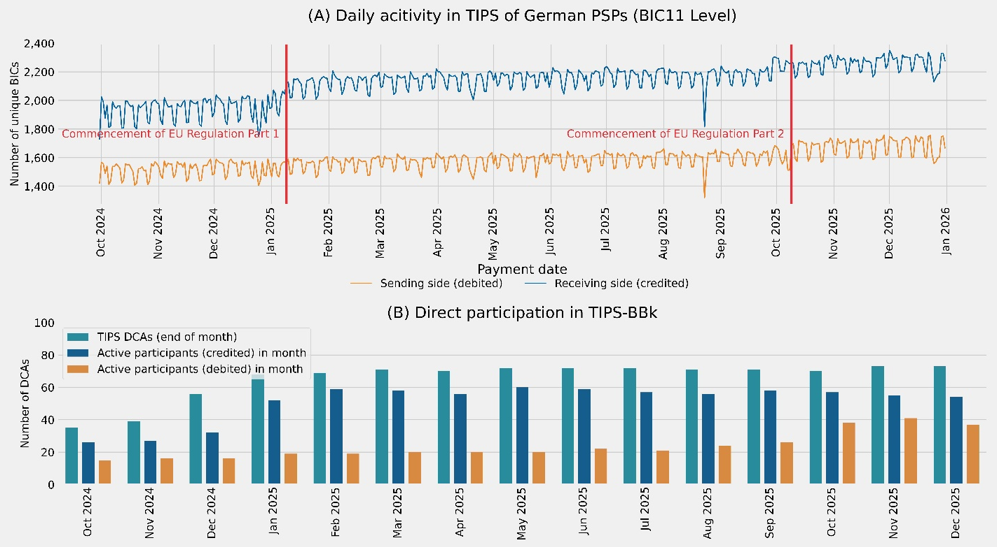
Developments in direct participation in TIPS offer additional insights into instant payment adoption.13 The substantial increase in the number of TIPS Dedicated Cash Accounts (DCAs) managed by the Deutsche Bundesbank in December 2024 and January 2025 reflects measures taken by German PSPs to comply with the obligation to receive instant payments from 9 January 2025 (see Figure 3B). Despite a 93% increase in TIPS-DCAs compared to November 2024, only 52 of 68 participants actively received instant payments in January 2025. The number of participants actively sending instant payments (at least one payment per month) increased markedly only with the implementation of the second part of the Instant Payments Regulation in October 2025 but still lags those actively receiving instant payments.
The limited activity of participants, both overall and on the sending side, may be attributable to the use of these accounts primarily for final settlement or pre-funding in other instant payment systems, rather than for direct transactions. Additionally, the discrepancy between the number of participants actively receiving and those actively sending instant payments may be explained by some participants receiving payments via TIPS while routing most outgoing payments through other instant payment systems.
Contrary to expectations, the measures introduced by the Instant Payments Regulation did not result in an overall decrease in failed transactions. Excluding outliers, settlement efficiency has remained relatively constant (see Figure 4). This indicates that both the value and number of failed transactions have increased proportionally with overall transaction growth on both the sending and the receiving side. On average, settlement efficiency in terms of the volume of transactions is 98.4% on the sending side and 98.3% on the receiving side. These figures are generally higher than those observed for transaction values, which are 95.2% and 95.9%, respectively.
Figure 4. Settlement efficiency
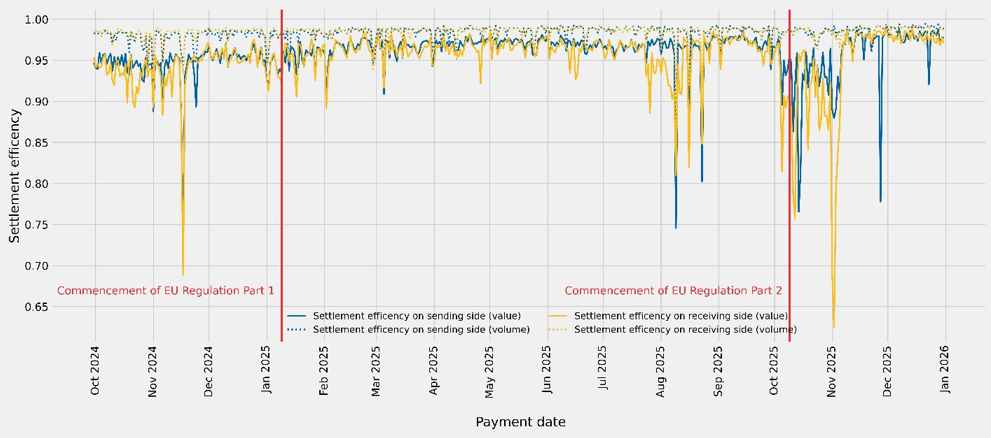
The temporary structural decrease in settlement efficiency in value terms in October and partially in November 2025 may be attributed to the removal of the maximum settlement amount in the SEPA Instant Credit Transfer (SCT Inst) scheme. While settlement efficiency in volume terms remained relatively stable, efficiency in value terms declined significantly, suggesting a higher impact of failed large-value transactions. This suggests that banks initially needed to adapt their internal processes in order to provide timely confirmations for higher-value payments. The significant increase in settlement efficiency from mid-November 2025, resulting in a convergence of value and volume settlement efficiency, supports this explanation, as transitional issues appear to have been resolved.
Analysis of the reasons for the settlement failure provides further insights into the effects of the Instant Payments Regulation. For clarity, error codes for failed transactions have been grouped into meaningful categories.14 The main reasons for failed transactions by volume are account-specific reasons, timeouts and offline agents, and unspecified reasons (see Figures 5B and 5D). On the receiving side, failures are predominantly due to unspecified reasons. The error codes are primarily used by German PSPs to indicate regulatory issues, as data protection guidelines prohibit specific reasons for settlement failure to the payer.
Figure 5. Composition of reasons for settlement failures
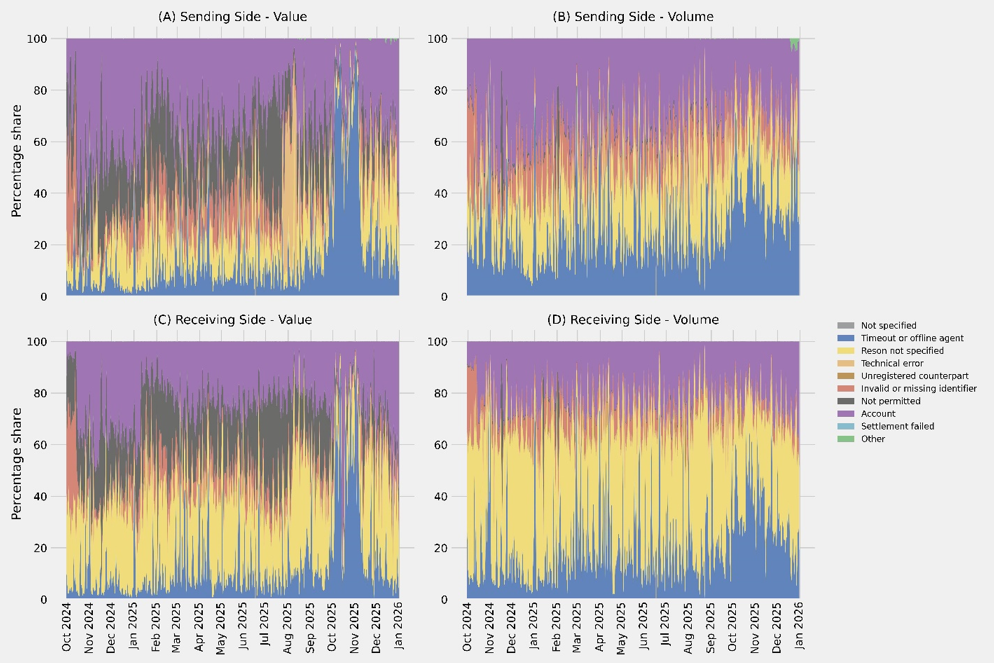
Both sides exhibit several spikes in the share of transactions failing due to settlement timeouts or offline agents. The increased share of unsettled payments in October and November 2025 correlates with a persistent increased share of this error group which is even more pronounced in terms of transaction value (see Figure 5A and 5C). This trend may be explained by the reduction in response times required for receiving participants, which were shortened from 20 to 7 seconds.15 Concurrently, the proportion of “non-permitted” transactions has declined sharply in value terms, consistent with expectations, as transactions previously rejected for exceeding the value threshold are included in this category. The temporary drop in settlement efficiency on the sending side in August 2025 is attributable to technical errors.
The findings of this paper indicate that the Instant Payments Regulation, introduced to address the slow adoption of instant payment services and to promote integration and competition, has catalyzed structural changes in transaction volumes, PSP activity, and settlement efficiency, at least within TIPS. However, the outcomes reveal a nuanced picture, with positive effects and further potential for improvement, particularly in the adaptation of internal processes and routines.
The elimination of price discrimination and transaction limits has contributed to a marked increase in transaction volumes and values in TIPS, particularly in the latter half of 2025. This is consistent with the regulation’s objective of enhancing the accessibility and attractiveness of instant payments. Medium-term shifts in transaction levels, as confirmed by structural break analyses, underscore the regulation’s effectiveness in fostering greater adoption of instant payments. Nevertheless, when compared to the overall transaction volumes and values of credit transfers in Germany (7.3 billion transactions and €64 trillion), instant payments are currently still far from being the “new normal”.16
The relatively low level of activity of PSPs and direct participants, especially on the sending side in TIPS, might suggest that further measures are necessary to achieve widespread and balanced adoption across the ecosystem. Given the complexity of payment routing in Europe, the findings should be interpreted with caution. For a comprehensive assessment, data from RT1 would also need to be taken into consideration.
Settlement efficiency has remained relatively stable in volume terms but experienced temporary declines in value terms, particularly following the removal of transaction limits. This pattern indicates that PSPs initially faced challenges in adapting their processes to accommodate (high-value) transactions within the reduced processing times. The subsequent recovery in efficiency levels demonstrates both the adaptability of PSPs and the effectiveness of transitional measures, while also highlighting the operational complexities introduced by the regulation.
The analysis of settlement failures provides additional insights into the challenges faced by PSPs. While the simplification of sanctions screening and the introduction of IBAN-name comparison have reduced certain regulatory-related failures, the increased share of timeouts and offline agent errors points to the operational strain imposed by shorter processing times. These findings suggest that, although the regulation has achieved its primary goals of increasing transaction volumes and enhancing PSP activity, it has also introduced new operational risks that require ongoing attention. Furthermore, the legal obligation to accept instant payments does not guarantee that every payment is processed within ten seconds.
In conclusion, the Instant Payments Regulation represents a significant step towards establishing instant payments as the “new normal” in European retail payments. However, the relatively low volumes and values in comparison to standard credit transfers, along with challenges related to settlement efficiency and operational risks, indicate that considerable progress is still necessary to fully achieve this objective. Ultimately, the widespread adoption of instant payments depends on the willingness of end customers and businesses to use them. While this cannot be mandated, it remains crucial to continue removing barriers in the processing of instant payments to ensure their seamless use. Continued collaboration between policymakers and industry stakeholders will be essential to address these challenges, ensuring that the benefits of instant payments are fully realized and available to customers and businesses while maintaining the resilience and efficiency of the payment system. As the European payments landscape continues to evolve, the lessons derived from this regulatory intervention will be instrumental in shaping future initiatives aimed at fostering innovation and integration in the European financial sector.
See Euro Retail Payments Board (ERPB) (2014), “Pan-European instant payments in euro: definition, vision and way forward”, 12 November 2014 (available at: https://www.ecb.europa.eu/paym/groups/erpb/shared/pdf/2nd_eprb_meeting_item6.pdf?27ef4897696839d1e7d0918f6b2dae48), which set out the vision for instant payments in Europe; and Yves Mersch (2018), “Speech at the ‘Rencontres du Club SEPA’”, 15 February 2018 (available at: https://www.ecb.europa.eu/press/key/date/2018/html/ecb.sp180215.de.html), who, for example, described instant payments as the “new normal”.
See Regulation (EU) 2024/886 of the European Parliament and of the Council of 13 March 2024 on instant credit transfers in euro.
For more information on TIPS (TARGET Instant Payment Settlement) please refer for example to Renzetti, M., S. Bernardini, G. Marino, L. Mibelli, L. Ricciardi and G.M. Sabelli (2021), “TIPS – TARGET Instant Payment Settlement The Pan-European Infrastructure for the Settlement of Instant Payments” in Markets, Infrastructures, Payment Systems Banca d’Italia Institutional Issues, Number 1, January 2021.
RT1 (Real Time 1) is the real-time gross payment system for the execution of SEPA Instant Credit Transfers (SCT Inst) of EBA Clearing, a private organisation founded by the European banking sector. For more Information on RT1 please see https://www.ebaclearing.eu/services-instant-payments/rt1/
See TIPS reachable parties list and RT1 reachable PSP list from December 2025.
According to published statistics, RT1 settled on average 5.2 million transactions (see https://www.ebaclearing.eu/services-instant-payments/rt1-sct-inst/statistics/) while TIPS settled about 3 million transactions (see https://www.ecb.europa.eu/paym/target/target-professional-use-documents-links/tips/shared/pdf/tipsmeetdoc/ecb.tipsmeetdoc251021_TIPS-CG-4.2.en.pdf?27e7ad042433c253eb7aa4a575802319) per day in September 2025.
The filtering is based on the country code contained in the BIC11 of the Originator or Beneficiary PSP, which must be “DE”.
Change points were detected using the PELT algorithm with a linear cost function, allowing for changes in both slope and intercept. Statistical significance of detected breakpoints was assessed using Chow tests for regression parameter stability at each estimated breakpoint. P-values were adjusted for multiple testing using the Benjamini–Hochberg procedure.
Seasonality is removed using STL decomposition (Seasonal-Trend decomposition using LOESS), which allows weekly patterns to vary over time. However, this comes at the cost of inherently shifting later turning points, because local averaging filters out trend components.
Detected structural breakpoints should be interpreted as approximate indicators of regime transitions rather than exact event dates. Deviations of several days from the policy implementation dates reflect gradual adjustment processes, smoothing in trend estimation, and the focus of break detection methods on persistent structural changes rather than immediate reactions.
As our analysis focuses on the development of PSP activity, we assume that each BIC represents a single PSP, disregarding the fact that some banks use multiple BICs for payment processing. Determining the actual number of PSPs would require consolidation at the bank level. However, the necessary information is not available to us.
See TIPS directory of 1 December 2025. In this context, we note that some BICs may be registered in the TIPS directory but actually route their instant payment flows through other payment systems, such as RT1, rather than TIPS. Furthermore, the TIPS directory contains a list of all BICs of a PSP, even when the BIC refers to an old and probably already closed branch.
Direct participation means the holding of a dedicated cash account (DCA) in the TARGET service TIPS.
The group “Timeout and offline agent” contains the errors “Aborted Settlement Timeout (AB03)”, “Timeout Creditor Agent (AB05)”, “Timeout Instructed Agent (AB06)”, “Offline Agent (AB07)”, “Offline Creditor Agent (AB08)” and “Invalid Cut Off Time (TM01)”. The group “Reason not specified” contains the errors “Not Specified Reason Agent Generated (MS03)” and “Regulatory Reason (RR04)”. The group “Technical error” contains the errors “Error Creditor Agent (AB09)”, “Error Instructed Agent (AB10)”, “Not Specified Reason (MS01)”, “Not Specified Reason Customer Generated (MS02)”, “Technical Problem (TECH)”, “Bank System Processing Error (FF10)”, “Reason is provided as narrative information (NARR)”, “Invalid File Format (FF01)”, “RTGS System Is Closed (L008)”, “Transmission Aborted (TA01)”, “Unknown Debtor or Debtor Account (L002)”, and “Intra Service LT Not Allowed (L014)”. The group “Unregistered counterpart” contains the errors “Creditor bank is not registered (CNOR)” and “Debtor bank is not registered (DNOR)”. The group “Invalid or missing identifier” contains the errors “Invalid Bank Operation Code (AG02)”, “Bank Identifier Incorrect (RC01)”, “Incorrect Account Number (AC01)”, “Missing Debtor Account Or Identification (RR01)”, “Missing Debtors Name Or Address (RR02)”, “Missing Creditors Name Or Address (RR03)”, “Invalid Debtor Bank Identifier (RC03)”, “Invalid Creditor Account Number (AC03)”, “Inconsistent With End Customer (BE01)”, and “Missing Creditor Address (BE04)”. The group “Not permitted” contains the errors “Not Allowed Amount (AM02)”, “Not Allowed Currency (AM03)”, “Amount Exceeds Settlement Limit (AM23)”, “Transaction Not Supported (AG03)”, “Duplication (AM05)” and “Future Date Not Supported (DT04)”. The group “Account” contains the errors “Closed Account Number (AC04)”, “Blocked Account (AC06)”, “Closed Creditor Account Number (AC07)” and “Transaction Forbidden (AG01)”. The group “Settlement failed” contains the errors “Settlement Failed (ED05)” and “Insufficient cash balance (L007)”. The group “Other” contains the errors “End Customer Deceased (MD07)”, “Invalid Date Range (DT01)”, “Invalid Creation Date (DT02)”, “Remittance Information Invalid (RR07)”, “Legal Decision (LEGL)” and “Agent Suspended (AG10)”. The group “Not specified” contains all other error reason codes.
By 6 October, the processing times were adjusted from 10-20-25 seconds to 5-7-9 seconds in TIPS. This means that a payment should be processed within 5 seconds. If no response is received, TIPS automatically triggers a timeout after 7 seconds. After 9 seconds, the sending participant may initiate an investigation request (“Investigation request”) if no response has been received.
See German Payment Statistics published by the Deutsche Bundesbank at https://www.bundesbank.de/dynamic/action/en/statistics/time-series-databases/time-series-databases/743796/743796?treeAnchor=BANKEN&statisticType=BBK_ITS.
For volumes we added the numbers of credit transfers (BBZVS02.H.ZVIN.W0.1._T._T.CTS_ALL._X._Z.N.PN) for 2024 and subtracted the respective numbers of instant payments (BBZVS02.H.ZVIN.W0.1.2000.R.CTS_SEPAI._X._Z.N.PN). For values we added the values of credit transfers in 2024 (BBZVS02.H.ZVIN.W0.1._T._T.CTS_ALL._X._Z.N.EUR) and subtracted the values of instant payments (BBZVS02.H.ZVIN.W0.1.2000.R.CTS_SEPAI._X._Z.N.EUR).