

This Policy Brief is based on Bordier, Frei and Stalder (2026), “Dollar dominance: A source of dollar volatility?“, SNB Working Papers, 5/2026. The views expressed are those of the authors and do not necessarily reflect those of the Swiss National Bank.
Abstract
88% of foreign exchange transactions involve the US dollar. An important reason for this is its use as a vehicle currency: Traders often route trades through the dollar to access better liquidity. Using high-frequency data from the primary interbank trading platforms, we identify such cross-trades and show that they move dollar exchange rates more than equivalent direct trades, because market makers cannot distinguish the legs of a cross-trade from stand-alone dollar trades. In aggregate, a one-standard-deviation increase in cross-trading raises dollar volatility by up to 12%. Dollar dominance thus entails a trade-off: While it enhances liquidity, it also exposes the dollar to uncertainty from other currencies.
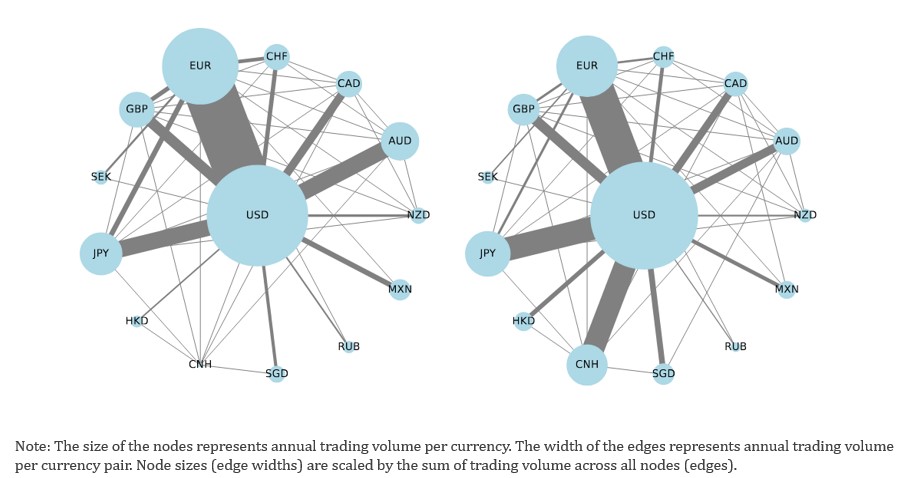
The US dollar (USD) dominates financial markets and has done so for many decades. Recently, however, dollar dominance is facing challenges, which have given rise to an active debate regarding the benefits, risks and implications of dollar dominance. We contribute to this debate by investigating dollar dominance in a market in which this phenomenon is especially prominent. In the world’s largest financial market, i.e., the foreign exchange (FX) market, more than 88% of all transactions involve the US dollar (BIS, 2022). Figure 1 plots FX spot trading volume by currency and illustrates that the dollar is the most traded currency by far. More strikingly, most other currencies are traded mainly against the dollar, and only rarely against one another.
Figure 1. The currency network on primary FX spot interdealer platforms, 2012 (left) and 2022 (right)
An important reason for this pattern is that the dollar is often used as a so-called vehicle currency to facilitate trades between two other currencies at favourable conditions. For instance, a trader wishing to buy euros against Japanese yen may choose to trade both currencies against the dollar with the goal of profiting from the better liquidity conditions in dollar markets (Somogyi, 2026). This has led to a strong concentration of the FX market on a single currency.
This concentration has clear benefits. When trading volumes are concentrated in dollar pairs, liquidity in those pairs improves and transaction costs fall for the market participants who want to trade them.
However, this brief argues that the FX market’s concentration on the US dollar also entails risks for the market as a whole. Consider an information shock between two non-dollar currencies (e.g., the euro and the yen) that increases their volatility and trading activity. Rather than trading these two currencies against each other directly, many market participants decide to trade them via the dollar. As a result, the volatility in the two currencies spills over to the dollar pairs used for the cross-trade, and ultimately to the dollar itself. Trades executed via the dollar thus amplify the dollar’s sensitivity to exogenous shocks in foreign currencies. Our study provides evidence for this channel.
Our first contribution is to construct a measure of cross-trading via the US dollar. We use high-frequency quote and trade data from the two primary interbank FX trading platforms, EBS Market and LSEG Matching, and identify pairs of dollar trades – for instance a euro-dollar and a yen-dollar trade – that meet four criteria:
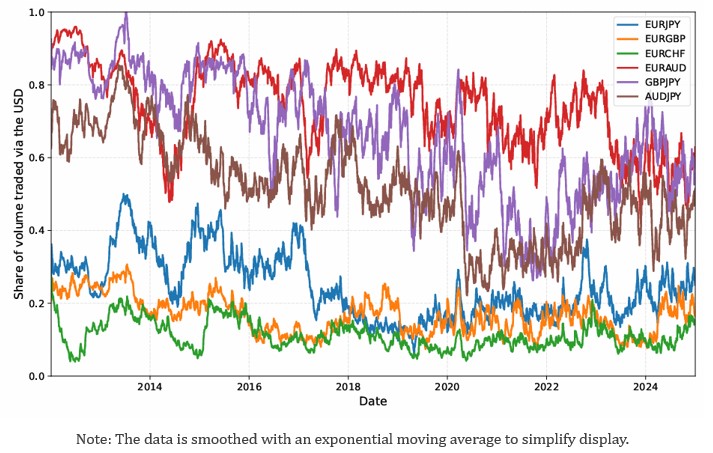
Using our measure of cross-trading, we find that the share of trading volume routed via the dollar varies considerably over time and across different currency triangles. Figure 2 illustrates the evolution of these cross-trading shares over time. Less frequently traded pairs – such as the euro against the Australian dollar, sterling against the yen, and the Australian dollar against the yen – tend to be crossed via the dollar more often, though this share has fallen over our sample period. The proportion of euro-Australian dollar volume routed via the dollar, for example, dropped from about 90% in 2012 to roughly 60% today. In contrast, more actively traded pairs – euro against the yen, sterling, and Swiss franc – exhibit relatively stable but lower shares of crossing via the dollar, of around 10-30%.
Figure 2. Daily cross-trading share per direct currency pair
Our second contribution is to show that these cross-trades raise the volatility of the dollar. The mechanism rests on incomplete information, which we formalise in a theoretical framework. In interdealer FX markets, traders submit buy and sell orders that are absorbed by market makers, who set prices to reflect their best estimate of a currency’s value given the order flow they observe. Market makers tend to specialise in a subset of platforms and currency pairs, and they see only the order flow submitted to their own market. They learn about price moves elsewhere only with a lag. A market maker therefore cannot tell whether an in-coming order is a stand-alone trade, or one leg of a cross-trade routed through the dollar.
Consider a trader who sells the euro against the yen and chooses to route the trade through the dollar. She submits a euro-dollar sell order to one market and a dollar-yen sell order to another. The euro-dollar market maker sees only a request to sell euros for dollars, and adjusts the value of the dollar upwards. The dollar-yen market maker sees only a sale of dollars for yen, and adjusts the value of the dollar downwards. Because each market maker reads their own leg as a directional dollar trade, the cross-trade moves both dollar rates by more than an equivalent direct euro-yen trade would. We confirm this empirically by estimating the immediate price impact of euro-yen trades on dollar exchange rates. A direct euro-yen trade moves the dollar-yen rate by about 0.075 basis points, whereas the same trade crossed through the dollar moves it by roughly 0.11 basis points.
In principle, these two adjustments should cancel out: One market maker has pushed the dollar up, the other down, and no-arbitrage ties the dollar rates together. But because the relevant market makers sit on different platforms and observe each other’s rates only with a delay, this reconciliation takes time. The dollar rate first overshoots and corrects only later, resulting in volatility in the dollar rate. And because all dollar pairs are linked through no-arbitrage conditions, this volatility does not stay contained: it spreads to dollar pairs unrelated to the original trade, and hence to the dollar itself.
For a single cross-trade the effect is small, but in aggregate it is sizeable. We quantify the effect in three ways that address confounding and reverse causality. A simple regression links a one-standard-deviation rise in aggregate cross-trading to a 7.4% increase in dollar volatility. Instrumenting with the EBS migration – a technological change that made cross-trading more attractive – raises the estimate to 9.6%. Our preferred approach, using granular instrumental variables (Gabaix and Koijen, 2024), puts it at 12.0%. This is equivalent to increasing dollar volatility from its sample median to its 66th percentile. Our central finding is, therefore, that the dollar’s role as a vehicle currency amplifies volatility spillovers across the currency network and increases the dollar’s exposure to uncertainty in other currencies.
Our results add a new dimension to the understanding of the dollar’s role in FX markets. Dollar dominance delivers well-established benefits, including improved liquidity and lower transaction costs in dollar pairs. Our findings show, however, that this dominance entails a trade-off that warrants attention: cross-trading creates a channel through which uncertainty from other currencies is transmitted to the dollar, amplifying dollar volatility.
Elevated dollar volatility matters for market participants for at least two reasons. First, it affects liquidity provision. Liquidity providers in FX markets are constrained by value-at-risk (VaR) limits (Huang et al., 2025). These VaR limits are computed from the return distribution and volatility of the assets in a dealer’s portfolio. Given the central role played by the dollar in the FX market, the dollar can be expected to account for a large share of any FX dealer’s portfolio. Hence, an increase in dollar volatility would substantially tighten dealers’ constraints and limit their intermediation capacity. As Huang et al. (2025) demonstrate, when dealers’ intermediation capacity is constrained, the cost of liquidity provision rises disproportionately, resulting in higher transaction costs for all FX market participants. Second, the link between cross-trades and dollar volatility is relevant to risk management. Because the intensity of cross-trading varies considerably over time, so does its contribution to the volatility, and hence the inventory risk of dollar-denominated portfolios.
We do not claim that these volatility effects outweigh liquidity benefits of dollar dominance: assessing the optimal degree of dollar concentration in FX markets is beyond the scope of this brief. However, by identifying cross-trading as a previously undocumented source of dollar volatility, we aim to contribute to a more complete understanding of what dollar dominance implies for the functioning of FX markets.
Bank for International Settlements. (2022). OTC foreign exchange turnover in April 2022. Triennial Central Bank Survey.
Bordier, C., Frei, L. & Stalder, S. (2026). Dollar dominance: A source of dollar volatility? SNB Working Papers 5/2026.
Gabaix, X., & Koijen, R. S. (2024). Granular instrumental variables. Journal of Political Economy, 132 (7).
Huang, W., Ranaldo, A., Schrimpf, A., & Somogyi, F. (2025). Constrained liquidity provision in currency markets. Journal of Financial Economics, 167 (2).
Somogyi, F. (2026). Dollar dominance in FX trading [Published online 2026-04-07]. Management Science.