

The views expressed in this Policy Brief are solely those of the author.
Abstract
The emergence of stablecoins and tokenised financial assets is shifting competition in international finance from currency issuance to the governance of cross-border settlement infrastructure. Using Hong Kong’s Linked Exchange Rate System as a case study, this Policy Brief argues that Hong Kong’s enduring advantage lies not primarily in regulatory competition, but in its unique institutional position at the intersection of the US dollar system, the renminbi system, and Gulf capital flows. While this position creates the potential for a trusted cross-border capital corridor, its long-term credibility depends on whether its payment infrastructure, reserve management framework, and legal foundations can withstand periods of market stress. Drawing on recent developments in global stablecoin regulation and cross-border payment initiatives, the Brief identifies key operational gaps and proposes practical measures to strengthen institutional resilience. Although focused on Hong Kong, its conclusions have broader implications for jurisdictions seeking to preserve trusted financial connectivity in an increasingly fragmented international monetary system.
Hong Kong’s linked exchange rate has long been described as a constraint. In the emerging architecture of global digital finance, that same constraint produces something no other jurisdiction possesses: a fully convertible, institutionally credible dollar anchor sitting at the edge of the renminbi system.
Singapore has regulatory sophistication. Europe has market scale. The United States has the dollar itself. Hong Kong’s configuration stands apart entirely — the only jurisdiction simultaneously embedded in the dollar system, adjacent to the renminbi system, and institutionally legible to Gulf sovereign capital.
That position is structural. It is difficult to replicate through legislation elsewhere and not easily displaced by regulatory competition. But it is only as credible as the settlement infrastructure built beneath it.
This is not ultimately a stablecoin story. It is a story about which financial centre will occupy the junction between the dollar system, the renminbi system, and Gulf sovereign capital — and whether that centre will build the operational foundation before the first real pressure event defines its role by default.
The global stablecoin conversation has moved well beyond crypto trading. Increasingly, it is about trade corridors, treasury management, and liquidity architecture. Token issuance itself is no longer the difficult part; building an orchestration layer that institutions can audit across cross-border flows is where the real work sits. The question is what kind of infrastructure ultimately emerges from that shift.
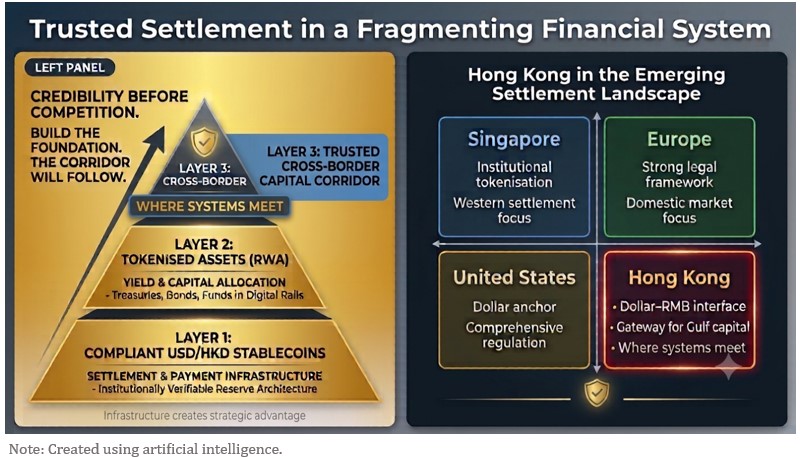
Hong Kong’s framework is building toward a three-layer structure — though the layers are not the same type of thing. The first two are financial functions. The third is a cross-border route, and it exists only if the first two are trustworthy enough to carry it.
Compliant dollar and HKD stablecoins serving institutional cash management, payment rails, and settlement needs. This is the foundation layer — the verifiable redemption and reserve architecture on which everything else depends.
Tokenised treasuries, funds, and bonds allowing institutional capital to move into return-generating products while maintaining settlement certainty. This is where traditional finance enters digital asset infrastructure at scale.
Both Layer 1 and Layer 2 are being developed in multiple jurisdictions, including Singapore and Europe.
Layer 3 is the corridor itself — the unique junction where dollar, renminbi, and Gulf capital flows can meet under auditable, compliant rules.
Project mBridge had processed over $55.5 billion in cumulative transactions by early 2026, with digital renminbi representing 95% of volume, connecting mainland China, Hong Kong, Thailand, the UAE, and Saudi Arabia at the central bank level. Alongside mBridge, the UAE’s emerging AED-backed stablecoin initiatives suggest that Gulf institutions are also building private, auditable settlement rails for cross-border capital flows.
But the capital this corridor ultimately requires runs on different rails than central-bank settlement. It depends on compliant dollar and HKD stablecoin infrastructure that private allocators can audit, price, and redeem independently of sovereign settlement systems.
In this context, Hong Kong’s advantage is not being a participant in every system. It is being trusted by multiple systems. Its role is not to win every network — it is to remain the place where networks meet.
The dependency is asymmetric and irreversible: Layer 3 can only function if Layers 1 and 2 provide auditable, stress-tested trust. Its credibility is a function of settlement reliability and asset quality — not geography alone.
And the first two layers are not yet fully tested.
Singapore, Europe, and the United States are each building capable frameworks. But none occupies Hong Kong’s structural position — and the reasons are architectural, not regulatory.
Singapore’s GL1 initiative and MAS Project Guardian represent one of the most sophisticated institutional tokenisation environments globally. But the design premise is Western institutional settlement. It is not structurally positioned to interface with the renminbi system or Gulf sovereign capital on the same terms — a gap regulation alone is unlikely to close, and one outside its core mandate.
Europe’s MiCA framework provides high legal clarity and strict reserve requirements, mandating licensed custody, segregation, and redemption rules. But its reserve architecture is designed around local sovereign debt and cash equivalents, and it is less naturally suited to cross-border tokenised real-world assets.
The United States has the dollar itself, and the GENIUS Act is formalising a comprehensive stablecoin framework anchored in 1:1 reserves and defined redemption standards. But no US framework sits at the interface between the renminbi system and Gulf sovereign capital in a way that is simultaneously institutionally neutral and operationally interoperable across those jurisdictions.
That difference is the point. Hong Kong is not in the same competition as Singapore, Europe, or the United States — their frameworks are built for different mandates and different junctions.
It is racing itself — against the window in which its first two layers must become as proven as its third layer’s position already is.
Strategic positioning alone does not produce institutional trust. What bridges that gap is the translation of strategic position into operational specification — moving the framework from principle to practice.
Tokenised real-world assets carrying a distributed value of $33 billion are already live on-chain (RWA.xyz, May 2026). Institutional capital is not waiting for perfect frameworks — it is already allocating. A recent independent cross-jurisdictional analysis of 32 currencies reportedly scores HKD at just 1 out of 5 on network effects — a dimension that appears to carry strong predictive weight for realised stablecoin adoption. HKD’s overall score of 3.75 still places it among the leading currencies globally capable of sustaining stablecoin issuance at scale, but the gap between strategic position and realised adoption is exactly what the first licence cycle must close.
The stress test that defines whether Hong Kong’s foundation holds will not announce itself in advance. The 2023 Silicon Valley Bank episode gave Circle 48 hours to defend USDC’s peg. Circle survived because a decade of verification architecture already existed: monthly Big Four attestation, reserve segregation, and disclosure of SVB exposure within 48 hours. Hong Kong’s framework, as currently structured, still relies heavily on principle-based standards rather than fully quantified operational thresholds in the first licence cycle.
In a MENA–Hong Kong treasury corridor, three operational frictions become critical under stress.
Cross-border disposal lags are extended by asynchronous settlement cycles between Islamic working weeks and Western markets, often reaching 72–96 hours in Gulf jurisdictions. Oracle pricing for tokenised receivables across non-overlapping time zones remains insufficiently stress-tested. And SPV enforceability across DIFC, ADGM, Hong Kong ring-fencing regimes, and mainland legal boundaries remains a multi-jurisdictional conflict-of-laws challenge. These are not abstract risks. They are the conditions under which settlement either clears or fractures.
They persist not because they are unknown, but because Basel-style capital frameworks were never designed to measure settlement speed under redemption pressure. The disposal-lag variable is not explicitly captured in Basel taxonomy.
Closing this gap requires not new legislation, but operational translation of existing principles. The precedents are already available: the FDIC’s April 2026 draft rule, Brazil’s atomic settlement protocols, Dubai’s tiered positive-list approach, and the EU’s Digital Operational Resilience Act, which makes systemic stress-testing a precondition of licensing rather than a response to crisis. None invented a new standard. Each operationalised one that already existed.
Three supplementary measures would close the gap within the first licence cycle:
A time-adjusted haircut schedule calibrated to disposal-lag values across asset classes, with explicit penalties for slow liquidation in cross-border conditions.
An independent valuation protocol covering simultaneous redemption stress, oracle failure, and custody disruption — making stress testing a precondition, not a post-event exercise.
A cross-border enforceability certification standard, requiring disclosure of legal and operational settlement constraints across jurisdictions, replacing implicit assumptions with explicit risk pricing.
These are not innovations. They make existing risks explicit.
Passing the first stress test is not a compliance milestone. It is the entry condition for corridor credibility.
The stakes extend well beyond Hong Kong’s own regulatory trajectory.
Beyond Hong Kong itself, the question is whether an increasingly fragmented global financial system can continue to support safe, efficient cross-border capital allocation — and meaningful regulatory oversight — within a world of multiplying payment rails and competing settlement systems. The issue is not simply financial innovation. It is whether trusted connectivity can be preserved as the architecture of global finance becomes increasingly multi-polar.
As geoeconomic and digital finance fragmentation deepens, trusted settlement environments are becoming scarcer. This scarcity directly constrains capital movement, risk pricing, and cross-jurisdictional governance. Where Layer 1 and Layer 2 infrastructure remains underdeveloped, capital allocation costs rise, settlement lags lengthen, and participants are pushed toward bilateral or weaponised payment corridors — eroding systemic resilience and normalising regulatory arbitrage.
Wall Street has already read the signal. BNY, Goldman Sachs, and BlackRock built reserve funds aligned with emerging stablecoin rules last year; State Street and Fidelity followed this year. None of them are racing to mint tokens. In June 2026, BNY — a global systemically important bank (G-SIB) and one of the world’s largest custodian institutions — added Circle’s USDC to its Digital Asset Custody platform, enabling clients to store, transfer, mint and burn USDC. The signal is not the product. It is the institution. They are positioning around settlement, custody, reserve management, and interoperability: the operational backbone of institutional-scale trust.
Recent shifts in reserve composition reinforce the same trend. Diversification is accelerating, but not toward a single dollar rival. Gold’s share continues to rise; the renminbi’s remains comparatively subdued. What is changing is not currency dominance, but the routing and settlement infrastructure that determines how capital flows between systems that cannot directly transact.
In this environment, the real competition is no longer between currencies. It is between settlement architectures. And financial fragmentation does not eliminate connectivity needs — it intensifies them. The dollar system, the renminbi system, and Gulf sovereign capital are all searching for trusted settlement junctions between existing networks and emerging on-chain markets.
In a world where trust is increasingly scarce and costly, the question that regulators, institutions, and jurisdictions are now racing to answer — whether framed as national security, settlement finality, or reserve resilience — is what makes financial infrastructure trustworthy enough to function as a bridge.
Hong Kong is one of the few viable junctions where that question can still be answered — not by building trust from scratch, but by extending a proven, institutionally deep financial ecosystem accumulated over decades into the on-chain era. For policymakers navigating the strategic age of financial infrastructure, it represents a live case study in whether accumulated institutional trust can make that transition.
Hong Kong’s success or failure is therefore not merely a local regulatory outcome. If the first two layers do not reach the standard required to support Layer 3, the cost would not be borne by Hong Kong alone — it would be borne by a global financial system increasingly forced to rely on bilateral arrangements rather than trusted shared infrastructure. That is a further step toward a more fragmented, higher-cost, and more weaponisable architecture — precisely the outcome a stable global financial system should seek to avoid.
That makes Hong Kong’s task unambiguous: its challenge is not competition, but readiness — and readiness begins before it is tested.
The race to define digital financial infrastructure has entered its decisive phase. Singapore, Europe, and the United States are competing intensely for Layers 1 and 2. Hong Kong does not need to join that race. But to unlock Layer 3, its Layer 1 and Layer 2 foundations must first prove robust.
Each improvement in verification standards, reduction in settlement latency, and clarification of cross-border enforceability strengthens the foundation that matters most.
The linked exchange rate is not a constraint in this architecture — it is the bridge. It anchors credibility with Western capital, proximity to the renminbi system provides relevance to Asian flows, and Gulf sovereign capital recognises both — but only where settlement reliability can be verified under pressure.
Hong Kong’s long-term advantage lies not in speed, but in trusted settlement.
Build the foundation. The corridor will follow.
BNY Mellon (2026). BNY Adds USDC to Digital Asset Custody Platform. Press release, June.
Circle (2023). $3.3 Billion of USDC Reserve Risk Removed, Dollar De-peg Closes. Circle press release, 12 March. https://www.circle.com/pressroom/3-3-billion-of-usdc-reserve-risk-removed-dollar-de-peg-closes
Dubai Financial Services Authority (DFSA) / ADGM (2026). Tiered positive-list approach for virtual asset activities.
European Union (2022/2026). Digital Operational Resilience Act (DORA). Regulation (EU) 2022/2554.
FDIC (2026). Draft Rule on Stablecoin and Digital Asset Reserves, April.
mBridge Project (2026). Cumulative transaction volume update. Bank for International Settlements / participating central banks (Hong Kong, Thailand, UAE, Saudi Arabia, mainland China).
RWA.xyz (2026). On-chain Real World Assets Dashboard, May. https://rwa.xyz
Singapore Monetary Authority (MAS) (various). Project Guardian and GL1 initiative.
U.S. GENIUS Act sponsors (2025). Statement on dollar dominance and stablecoin framework.
Additional contextual sources (for operational precedents):
Brazil Central Bank. Atomic settlement protocols in tokenised systems.
Ahmed, R., Aldasoro, I., & Duley, C. (2024). Public information and stablecoin runs. BIS Working Papers No. 1164, Bank for International Settlements (revised January 2025).
Anadu, K. et al. (2023). Runs and flights to safety: Are stablecoins the new money market funds? Federal Reserve Bank of New York Staff Report.