

The views expressed in this SUERF policy brief are those of the authors and do not necessarily represent the views of Banca d’Italia or the Eurosystem. The policy brief is based on the Banca d’Italia Working Paper “Deposit Funding, Market Power and Monetary Policy Transmission”, which is part of the ChaMP Research Network.
Abstract
During the 2022–23 ECB’s monetary tightening cycle, the pass-through from policy rates to bank deposit rates was markedly weaker than historical regularities would predict. Using euro-area bank-level data and a state-dependent panel IV local projection framework, we show that two key drivers help explain this muted transmission: the large share of deposit funding accumulated during the preceding period of accommodative monetary policy, and rising deposit market power among banks. While the impact of deposit funding is mainly short-lived, deposit market power has a more persistent dampening effect, extending beyond funding costs to lending conditions.
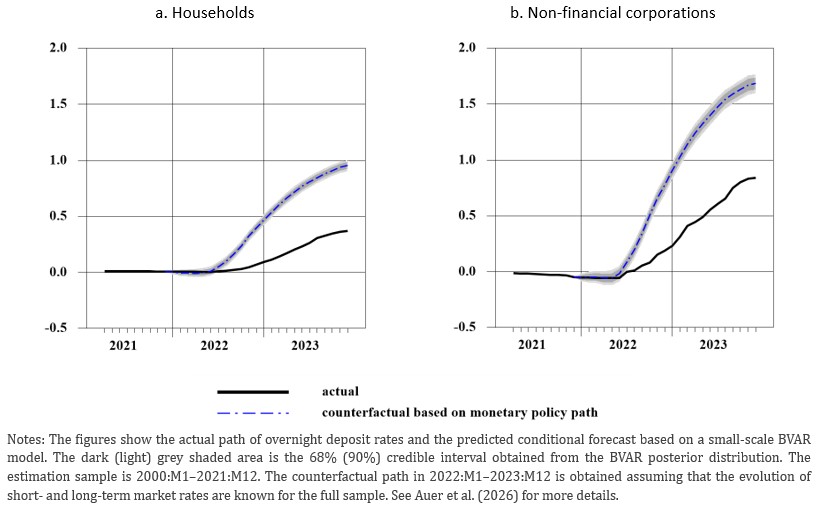
The 2022–23 ECB’s monetary tightening cycle represents one of the most rapid and sizeable episodes of policy rate increases in the history of the euro area, yet the transmission to bank funding conditions was markedly weak. In particular, the remuneration of overnight deposits increased only marginally, remaining well below levels predicted by historical patterns. Counterfactual estimates based on Bayesian VAR models indeed suggest that overnight deposit rates should have adjusted much more strongly given the observed path of market rates. Between July 2022 and September 2023, the ECB increased its policy rate by about 450 basis points. Over the same period, the average remuneration of overnight deposits rose only from around −0.1% to 0.8% for non-financial corporations (NFCs) and from 0.0% to 0.3% for households (HHs). By contrast, the predicted counterfactual paths of overnight deposit rates would have increased to roughly 1.6% for NFCs and 1% for HHs (Figure 1). This muted response constitutes a clear “missing pass-through” puzzle and suggests that some features of the banking system may have played a crucial role in shaping the transmission during this tightening episode.
The relevance of this puzzle extends beyond the behavior of deposit rates. Since bank funding costs are a key determinant of lending conditions, an incomplete pass-through (PT) may alter the transmission of monetary policy to credit supply, aggregate demand and, ultimately, inflation dynamics. Understanding its drivers is therefore essential for assessing the effectiveness of monetary policy in environments characterized by large and rapid policy adjustments (Lane, 2023; Panetta, 2024).
Figure 1. Missing pass-through from policy to overnight deposit rates
In Auer et al. (2026), we focus on two factors that gained prominence during the long phase of very accommodative monetary policy that preceded the 2022–23 ECB’s tightening cycle and that may explain this muted PT: banks’ reliance on deposit funding and their market power in deposit markets.1 Banks’ deposit funding is defined as the share of deposits over total bank funding, while deposit market power is measured as the deposit markdown obtained through a logit demand model (see Auer et al., 2026, for more details).
Between 2015 and 2021, the low opportunity cost of holding money in a low interest rate environment and the large-scale asset purchase programmes implemented by the ECB led to a large inflow of deposits for euro-area banks, matched by a corresponding increase in their reserves on the asset side. Banks with higher deposit funding, and with adequate excess reserves, may limit the PT of monetary policy to deposit rates. In such an environment, banks had weaker incentives to compete for deposits through higher remuneration (Messer and Niepmann, 2023), while a larger deposit base increased the cost of repricing liabilities following monetary tightening (Gambacorta, 2008; Eggertsson et al., 2024; Cappelletti et al., 2024).
After being remarkably stable over the period 2007–15, banks’ deposit market power trended upwards, mirroring the evolution of deposit funding at least until the onset of the 2022–23 ECB’s tightening cycle. In a period characterized by a significant increase in aggregate deposits and persistently low interest rates — a condition that limited customers’ incentives to reallocate their funds toward alternative financial products — some banks were able to attract a larger share of deposits, thereby strengthening their deposit market power. Facing a lower demand-price elasticity, these banks may have limited the PT of policy rate hikes to earn larger intermediation margins. This mechanism is at the heart of the so-called deposit channel of monetary policy in Drechsler et al. (2017, 2021).
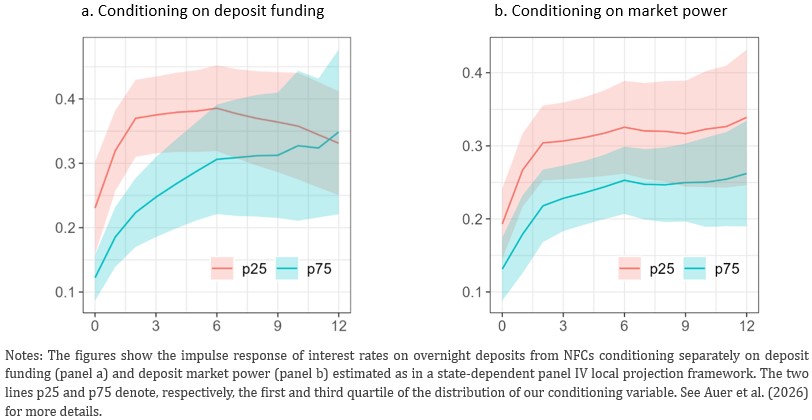
Using granular bank-level data for the euro area and a state-dependent panel IV local projection framework, we find that higher incidence of deposit funding is associated with a lower pass-through to overnight deposit rates, but mainly in the short term. The dampening effect of deposit market power is instead more persistent. Following a 100 bps increase in the reference rate, a bank with a share of deposits over total funding at the 75th percentile, compared with a bank at the 25th percentile, on impact would pass on 10 bps less to the remuneration of overnight deposits from NFCs and 15 bps less to that of overnight deposits from HHs (Figures 2 and 3). For deposit market power, the dampening effect on the PT is 5 and 3 bps, respectively, on impact. After 12 months, the attenuation in the PT associated with higher deposit funding disappears almost completely, while higher deposit market power is still associated with a lower PT to overnight deposit rates by 10 and 6 bps for NFCs and HHs, respectively.
Importantly, only deposit market power has a dampening effect also on the PT to lending rates, suggesting that its influence extends beyond bank funding costs and affects the broader transmission of monetary policy to financing conditions for NFCs and HHs. After 12 months, the attenuation in the PT associated with higher deposit market power is around 10 bps for NFC lending rates and 6 bps for mortgage rates.
Figure 2. State-dependent pass-through to interest rates on overnight deposits from HH
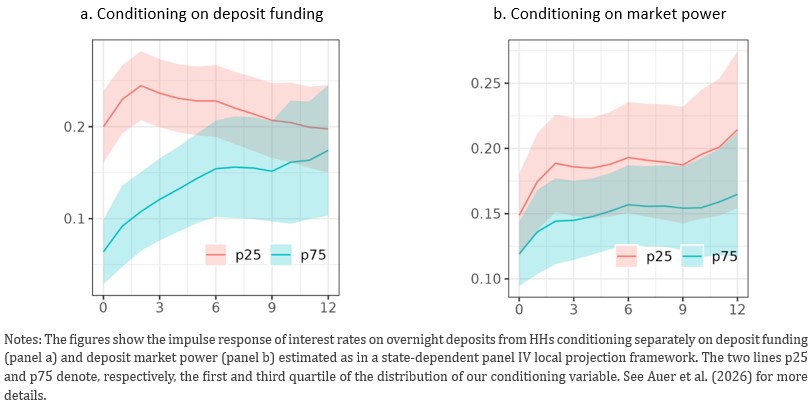
Figure 3. State-dependent pass-through to interest rates on overnight deposits from NFCs
Our findings carry relevant policy implications.
First, although keeping policy rates low for an extended period and implementing large asset purchase programmes contribute to increasing banks’ deposit funding, this has, per se, only limited and temporary effects on the transmission mechanism of monetary policy to bank funding costs and no impact on lending rates. The benefits of these highly accommodative policy measures — such as stimulating aggregate demand and supporting price and financial stability — are therefore not counterbalanced by the side effect associated with an increase in banks’ deposit funding.
Second, higher deposit market power, possibly associated with some banks being more able to attract and retain a larger share of deposits in a context of low interest rates, has a dampening effect on the pass-through of monetary policy that can be more relevant and persistent. Therefore, adequate competition in the credit sector ensures that the central bank can more effectively calibrate its monetary policy impulse and that this impulse is properly transmitted to the economy.
Auer, S., Conti, A.M. and Farroni, P. (2026). “Deposit funding, market power and monetary policy transmission”, Temi di Discussione (Working Papers), No. 1533, Bank of Italy, Economic Research and International Relations Area.
Bussière, M., Gasparini, T., Horny, G. and Nguyen, B. (2025). “Deposit Funding and the Credit Channel of Monetary Policy”, Working Papers, No. 1029, Banque de France.
Cappelletti, G., Marqués-Ibáñez, D., Reghezza, A. and Salleo, C. (2024). “As interest rates surge: flighty deposits and lending”, Working Paper Series, No. 2923, European Central Bank.
Drechsler, I., Savov, A. and Schnabl, P. (2017). “The deposits channel of monetary policy”, The Quarterly Journal of Economics, 132 (4), 1819–1876.
Drechsler, I., Savov, A. and Schnabl, P. (2021). “Banking on deposits: Maturity transformation without interest rate risk”, The Journal of Finance, 76 (3), 1091–1143.
Eggertsson, G.B., Juelsrud, R.E., Summers, L.H. and Wold, E.G. (2024). “Negative nominal interest rates and the bank lending channel”, The Review of Economic Studies, 91 (4), 2201–2275.
Gambacorta, L. (2008). “How do banks set interest rates?”, European Economic Review, 52 (5), 792–819.
Kho, S. (2025). “Deposit market concentration and monetary transmission: Evidence from the euro area”, European Economic Review, 173, 104933.
Lane, P. (2023). “The banking channel of monetary policy tightening in the euro area”, Remarks at the Panel Discussion on Banking Solvency and Monetary Policy, NBER Summer Institute 2023 Macro, Money and Financial Frictions Workshop, Cambridge, 12 July.
Messer, T. and Niepmann, F. (2023). “What determines passthrough of policy rates to deposit rates in the euro area?”, FEDS Notes 2023-07-28-2, Board of Governors of the Federal Reserve System (U.S.).
Panetta, F. (2024). “Monetary policy in a shifting landscape”, Speech at the Inaugural conference of the ChaMP Research Network, Frankfurt am Main, 25 April.
Our analysis adds to the recent strand of the literature that explores drivers possibly contributing to the muted PT from monetary policy to deposit rates in the euro area during 2022–23. See, for example, Kho (2025), Bussière et al. (2025) and Messer and Niepmann (2023).