

This policy brief is based on Working Papers 202601, Banco de Portugal, Economics and Research Department. The views expressed are those of the authors and not necessarily those of the institutions the authors are affiliated with.
Abstract
Using a small open economy New Keynesian DSGE model with financial intermediation, we show how optimal macroprudential policy and bank capital ratios vary depending on whether monetary policy prioritizes domestic price stability or exchange rate stability. Macroprudential policy is valuable in shielding the economy from external financial shocks, in particular when monetary policy focuses on exchange rate stability. Optimal macroprudential policy raises bank capital ratios by 5 percentage points and delivers welfare gains of nearly 1 percent of steady-state consumption. A key implication of our analysis is that macroprudential policy and higher bank capital ratios can act as a partial substitute for exchange rate flexibility in open economies.
Banks tend to rely on short-term borrowing to fund long-term lending. This makes bank net interest margins – the difference between returns on assets and the cost of funding – sensitive to fluctuations in the short-term policy rate. Volatile net interest margins create volatility in net worth, which tightens banks’ borrowing constraints, and weakens balance sheets. This depresses lending and ultimately reduces long-run aggregate output.
In our paper, “Optimal Macroprudential Policy and Bank Capital in Open Economies” we use a New Keynesian DSGE model and study a macroprudential policy which raises bank capital ratios through a subsidy to outside equity. By incentivizing a shift in bank funding away from short-term deposits and towards outside equity, this type of macroprudential policy reduces the sensitivity of net interest margins to changes in the policy rate and mitigates the negative effects of volatility on lending.
Our analysis focuses on an open economy in which the volatility of the policy rate depends on whether the central bank prioritizes stabilizing domestic prices or the exchange rate. In this case, the exchange rate focus of monetary policy influences the volatility of bank net interest margins, which in turn affects the extent to which macroprudential policy should be used to alter bank capital ratios. Our analysis provides an assessment of how bank capital ratios should depend on the exchange rate focus of monetary policy.
To explain our results, we begin by studying two polar monetary policy regimes. The first is domestic inflation targeting (DIT), in which case the central bank stabilizes domestic prices, whilst allowing the exchange rate to adjust freely to shocks. The second is an exchange rate peg (PEG). In Figure 1 we show that movements in the policy rate differ considerably across these two monetary regimes. To do so, we plot impulse responses functions for the policy rate when there are one-off shocks to domestic technology (top row) and to the foreign interest rate (bottom row). We report two impulse response functions per shock-policy regime combination. Plain lines are impulse response functions without macroprudential policy and square markers indicate there is a subsidy to outside equity, with correspondingly higher bank capital ratios.
Consider the top row of Figure 1. When there is a negative technology shock firms wish to raise prices. Under the DIT policy regime, a large rise in the policy rate is required to stop this process, and the value of the domestic currency adjusts accordingly. Under the PEG regime, such a large change in the policy rate is no longer necessary, and prices are allowed to rise. Now consider the second row of Figure 1. A shock to the foreign interest rate leads to a relatively weak response of the policy rate under the DIT regime because the exchange rate moves to accommodate the shock. Under the PEG regime, a strong response of the policy rate is required to maintain the value of the currency.
Figure 1 shows that the policy rate is volatile under the DIT regime when there are technology shocks and under the PEG regime when there are foreign interest rate shocks. These are the cases in which bank net interest rate margins are relatively more volatile. We argue that in such circumstances macroprudential policy should be used to incentivize a shift in bank funding towards outside equity. This raises bank capital ratios and mitigates the effects of shocks on the macroeconomy.
We develop this argument by varying the subsidy to outside equity under both monetary policy regimes. To this end, Figures 2 and 3 plot risk-adjusted steady state outcomes for key variables of interest when we vary the subsidy to outside equity. Solid lines correspond to the DIT regime and dashed lines correspond to the PEG regime.
Figure 1. Impulse Response Functions of the Policy Rate for Different Monetary Policy Regimes
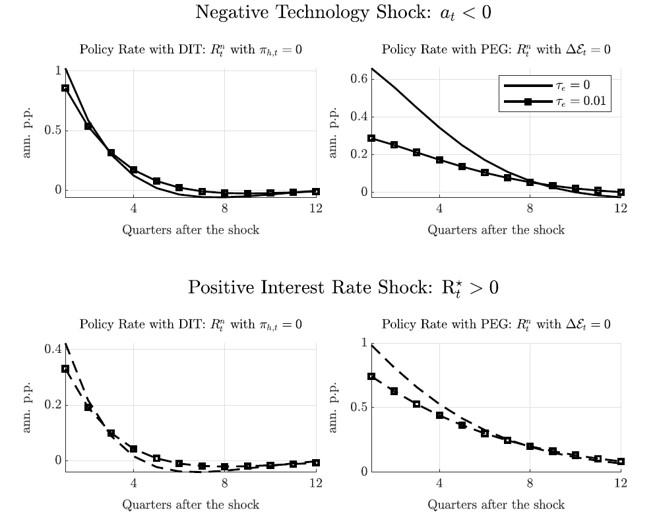
Figure 2 considers the case in which there are shocks to domestic technology.
Figure 2. Macroprudential Policy, the Risk-Adjusted Steady State, and Welfare (Domestic Technology Shocks)
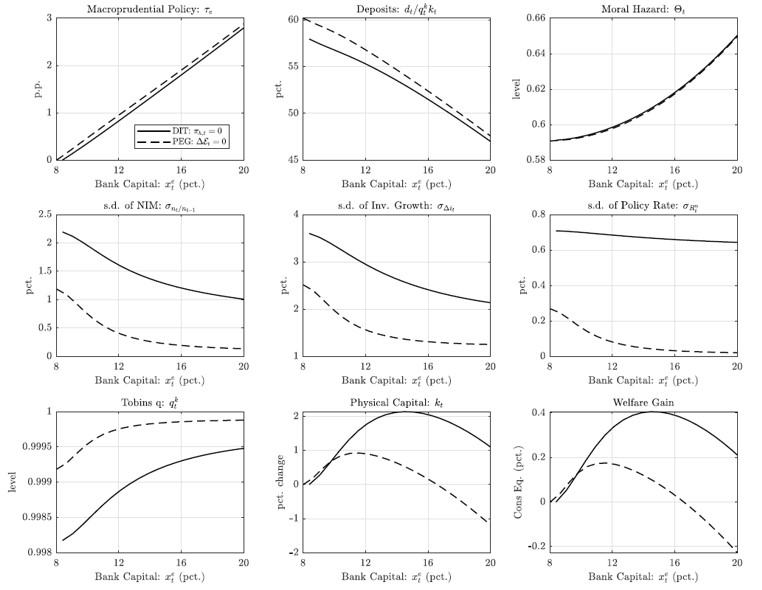
In the first row of Figure 2 we show that the subsidy to outside equity increases the bank capital ratio. This is consistent with a fall in deposit funding. In the second row, we show that as bank capital rises, the volatility of the net interest rate margin (NIM) falls. This is because banks are issuing more outside equity, and outside equity provides a relatively stable source of funding. We then identify the bank capital ratio which generates the largest welfare gain. The final graph in the bottom row shows this result. Under the DIT regime, the optimal bank capital ratio is about 15 percent, and is associated with a welfare gain of 0.4 percent of steady state consumption. Under the PEG regime, the optimal bank capital ratio is lower, at about 11 percent, and the welfare gain is below 0.2 percent of steady state consumption.
Next, we consider the case in which fluctuations are driven by external financial shocks.
Figure 3. Macroprudential Policy, the Risk-Adjusted Steady State, and Welfare (Foreign Interest Rate Shocks)
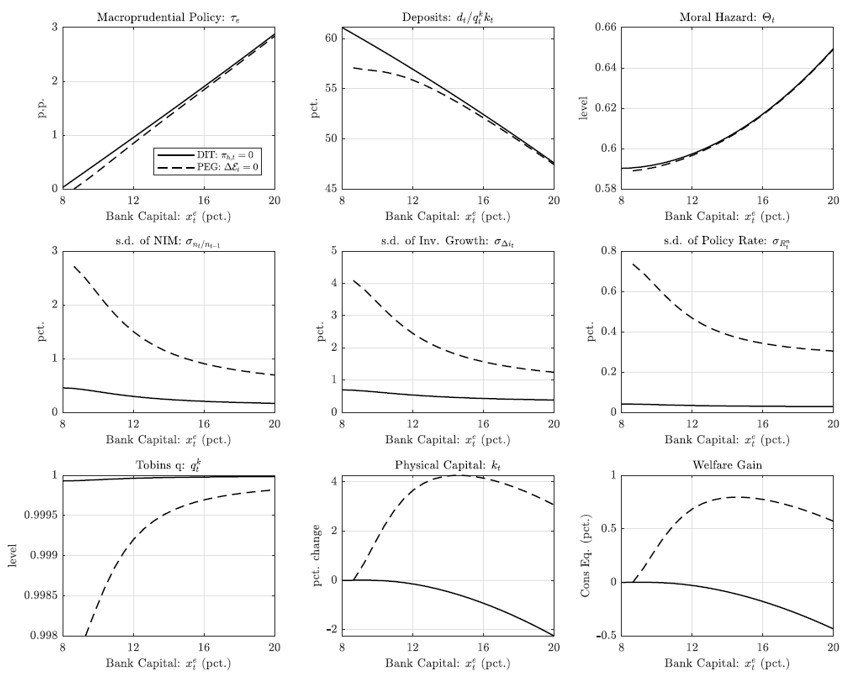
Figure 3 shows that when there are external financial shocks raising bank capital ratios acts powerfully to reduce volatility. Compared to the case in which there are domestic technology shocks, bank capital ratios should be higher under the PEG regime than the DIT regime. This result follows almost immediately from Figure 1 which shows that the policy rate is more volatile when there are foreign interest rate shocks under the PEG regime.
Figure 3 also shows that, despite similar optimal bank capital ratios, the welfare gains when there are foreign interest rate shocks under the PEG regime are larger than the welfare gains when there are technology shocks under the DIT regime. This result is linked to the presence of frictions in international financial markets which are reflected in deviations from uncovered interest rate parity – the gap between domestic and foreign interest rates after adjusting for expected exchange rate changes.
Higher foreign interest rates, weaken bank balance sheets, and widen the domestic credit spread. Higher foreign interest rates also exacerbate frictions in international financial markets. The result is that, when a central bank focuses on exchange rate stability, the policy rate needs to rise by more than the foreign interest rate to maintain the value of the currency. This creates a self-reinforcing loop that amplifies the negative effects of the shock. Since the PEG regime leads to greater policy rate volatility the welfare benefits from macroprudential policy are enhanced.
Many countries use hybrid monetary policy regimes in which the central bank focuses on movements in domestic prices and the exchange rate. To account for this possibility – and to determine how the exchange rate focus of monetary policy affects our conclusions – we re-run our analysis, instead supposing that monetary policy is conducted using an interest rate rule which accounts for such possibilities (Gali and Monacelli, 2016).
Figure 4. Optimal Bank Capital and the Exchange Rate Focus of Monetary
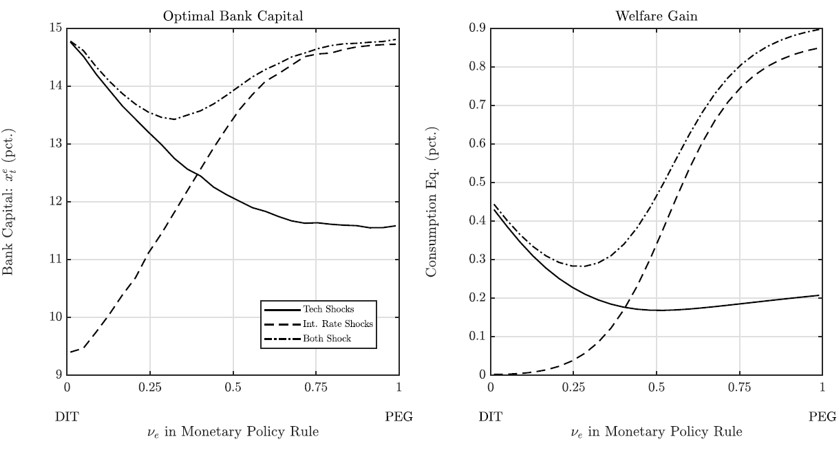
The left-hand panel of Figure 4 plots the optimal bank capital ratio on the vertical axis against the exchange rate focus of monetary policy, ranging from domestic inflation targeting (DIT, left) to an exchange rate peg (PEG, right), on the horizontal axis. The right-hand side panel plots the corresponding welfare gain in units of steady state consumption. The three lines in each graph correspond to the cases in which there is either a single shock to domestic technology, a single shock to the foreign interest rate, or when both shocks are present simultaneously.
When there are only domestic technology shocks (solid line) the optimal bank capital ratio declines gradually as monetary policy becomes more exchange-rate-focused. A greater emphasis on exchange rate stability reduces the need for the policy rate to adjustment to technology shocks. When there are only foreign interest rate shocks (dash-dot line) the reverse holds and optimal bank capital rises steeply as monetary policy focuses more on exchange rate stability. This is because large changes in the policy rate are required to defend the peg and these contribute to volatility in net interest margins. When both shocks are present simultaneously (dashed line) the optimal bank capital ratio is U-shaped in the exchange rate focus of monetary policy. For monetary policy close to DIT, exchange rate flexibility absorbs foreign rate shocks, making technology shocks the dominant macroprudential concern, pushing optimal capital ratios down. As monetary policy shifts towards a PEG, foreign interest rate shocks become the dominant concern, pushing optimal bank capital ratios up.
We find that the welfare gain associated with a particular level of bank capital is not symmetric across monetary regimes and shock origination. When technology shocks dominate, the welfare gains from optimal macroprudential policy are modest, and peak at around 0.4 percent of steady-state consumption under the DIT regime. When foreign interest rate shocks dominate, the gain is considerably lower under the DIT regime – macroprudential policy adds little because the policy rate is already stable. Under the PEG regime, however, the welfare gain from an optimal bank capital ratio rises to nearly 1 percent of steady state consumption. In general, when both shocks are present, welfare gains tend to be larger under PEG than under DIT.
A long-standing debate in international economics concerns whether flexible exchange rates provide insulation from global financial shocks. Obstfeld et al. (2019) argue that flexible rates do provide such insulation, whereas Rey (2013) argues that there is a global financial cycle, which limits the usefulness of flexible exchange rates in this regard. Our results speak to this debate from a different angle. By raising bank capital ratios and strengthening balance sheets, macroprudential policy can mitigate the transmission of external shocks through funding costs and net worth volatility. These ideas find empirical support – for example, in the work of Bergant et al. (2024).
Our results also imply that the interaction between macroprudential and monetary policy is not neutral. A shift toward greater exchange rate stability, for example, should prompt a reassessment of optimal bank capital ratios, and macroprudential policy is particularly valuable precisely when monetary policy is constrained by an exchange rate objective. In this sense, our results have relevance for the euro area, where member states cannot use the exchange rate as an adjustment tool. First, national macroprudential authorities should account not only for domestic credit conditions, but also for the degree to which the common monetary policy may amplify or dampen financial conditions in each country. Second, macroprudential policy should consider the impact of specific shocks that are more likely to hit the economy, with countries facing greater exposure to global financial shocks benefiting the most from higher bank capital ratios.
Akinci, O. and Queralto, A. (2024). ‘Exchange Rate Dynamics and Monetary Spillovers with Imperfect Financial Markets.’ Review of Financial Studies 37, 309–355.
Bergant, K., Grigoli, F., Hansen, N. and Sandri, D. (2024). ‘Dampening Global Financial Shocks: Can Macroprudential Regulation Help (More than Capital Controls)?’ Journal of Money, Credit and Banking 56, 1405–1438.
Basu, S., Boz, E., Gopinath, G., Roch, F. and Unsal, F. (2025). ‘Integrated Monetary and Financial Policies for Small Open Economies.’ Econometrica 93, 2201–2234.
Cooke, D. and Damjanovic, T. (2026). ‘Optimal Macroprudential Policy and Bank Capital in Open Economies.’ Working Papers w202601, Banco de Portugal, Economics and Research Department.
Gertler, M., Kiyotaki, N. and Queralto, A. (2012). ‘Financial Crises, Bank Risk Exposure and Government Financial Policy.’ Journal of Monetary Economics 59, S17–S34.
Gali, J. and Monacelli, T. (2016). ‘Understanding the Gains from Wage Flexibility: the Exchange Rate Connection’ American Economic Review 106, 3829–3868.
Obstfeld, M., Ostry, J. and Qureshi, M. (2019). ‘A Tie That Binds: Revisiting the Trilemma in Emerging Market Economies.’ Review of Economics and Statistics 101, 279–293.
Forbes, K. (2021). ‘The International Aspects of Macroprudential Policy.’ Annual Review of Economics 13, 203–228.
Rey, H. (2013). ‘Dilemma not Trilemma: The Global Financial Cycle and Monetary Policy Independence.’ Proceedings – Economic Policy Symposium – Jackson Hole.