

The views expressed are those of the authors and do not necessarily represent those of the Banque de France or the Eurosystem.
Abstract
Carbon pricing is often presented as generation-neutral. In Annicchiarico, Sahuc and Vermandel (2026), we argue it is not. In an overlapping-generations economy, workers depend on labour income while retirees live off financial wealth, and carbon pricing moves these two sources in opposite directions: it compresses wages and, through the disinflation that accompanies a credible carbon-price path, lifts real asset values. Calibrating an environmental New Keynesian model to euro-area household data, we find the labour-income channel dominates, producing lifetime welfare losses of up to 6% of permanent consumption for working-age cohorts and comparable gains for retirees. The redistribution is structural. Fiscal recycling can contain it but only within a narrow corridor; monetary policy cannot.
Carbon pricing is widely seen as a clean instrument: correct an externality, recycle the revenues, improve aggregate welfare. The distributional arithmetic, however, depends on who holds what. This note argues that the conventional view misses a structural force rooted in the life cycle.
Households at different ages rely on fundamentally different income sources. Working-age households draw most of their resources from labour income; retirees live largely off accumulated financial wealth. Carbon pricing moves these two sources in opposite directions. Carbon pricing affects these two sources in opposite directions. By raising firms’ production costs, it compresses wages; by triggering a disinflationary contraction in demand, it raises the real value of nominal assets and the real return on saving. Because reliance on labour income falls steadily with age, from close to one for the young to near zero for the retired, the policy generates a systematic transfer from workers to asset holders. This transfer is not an incidental by-product of carbon pricing but an inherent consequence of the economy’s structure. We call it the redistribution force of climate policy.
The force is especially strong in the euro area, where rapid population ageing amplifies the demographic footprint of any generational transfer, cross-cohort differences in income composition are large, and the Paris Agreement commits the region to a sustained, ambitious carbon-price path.
Climate policy reaches household welfare through two opposing mechanisms. The labour-income channel operates via production costs: as carbon pricing raises firms’ marginal costs and depresses labour demand, and because capital cannot adjust immediately, the incidence of abatement falls disproportionately on wages. The financial-wealth channel works in the opposite direction: the announcement of a steeper carbon-tax path triggers a forward-looking contraction in demand, the resulting disinflation raises the real value of nominal assets, and lower discount rates lift capital prices and financial returns.
Figure 1. Household budget decomposition and financial assets
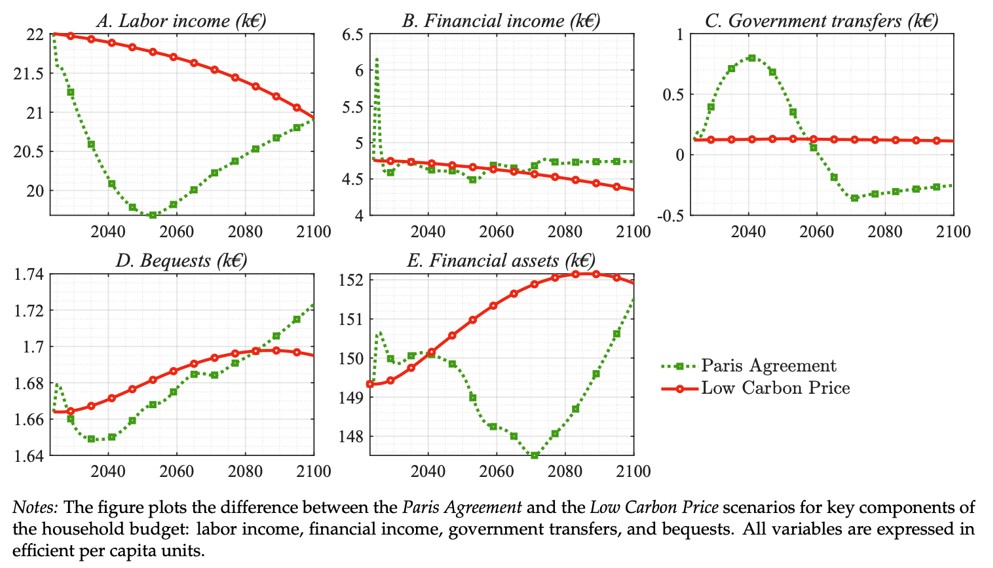
We quantify the resulting redistribution in an environmental overlapping-generations New Keynesian model, calibrated on four waves of the Household Finance and Consumption Survey (HFCN, 2023) and United Nations life tables. We compare two alternative transition paths. The first is a Paris Agreement scenario that implements a carbon tax consistent with limiting global warming to below 2◦C above pre-industrial levels. The second is a Low Carbon Price scenario that extrapolates policies in place as of 2023, with a global average carbon price of $6/tCO2 growing at 2.5% annually (Barrage and Nordhaus, 2024). We find that the labour-income channel is the dominant source of intergenerational redistribution (Figure 1). Under the Paris Agreement scenario, aggregate labour income declines by almost 10% during the first three decades of the transition. Although carbon pricing also generates a temporary asset revaluation that benefits wealth holders, these gains are quantitatively smaller and fade as inflation expectations adjust. The dominance of the labour-income channel is reinforced by two features of household behaviour. First, portfolio adjustment costs limit households’ ability to reallocate wealth and capture transitional capital gains. Second, a binding borrowing constraint leaves young households with high marginal propensities to consume (Kaplan and Violante, 2014), causing wage losses to translate rapidly into lower consumption.
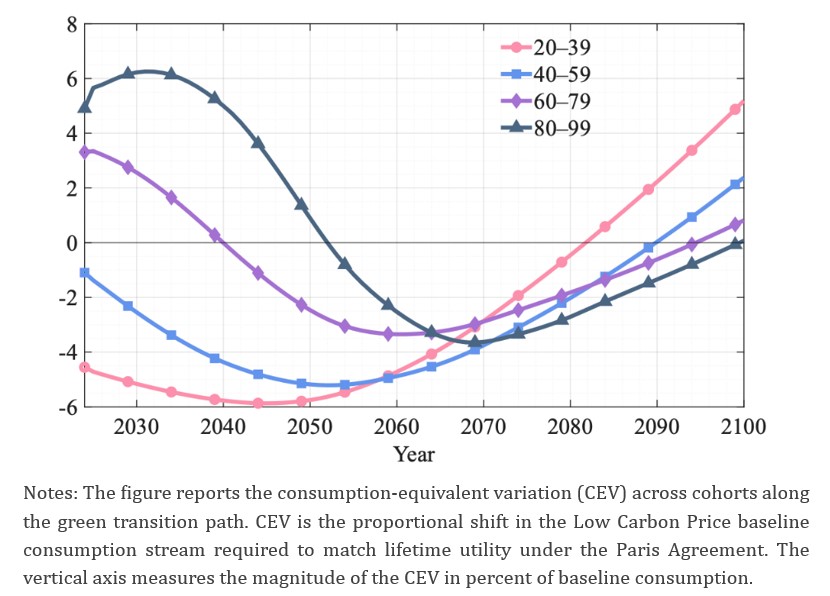
To measure the lifetime impact, the paper computes a consumption-equivalent variation (CEV) for each cohort: the proportional change in remaining lifetime consumption that would make a household indifferent between the Low Carbon Price and Paris Agreement scenarios. Working-age households incur losses of up to 6% of permanent consumption; retirees gain up to 6% (Figure 2).
These costs are not transitory. Cohorts that experience wage compression during their peak earning years save less, enter retirement with a thinner wealth base, and carry the loss for the rest of their lives. These persistent effects reflect what we call the demographic footprint of carbon policy. This scarring outlasts the physical decarbonisation by more than two decades, reflecting the slow dynamics of wealth accumulation. Younger cohorts with longer horizons do eventually benefit from avoided climate damages, but only well into the second half of the century, long after the wage compression has done its work. The redistribution is not a static transfer: its direction reverses across cohorts as the transition unfolds.
Figure 2. Consumption-equivalent variation from the green transition
Revenue recycling is the primary instrument for shaping who bears the cost (Goulder, 1995). The paper compares two polar schemes and their combinations. Recycling through labour-tax cuts lowers the wedge on wages, partly offsetting the pre-tax decline, supporting working-age consumption, improving efficiency, and compressing inequality, but it reallocates revenue away from retirees, who lose relative to a lump-sum baseline. Recycling through financial-income tax cuts raises after-tax returns, strengthens the financial-wealth channel, compensates retirees, and supports investment and output, at the cost of a persistent rise in consumption inequality, since the gains concentrate among the asset-rich.
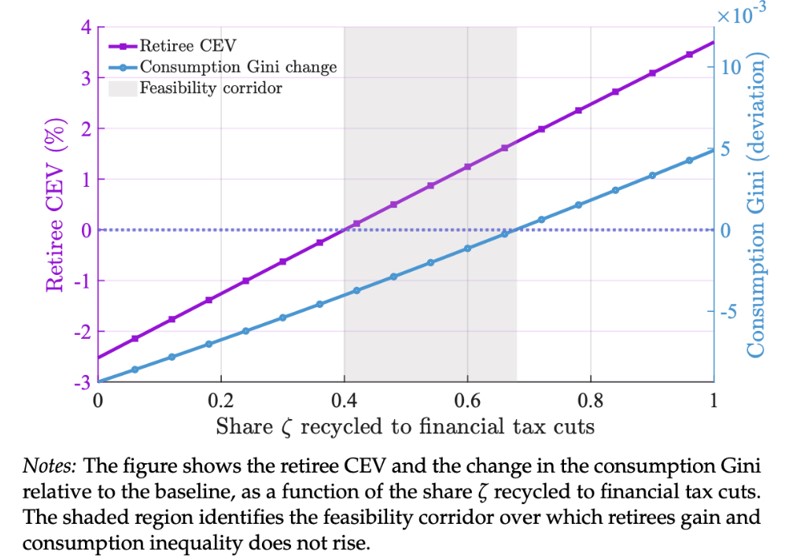
Neither instrument alone can both compensate retirees and avoid higher inequality. A combination can. Let ζ denote the share of carbon revenues directed to financial-income tax cuts, with the remainder going to labour-tax relief. Imposing two conditions, non-negative welfare gains for retirees and no rise in the consumption Gini relative to the baseline, defines a feasibility corridor. In the baseline calibration, the corridor is ζ ∈ [0.40, 0.68]: below 0.40, retirees lose; above 0.68, inequality rises (Figure 3). The interval is narrow, which is itself the message: it reflects a genuine equity–efficiency trade-off rather than a free lunch.
Figure 3. Consumption-equivalent variation from the green transition
The financial-wealth channel has an apparent monetary dimension, since the transition-induced disinflation is what revalues nominal assets. Could a more aggressive monetary stance dampen the revaluation and thereby reshape the redistribution? The answer is essentially no. Across a wide grid of Taylor-rule responses to inflation and output, the dispersion of outcomes is negligible for output, consumption, inflation, and inequality alike. Even under the welfare-maximising rule, the intergenerational redistribution remains largely unchanged.
Two structural features explain this neutrality. First, carbon pricing works through real forces, production costs, and factor returns, so nominal rigidities shape only the timing of price adjustment, not the underlying redistribution. Second, the overlapping-generations structure weakens the intertemporal substitution channel (Bielecki et al., 2022, 2023): as survival probabilities fall, households’ effective horizons shorten, blunting their response to interest-rate changes and, together with borrowing and portfolio frictions, attenuating the transmission from policy rates to wages and labour income across the whole age distribution.
Annicchiarico, B., Sahuc, J.-G., and Vermandel, G. (2026). Intergenerational Redistribution in the Green Transition, Available at SSRN: https://papers.ssrn.com/sol3/papers.cfm?abstract_id=68276399
Barrage, L. and Nordhaus, W. (2024). Policies, projections, and the social cost of carbon: Results from the DICE-2023 model. Proceedings of the National Academy of Sciences, 121:e2312030121.
Bielecki, M., Brzoza-Brzezina, M., and Kolasa, M. (2022). Intergenerational redistributive effects of monetary policy. Journal of the European Economic Association 20: 549–580.
Bielecki, M., Brzoza-Brzezina, M., and Kolasa, M. (2023). Demographics, monetary policy, and the zero lower bound. Journal of Money, Credit and Banking 55: 1857–1887.
Goulder, LH. (1995). Environmental taxation and the double dividend: A reader’s guide. International tax and public finance 2: 157–183.
HFCN (2023). Household Finance and Consumption Survey: Methodological Report for the 2021 Wave. Statistical Paper Series #45, European Central Bank.
Kaplan, G. and Violante, GL. (2014). A model of the consumption response to fiscal stimulus payments. Econometrica 82: 1199–1239.
Nordhaus, W. (1992). The ‘DICE’ model: Background and structure of a dynamic integrated climate-economy model of the economics of global warming. Cowles Foundation Discussion Papers 1009, , Cowles Foundation for Research in Economics, Yale University.