

This policy brief is based on Banque de France, Working Paper Series no. 1039. The views expressed are those of the authors and not necessarily those of the institutions the authors are affiliated with.
Abstract
Europe’s commitment to raise core defence spending creates a lasting fiscal challenge, especially for high-debt countries. This brief studies how different ways of financing a permanent increase in public spending affect output, private consumption and inequality. In a calibration exercise on French data, the main finding is that the financing mix matters as much as the spending increase itself. Broad-based labour taxation is costly because it discourages work and erodes the tax base. Capital taxation depresses investment. Consumption taxation is less distortionary but does not strongly reduce inequality. Social-security reforms, in particular a higher retirement age, can finance a sizeable part of the military buildup with limited aggregate consumption losses, but they concentrate costs on older cohorts. No single instrument dominates: policymakers face a trade-off between limiting aggregate crowding-out and sharing the burden more evenly.
European governments have committed to a major and persistent increase in military capabilities. NATO members agreed in June 2025 to raise spending on “core defence requirements” from the previous 2% target to 3.5% of GDP. For many countries, this comes after a decade of rising defence outlays and in a context of already limited fiscal space.
The macroeconomic question is therefore not only how much to spend, but how to finance it. A permanent rise in public expenditure must ultimately be paid for through some combination of higher taxes, lower transfers, or longer working lives (higher public debt is not an option for financing a permanent military buildup, as it could only further reduce fiscal space in the long run, by raising the debt burden).
Our analysis asks a simple policy question: if governments must finance a defence buildup of this magnitude, which instruments generate the smallest aggregate cost, and who bears that cost?
The answer depends on household heterogeneity. A tax rise does not only reduce disposable income. It also changes incentives to work, save and consume, and those responses differ sharply by age, income, wealth and labour-market attachment.
We therefore use a quantitative overlapping-generations model with heterogeneous households, calibrated to the French economy1. Households differ across the life cycle and within each age group. The model includes labour, capital and consumption taxes, transfers, public debt, and a pay-as-you-go pension system. It is designed to capture both aggregate effects and distributional effects.
The experiment is deliberately comparable across policy options. We first consider a two-year increase in the legal retirement age, from 63 to 65, and let government spending adjust so as to keep the public debt-to-GDP ratio constant. This delivers a permanent increase in public spending of 1.4 percentage points of GDP, close to the increase implied by the new NATO core-defence target and current policy discussions. We then impose the same spending path across alternative financing scenarios and evaluate their long-run effects on output, employment, capital, private consumption and inequality.
The same defence-spending path has very different aggregate effects depending on how it is financed. Labour taxes operate primarily through participation incentives. Capital taxes weigh especially on saving and investment. Consumption taxes affect the price of consumption relative to future resources and leisure. Pension parameters shape both public transfers and labour supply around retirement ages.
Table 1 reports the long-run effects of financing the same permanent spending increase with one instrument only. It should not be read as a policy ranking in isolation, because distributional outcomes also matter. It does show, however, that the aggregate cost of the buildup is highly sensitive to the financing instrument.
Table 1. Long-run macroeconomic effects of alternative financing options
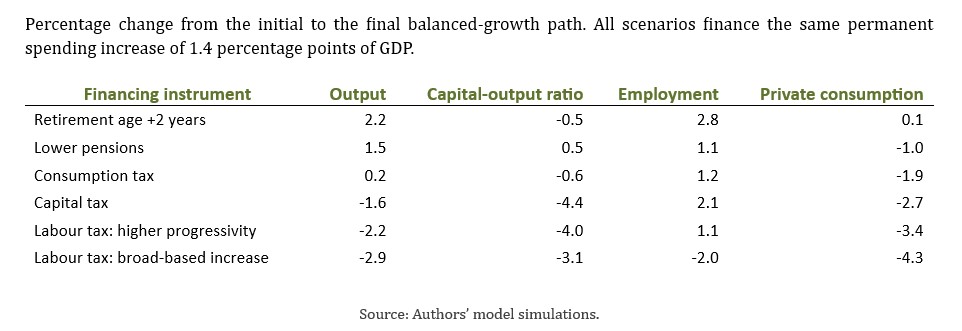
The comparison is stark. A two-year increase in the legal retirement age is the only single-instrument reform in our simulations that finances the target spending path with virtually no long-run fall in aggregate private consumption. The mechanism is not mechanical austerity: it works by increasing labour-market participation, especially among older workers, and by expanding the tax base.
At the other end of the spectrum, financing the same spending path through labour taxation generates the largest fall in aggregate private consumption. Capital taxation is also costly because it reduces capital accumulation. Among tax instruments, consumption taxation produces the smallest aggregate consumption loss in our simulations.
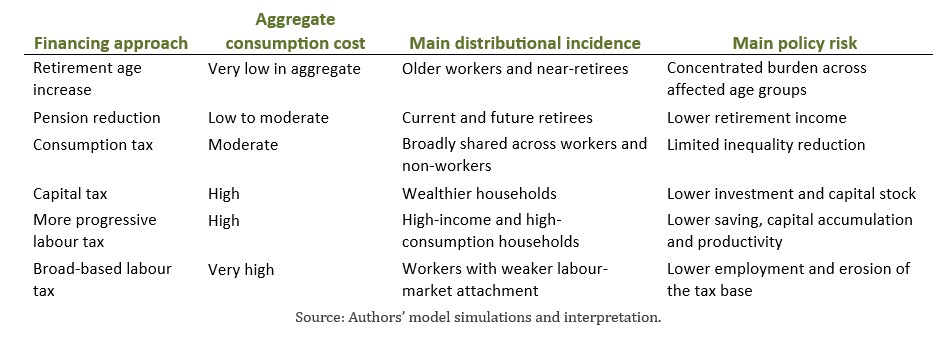
Aggregate consumption crowding-out is a useful summary statistic, but it is not enough. The model also tracks how the adjustment is distributed across households. This matters because a policy can preserve aggregate consumption while concentrating the burden on particular age or skill groups. Conversely, a policy can reduce consumption inequality while generating larger aggregate losses.
The main result is a trade-off rather than a single winner. Broad-based labour taxation is unattractive because it combines high aggregate crowding-out with higher consumption inequality. Higher labour-tax progressivity does better on inequality, but at a larger aggregate cost than consumption taxation or pension-based instruments. Consumption taxation keeps aggregate losses relatively contained, but it does little to reduce consumption inequality. Retirement-age increases and pension cuts limit aggregate crowding-out, while shifting more of the adjustment toward older households.
Table 2. Financing options and the aggregate-distributional trade-off
Real-world fiscal packages rarely rely on a single instrument. We therefore also study mixed adjustments that combine a one-year increase in the retirement age with another instrument to cover the remaining fiscal need.
These packages naturally soften the extremes. They retain part of the aggregate benefit from higher labour-force participation at older ages, while reducing the required increase in taxes or the required cut in pensions. In our simulations, combinations involving a one-year retirement-age increase and either consumption taxation, pension adjustment, or higher labour-tax progressivity perform better than relying heavily on one tax instrument alone.
But mixed packages do not eliminate the core policy trade-off. The more a package leans toward instruments that preserve aggregate consumption, the more it tends to concentrate the burden on particular cohorts or groups. The more it leans toward redistribution, the more it risks weakening saving, investment or labour-market incentives.
The first lesson is that the financing of defence spending is a central macroeconomic issue, not a secondary implementation detail. A permanent spending increase financed through broad-based labour taxes can generate large private-consumption losses because it weakens incentives to work and reduces the tax base.
The second lesson is that fiscal capacity depends on existing distortions. In a country where labour taxation is already high, raising it further can be especially costly. This is why consumption taxes and social-security parameters look comparatively less damaging in our calibration.
The third lesson is that the distributional objective must be explicit. If the priority is to minimize aggregate crowding-out, retirement-age increases or pension-based adjustments look relatively favourable. If the priority is to reduce inequality, higher labour-tax progressivity is more attractive, but it comes with aggregate costs. If the priority is to spread the burden broadly with limited labour-market distortions, consumption taxation is a natural candidate, though not a strongly redistributive one.
Finally, the most robust policy message is not that one instrument should carry the whole burden. A durable defence buildup is better financed through a balanced package that avoids excessive reliance on broad-based labour taxation, uses social-security margins with attention to their age-group incidence, and calibrates any tax increases to their behavioural and distributional consequences.
Europe’s defence buildup requires a fiscal strategy. Our results show that the same permanent increase in public spending can have very different macroeconomic and distributional consequences depending on how it is financed. In the French calibration, a higher retirement age can finance a sizeable part of the increase with little aggregate consumption loss, while broad-based labour taxation is especially costly. Consumption taxation is less distortionary but less redistributive. Progressive labour taxation shifts the burden toward higher-income households but can depress saving and capital accumulation.
There is no free lunch: financing defence requires choosing how much aggregate consumption to sacrifice and how to distribute the burden. That trade-off should be made explicit in policy design.
Our calibration moslty uses European databases, making our framework easily applicable to other EU countries.