

The views expressed are those of the author and do not necessarily represent the views of the IMF, its Executive Board, or IMF management. This note is based on and distills key results from the IMF Working Paper “Who Captures Export Windfalls? Exchange Rates, Export Profitability, and National Saving under Dominant-Currency Pricing.”
Abstract
When exports are priced in U.S. dollars (dominant-currency pricing), the real exchange rate shapes who captures an export windfall. With a stable real exchange rate, higher dollar export receipts translate into higher real local-currency export income for producers, stronger exporter margins, and higher national saving. With real appreciation, part of the windfall shifts to consumers through cheaper imports, compressing margins and weakening the saving response. Using five-year changes for 42 economies over 1982–2022, national saving rises by about 0.27 percentage points for each 1 percentage point of GDP increase in real local-currency export income, while dollar export income has no independent effect once the local-currency measure is included. The mechanism is illustrated by China’s post-WTO surge, Peru versus Brazil during the commodity boom, and Argentina’s 2002 devaluation.
Export booms generate sharply different macroeconomic outcomes. In some cases, they coincide with sustained investment, rising tradable capacity, and structural transformation; in others, they mainly finance temporary consumption increases that reverse when external conditions deteriorate. The 2000s provide a vivid contrast. Peru and Brazil both benefited from the commodity boom, yet Peru experienced a more gradual real appreciation alongside high saving and investment, while Brazil saw a sharper appreciation and a stronger consumption response. China’s post-WTO export surge was accompanied by an unprecedented ten-percentage-point rise in the national saving rate within five years; after 2007, real appreciation coincided with compressed margins and a decline in saving. Standard explanations — institutions, demographics, and financial structure — help explain differences in saving levels, but they evolve too slowly to account for the sharp medium-term changes observed during major export booms.
Under dominant-currency pricing, many export prices are set in dollars. In that environment, exchange-rate movements do not mainly reprice exports in foreign markets in the short run; instead, they shift the domestic purchasing power of dollar export receipts.
With a stable real exchange rate, rising dollar export receipts pass through into higher real local-currency export income — the component that accrues to domestic producers — raising profitability and retained earnings.
With real appreciation, the same dollar receipts translate into fewer real local-currency resources for exporters; more of the windfall shows up as higher consumer purchasing power via cheaper imports. Because firms typically save more at the margin than households, this distribution shift matters for aggregate saving.
This yields a sharp implication: national saving should track real local-currency export income, not dollar export income per se.

Figure 1 shows the same relationship within three prominent episodes: China’s post-WTO boom, Peru during the commodity upswing, and Brazil over the same period.
China (post-WTO): Between 2002 and 2007, China’s saving-to-GDP ratio increased by 9.7 percentage points. Five-year changes in saving closely track five-year changes in real local-currency export income, consistent with the idea that stable real exchange rates allow dollar export windfalls to translate into domestic profitability and saving.
Peru vs. Brazil (commodity boom): Both benefited from stronger external conditions, but outcomes diverged alongside differences in real exchange-rate dynamics and fiscal behavior. Peru’s more moderate real exchange-rate movements and fiscal saving coincided with a stronger increase in saving and investment; Brazil’s sharper real appreciation and fiscal expansion coincided with a weaker saving response and investment tilted toward nontradables.
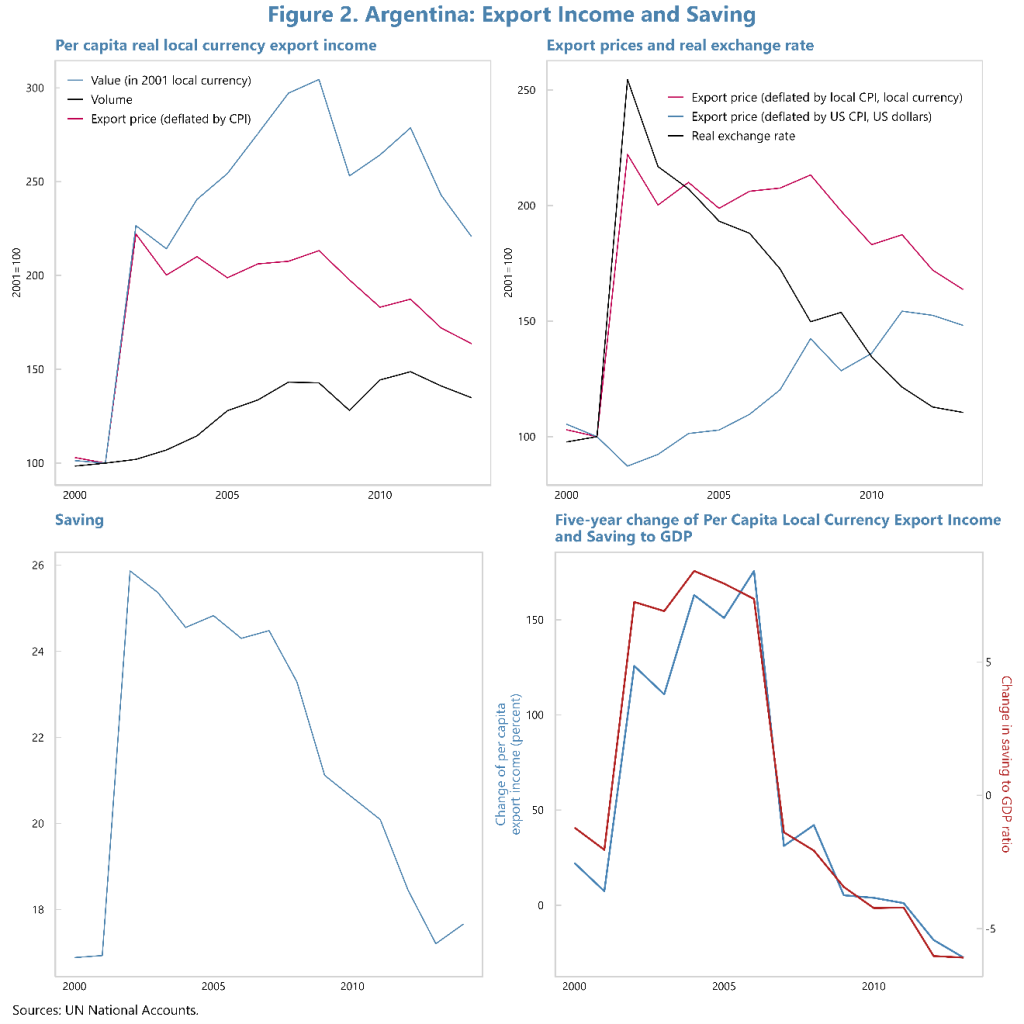
Argentina (2002): The collapse of convertibility produced a large real depreciation. With exports invoiced largely in dollars, real local-currency export income rose quickly, and the national saving rate jumped sharply within a year—consistent with an immediate profitability channel rather than a slow investment-capacity channel (Figure 2).
Using five-year changes for 42 economies since the early 1980s, a 1 percentage point of GDP increase in real local-currency export income is associated with an approximately 0.27 percentage point increase in the national saving rate. Dollar export income does not have an independent effect once the local-currency measure is included.
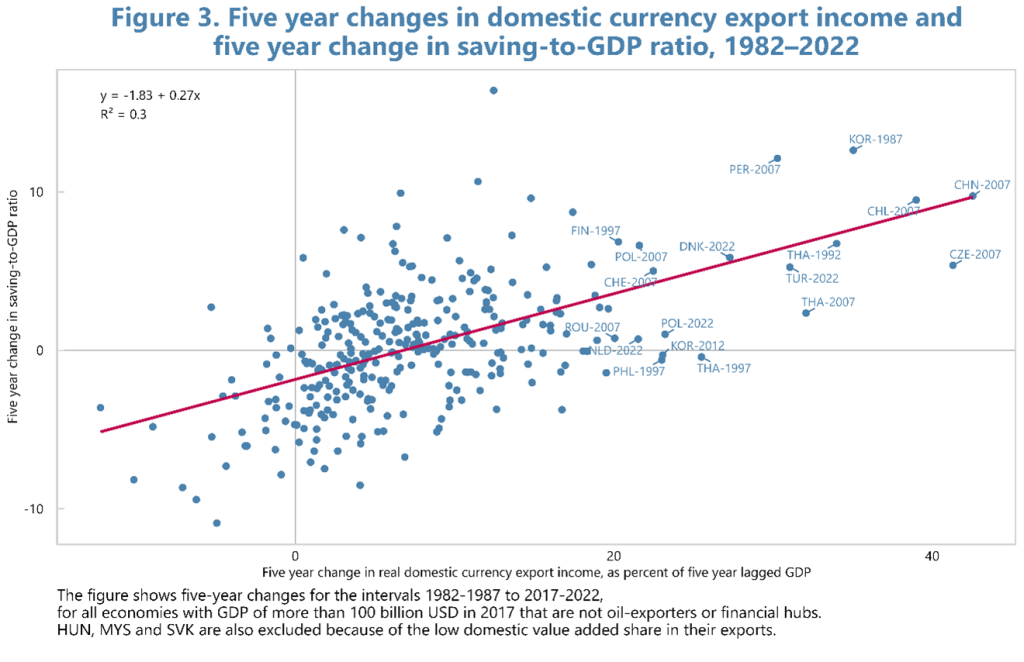
An out-of-sample exercise illustrates the mechanism’s discipline: a coefficient estimated from 41 countries excluding China predicts China’s 2002–2007 saving increase with an error of 0.1 percentage point and also matches the subsequent moderation after 2007.
Under dominant-currency pricing, exchange rates are not only relative prices; they also shape the distribution of export windfalls between producers and consumers. Because saving propensities differ, this distribution helps explain why some export booms are associated with rising saving and investment, while others are associated with consumption booms and weaker tradable expansion. The analysis is positive rather than prescriptive: exchange-rate choices involve trade-offs, and resisting appreciation may not be appropriate in all circumstances.