

This policy brief is based on: Cupak, A., Gertler, P., Hajdiak, D., Klacso, J., and Rychtárik, Š. (2026). Determinants of digital euro adoption: The role of political orientation. Economic Modelling 162, 107657. https://doi.org/10.1016/j.econmod.2026.107657. The views expressed are those of the authors and not necessarily those of the institutions the authors are affiliated with.
Abstract
We draw on a face-to-face survey of Slovak individuals conducted in 2024 to examine awareness of and potential interest in using the digital euro. Political orientation is a significant and previously overlooked determinant of adoption: right-leaning respondents are substantially more likely to express interest, while EU-sceptical individuals are less inclined. However, this effect is not uniform and depends on payment habits. Cash affinity is the single largest barrier. Cash-preferring respondents are around 25 percentage points less likely to adopt, with a substantial negative effect remaining even among right-leaning individuals. Envisaged transaction volumes are moderate, with a median of 16% of net monthly income. Privacy protection and payment anonymity rank as the most valued design attributes, consistently across all socioeconomic and political groups. These findings point to clear implications for how central banks should design communication strategies ahead of a potential launch of the digital euro.
For the digital euro to succeed, uptake must be broad. At the same time, policymakers must monitor substitution patterns carefully, since large-scale shift of bank deposits into the digital euro could imply risks to bank funding and financial intermediation. Understanding prospective demand is therefore essential for calibrating design features, setting holding limits, and shaping communication strategies. The ECB is currently in the preparation phase of a retail digital euro, making these questions highly policy relevant. A growing empirical literature on CBDC demand based on survey evidence from Austria, the Netherlands, several other euro area countries, and Canada (see Abramova et al., 2022; Li, 2023; Bijlsma et al., 2024; Georgarakos et al., 2025) highlights the importance of trust in central banks, payment habits, and currency design features such as privacy and security. However, one potentially important dimension has received little attention: political preferences. This is noteworthy, given the well-established link between political orientation and participation in financial markets, from stock market engagement to crypto-asset holdings (e.g., Kaustia and Torstila, 2011; de Jong et al., 2022; Ke, 2024).
This policy brief summarises a study that addresses this gap using a unique face-to-face survey carried out in Slovakia in 2024. The survey captures not only standard socio-demographic and financial drivers of digital euro attitudes, but also political self-identification of respondents and their views on European integration. Slovakia provides a particularly informative setting. While individuals show high acceptance of digital payments within the euro area, many still hold precautionary cash reserves at home, highlighting a dual pattern of digital readiness alongside a persistent attachment to physical money.
The analysis draws on a quota-based Computer-Assisted Personal Interview (CAPI) survey administered by FOCUS in April 2024, covering more than 1,200 responses. The sampling design approximates representativeness across gender, age, education, employment status, municipality size, and region, and survey weights were calibrated to match national census distributions. While the non-probabilistic design limits strict statistical inference, the weighted sample closely mirrors demographic structure in Slovakia.
The survey captures a broader set of dimensions than most existing CBDC surveys. In addition to standard socio-demographic characteristics, it captures: (i) payment behaviour and cash preferences; (ii) digital engagement; (iii) financial asset holdings (including crypto-assets); (iv) trust in financial institutions; (v) awareness of and interest in the digital euro; (vi) expected usage; (vii) preferences over key design features; and (viii) detailed information on political orientation, including attitudes toward EU integration.
The study examines three main outcomes. First, an awareness indicator captures whether respondents have heard or read about the digital euro. Second, an adoption indicator measures whether they would consider using it. Third, a continuous measure tracks envisaged digital euro transactions as a share of net monthly income. The survey also captures preferences over key design features, including privacy protection, payment anonymity, reversibility of payments, instant settlement, offline payment functionality, and improved interaction with public institutions, with responses recorded on a three-point agreement scale.
About one third of respondents had heard of the digital euro at the time of the survey. Around 26% expressed willingness to adopt it and additional 16% were uncertain, which is a meaningful but moderate base that leaves considerable room for communication to shift intentions. The remaining 58% claimed no interest. Adoption interest in Slovakia is somewhat below comparable pre-launch surveys in Austria (over 50%) and in the Netherlands (roughly half), though not out of step with the euro area range.
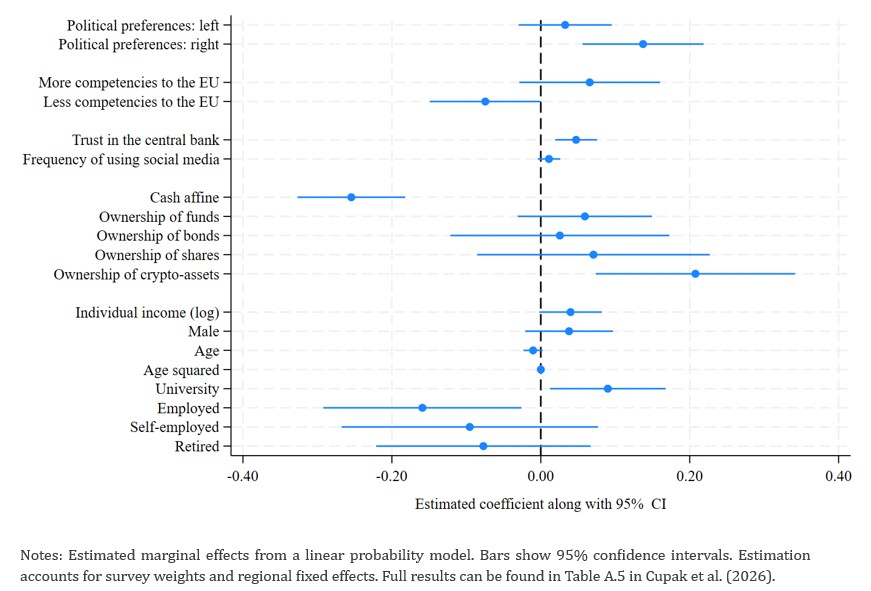
Political orientation emerges as a significant predictor of digital euro adoption. Figure 1 suggests that right-leaning respondents are significantly more likely to express interest in using the digital euro relative to centrists. This effect holds across all model specifications and alternative measures of political views.1
This finding connects to a broader literature showing that right-leaning voters engage more with financial markets and innovative financial products. The digital euro, while institutionally anchored in the central bank, is a novel payment instrument. Individuals more comfortable with financial innovation appear more predisposed to adopt it. EU attitudes add a further dimension. Respondents favouring less EU competences are significantly less inclined to use the digital euro. This reflects an identity-based aversion to a pan-European institutional project rather than purely economic calculation.
Figure 1. Determinants of potential digital euro adoption
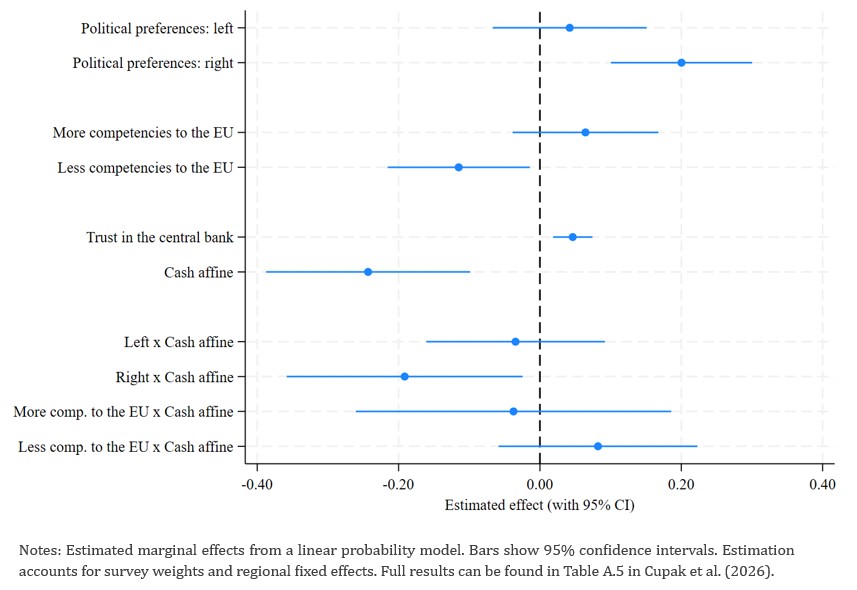
This political effect is not uniform within groups. Figure 2 shows that among right-leaning respondents, cash affinity remains a binding constraint. Cash-affine right-leaners are substantially less likely to adopt the digital euro than their non-cash-affine counterparts, which suggests that payment habits can override political predispositions.
Cash affinity is the single largest barrier to adoption. Cash-preferring respondents are around 25 percentage points less likely to express adoption interest. This holds across all specifications and mirrors the evidence from Austria. The pattern sharpens when payment habits are measured more precisely. Card-preferred respondents are substantially more likely to adopt the digital euro, while mixed-payment users occupy an intermediate position but lean toward adoption.
Trust in the national central bank is the strongest positive predictor. Each additional point on the five-point trust scale is associated with a 5–6 percentage point higher probability of adoption. As in Austria and the Netherlands, trust in the issuing institution appears to be a prerequisite for public acceptance.
Prior exposure to digital financial innovation also matters. Respondents holding crypto-assets are around 20 percentage points more likely to express adoption interest. This is the largest single binary predictor in the model after cash affinity. Education and income exert additional positive effects, though of smaller magnitude.
Figure 2. The cash affinity constraint among right-leaning respondents
Among respondents who express willingness to use the digital euro, planned transaction volumes are moderate. The median planned allocation is 16% of net monthly income, and the mean is 26%. This is broadly in line with Li (2023), who estimates that Canadian households would allocate around 20% of liquid assets to a CBDC under comparable design assumptions.
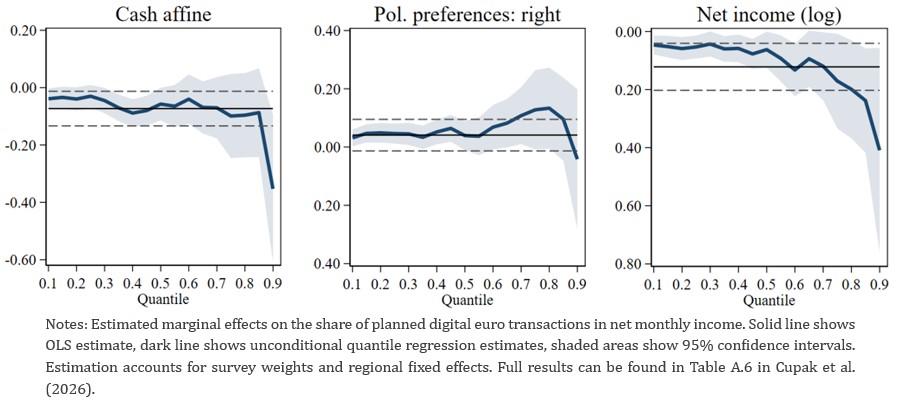
Cash affinity and income are the main drivers of planned transaction volumes as shown in Figure 3. Cash-affine respondents plan significantly smaller digital euro transactions. Higher-income respondents plan lower transaction shares relative to income, though their absolute amounts are larger.
The profile of likely high-volume users, i.e. digitally engaged, card-preferring, lower cash affinity, holding crypto-assets point to one clear conclusion. Uptake of the digital euro would draw primarily from bank deposits rather than from cash balances. Cash serves as a buffer stock that persists even when new digital instruments are introduced.
Figure 3. Drivers of planned digital euro transactions as a share of monthly income
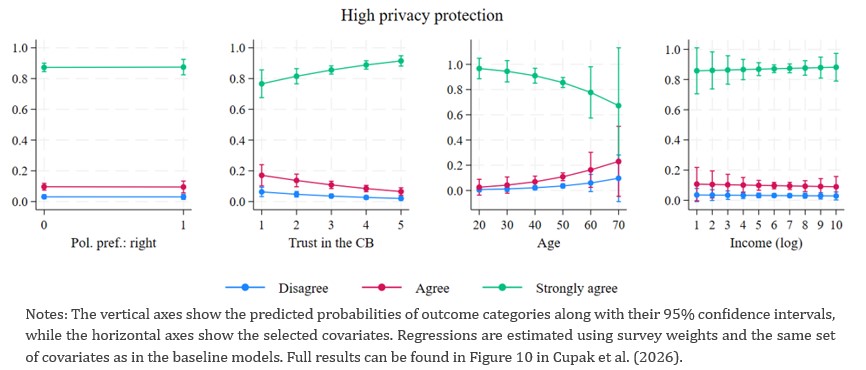
Privacy and anonymity top the ranking of design preferences. Respondents value all six attributes of the digital euro, but a clear hierarchy emerges. Privacy protection ranks first, with 80% of respondents strongly agreeing on its importance. Guaranteed payment anonymity follows closely. Functional features, such as reversibility of transactions, instant settlement of payments, offline payments, and better communication with public institutions, are broadly valued but rank lower.
These preferences are consistent with the ECB public consultation on the digital euro (ECB, 2021) and with survey evidence from Austria and Canada. Privacy and security consistently emerge as the top citizen priorities across countries and survey designs.
As we show in Figure 4, respondents who trust the central bank most are also most demanding about privacy safeguards. Trust and privacy concerns are complements, not substitutes. Age works in opposite direction. Older respondents systematically attach less importance to all six design attributes, likely reflecting lower engagement with digital payments generally. Income and political views do not shift this pattern.
Figure 4. Valuing privacy protection by key respondent characteristics
This study documents that public attitudes toward the digital euro are shaped by a rich mix of factors. Payment habits, institutional trust, financial sophistication, and political orientation are among them. No single determinant dominates. Effective preparation for a potential launch requires acknowledging this heterogeneity. Several implications stand out.
Tailor communication to heterogeneity across political views. Right-leaning and EU-supportive respondents are more receptive to the digital euro. EU-sceptical and nationally oriented groups are less so. Generic outreach will not move these groups. Communication strategies may need to address identity-based concerns directly, particularly around sovereignty and institutional control.
Make privacy commitments specific. Privacy and anonymity are the top-ranked design priorities across all groups. Central banks should lead communication with specific, technically grounded privacy commitments rather than general assurances. Trust and privacy demand are complements, which means that building one reinforces the other.
Engage the cash-affine population through complementarity messaging. Cash-preferring individuals are the least likely adopters. Messaging that frames the digital euro as a complement to cash, rather than a replacement, may reduce resistance in this group.
Convert the uncertain majority. Many respondents remain uncertain or agnostic about adoption. Targeted information campaigns are the most promising instrument here.
Monitor demand continuously. Attitudes toward a novel instrument will evolve. Survey-based microdata of the kind used here should be treated as an ongoing monitoring tool rather than a one-off exercise.
Abramova, S., Böhme, R., Elsinger, H., Stix, H., Summer, M. (2022). What Can CBDC Designers Learn from Asking Potential Users? Results from a Survey of Austrian Residents. OeNB Working Paper No. 241. Oesterreichische Nationalbank.
Bijlsma, M., van der Cruijsen, C., Jonker, N., Reijerink, J. (2024). What triggers consumer adoption of central bank digital currency? Journal of Financial Services Research 65(1), 1–40.
De Jong, A., Shahriar, A. Z., Shazia, F. (2022). Reaching out to the unbanked: The role of political ideology in financial inclusion. Journal of International Money and Finance, 126, 102678.
ECB (2021). Eurosystem Report on Public Consultation on a Digital Euro. European Central Bank.
Elsinger, H., Stix, H., Summer, M. (2025). Consumer Preferences for a Digital Euro: Insights from a Discrete Choice Experiment in Austria. BIS Working Paper No. 1302. Bank for International Settlements.
Georgarakos, D., Kenny, G., Laeven, L., Meyer, J. (2025). Consumer Attitudes Towards a Central Bank Digital Currency. ECB Working Paper No. 3035. European Central Bank.
Kaustia, M., Torstila, S. (2011). Stock market aversion? Political preferences and stock market participation. Journal of Financial Economics, 100(1), 98-112.
Ke, D. (2024). Left behind: Partisan identity, stock market participation, and wealth inequality. Journal of Banking & Finance, 164, 107201.
Laméris, M. D., Jong-A-Pin, R., Garretsen, H. (2018). On the measurement of voter ideology. European Journal of Political Economy, 55, 417–432.
Li, J. (2023). Predicting the demand for central bank digital currency: A structural analysis with survey data. Journal of Monetary Economics 134, 73–85.
Littrell, S., Klofstad, C., Uscinski, J. E. (2024). The political, psychological, and social correlates of cryptocurrency ownership. PLOS ONE, 19(7), e0305178.
Note that in a Slovak/European context, centre-right political identification frequently coincides with economically liberal attitudes, a classification also supported by Laméris et al. (2018). This alignment may help explain the positive association with digital euro adoption.