

This policy brief is based on “Playing with Blocs: Quantifying Decoupling”, Journal of International Economics (forthcoming), as well as the IMF Working Paper 25/263. The views expressed here are those of the authors and do not necessarily reflect the views of the institutions the authors are affiliated with.
Abstract
We develop a data-driven way to measure trade fragmentation over the period 2015-2023. We assign countries to the US bloc, China bloc, or to an unaligned group based on whether their trade costs with the US and China increased or decreased over this period. We find that the US bloc and the China bloc each contain roughly a quarter of the countries in the world, with about half the countries remaining unaligned. We then use a quantitative model to simulate the real GDP and real income effects of decoupling. Because within-bloc trade costs fell at the same time as across-bloc trade costs increased, the change in the global trade costs over the period 2015-2023 increased global GDP and real income for the median country by about 0.6%. This is contrary to the widespread belief that fragmentation has been welfare-reducing. Finally, we find that countries in the US bloc would on average benefit from moving to the China bloc, and vice versa, though the real income impacts of moving blocs always range from positive to negative across countries. These results suggest that political alignment does not always follow trade-related economic interests.
As geopolitical tensions rise, fears of “deglobalisation” have taken centre stage. The US–China trade war, Brexit, and Russia’s invasion of Ukraine have led many to conclude that globalisation is unravelling. Yet, despite these shocks, world trade has remained surprisingly resilient, at least through 2023.
In our recent research (Bonadio et al. 2025), we show that the global trading system has not collapsed but reorganised into distinct blocs. This decoupling — the redirection of trade toward friendly partners — has so far produced little loss in global welfare. Instead of deglobalisation, we find a reconfiguration of global trade links, echoing Antràs (2020), who argues that global value chains are adapting rather than retreating.
Figure 1. world trade / GDP ratio
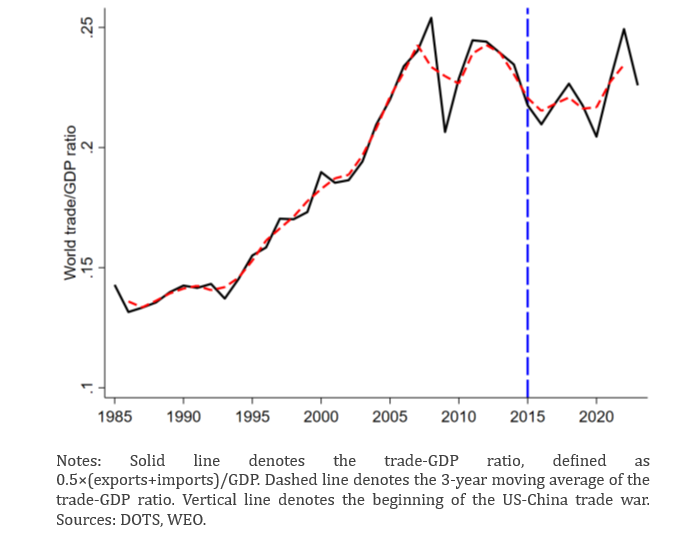
Since 2016, global trade patterns have undergone a quiet transformation. Using data on bilateral trade flows from 2015 to 2023, we observe that while trade between geopolitical rivals has fallen, it has increased elsewhere. The world trade-to-GDP ratio has stabilised, even reversing its post-financial-crisis decline (Figure 1).
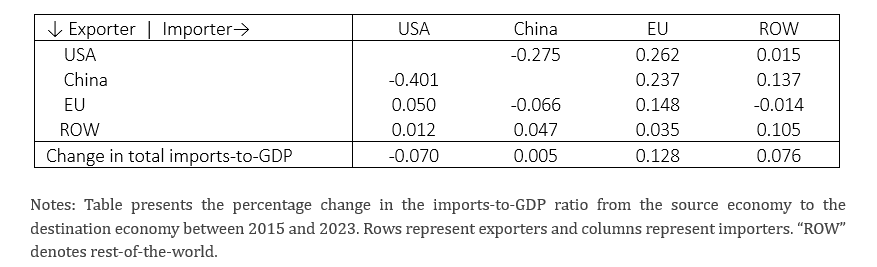
What explains this resilience? As Antràs (2020) and Goldberg and Reed (2023) have documented, we are not experiencing deglobalization but rather fragmentation or decoupling – a reconfiguration of trade links across the globe. As countries involved in trade conflicts disengage from each other, they ramp up trade with other partners. Table 1 confirms this pattern: even as trade between the US and China fell, both economies increased trade with the rest of the world.
Table 1. Change in trade (2015-2023)
Our research employs a data-driven approach to identify which countries are aligning into which trade blocs. Using bilateral trade data from 2015 to 2023, we identify decoupling patterns and quantify their economic impacts.
We categorize countries into three groups: 1) Those moving towards the US bloc, consisting of countries that experienced reduced trade costs with the US and increased trade costs with China, 2) those movings towards the China bloc, comprising countries with heightened trade costs with the US and decreased trade costs with China, and 3) Unaligned countries, where trade costs with both the US and China moved in the same direction. We identify revealed trade costs from observed trade flows, by running a standard gravity equation. The residual of this equation is then revealed bilateral trade costs, up to the trade elasticity. Our approach, based on observed trade flows, contrasts to alternatives where the bloc structure is imposed on the data using observations like U.N voting patterns.
In our analysis of 187 countries, we find that roughly one-quarter of countries have aligned with the US, another quarter with China, and about half remain unaligned. Russia, Saudi Arabia, Israel, and Hong Kong are clearly aligned with China, while European countries, along with India, Korea, Japan, and Singapore, are part of the US bloc.
Utilizing a quantitative multi-country, multi-sector global production network model, we evaluate the economic effects of observed changes in trade costs. Contrary to the widespread belief that fragmentation reduces welfare, the median country experienced a 0.6% increase in real income from trade cost changes between 2015 and 2023.
This surprising result reflects the stability of global trade volumes. Lower trade between some partners was offset by higher trade elsewhere, leaving average trade costs roughly unchanged. As Evenett et al (2024) notes, protectionism has risen selectively rather than universally, producing a world of fragmented openness rather than autarky.
Interestingly, unaligned countries gained slightly more than bloc members (around 0.8%), since they could reorient trade toward both sides. These findings suggest that fragmentation, so far, has not been as costly as feared.
If most countries benefit from decoupling, are they choosing blocs that maximise their welfare? To explore this, we conduct counterfactual exercises, moving countries from one bloc to another. Surprisingly, we find that economic self-interest does not fully account for current bloc formations. The median country in the US bloc would be better off joining the China bloc, and vice versa.
This misalignment implies that geopolitical considerations, rather than purely economic incentives, are driving bloc formation. Campos et al (2023) similarly highlight that the political economy of bloc formation often diverges from economic self-interest. We show that trade reorientation increasingly mirrors political alliances — measured, for example, by UN voting patterns — rather than comparative advantage.
Three key lessons emerge from our analysis:
Globalisation is not ending — it is being reorganised. The emergence of trade blocs has, until 2023, been more of a reshuffling than a retreat. Most countries have managed to maintain, or even slightly improve, their welfare despite decoupling. However, as the 2025 trade war escalates and trade barriers rise within blocs, the world may move closer to the true economic costs of fragmentation. Policymakers should therefore focus on preserving the gains from openness while adapting to the geopolitical realities of a multi-bloc world.
Pol Antràs, “De-Globalisation? Global Value Chains in the Post-COVID-19 Age,” NBER Working Paper 28115 (2020).
Bonadio, B., Z. Huo, E. Kang, A.A. Levchenko, N. Pandalai-Nayar, and H. Toma (2025), “Playing with blocs: Quantifying decoupling”, Journal of International Economics, 104204.
Campos, R., Flores, J., Furceri, D., Timini, J. (2023), “Geopolitical Fragmentation and Trade”, VoxEU.
Evenett, S. Jakubik, A., Martin, F., Ruta, M. (2024), “The return of industrial policy in data”, VoxEU,
Goldberg, Pinelopi K and Tristan Reed. 2023. “Is the global economy deglobalizing? If so, why? And what is next?” Brookings Papers on Economic Activity 2023 (1):347–423.
Gopinath, Gita, Pierre-Olivier Gourinchas, Andrea F. Presbitero, and Petia Topalova. 2025. “Changing Global Linkages: Bridging Geopolitical Fragments.” AEA Papers and Proceedings 115: 605–10